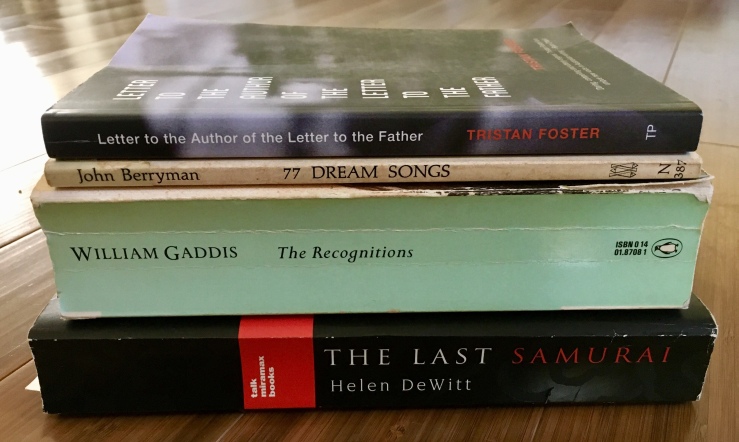
Riff on some recent reading

img_1804

It seems that for the past two weeks I have been reading mostly final exams and research papers, but I have read some other things too.

I have all but finished Tristan Foster’s collection Letter to the Author of the Letter to the Father, which I think is excellent contemporary fiction. Foster’s pieces do things that I did not know that I wanted contemporary fiction to do until I read the pieces. Read his story/poem/thing “Economies of Scale” to get an illustrating example. Letter to the Author of the Letter to the Father deserves a proper review and I will give it one sooner rather than later. For now let me say that I am jealous of that title.

I’ve continued sifting unevenly through John Berryman’s 77 Dream Songs. Earlier this year I tried reading one Dream Song a day and then realized I didn’t like reading one Dream Song a day. Some days I wanted to read three or five and some days I wanted to read none and some days I felt like skipping ahead to later Dream Songs and some days I got stuck on a few lines or a spare image or an oblique word and then I couldn’t move on. Here is Dream Song 30, which took me two days to read (I got hung up on “Hell talkt my brain awake” for more than a little while):

img_1807

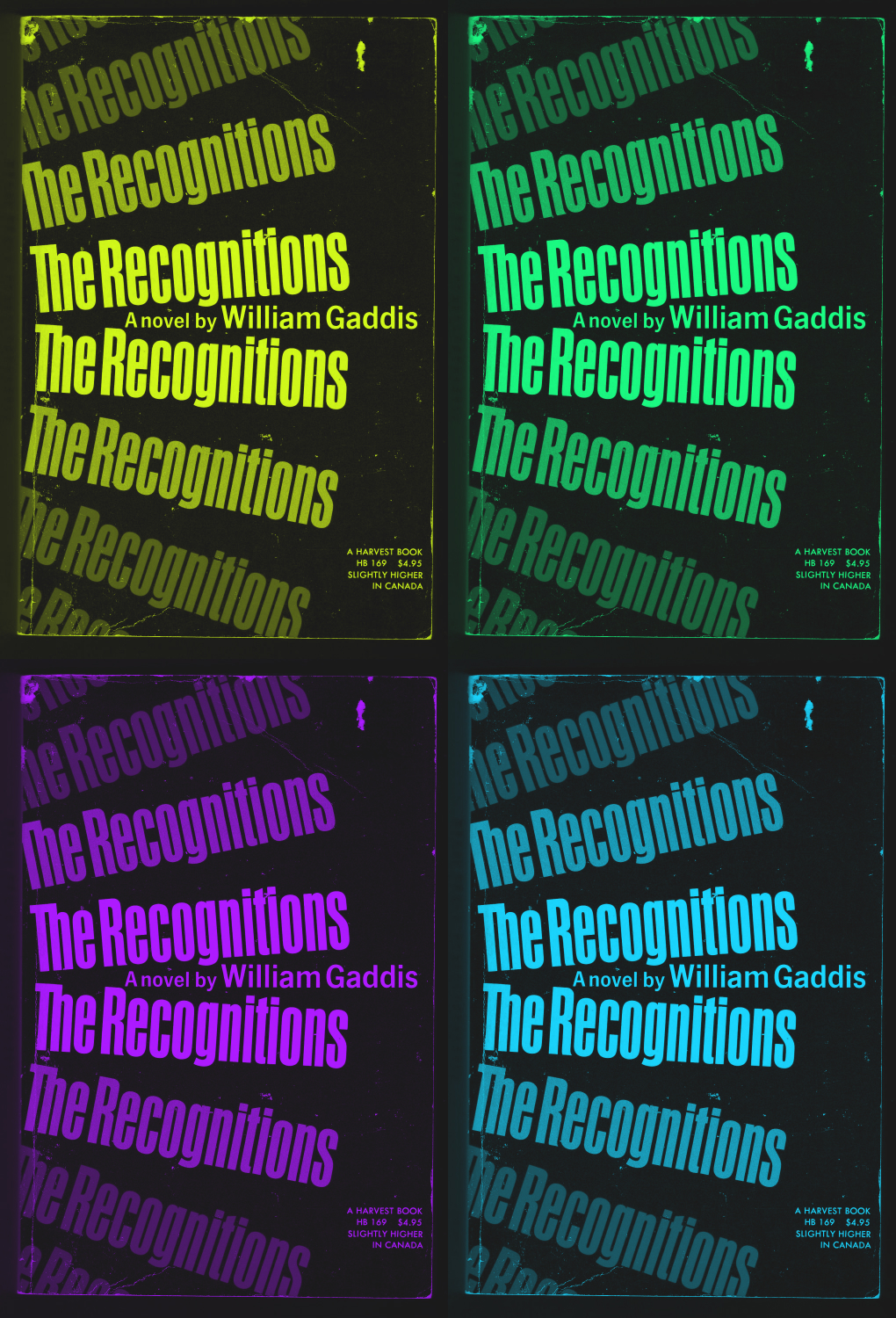
I am still auditing/rereading William Gaddis’s first novel The Recognitions. I riffed on rereading it here and here and here) and hope to riff some more, but I doubt I’ll have anything comprehensible to write about the chapter I just finished, II.3 (Chapter 3 of Section II). The opening of this chapter is a stream-of-consciousness flowing so freely that it overwhelms the reader. Gaddis takes us into Wyatt’s addled brains, a space overstuffed with hurtling esoteric mythopoetic gobbledygook. (The section also strongly recalls Stephen Dedalus’s stroll on the beach in Chapter 3 of Ulyssesalthough Gaddis denied having read Joyce’s opus).

The interior of Wyatt’s skull is frustrating as hell, which is maybe half the point. Things don’t get any simpler when Wyatt goes to his childhood home where no one recognizes him. Or, rather, he is misrecognized, recognized as someone else: an acolyte of Mithras, Prester John, the Messiah. As always with The Recognitions though, there’s a radical ambiguity: Is Wyatt misrecognized? Or is there an originality under the surface that his ersatz fragmented family recognizes?

I have around 100 more pages left to read of Helen DeWitt’s debut novel The Last Samurai. I’ve read the book at such a fast clip that I’m frankly suspicious of it. The book is 530 pages but feels like its 150 pages. I’m not sure what that means. Maybe it means it’s not a particularly dense novel, although it is rich in ideas—ideas about art, language, family. The book won me over when DeWitt steers the narrative into one of its first major side quests, the story of a musician named Kenzo Yamamoto. I recall reading late into the night, overtired but unable to put the book down. I stayed up too late and was too tired the next day, and then sneaked in a few sections during office hours the next morning. I think that means that I like the book very much—but I also find myself irked at times by something in DeWitt’s style—a sort of archness that veers into preciousness, a cleverness that interminably announces itself. The book tries to spin irony into earnestness, which is vaguely exhausting. I think I would have been head over heels in love with this book if I had read it ten or fifteen years ago.

In his recent review of The Last Samurai at Vulture — where the book garnered the dubious prize of being prematurely called “The Best Book of the Century” — Christian Lorentzen wrote that DeWitt’s “novel was never easily subsumed in one of the day’s critical categories, like James Wood’s hysterical realism.” But reading The Last Samurai, I am reminded of the books that Wood thought of as “hysterical realism.” Wood coined the term to describe a trend he saw in literature of the late nineties, literature that combined absurdity with social and cultural realism (at the expense of Wood’s precious psychological realism). Wood specifically applied his description to Zadie Smith’s novel White Teeth (published, like The Last Samurai, in 2000), but slapped it down elsewhere, notably to David Foster Wallace. While I don’t endorse Wood’s scolding use of the phrase “hysterical realism,” I do think that it’s a useful (if perhaps too-nebulous) description for a set of trends in some of the major novels published in the late nineties and early 2000s: Infinite JestMiddlesexThe Corrections, A Heartbreaking Work of Something or Other, etc. And, to come in where I started: The Last Samurai shares a lot of the same features with these texts—the blending of styles and texts and disciplines, etc. DeWitt’s filtering a lot of the same stuff, I guess. I would maybe use the term post-postmodernism in place of “hysterical realism” though—although a novel need not be subsumed by any term, and maybe the best can’t really be described in language at all.
Donald Barthelme interviewed by George Plimpton

J.G. Ballard’s “The Subliminal Man,” John Carpenter’s They Live, and Black Friday

Today is Black Friday in America. I don’t think it’s necessary to remark at length on the bizarre disjunction between this exercise in consumerism-as-culture and the intended spirit of the Thanksgiving holiday that precedes it. Indeed, I think that the cognitive dissonance that underwrites Black Friday—the compulsion to suffer (and cause suffering), both physically and mentally,  to “save” money on “consumer goods” (sorry for all the scare quotes, but these terms are euphemisms and must be placed under suspicion)—I think that this cognitive dissonance is nakedly apparent to all who choose to (or are forced to) actively engage in Black Friday. The name itself is dark, ominous, wonderfully satanic.

Rereading “The Subliminal Man,” I was struck by how presciently J.G. Ballard anticipated not only the contours of consumerist culture—urban sprawl, a debt-based economy, the mechanization of leisure, the illusion of freedom of choice—but also how closely he intuited the human, psychological responses to the consumerist society he saw on the horizon. Half a century after its publication, “The Subliminal Man” seems more relevant than ever.

The premise of the tale is fairly straightforward and fits neatly with the schema of many other early Ballard stories: Franklin, an overworked doctor, is approached by Hathaway, a “crazy beatnik,” who refuses to take part in the non-stop consumerism of contemporary society. Hathaway can “see” the subliminal messages sent through advertising. He asks for Franklin’s help in stopping the spread of these messages. Hathaway reasons that the messages are intended to enforce consumerist society:

Ultimately we’ll all be working and spending twenty–four hours a day, seven days a week. No one will dare refuse. Think what a slump would mean – millions of lay–offs, people with time on their hands and nothing to spend it on. Real leisure, not just time spent buying things . . .

The fear of a slump. You know the new economic dogmas. Unless output rises by a steady inflationary five per cent the economy is stagnating. Ten years ago increased efficiency alone would raise output, but the advantages there are minimal now and only one thing is left. More work. Subliminal advertising will provide the spur.

Franklin is unconvinced, even though he is already working Saturdays and Sunday mornings to payoff TVs, radios, and other electronic goods that he and his wife replace every few months. Soon, however, he realizes that something is wrong:

He began his inventory after hearing the newscast, and discovered that in the previous fortnight he and Judith had traded in their Car (previous model 2 months old) 2 TV sets (4 months) Power mower (7 months) Electric cooker (5 months) Hair dryer (4 months) Refrigerator (3 months) 2 radios (7 months) Record player (5 months) Cocktail bar (8 months)

Franklin finally sees the truth, but only after Hathaway takes to blowing up signs’ switch boxes (the word “terrorism” is of course not used in the text, although it surely would be today):

Then the flicker of lights cleared and steadied, blazing out continuously, and together the crowd looked up at the decks of brilliant letters. The phrases, and every combination of them possible, were entirely familiar, and Franklin knew that he had been reading them for weeks as he passed up and down the expressway.

BUY NOW BUY NOW BUY NOW BUY NOW BUY NEW CAR NOW NEW CAR NOW NEW CAR NOW

YES YES YES YES YES YES YES YES YES YES

Like many Ballard stories, “The Subliminal Man” ends on a pessimistic note, with Franklin choosing to ignore his brief enlightenment and give in. Ballard drives his criticism home in the final image of the story, with Franklin and his wife heading out to shop:

They walked out into the trim drive, the shadows of the signs swinging across the quiet neighbourhood as the day progressed, sweeping over the heads of the people on their way to the supermarket like the blades of enormous scythes.

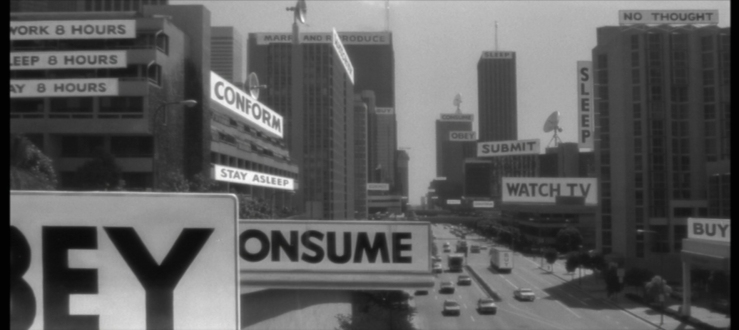
“The Subliminal Man” offers a critique of consumerism that John Carpenter would make with more humor, violence, and force in his 1988 film They Live. In Carpenter’s film, the hero John Nada (played by Roddy Piper) finds a pair of sunglasses that allow him to see through the ads, billboards, and other commercials he’s exposed. What’s underneath? Naked consumerism:

they-live-billboard

The images here recall the opening lines of “The Subliminal Man”: ‘The signs, Doctor! Have you seen the signs?’ Like Ballard’s story, Carpenter’s film is about waking up, to seeing the controlling messages under the surface.

In his film The Pervert’s Guide to Ideology, Slavoj Žižek offers a compelling critique of just how painful it is to wake up to these messages:

It’s worth pointing out that Carpenter offers a far more optimistic vision than Ballard. Ballard’s hero gives in—goes back to sleep, shuts his eyes. Carpenter’s hero Nada resists the subliminal messages—he actually takes up arms against them. This active resistance is possible because Carpenter allows his narrative an existential escape hatch: In They Live, there are real, genuine bad guys, body-snatching ugly-assed aliens—others that have imposed consumerism on humanity to enslave them. That’s the big trick to They Live: It’s not us, it’s them.

Ballard understands that there is no them; indeed, even as the story skirts around the idea of a conspiracy to dupe consumers into cycles of nonstop buying, working, and disposing, it never pins that conspiracy on any individual or group. There’s no attack on corporations or government—there’s not even a nebulous “them” or “they” that appears to have controlling agency in “The Subliminal Man.” Rather, Ballard’s story posits ideology as the controlling force, with the only escape a kind of forced suicide.

I don’t think that those who engage in consumerism-as-sport, in shopping-as-a-feeling are as blind as Ballard or Carpenter represent. I think they are aware. Hell, they enjoy it. What I think Ballard and Carpenter (and others, of course) really point to is the deep dissatisfaction that many of us feel with this dominant mode of life. For Ballard, we have resistance in the form of the beatnik Hathaway, an artist, a creator, a person who can perceive what real leisure would mean. For Carpenter, Nada is the resister—an outsider, a loner, a weirdo too. It’s somehow far more satisfying to believe that those who engage in spectacle consumerism are brainwashed by aliens than it is to have to come to terms with the notion that these people are acting through their own agency, of their own will and volition. Happy shopping everyone!

Ed. note: Biblioklept published a version of this post a few years ago. It is offered again now in the spirit of Thanksgiving leftovers.

“One day is there of the series / Termed Thanksgiving day” — Emily Dickinson

ED

“That morning, the city was celebrating Consumer Thanksgiving Day” | Italo Calvino

That morning, the city was celebrating Consumer Thanksgiving Day. This feast came around every year, on a day in November, and had been set up to allow shoppers to display their gratitude toward the god Production, who tirelessly satisfied their every desire. The biggest department store in town organized a parade every year: an enormous balloon in the shape of a garishly colored doll was paraded through the main streets, pulled by ribbons that sequin-clad girls held as they marched behind a musical band. That day, the procession was coming down Fifth Avenue: the majorette twirled her baton in the air, the big drums banged, and the balloon giant, representing the Satisfied Customer, flew among the skyscrapers, obediently advancing on leashes held by girls in kepis, tassels, and fringed epaulets, riding spangly motorcycles.

At the same time, another parade was crossing Manhattan. The flaky, moldy moon was also advancing, sailing between the skyscrapers, pulled by the naked girls, and behind it came a line of beat-up cars and skeletons of trucks, amid a silent crowd that was gradually increasing in size. Thousands of people joined the throng that had been following the moon since the early hours of the morning, people of all colors, whole families with children of every age, especially as the procession filed past the crowded black and Puerto Rican areas of Harlem.

Read the rest of Italo Calvino’s short story “The Daughters of the Moon” — or listen to Robert Coover read and discuss it.


100 phrases culled from The New York Times list of “100 Notable Books of 2018”

The following phrases appear in The New York Times list of “100 Notable Books of 2018.” There is one phrase culled from each blurb on the list.


slow burn

latest novel

bizarre story

tour de force

stunning debut

homage of sorts

explores this idea

tactile immediacy

fragmented novel

fascinating paean

grapples seriously

searching account

harrowing account

harrowing memoir

fascinating portrait

expansive narrative

novel that ricochets

fast-paced account

stunning new novel

bristling intelligence

impassioned account

incisive new collection

magisterial new novel

bighearted family saga

breezy, appealing style

impressive debut novel

bewitching debut novel

remarkable debut novel

private and public twists

stylish and inspired collection

deeply and lovingly personal

describes the years of research

reveals surprising connections

world of scams and seductions

our history and our current age

dire consequences for democracy

darkly comic and profound novel

memoir of an unstable childhood

powerful and realistic page turner

mammoth autobiographical novel

devastatingly beautiful debut novel

blazingly moral and devastatingly sidelong

capturing the themes of identity and reinvention

written by the actress herself and not a ghostwriter

seemingly quiet but ultimately volcanic collection

recounted here with great lyricism and emotion

sometimes fanciful, always gossipy portrait

navigate the political and the personal

tense, moment-by-moment account

illuminates her narrator’s inner life

public and private responsibilities

searing autobiographical novel

the personal and the political

more political than economic

vivid, slightly surreal history

writes about new research

sweeping, sobering account

deep dive into the question

unnerving cautionary tale

searingly passionate book

deeply reported account

monumental biography

heralds America’s future

much more complicated

posthumous collection

law professor recounts

marvelous debut novel

nervy, obsessive novel

shattering work of art

important biography

recounts her struggle

first major biography

semi-surreal sendup

landmark translation

thinly veiled memoir

satisfying slow burn

unbelievable debut

forgotten histories

reads like a thriller

fast-paced thriller

mine the question

capture the chaos

infinitely capable

rousing defense

widens the lens

singular portrait

sparkling novel

eloquent novel

riveting exposé

gritty depiction

noted historian

searing memoir

writerly passion

road-trip novel

think differently

page after page

Pulitzer finalist

tells his story

timely novel

wry catalog

Seek it like a dream | Another blog about Gaddis’s The Recognitions

Screenshot 2018-11-18 at 2.44.13 PM

Earlier this week, continuing my audit of William Gaddis’s 1955 novel The Recogntions, I felt a tingling sense of recognition in the following lines from which Basil Valentine reads from “a copy of Thoreau” (this is at the very end of Part I, on page 265):

What you seek in vain for, half your life, one day you come full upon, all the family at dinner. You seek it like a dream, and as soon as you find it you become its prey.

I attributed this tingling recognition to having read The Recognitions before (and to having read Part I once before that)—but then I realized that I’d read the line far, far more recently: It’s the epigraph to Gaddis’s fourth novel A Frolic of His Own, which I’d opened up again just a few weeks ago (and subsequently put back down).

This recognition is nothing special and certainly uninteresting to longtime Gaddis fans, but it motivated me enough to look more into the remark, so I plugged it into Google and quickly found  J. M. Tyree’s essay “Henry Thoreau, William Gaddis, and the Buried History of an Epigraph.” Tyree’s essay was originally published in New England Review but I found it, natch, on Steven Moore’s The Gaddis Annotations.

Tyree’s essay is a fascinating read, tracking the strange history of the line. Thoreau’s words, it turns out, are not exactly Thoreau’s words—rather, they are Emerson’s recollections of a conversation between the pair from a walk in the woods. Additionally, Emerson wrote and attributed these words after Thoreau’s death. The remark initially appeared in Emerson’s literary eulogy “Thoreau,” published in the August 1862 edition of Atlantic Monthly. As Tyree observes,

This detail, which seems highly trivial at first, in fact slyly reinforces the theme of original and copy supersaturating Gaddis’s novel. The very nature of authorship falls into question here, in a manner similar to the problem of Socrates and Plato: is Thoreau’s saying from Emerson or from Thoreau, or is it from both?

While issues of originality and authenticity of authorship clearly correlate to the themes of The Recognitions, Tyree’s essay is most interesting to me in the ways by which it situates Gaddis’s work with/against the American Renaissance tradition. Tyree gives us some of the flavor of that tradition, recontextualizing Gaddis’s epigraph in a full paragraph of Emerson’s. Here’s Emerson eulogizing his friend Thoreau:

It was a pleasure and a privilege to walk with him. He knew the country like a fox or a bird, and passed through it as freely by paths of his own. He knew every track in the snow or on the ground, and what creature had taken this path before him. One must submit abjectly to such a guide, and the reward was great . . . Presently he heard a note which he called that of the night-warbler, a bird he had never identified, had been in search of twelve years, which always, when he saw it, was in the act of diving down into a tree or bush, and which it was vain to seek; the only bird that sings indifferently by night and by day. I told him he must beware of finding and booking it, lest life should have nothing more to show him. He said, “What you seek in vain for, half your life, one day you come full upon, all the family at dinner. You seek it like a dream, and as soon as you find it you become its prey.”

Tyree situates the passage within the contrasting (and quickly diverging) philosophies of the old friends: “Emerson was essentially cosmic in his Transcendentalism, while Thoreau sought the divine in the actual empirical details of nature.”

Tyree’s essay becomes most interesting to me when he begins to interpret just what the hell the quote means. His analysis hovers around the word family, underlining an obsession of American literature: escape from domesticity. Here’s Tyree’s paraphrase of the Thoreau’s/Emerson’s line:

One finds the object of a long quest, quite suddenly, at the family dinner table. But in the moment of discovery, something seems to go wrong; rather than capturing the truth, one becomes its prey.  Clearly, the conversation here has expanded beyond night-warblers. Thoreau is now speaking of truth and its relationship to the family dinner table.

Tyree then susses out Thoreau’s complicated relationship with Emerson’s family:

It is possible to make too much of the fact that Thoreau’s intellectual life, as both a thinker and a man, developed in Emerson’s shade, in the shelter of Emerson’s house and family. But it is clear that Thoreau was often of two minds about living with or near Emerson. In a September 1841 letter….Thoreau told a friend that he was “living with Mr. Emerson in very dangerous prosperity.”

That “dangerous prosperity” of domestic life echoes one of the grand themes of American literature—namely, civilization is a blockade to be surpassed on the trek into wild nature, individuality, and freedom. Domestic duty interferes with such adventures. Just ask Rip Van Winkle, Ishmael, or Huck Finn. (Or perhaps Hawthorne’s cautionary figure, Young Goodman Brown).

Tyree underlines the point (final emphasis mine):

In the exchange over the night-warbler, the family is again identified in terms of danger; the quest is a danger to the family, or the family is a danger to the quest. One might read this as Thoreau’s critique of what would now be called Emerson’s “lifestyle.” A man who is the prey to truth must leave the dinner table to find it, but Emerson, in the comfort of his household, among his family, will never book the night-warbler. Thoreau does not say that having “all the family at dinner” stops one’s seeking, only that one becomes the prey of a protracted, half-conscious quest at mealtime. Then, one must decide what to do about it—whether to search out the night-warbler or not, and how to do it. The question seems to be whether the truth can be found through the life of the family, or whether one must leave it behind in some sense.

In The Recognitions, Wyatt circumvents the danger to his quest by not only removing himself from family (in the form of his wife Esther), but from removing himself from society in general. In J R (1975), most of Gaddis’s heroes find themselves unable to reconcile to Wyatt’s solution; their seeking fumbled out in half measures, neatly figured in the 96th Street apartment apartment shared by Gibbs, Eigen, and Bast. This hellhole is a transitory space, an inbetweeness of domesticity and city wilderness. Carpenter’s Gothic (1985) offers a more thorough critique of the impulse in American literature to send its (generally masculine) characters out into the wild spaces where they can transcend all the trappings of domesticity that bog them down. Carpenter’s Gothic confines its heroine to one haunted house, the men in her life flitting in and out if like silly birds on foiled quests. That domestic confinement reaches a kind of apotheosis in Gaddis’s posthumous novel Agapē Agape (2002), the stifling uninterrupted monologue of a man in a room, fighting against entropy.

And what about A Frolic of His Own (1994)? Well I haven’t read it yet.

Golding’s Pincher Martin, DeWitt’s The Last Samurai (Books acquired,16 Nov. 2018)

img_1554

I spent a relaxing hour and a half browsing my favorite local used bookstore this afternoon. I ended up finding a copy of Helen DeWitt’s debut novel The Last Samurai, which all kindsa smart folks have been telling me to read for years. I didn’t like her follow-up Lightning Rods, and stalled out on her collection Some Trick earlier this year—but we’ll see.

William Goldman died today. I’ve always thought of him primarily as a screenwriter, and I think much of his screenwriting work is pretty great, The Princess Bride in particular (the one Goldman novel we own is The Princess Bride, currently in my daughter’s possession). I couldn’t help but look over some of his books today.

img_1552

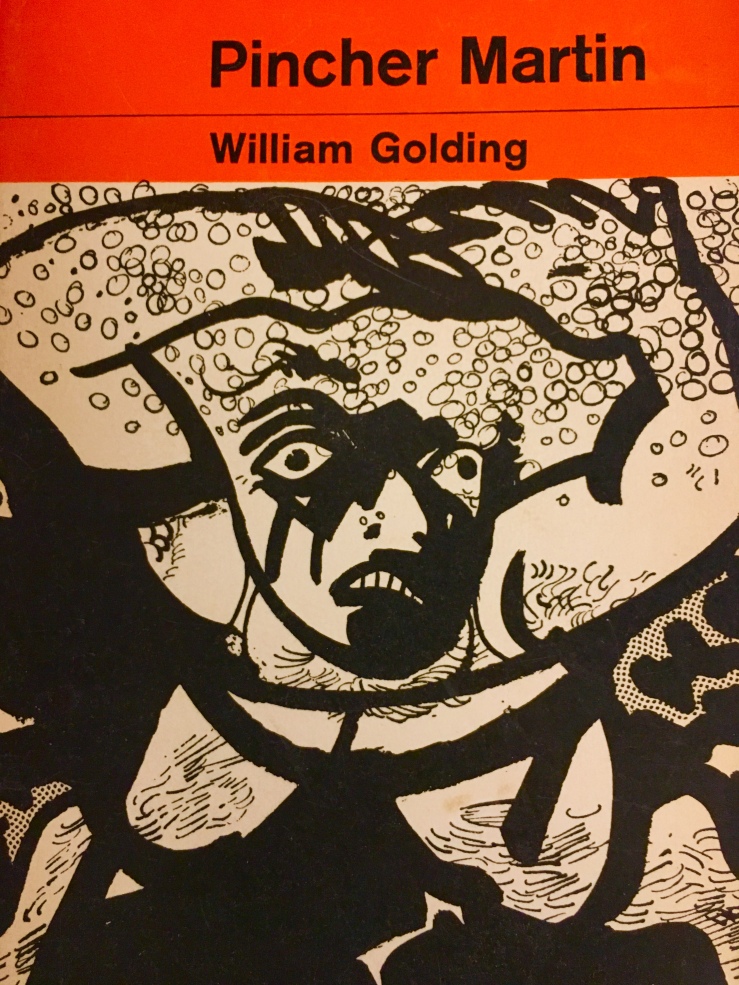
…which is how I ended up picking up William Golding’s Pincher Martin. (Golding, not Goldman). I read his 1955 novel The Inheritors a few years ago and I think when I was talking about it somewhere (maybe online), someone recommended Pincher Martin—and I couldn’t pass up this Penguin edition with cover art by Paul Hogarth.

img_1555

I also thumbed through a copy of Robert Scholes’s Fabulation and Metafiction (1980), reading a big chunk of the chapter called “The Nature of Experimental Fiction.” The chapter begins with four illustrating quotations from four masters of metafiction:

img_1550

João Gilberto Noll’s Lord (Book acquired, 5 Nov. 2018)

drq8kxbvyaatsec

João Gilberto Noll’s novel Lord is new in English translation (by Edgar Garbeletto) from Two Lines Press. I really enjoyed the last two I read by Noll, Atlantic Hotel and  Quiet Creature on the Corner, so I’m looking forward to carving out time for Lord. In the meantime, Two Lines’ blurb:

As Lord begins, a Brazilian author is arriving at London’s Heathrow airport for reasons he doesn’t fully understand. Only aware that he has been invited to take part in a mysterious mission, the Brazilian starts to churn with anxiety. Torn between returning home and continuing boldly forward, he becomes absorbed by fears: What if the Englishman who invited him here proves malign? Maybe he won’t show up? Or maybe he’ll leave the Brazilian lost and adrift in London, with no money or place to stay? Ever more confused and enmeshed in a reality of his own making, the Brazilian wanders more and more through London’s immigrant Hackney neighborhood, losing his memory, adopting strange behaviors, experiencing surreal sexual encounters, and developing a powerful fear of ever seeing himself reflected in a mirror.

A novel about the unsettling space between identities, and a disturbing portrait of dementia from the inside out, Lord constructs an altogether original story out of the ways we search for new versions of ourselves. With jaw-dropping scenes and sensual, at times grotesque images, renowned Brazilian author João Gilberto Noll grants us stunning new visions of our own personalities and the profound transformations that overtake us throughout life.

Novel factory | A passage from (and a short riff on) William Gaddis’s The Recognitions

In Ch. VII of Part I of William Gaddis’s 1955 novel The Recognitions, the erstwhile hero of the novel, Wyatt Gwyon—who has by this point disappeared into an anonymous he—meets Basil Valentine, a somewhat ambiguous and priestly art-world contact for Recktall Brown, the arch-capitalist Mephistophelean villain of the novel. Brown uses Valentine to arrange the forgeries that Gwyon executes. Here, Valentine and Wyatt discuss Brown, who has left the room. (Brown is the initial He; Valentine speaks first):

—He would absolutely have to have Alexander Pope in a box, to enjoy him. He is beyond anything I’ve ever come upon. Honestly, I never in my life could have imagined that business could live so powerfully independent of every other faculty of the human intelligence. Basil Valentine rested his head back, blowing smoke toward the ceiling, and watching it rise there. —Earlier, you know, he mentioned to me the idea of a novel factory, a sort of assembly line of writers, each one with his own especial little job. Mass production, he said, and tailored to the public taste. But not so absurd, Basil Valentine said sitting forward suddenly.

—Yes, I … I know. I know.

—When I laughed . . . but it’s not so funny in his hands, you know. Just recently he started this business of submitting novels to a public opinion board, a cross-section of readers who give their opinions, and the author makes changes accordingly. Best sellers, of course.

—Yes, good God, imagine if … submitting paintings to them, to a cross section? You’d better take out . . . This color . . . These lines, and . . . He drew his hand down over his face, —You can change a line without even touching it. No, he went on after a pause, and Valentine watched him closely, —nothing is funny in his hands. Everything becomes very . . . real.

Do you like the passage? I do.

I continue to enjoy re-reading Gaddis’s debut novel, aided in large part by an audiobook version read by Nick Sullivan. I’ve also been reading The Recognitions with/against Letters of William Gaddis (ed. Steven Moore, Dalkey Archive, 2013), which I do not recommend doing (especially for first-time readers). Gaddis, paraphrasing his own novel, said that the artist was simply “the dregs of his [own] work,” and much of The Recognitions reads like Gaddis polishing the material from his own early life and travels and readings, and then forcing that material—the nuggets and the morsels (and, let us be honest, the occasional duds)—into an angry demanding sustained attack on the Modern condition. But the material is good ammunition in that oh-so self-conscious attack on Modernism—an attack that in many ways engenders postmodernism, or at least builds a bridge to it, or perhaps sunders links to Modernism—

—look, I have way too many stupid metaphors cooking here, forgive me: What I mean to say, in simpler terms, is that The Recognitions diagnoses the end of big-em Modernism, that it describes something yet-to-emerge, and that it also, significantly, performs that something yet-to-emerge. Gaddis’s letters show the frustrations of a young man trying to cook up adventures in a modern world: a world already explored, mapped, tagged, and written about by other folks. And not just written about im histories and novels, but also in cheap guide books and cheap glossy magazines. This is the world after the age of mechanical reproduction, the world in which Gaddis’s hero Wyatt strives to forge a legitimate forgery of a place for himself.

Gaddis’s novel’s emergent postmodernism—more fully realized in his follow-up, J R—also presciently points to the post-postmodernist storytelling world of late capitalism. Gaddis’s villain Recktall Brown is a brute, but this philistine is perceptive, and he understands the economy of middlebrow aesthetics. As erudite Valentine laments, “I never in my life could have imagined that business could live so powerfully independent of every other faculty of the human intelligence.” Valentine should imagine harder. But this is America, where people frequently mistake wealth and the power to create wealth with creative intelligence.

Maybe I’m too hard here on Valentine, who eventually realizes that an appeal to the lowest common denominator is “not so absurd,” after he reflects on Recktall’s business idea “of a novel factory, a sort of assembly line of writers, each one with his own especial little job. Mass production…tailored to the public taste.” And we then learn that Recktall has already capitalized on his vision of masscult writing: “Just recently he started this business of submitting novels to a public opinion board, a cross-section of readers who give their opinions, and the author makes changes accordingly. Best sellers, of course.”

Reading this, I mentally annotated: Ah, Netflix-that’s the novel factory of 2018. And not just Netflix—I mean, clearly, not just Netflix, that’s simply a signal example—but rather the idea of the data-driven artefact, the non-artefact, the copy of a copy of a copy, the narrative entirely derived from atomizing the masscult nostalgia artefacts of 20, 30, 40 years ago, retrofitting them, repackaging them, and selling them as the real thing. Wyatt’s final observation in the passage laments that Recktall Brown, and the emerging late capitalism he represents, is winning a kind of war on culture and imagination. And nothing is funny in this devil’s busy hands: “Everything becomes very . . . real.” Even the fakes. Even the copies. Especially the copies.

Curse of the genuine article (William Gaddis’s The Recognitions)

dqx3nv9u0aaq8m4

—Taste changes, he went on in an irritating monotone. —Most forgeries last only a few generations, because they’re so carefully done in the taste of the period, a forged Rembrandt, for instance, confirms everything that that period sees in Rembrandt. Taste and style change, and the forgery is painfully obvious, dated, because the new period has discovered Rembrandt all over again, and of course discovered him to be quite different. That is the curse that any genuine article must endure.

From The Recognitions by William Gaddis.

Inherent Vice 2: Inherent Boogaloo (William Gaddis’s The Recognitions)

img_1478

From page 234 of my copy of William Gaddis’s The Recognitions. (See also and also and also).

Saul Steinberg’s The Labyrinth (Book acquired 27 Oct. 2018)

img_1471

Saul Steinberg’s The Labyrinth is new in print again from NYRB, this time with a new introduction by novelist Nicholson Baker. The book is simply gorgeous.

img_1327

My eight-year-old son immediately asked if he might read it (he has been on a sort of comix probation since I caught him reading a R. Crumb collection), and he shuttled through the thing two or three times over half an hour.

img_1474

The Labryinth is 280 or so pages of illustrations with no story or plot, and he was a bit bewildered when I told him I planned to review the thing. “How?” I’ll figure out a way.

img_1472

For now, here’s NYRB’s blurb:

Saul Steinberg’s The Labyrinth, first published in 1960 and long out of print, is more than a simple catalog or collection of drawings— these carefully arranged pages record a brilliant, constantly evolving imagination confronting modern life. Here is Steinberg, as he put it at the time, “discovering and inventing a great variety of events: Illusion, talks, music, women, cats, dogs, birds, the cube, the crocodile, the museum, Moscow and Samarkand (winter, 1956), other Eastern countries, America, motels, baseball, horse racing, bullfights, art, frozen music, words, geometry, heroes, harpies, etc.” This edition, featuring a new introduction by Nicholson Baker, an afterword by Harold Rosenberg, and new notes on the artwork, will allow readers to discover this unique and wondrous book all over again.

img_1473

Inherent Vice (William Gaddis’s The Recognitions)

img_1462

From page 182 of my copy of William Gaddis’s The Recognitions. (See also and also).

Blog about November reading (and blogging) goals

img_1447

For the past few days I’ve felt as if I would never put one word after another again, that I would never put together a sentence, string together clauses and sling them out into the world. This previous statement is hyperbole and I am silly—but even simple emails have seemed the acme of wretched futility to compose. Chalk it up to a mild head cold; chalk it up to too many essays to grade; chalk it up to anxiety of (fear of) writing. But I feel like I used to want to feel like I needed to write, right? On 1 Oct. 2018 I wrote a silly post on this weblog called “Blog about October reading (and blogging) goals,” in which I set a goal to blog “every day, even about nothing,” which I failed to achieve.

did actually achieve some of the reading goals expressed in that October goals blog though: I finished George Eliot’s Silas Marner; I made a bigger dent in Moderan, David R. Bunch’s cult dystopian novel; I finally read William Gaddis’s novel Carpenter’s Gothic; I actually returned and did not keep forever a book I borrowed from a friend; I did not gobble up Paul Kirchner’s Hieronymus & Bosch but rather limited myself to one or two cartoon strips a day (or sometimes, like, five).

So for November—

I’ve read the first two stories in Chris Power’s debut collection Mothers and they are good (the collection is available in the US in January 2019; I should have a full review then).

Tristan Foster’s collection Letter to the Author of the Letter to the Father is very much my weird cup of weird tea.

David Bunch’s Moderan deserves a big proper essay. I’ve suggested that our zeitgeist surpasses the parodic powers of postmodernism’s toolkit, but Moderan anticipates and slices up Our Bad Times.

Part of my anxiety about writing comes from having failed three times now to write a proper review of Conversations with Gordon Lish, which is the kind of self-deconstructing performance of writing about writing that is difficult to describe or analyze; it’s the sort of thing you simply want the reader to read.

I started the audiobook of William Gaddis’s novel The Recognitions, and have ended up not only reading my Penguin edition in tandem—a sort of re-rereading—but have also been flirting with The Gaddis Tapes1 and Letters of William Gaddis.  (This summer I said I’d reread The Recognitions: is this that?). I don’t really know what I want from this material, and I certainly don’t suggest it as anything approaching ancillary or auxiliary “help” with Gaddis’s project—I mean, in his Paris Review interview Gaddis paraphrases his hero and explains why we shouldn’t look for keys to art in the artist:

I’d go back to The Recognitions where Wyatt asks what people want from the man they didn’t get from his work, because presumably that’s where he’s tried to distill this “life and personality and views” you speak of. What’s any artist but the dregs of his work: I gave that line to Wyatt thirty-odd years ago and as far as I’m concerned it’s still valid.

—but hey look I know what I just did—took my cue from the artist in explaining the artist’s art. So. Oh, hey, here’s a great little segment from a letter Gaddis to his mama (from Mexico City) in April, 1947:

Could you then do this?: Send, as soon as it is conveniently possible, to me at Wells-Fargo:

My high-heeled black boots.

My spurs.

a pair of “levis”—those blue denim pants, if you can find a whole pair

the good machete, with bone handle and wide blade—and scabbard—if

this doesn’t distend package too much.

Bible, and paper-bound Great Pyramid book from H—Street.

those two rather worn gabardine shirts, maroon and green.

Incidentally I hope you got my watch pawn ticket, so that won’t be lost.

PS My mustache is so white and successful I am starting a beard.

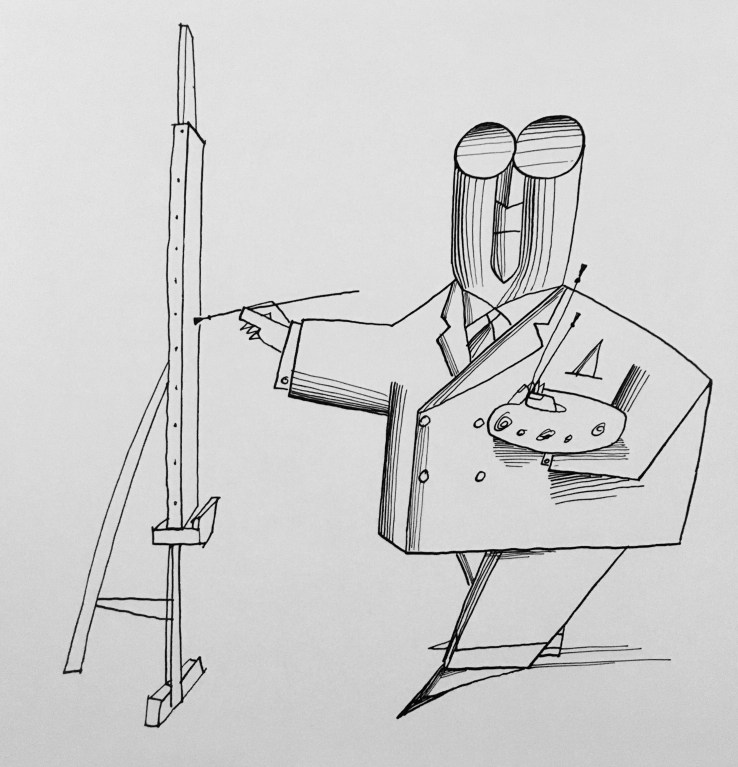
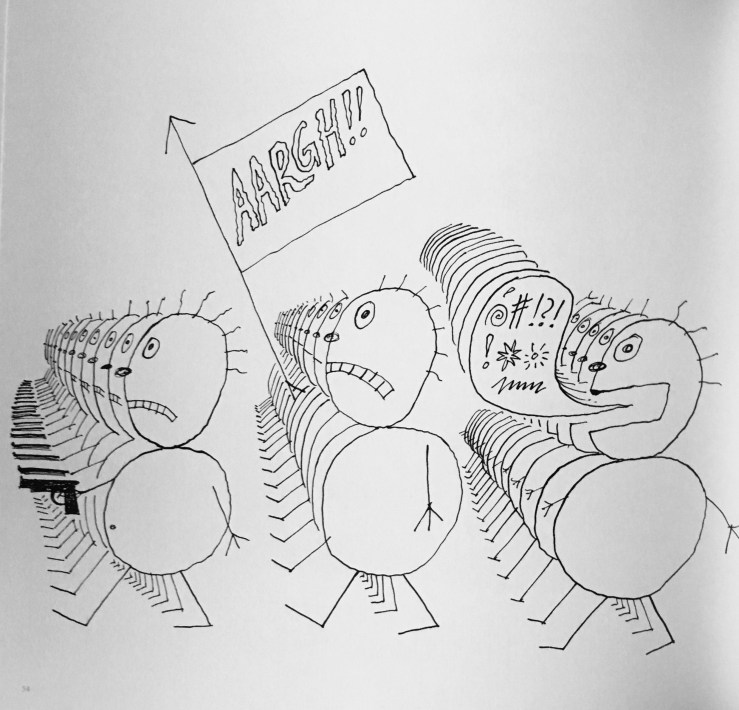
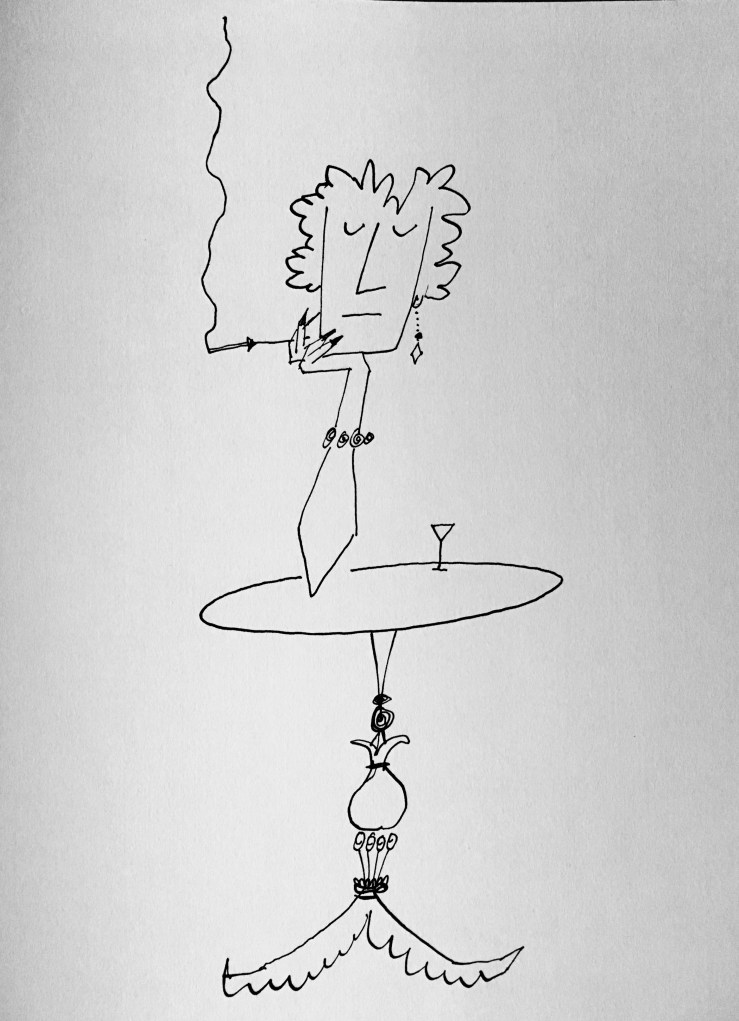
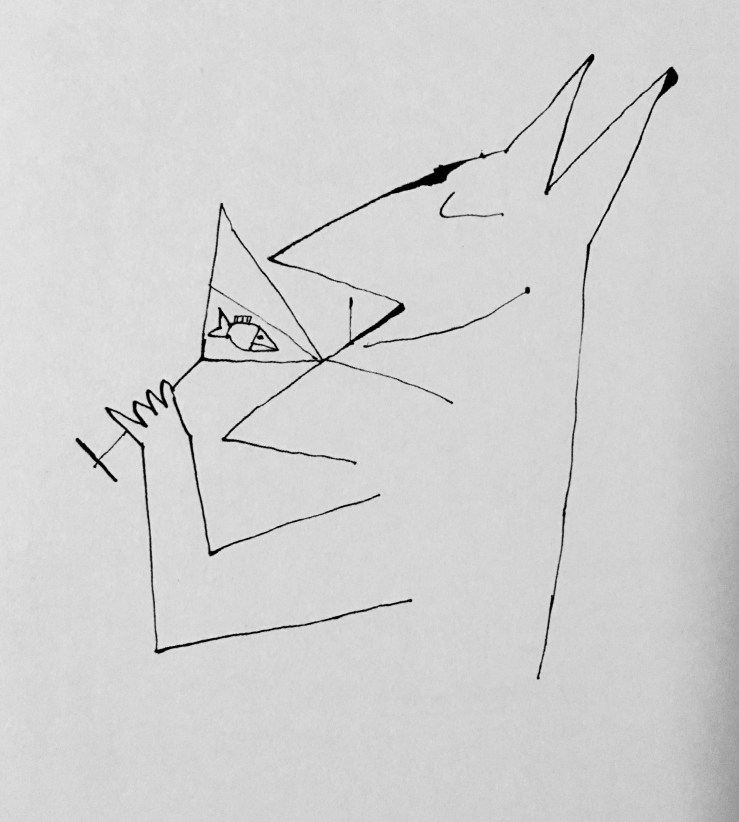
The same day I got The Labyrinth, a collection of mid-century cartooning by Saul Steinberg (new from NYRB, I read a passage in The Gaddis Tapes where Gaddis quotes his friend, Saul Steinberg. That same day my son, eight, went through the whole volume, and asked me what it was, how I was supposed to write about it, etc. Still not sure, but it’s great, heroic, etc. and I hope to post a review at The Comics Journal later this month. Here is Steinberg’s Quixote:

img_1444

And I like to pretend this is his illustration of some Gaddis character at a party in The Recognitions (even if I recognize it is not):

img_1445

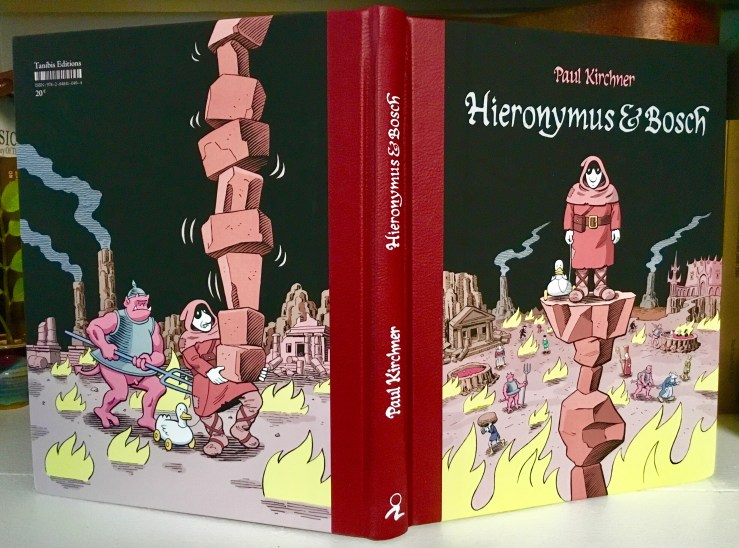
Bottom of the stack is Paul Kirchner’s latest Hieronymus & Bosch, a sort of MAD Magazine take on eternal damnation that puts the scatology in eschatology. Great stuff.

Not pictured in the stack is Angela Carter’s 1972 novel The Infernal Desire Machines of Doctor Hoffman, which is by my bed and which I keep falling asleep to. It deserves better from me; or maybe it’s a bit of evidence in the emerging truth that I can’t read before bed most of the time most of these days. (Separate blog post, perhaps—chalk it up to a head cold; chalk it up to too many essays to grade; chalk it up to two kids; chalk it up to too much read wine; chalk chalk chalk).

Hope to do better than this in the next 29 days.


Knight, Christopher J., William Gaddis, and Tom Smith. “The New York State Writers Institute Tapes: William Gaddis.” Contemporary Literature 42, no. 4 (2001): 667-93. doi:10.2307/1209049.

“Bogus Sausages” — Bram Stoker

“Bogus Sausages”

a chapter from

Famous Impostors (1910)

by

Bram Stoker


Two weary porters at the King’s Cross terminus of the Great Northern Railway were thinking about going home, when a breathless, simple-looking countryman rushed up to them with anxious enquiries for a certain train. It had gone. He was crushed. “Whatever was he to do? He had been sent up from Cambridge with a big hamper of those sausages for which the University town is celebrated—a very special order. Was there no other train?” “No.” The poor fellow seemed overwhelmed. “As it is too late to find another market,” he complained, “the whole lot will be lost.” Then a happy thought seemed to strike him as more of the railway men gathered round, and he inquired ingratiatingly, “Would you care to buy the sausages; if you would, you could have them for fourpence a pound? If I keep them, they will probably go bad before I can dispose of them.” The idea took—“Real Cambridge Sausages” at fourpence a pound was not to be sneezed at. The dainties, neatly packed in pounds, went like the proverbial hot cakes. Shouldering the empty basket, and bidding his customers a kindly goodnight, the yokel set off to find a humble lodging for the night. Grateful smiles greeted the purchasers when they got home. Frying pans were got out and the sausages were popped in, and never was such a sizzling heard in the railway houses—or rather never should such a sizzling have been heard. But somehow they didn’t sizzle. “They are uncommon dry; seem to have no fat in ’em,” said the puzzled cook. They were dry, very dry, for closer investigation showed that the “prime Cambridge” were nothing but skins stuffed with dry bread! The railway staff of King’s Cross were long anxious to meet that simple countryman from Cambridge.

Paul Kirchner’s Hieronymus & Bosch (Book acquired, 17 Oct. 2018)

img_1398

This afternoon, I started putting together a review of Biblioklept fave Paul Kirchner’s latest, Hieronymus & Bosch, and I realized that although I’d written a bit about it recently, I hadn’t put together one of these book acquired posts for it. So this is that post.

l

I really dig the book. It’s goofy and funny and has a lot of soul to it. Kirchner’s hapless hero Hieronymus seems like an extension—with difference—of the commuter, the hero of Kirchner’s bus strips. I hope to have a review up at The Comics Journal soon (where I reviewed Kirchner’s last collection, Awaiting the Collapse), but for now,  here’s publisher Tanibis’s blurb:

Meet the medieval miscreant Hieronymus and his wooden duck Bosch. When Hieronymus commits yet another petty crime, things go badly wrong and both are catapulted into a cartoonish version of Hell. There, lakes are made of lava (or, more often, poop) and an army of mischievous spiky-tailed devils bully the inmates and play impish pranks. Despite many gag-filled attempts at escaping this literal hell, Hieronymus and Bosch always end up being the butt of their trident-wielding guards’ most humiliating and painful jokes.

This book puts together about a hundred one-pagers filled with hilariously surrealistic and scatological gags by American comic book artist Paul Kirchner. Kirchner drew his inspiration from the medieval depictions of Hell by Dante and Hieronymus Bosch (duh!) as well as from the zany, almost sadistic humor of Warner Bros. cartoons like the Road Runner Show. Some of the stories published in this book originally appeared on the Adult Swim website.

Hieronymus & Bosch also evokes Kirchner’s famous comic strip series the bus. However, the bus‘ main character always got out from the practical jokes played on him unharmed, even if a bit confused. Hieronymus & Bosch‘s two heroes get burnt by lava, stabbed with tridents, used as a Q-tip by Satan himself, or just covered in a torrent of poop gushing down from above. Yet they carry on, finding fun where they can and refusing to abandon all hope.