That morning, the city was celebrating Consumer Thanksgiving Day. This feast came around every year, on a day in November, and had been set up to allow shoppers to display their gratitude toward the god Production, who tirelessly satisfied their every desire. The biggest department store in town organized a parade every year: an enormous balloon in the shape of a garishly colored doll was paraded through the main streets, pulled by ribbons that sequin-clad girls held as they marched behind a musical band. That day, the procession was coming down Fifth Avenue: the majorette twirled her baton in the air, the big drums banged, and the balloon giant, representing the Satisfied Customer, flew among the skyscrapers, obediently advancing on leashes held by girls in kepis, tassels, and fringed epaulets, riding spangly motorcycles.
At the same time, another parade was crossing Manhattan. The flaky, moldy moon was also advancing, sailing between the skyscrapers, pulled by the naked girls, and behind it came a line of beat-up cars and skeletons of trucks, amid a silent crowd that was gradually increasing in size. Thousands of people joined the throng that had been following the moon since the early hours of the morning, people of all colors, whole families with children of every age, especially as the procession filed past the crowded black and Puerto Rican areas of Harlem.
What you seek in vain for, half your life, one day you come full upon, all the family at dinner. You seek it like a dream, and as soon as you find it you become its prey.
I attributed this tingling recognition to having read The Recognitions before (and to having read Part I once before that)—but then I realized that I’d read the line far, far more recently: It’s the epigraph to Gaddis’s fourth novel A Frolic of His Own, which I’d opened up again just a few weeks ago (and subsequently put back down).
Tyree’s essay is a fascinating read, tracking the strange history of the line. Thoreau’s words, it turns out, are not exactly Thoreau’s words—rather, they are Emerson’s recollections of a conversation between the pair from a walk in the woods. Additionally, Emerson wrote and attributed these words after Thoreau’s death. The remark initially appeared in Emerson’s literary eulogy “Thoreau,” published in the August 1862 edition of Atlantic Monthly. As Tyree observes,
This detail, which seems highly trivial at first, in fact slyly reinforces the theme of original and copy supersaturating Gaddis’s novel. The very nature of authorship falls into question here, in a manner similar to the problem of Socrates and Plato: is Thoreau’s saying from Emerson or from Thoreau, or is it from both?
While issues of originality and authenticity of authorship clearly correlate to the themes of The Recognitions, Tyree’s essay is most interesting to me in the ways by which it situates Gaddis’s work with/against the American Renaissance tradition. Tyree gives us some of the flavor of that tradition, recontextualizing Gaddis’s epigraph in a full paragraph of Emerson’s. Here’s Emerson eulogizing his friend Thoreau:
It was a pleasure and a privilege to walk with him. He knew the country like a fox or a bird, and passed through it as freely by paths of his own. He knew every track in the snow or on the ground, and what creature had taken this path before him. One must submit abjectly to such a guide, and the reward was great . . . Presently he heard a note which he called that of the night-warbler, a bird he had never identified, had been in search of twelve years, which always, when he saw it, was in the act of diving down into a tree or bush, and which it was vain to seek; the only bird that sings indifferently by night and by day. I told him he must beware of finding and booking it, lest life should have nothing more to show him. He said, “What you seek in vain for, half your life, one day you come full upon, all the family at dinner. You seek it like a dream, and as soon as you find it you become its prey.”
Tyree situates the passage within the contrasting (and quickly diverging) philosophies of the old friends: “Emerson was essentially cosmic in his Transcendentalism, while Thoreau sought the divine in the actual empirical details of nature.”
Tyree’s essay becomes most interesting to me when he begins to interpret just what the hell the quote means. His analysis hovers around the word family, underlining an obsession of American literature: escape from domesticity. Here’s Tyree’s paraphrase of the Thoreau’s/Emerson’s line:
One finds the object of a long quest, quite suddenly, at the family dinner table. But in the moment of discovery, something seems to go wrong; rather than capturing the truth, one becomes its prey. Clearly, the conversation here has expanded beyond night-warblers. Thoreau is now speaking of truth and its relationship to the family dinner table.
Tyree then susses out Thoreau’s complicated relationship with Emerson’s family:
It is possible to make too much of the fact that Thoreau’s intellectual life, as both a thinker and a man, developed in Emerson’s shade, in the shelter of Emerson’s house and family. But it is clear that Thoreau was often of two minds about living with or near Emerson. In a September 1841 letter….Thoreau told a friend that he was “living with Mr. Emerson in very dangerous prosperity.”
That “dangerous prosperity” of domestic life echoes one of the grand themes of American literature—namely, civilization is a blockade to be surpassed on the trek into wild nature, individuality, and freedom. Domestic duty interferes with such adventures. Just ask Rip Van Winkle, Ishmael, or Huck Finn. (Or perhaps Hawthorne’s cautionary figure, Young Goodman Brown).
Tyree underlines the point (final emphasis mine):
In the exchange over the night-warbler, the family is again identified in terms of danger; the quest is a danger to the family, or the family is a danger to the quest. One might read this as Thoreau’s critique of what would now be called Emerson’s “lifestyle.” A man who is the prey to truth must leave the dinner table to find it, but Emerson, in the comfort of his household, among his family, will never book the night-warbler. Thoreau does not say that having “all the family at dinner” stops one’s seeking, only that one becomes the prey of a protracted, half-conscious quest at mealtime. Then, one must decide what to do about it—whether to search out the night-warbler or not, and how to do it. The question seems to be whether the truth can be found through the life of the family, or whether one must leave it behind in some sense.
In The Recognitions, Wyatt circumvents the danger to his quest by not only removing himself from family (in the form of his wife Esther), but from removing himself from society in general. In J R(1975), most of Gaddis’s heroes find themselves unable to reconcile to Wyatt’s solution; their seeking fumbled out in half measures, neatly figured in the 96th Street apartment apartment shared by Gibbs, Eigen, and Bast. This hellhole is a transitory space, an inbetweeness of domesticity and city wilderness. Carpenter’s Gothic (1985) offers a more thorough critique of the impulse in American literature to send its (generally masculine) characters out into the wild spaces where they can transcend all the trappings of domesticity that bog them down. Carpenter’s Gothic confines its heroine to one haunted house, the men in her life flitting in and out if like silly birds on foiled quests. That domestic confinement reaches a kind of apotheosis in Gaddis’s posthumous novel Agapē Agape(2002), the stifling uninterrupted monologue of a man in a room, fighting against entropy.
And what about A Frolic of His Own (1994)? Well I haven’t read it yet.
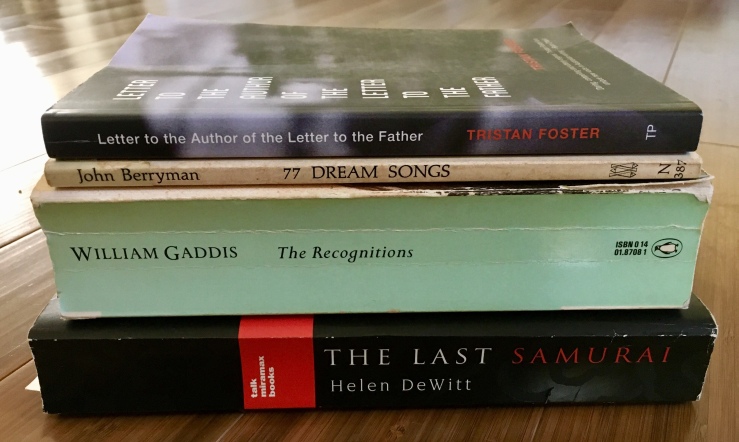
I spent a relaxing hour and a half browsing my favorite local used bookstore this afternoon. I ended up finding a copy of Helen DeWitt’s debut novel The Last Samurai, which all kindsa smart folks have been telling me to read for years. I didn’t like her follow-up Lightning Rods, and stalled out on her collection Some Trick earlier this year—but we’ll see.
William Goldman died today. I’ve always thought of him primarily as a screenwriter, and I think much of his screenwriting work is pretty great, The Princess Bride in particular (the one Goldman novel we own is The Princess Bride, currently in my daughter’s possession). I couldn’t help but look over some of his books today.
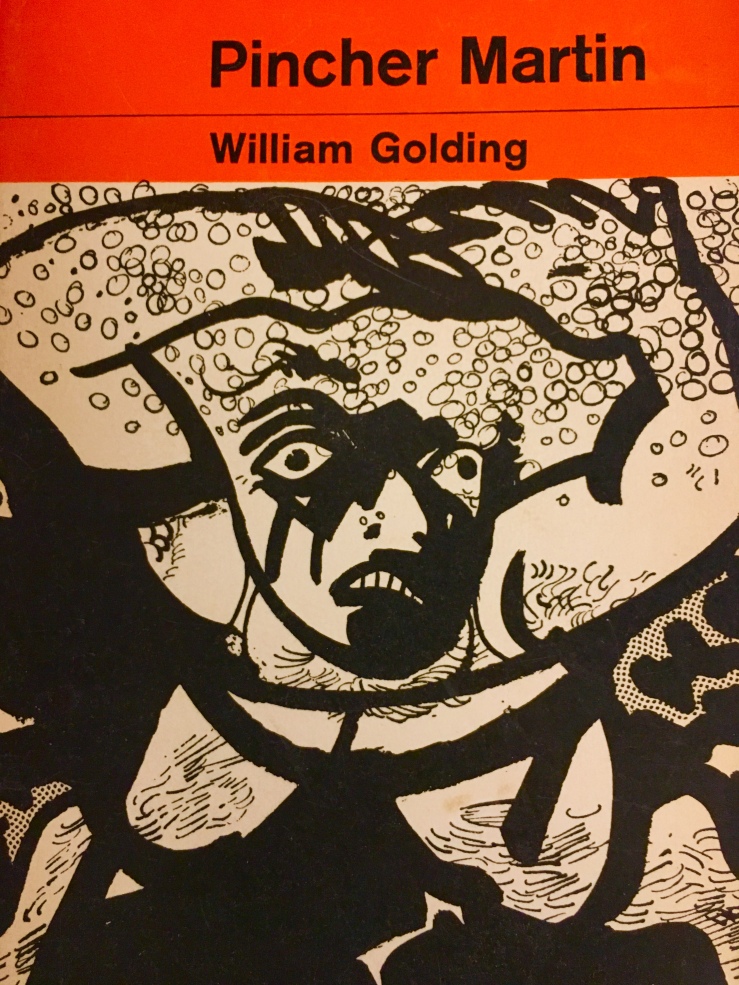
…which is how I ended up picking up William Golding’s Pincher Martin. (Golding, not Goldman). I read his 1955 novel The Inheritors a few years ago and I think when I was talking about it somewhere (maybe online), someone recommended Pincher Martin—and I couldn’t pass up this Penguin edition with cover art by Paul Hogarth.
I also thumbed through a copy of Robert Scholes’s Fabulation and Metafiction (1980), reading a big chunk of the chapter called “The Nature of Experimental Fiction.” The chapter begins with four illustrating quotations from four masters of metafiction:
João Gilberto Noll’s novel Lord is new in English translation (by Edgar Garbeletto) from Two Lines Press. I really enjoyed the last two I read by Noll, Atlantic Hotel and Quiet Creature on the Corner, so I’m looking forward to carving out time for Lord. In the meantime, Two Lines’ blurb:
As Lord begins, a Brazilian author is arriving at London’s Heathrow airport for reasons he doesn’t fully understand. Only aware that he has been invited to take part in a mysterious mission, the Brazilian starts to churn with anxiety. Torn between returning home and continuing boldly forward, he becomes absorbed by fears: What if the Englishman who invited him here proves malign? Maybe he won’t show up? Or maybe he’ll leave the Brazilian lost and adrift in London, with no money or place to stay? Ever more confused and enmeshed in a reality of his own making, the Brazilian wanders more and more through London’s immigrant Hackney neighborhood, losing his memory, adopting strange behaviors, experiencing surreal sexual encounters, and developing a powerful fear of ever seeing himself reflected in a mirror.
A novel about the unsettling space between identities, and a disturbing portrait of dementia from the inside out, Lord constructs an altogether original story out of the ways we search for new versions of ourselves. With jaw-dropping scenes and sensual, at times grotesque images, renowned Brazilian author João Gilberto Noll grants us stunning new visions of our own personalities and the profound transformations that overtake us throughout life.
In Ch. VII of Part I of William Gaddis’s 1955 novel The Recognitions, the erstwhile hero of the novel, Wyatt Gwyon—who has by this point disappeared into an anonymous he—meets Basil Valentine, a somewhat ambiguous and priestly art-world contact for Recktall Brown, the arch-capitalist Mephistophelean villain of the novel. Brown uses Valentine to arrange the forgeries that Gwyon executes. Here, Valentine and Wyatt discuss Brown, who has left the room. (Brown is the initial He; Valentine speaks first):
—He would absolutely have to have Alexander Pope in a box, to enjoy him. He is beyond anything I’ve ever come upon. Honestly, I never in my life could have imagined that business could live so powerfully independent of every other faculty of the human intelligence. Basil Valentine rested his head back, blowing smoke toward the ceiling, and watching it rise there. —Earlier, you know, he mentioned to me the idea of a novel factory, a sort of assembly line of writers, each one with his own especial little job. Mass production, he said, and tailored to the public taste. But not so absurd, Basil Valentine said sitting forward suddenly.
—Yes, I … I know. I know.
—When I laughed . . . but it’s not so funny in his hands, you know. Just recently he started this business of submitting novels to a public opinion board, a cross-section of readers who give their opinions, and the author makes changes accordingly. Best sellers, of course.
—Yes, good God, imagine if … submitting paintings to them, to a cross section? You’d better take out . . . This color . . . These lines, and . . . He drew his hand down over his face, —You can change a line without even touching it. No, he went on after a pause, and Valentine watched him closely, —nothing is funny in his hands. Everything becomes very . . . real.
Do you like the passage? I do.
I continue to enjoy re-reading Gaddis’s debut novel, aided in large part by an audiobook version read by Nick Sullivan. I’ve also been reading The Recognitions with/against Letters of William Gaddis (ed. Steven Moore, Dalkey Archive, 2013), which I do not recommend doing (especially for first-time readers). Gaddis, paraphrasing his own novel, said that the artist was simply “the dregs of his [own] work,” and much of The Recognitions reads like Gaddis polishing the material from his own early life and travels and readings, and then forcing that material—the nuggets and the morsels (and, let us be honest, the occasional duds)—into an angry demanding sustained attack on the Modern condition. But the material is good ammunition in that oh-so self-conscious attack on Modernism—an attack that in many ways engenders postmodernism, or at least builds a bridge to it, or perhaps sunders links to Modernism—
—look, I have way too many stupid metaphors cooking here, forgive me: What I mean to say, in simpler terms, is that The Recognitions diagnoses the end of big-em Modernism, that it describes something yet-to-emerge, and that it also, significantly, performs that something yet-to-emerge. Gaddis’s letters show the frustrations of a young man trying to cook up adventures in a modern world: a world already explored, mapped, tagged, and written about by other folks. And not just written about im histories and novels, but also in cheap guide books and cheap glossy magazines. This is the world after the age of mechanical reproduction, the world in which Gaddis’s hero Wyatt strives to forge a legitimate forgery of a place for himself.
Gaddis’s novel’s emergent postmodernism—more fully realized in his follow-up, J R—also presciently points to the post-postmodernist storytelling world of late capitalism. Gaddis’s villain Recktall Brown is a brute, but this philistine is perceptive, and he understands the economy of middlebrow aesthetics. As erudite Valentine laments, “I never in my life could have imagined that business could live so powerfully independent of every other faculty of the human intelligence.” Valentine should imagine harder. But this is America, where people frequently mistake wealth and the power to create wealth with creative intelligence.
Maybe I’m too hard here on Valentine, who eventually realizes that an appeal to the lowest common denominator is “not so absurd,” after he reflects on Recktall’s business idea “of a novel factory, a sort of assembly line of writers, each one with his own especial little job. Mass production…tailored to the public taste.” And we then learn that Recktall has already capitalized on his vision of masscult writing: “Just recently he started this business of submitting novels to a public opinion board, a cross-section of readers who give their opinions, and the author makes changes accordingly. Best sellers, of course.”
Reading this, I mentally annotated: Ah, Netflix-—that’s the novel factory of 2018. And not just Netflix—I mean, clearly, not just Netflix, that’s simply a signal example—but rather the idea of the data-driven artefact, the non-artefact, the copy of a copy of a copy, the narrative entirely derived from atomizing the masscult nostalgia artefacts of 20, 30, 40 years ago, retrofitting them, repackaging them, and selling them as the real thing. Wyatt’s final observation in the passage laments that Recktall Brown, and the emerging late capitalism he represents, is winning a kind of war on culture and imagination. And nothing is funny in this devil’s busy hands: “Everything becomes very . . . real.” Even the fakes. Even the copies. Especially the copies.
—Taste changes, he went on in an irritating monotone. —Most forgeries last only a few generations, because they’re so carefully done in the taste of the period, a forged Rembrandt, for instance, confirms everything that that period sees in Rembrandt. Taste and style change, and the forgery is painfully obvious, dated, because the new period has discovered Rembrandt all over again, and of course discovered him to be quite different. That is the curse that any genuine article must endure.
Saul Steinberg’s The Labyrinth is new in print again from NYRB, this time with a new introduction by novelist Nicholson Baker. The book is simply gorgeous.
My eight-year-old son immediately asked if he might read it (he has been on a sort of comix probation since I caught him reading a R. Crumb collection), and he shuttled through the thing two or three times over half an hour.
The Labryinth is 280 or so pages of illustrations with no story or plot, and he was a bit bewildered when I told him I planned to review the thing. “How?” I’ll figure out a way.
Saul Steinberg’s The Labyrinth, first published in 1960 and long out of print, is more than a simple catalog or collection of drawings— these carefully arranged pages record a brilliant, constantly evolving imagination confronting modern life. Here is Steinberg, as he put it at the time, “discovering and inventing a great variety of events: Illusion, talks, music, women, cats, dogs, birds, the cube, the crocodile, the museum, Moscow and Samarkand (winter, 1956), other Eastern countries, America, motels, baseball, horse racing, bullfights, art, frozen music, words, geometry, heroes, harpies, etc.” This edition, featuring a new introduction by Nicholson Baker, an afterword by Harold Rosenberg, and new notes on the artwork, will allow readers to discover this unique and wondrous book all over again.
For the past few days I’ve felt as if I would never put one word after another again, that I would never put together a sentence, string together clauses and sling them out into the world. This previous statement is hyperbole and I am silly—but even simple emails have seemed the acme of wretched futility to compose. Chalk it up to a mild head cold; chalk it up to too many essays to grade; chalk it up to anxiety of (fear of) writing. But I feel like I used to want to feel like I needed to write, right? On 1 Oct. 2018 I wrote a silly post on this weblog called “Blog about October reading (and blogging) goals,” in which I set a goal to blog “every day, even about nothing,” which I failed to achieve.
I did actually achieve some of the reading goals expressed in that October goals blog though: I finished George Eliot’s Silas Marner; I made a bigger dent in Moderan, David R. Bunch’s cult dystopian novel; I finally read William Gaddis’s novel Carpenter’s Gothic; I actually returned and did not keep forever a book I borrowed from a friend; I did not gobble up Paul Kirchner’s Hieronymus & Bosch but rather limited myself to one or two cartoon strips a day (or sometimes, like, five).
So for November—
I’ve read the first two stories in Chris Power’s debut collection Mothers and they are good (the collection is available in the US in January 2019; I should have a full review then).
Tristan Foster’s collection Letter to the Author of the Letter to the Father is very much my weird cup of weird tea.
Part of my anxiety about writing comes from having failed three times now to write a proper review of Conversations with Gordon Lish, which is the kind of self-deconstructing performance of writing about writing that is difficult to describe or analyze; it’s the sort of thing you simply want the reader to read.
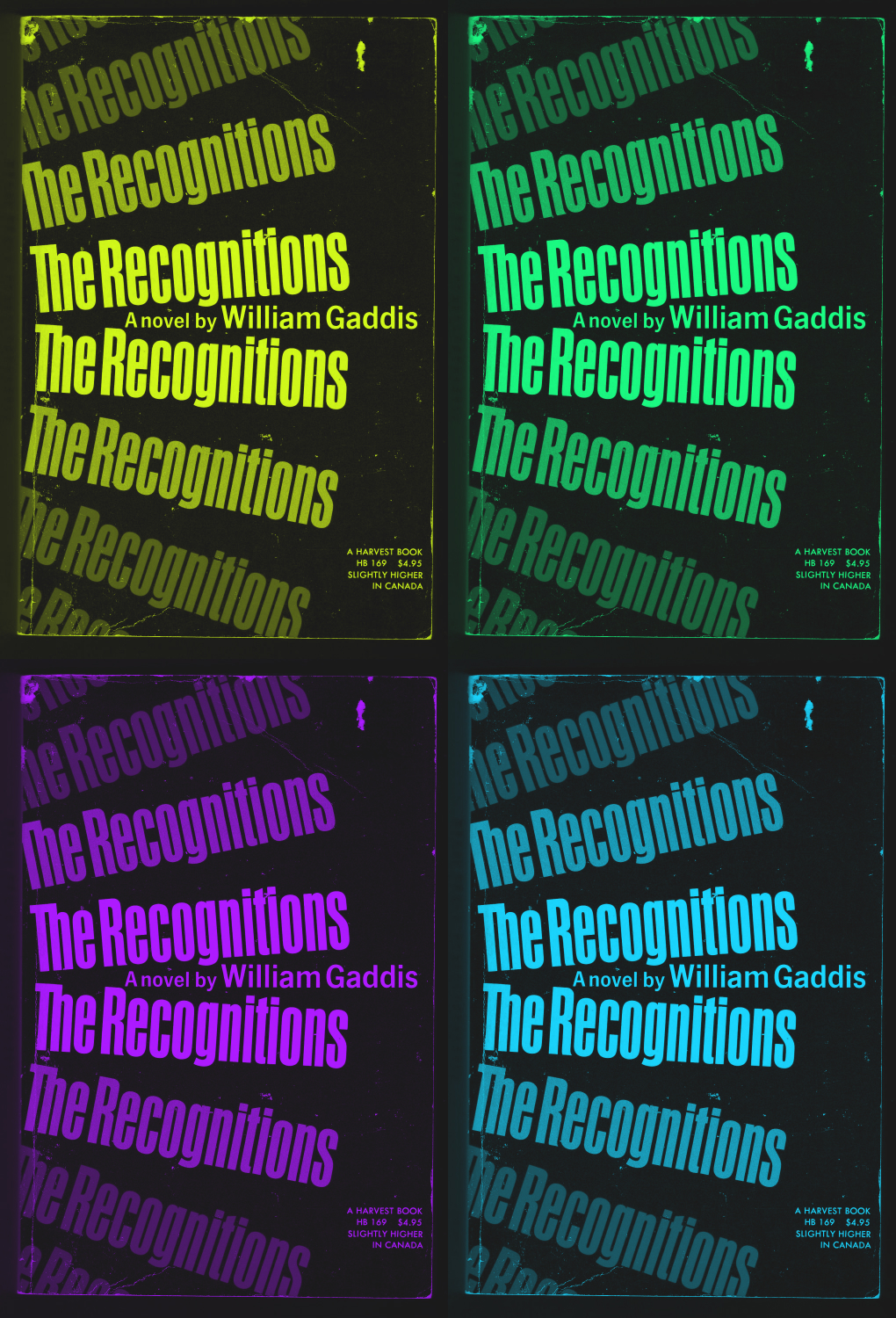
I started the audiobook of William Gaddis’s novel The Recognitions, and have ended up not only reading my Penguin edition in tandem—a sort of re-rereading—but have also been flirting with The Gaddis Tapes1 and Letters of William Gaddis. (This summer I said I’d reread The Recognitions: is this that?). I don’t really know what I want from this material, and I certainly don’t suggest it as anything approaching ancillary or auxiliary “help” with Gaddis’s project—I mean, in his Paris Review interview Gaddis paraphrases his hero and explains why we shouldn’t look for keys to art in the artist:
I’d go back to The Recognitions where Wyatt asks what people want from the man they didn’t get from his work, because presumably that’s where he’s tried to distill this “life and personality and views” you speak of. What’s any artist but the dregs of his work: I gave that line to Wyatt thirty-odd years ago and as far as I’m concerned it’s still valid.
—but hey look I know what I just did—took my cue from the artist in explaining the artist’s art. So. Oh, hey, here’s a great little segment from a letter Gaddis to his mama (from Mexico City) in April, 1947:
Could you then do this?: Send, as soon as it is conveniently possible, to me at Wells-Fargo:
My high-heeled black boots.
My spurs.
a pair of “levis”—those blue denim pants, if you can find a whole pair
the good machete, with bone handle and wide blade—and scabbard—if
this doesn’t distend package too much.
Bible, and paper-bound Great Pyramid book from H—Street.
those two rather worn gabardine shirts, maroon and green.
Incidentally I hope you got my watch pawn ticket, so that won’t be lost.
PS My mustache is so white and successful I am starting a beard.
The same day I got The Labyrinth, a collection of mid-century cartooning by Saul Steinberg (new from NYRB, I read a passage in The Gaddis Tapes where Gaddis quotes his friend, Saul Steinberg. That same day my son, eight, went through the whole volume, and asked me what it was, how I was supposed to write about it, etc. Still not sure, but it’s great, heroic, etc. and I hope to post a review at The Comics Journal later this month. Here is Steinberg’s Quixote:
And I like to pretend this is his illustration of some Gaddis character at a party in The Recognitions (even if I recognize it is not):
Bottom of the stack is Paul Kirchner’s latest Hieronymus & Bosch, a sort of MAD Magazine take on eternal damnation that puts the scatology in eschatology. Great stuff.
Not pictured in the stack is Angela Carter’s 1972 novel The Infernal Desire Machines of Doctor Hoffman, which is by my bed and which I keep falling asleep to. It deserves better from me; or maybe it’s a bit of evidence in the emerging truth that I can’t read before bed most of the time most of these days. (Separate blog post, perhaps—chalk it up to a head cold; chalk it up to too many essays to grade; chalk it up to two kids; chalk it up to too much read wine; chalk chalk chalk).
Hope to do better than this in the next 29 days.
1 Knight, Christopher J., William Gaddis, and Tom Smith. “The New York State Writers Institute Tapes: William Gaddis.” Contemporary Literature 42, no. 4 (2001): 667-93. doi:10.2307/1209049.
Two weary porters at the King’s Cross terminus of the Great Northern Railway were thinking about going home, when a breathless, simple-looking countryman rushed up to them with anxious enquiries for a certain train. It had gone. He was crushed. “Whatever was he to do? He had been sent up from Cambridge with a big hamper of those sausages for which the University town is celebrated—a very special order. Was there no other train?” “No.” The poor fellow seemed overwhelmed. “As it is too late to find another market,” he complained, “the whole lot will be lost.” Then a happy thought seemed to strike him as more of the railway men gathered round, and he inquired ingratiatingly, “Would you care to buy the sausages; if you would, you could have them for fourpence a pound? If I keep them, they will probably go bad before I can dispose of them.” The idea took—“Real Cambridge Sausages” at fourpence a pound was not to be sneezed at. The dainties, neatly packed in pounds, went like the proverbial hot cakes. Shouldering the empty basket, and bidding his customers a kindly goodnight, the yokel set off to find a humble lodging for the night. Grateful smiles greeted the purchasers when they got home. Frying pans were got out and the sausages were popped in, and never was such a sizzling heard in the railway houses—or rather never should such a sizzling have been heard. But somehow they didn’t sizzle. “They are uncommon dry; seem to have no fat in ’em,” said the puzzled cook. They were dry, very dry, for closer investigation showed that the “prime Cambridge” were nothing but skins stuffed with dry bread! The railway staff of King’s Cross were long anxious to meet that simple countryman from Cambridge.
This afternoon, I started putting together a review of Biblioklept fave Paul Kirchner’s latest, Hieronymus & Bosch, and I realized that although I’d written a bit about it recently, I hadn’t put together one of these book acquired posts for it. So this is that post.
I really dig the book. It’s goofy and funny and has a lot of soul to it. Kirchner’s hapless hero Hieronymus seems like an extension—with difference—of the commuter, the hero of Kirchner’s bus strips. I hope to have a review up at The Comics Journal soon (where I reviewed Kirchner’s last collection, Awaiting the Collapse), but for now, here’s publisher Tanibis’s blurb:
Meet the medieval miscreant Hieronymus and his wooden duck Bosch. When Hieronymus commits yet another petty crime, things go badly wrong and both are catapulted into a cartoonish version of Hell. There, lakes are made of lava (or, more often, poop) and an army of mischievous spiky-tailed devils bully the inmates and play impish pranks. Despite many gag-filled attempts at escaping this literal hell, Hieronymus and Bosch always end up being the butt of their trident-wielding guards’ most humiliating and painful jokes.
This book puts together about a hundred one-pagers filled with hilariously surrealistic and scatological gags by American comic book artist Paul Kirchner. Kirchner drew his inspiration from the medieval depictions of Hell by Dante and Hieronymus Bosch (duh!) as well as from the zany, almost sadistic humor of Warner Bros. cartoons like the Road Runner Show. Some of the stories published in this book originally appeared on the Adult Swim website.
Hieronymus & Bosch also evokes Kirchner’s famous comic strip series the bus. However, the bus‘ main character always got out from the practical jokes played on him unharmed, even if a bit confused. Hieronymus & Bosch‘s two heroes get burnt by lava, stabbed with tridents, used as a Q-tip by Satan himself, or just covered in a torrent of poop gushing down from above. Yet they carry on, finding fun where they can and refusing to abandon all hope.
To turn now–it’s not a different direction; it’s this whole idea of the risk of authorial absence and the risk one takes with the reader putting down the book, saying, “It’s too much trouble, I don’t know what’s going on here.” Refusing to collaborate because it’s not worth the effort. So in that light, the idea of the writer as a confidence man has always appealed to me and to many writers. When you think about it, the number of novels [wherein there is a confidence man is great; one thinks] of Melville and, oh dear, Maugham I think had one. The idea of a confidence man has a great appeal for writers because there is something of the con man in the writer, I think. He’s trying—What? What does the confidence man do?—he is working for this “willing suspension of disbelief.”
An excerpt from William Gaddis’s New York State Writers Institute reading, April 4, 1990
I downloaded the audiobook of version of William Gaddis’s first novel The Recognitions the other afternoon. The recording is 51 hours and 41 minutes long, and read by Nick Sullivan.
I am almost exactly six hours in, over halfway through the novel’s third chapter, an aural space that correlates to page 114 of my 956-page Penguin edition of the novel. In this particular moment, Wyatt Gwyon, the sorta-hero of The Recognitions, rants to his wife Esther about literary modernism. I stopped the book at that particular moment to find that particular passage in my copy of The Recognitions; it was particularly easy to find because I’d already dogeared that particular page.
I’m not sure if I dogeared that particular page when I first attempted The Recognitions in 2009 (I stalled out in the book’s second of three sections, somewhere around page 330 or so), or if I dogeared it on my second (and successful) reading in 2012. And while I’m tempted to focus on the passage I’ve just audited and then reread—a meta-moment where Wyatt raves about Modernism (even making a dig at Hemingway)—I’m more interested in making a few generalizations about the audiobook and the first chapter of The Recognitions.
So a few generalizations:
Nick Sullivan, who reads The Recognitions, is excellent. He’s expressive, and imbues the novel with a wonderful rhythm and vitality, differentiating the voices of each of the characters (no mean feat). I have audited Sullivan’s reading of Gaddis’s second novel JR, which is marvelous, and in many ways taught me to “read” that novel, which is told in almost entirely unattributed dialogue. I would strongly recommend anyone daunted by JR to read it in tandem with Sullivan’s audiobook version.
I would not, however, recommend using the audiobook of The Recognitions for a first go through (unless you intend to use the audiobook chapters after you’ve read the chapters yourself). The Recognitions simply contains a density of information unparalleled in almost any other novel I can think of). You’ll need to attend closely to it to parse the threads that matter in terms of the plot and the threads that are there to build the theme. And unless you’re a polyglot, hearing all the untranslated Latin, Spanish, Italian, and German read aloud does little for comprehension. No, I think The Recognitions is best read slowly, and ideally the reader should take the time to attend to its many allusions and motifs (Steven Moore’s online guide is invaluable here). This isn’t to say that readers need to get every damn little reference to enjoy and appreciate Gaddis’s novel—but it doesn’t hurt to try.
Still, there’ a lot in The Recognitions. The book is wonderful, a work of genius, and this is perhaps one of its faults—it suffers from First Novel Syndrome, the author cramming in all that he can, anxious that the audience Recognize Genius. Gaddis was young when it was published—just 34 (amazing). A much older Gaddis seemed to recognize this, saying the following in 1990:
So, in the work I’ve tried to do, in J R, especially the awful lot of description and narrative interference, as I see it now, in The Recognitions, where I am awfully pleased with information that I have come across and would like to share it with you-so I go on for two pages about, oh, I don’t know, the medieval Church,… the forgery, painting, theories of forgery and so forth, and descriptions, literally, of houses or landscapes. And when I got started on the second novel, which was J R, 726 pages, almost entirely my intention was to get the author out of there, to oblige the characters to create themselves and each other and their story, and all of it in dialogue
The first chapter of The Recognitions, the fruit of an author awfully pleased with information that he has come across, lays out an encyclopedic range of references to literature, art, religion, history, and every other manifestation of culture you might think of. The chapter is impossibly rich, and in some ways, the rest of the novel can never quite match it. Or rather, the rest of the novel teases out the material that Gaddis offers at its outset, threading the material into cables of plot and theme. Or maybe what I’m trying to say is, The first chapter of The Recognitions might be the best first chapter of any novel I can think of. At 62 pages, it’s almost a novella, and it can arguably stand on its own. Let me borrow my own summary of Chapter I from my 2009 write-up:
The first chapter is the best first chapter of any book I can remember reading in recent years. It tells the story of Rev. Gwyon looking for solace in the Catholic monasteries of Spain after his wife’s death at sea under the clumsy hands of a fugitive counterfeiter posing as a doctor (already, the book posits the inherent dangers of forgery, even as it complicates those dangers by asking who isn’t in some sense a phony). There’s a beautiful line Gaddis treads in the first chapter, between pain, despair, and melancholy and caustic humor, as Gwyon slowly realizes the false limits of his religion. The chapter continues to tell the story of young Wyatt, growing up under the stern care of his puritanical Aunt May, whose religious attitude is confounded by the increasingly erratic behavior of Wyatt’s often-absent father. While deathly ill, Wyatt teaches himself to paint by copying masterworks. He also attempts an original, a painting of his dead mother, but he cannot bear to finish it because, as he tells his father, “There’s something about . . . an unfinished piece of work . . . Where perfection is still possible. Because it’s there, it’s there all the time, all the time you work trying to uncover it.” This problem of originality, of Platonic perfection guides much of the novel’s critique on Modernism.
(The “novel’s critique on Modernism” — well, hey, that’s sort of how I came into this riff—stopping the audiobook six hours in to go track down pages 113-14, where Wyatt attacks Hemingway’s modern prose style). There’s more to the plot of Ch. 1, including a ritual sacrifice that’s easy to miss if you’re not paying close enough attention. There are also numerous references to pipe organs, planting the seeds of The Recognitions’ strange conclusion. But now of course is not the time to write about that conclusion; instead, I’ll conclude by remarking that I saw more of the novel’s form—including its conclusion—in its introduction than I had previously thought was there. And that’s the value in rereading a big novel—recognizing what we previously did not recognize.
HECATE, the Grecian goddess of the infernal regions, presided over magic and enchantment, and may fairly be styled the goddess, queen, and patroness of Witches and sorcerers. She was acquainted with the properties of every herb, and imparted this knowledge to her daughters Medea and Circe. To this trio of classical Witches were specially consecrated the following herbs:—The Mandrake, the Deadly Nightshade, the Common Nightshade, the Wolfs-bane, the Pontic Azalea, the Cyclamen, the Cypress, Lavender, Hyssop-leaved Mint, the Poley or Mountain Germander, the Ethiopian Pepper, the Corn Feverfew, the Cardamom, the Musk Mallow, the Oriental Sesame, the rough Smilax, the Lion’s-foot Cudweed (a love philtre), and Maidenhair, a plant particularly dear to Pluto. Medea was specially cognisant of the qualities of the Meadow Saffron, Safflower, Dyer’s Alkanet, the clammy Plantain or Fleawort, the Chrysanthemum, and the brown-berried Juniper. All these plants are, therefore, persistently sought for by Witches, who have not only the power of understanding and appreciating the value of herbs, but know also how to render harmless and innocuous plants baleful and deadly. Thus we find that an Italian Witch, condemned in 1474, was shown to have sown a certain noxious powder amidst the herbage near her dwelling, and the unfortunate cows, stricken at first with the Evil Eye, were at length attacked with a lingering but deadly malady. So, again, in the ‘Tempest,’ Shakspeare tells us that in the magic rings traced on the grass by the dance of the Elves, the herbage is imbued with a bitterness which is noisome to cattle. These rings, which are often to be met with on the Sussex Downs, are there called Hag-tracks, because they are thought to be caused by hags and Witches who dance there at night.
It is recorded that, during the period of the Witch persecutions, whoever found himself unexpectedly under an Elder-tree was involuntarily seized with such horror, that he in all probability fell into an ecstatic or hysterical state. Although not one of the trees dedicated to Hecate and her Witch progeny, the Elder appears to have invariably possessed a certain weird attraction for mischievous Elves and Witches, who are fond of seeking the shelter of its pendent boughs, and are wont to bury their satanic offspring, with certain cabalistic ceremonies, beneath its roots.
These satanic children of Witches are elfish creatures, sometimes butterflies, sometimes bumble bees, sometimes caterpillars or worms. They are called good or bad things—Holds or Holdikens. The Witches injure cattle with them; conjure them into the stem of a tree; and, as we have seen, bury them under the Elder-bushes; then, as the caterpillars eat the foliage of the tree, the hearts of those people are troubled of whom the Witches think.
The ill-omened Cercis Siliquastrum, or Judas Tree, is reputed to be specially haunted by Witches, who experience a grim pleasure in assembling around the tree on which the traitorous disciple is said to have hung himself. Perhaps it is they who have spread the tradition that death overtakes anyone who is unfortunate enough to fall into one of these trees.
The Witches of the Tyrol are reputed to have a great partiality for Alder-trees.
Witches are fond of riding about through the air in the dead of night, and perform long journeys to attend their meetings. Matthison tells us that
Detail from Spectrum Appearance of Banquo by Gustave Doré.
Roberto Bolaño’s short story “The Return” is so good that it has two perfect opening paragraphs:
I have good news and bad news. The good news is that there is life (of a kind) after this life. The bad news is that Jean-Claude Villeneuve is a necrophiliac.
That’s a hell of a way to start a story! Bolaño lays out his two themes—the afterlife and necrophilia—in a jovial, almost cavalier, but dare I say sweet, even charming way. And then this paragraph:
Death caught up with me in a Paris disco at four in the morning. My doctor had warned me, but some things are stronger than reason. I was convinced, mistakenly (and even now it’s something I regret), that drinking and dancing were not the most hazardous of my passions. Another reason I kept going out every night to the fashionable places in Paris was my routine as a middle manager at Fracsa; I was after what I couldn’t find at work or in what people call the inner life: the buzz that you get from a certain excess.
Those are the first two paragraphs, and maybe they’ll entice you to read the story. However, the following riff includes what some people might consider spoilers; my hope is that if you’ve never read it before, you’ll take it on faith that “The Return” is a great, great story and you’ll go read it and stop reading this riff now. (Maybe come back later though after you’ve read it).
“The Return” is a ghost story that transmutes the horror of death and the abjection of the corpse into love, empathy, and communication—and art. It’s a beautiful ghost tale in the Romantic, Gothic tradition of Edgar Allan Poe, from whom Bolaño drew heavily. However, while Poe’s tales of necrophilia (like the poem “Annabel Lee,” “The Fall of the House of Usher,” and “Berenice” to name just a few) obsess over repression, loss, burial, and imperfect and violent attempts at restoration, Bolaño’s “The Return” offers its readers a peaceful reconciliation with death. It’s collected in The Return (New Directions, English translation by Chris Andrews), which is a perfect introduction to Bolaño—so many great stories there (“Buba,” “Clara,” “William Burns,” etc.). So go read it.
So but and anyway: a close reading continued for those inclined.
Our narrator is a ghost, a man who died on the dance floor. Bolaño’s next move is so ridiculous that it almost seems unbelievable at first:
Like just about everyone else, I went to see Ghost, I don’t know if you remember it, a box office hit, with Demi Moore and Whoopi Goldberg, the one where Patrick Swayze gets killed and his body is left lying on a Manhattan street, or in an alley, maybe, on a dirty pavement anyway, while in a special-effects extravaganza (they were special for the time, anyway) his soul comes out of his body and stares at it in astonishment. Well, apart from the special effects, I thought it was idiotic. A typical Hollywood cop-out, inane and unbelievable.
But when my turn came, that’s exactly what happened.
The narrator is quick to accept the conceit—he’s quick to accept a lot in this story. He concedes of Hollywood artifice that there’s “more to American naiveté than meets the eye; it can hide something that we Europeans can’t or don’t want to understand.” This acceptance quickly turns into a new affect: strange joy: “Once I was dead, I felt like bursting out laughing.” (Forgive me, but it’s impossible for me not to note that “The Return” was composed very late in Bolaño’s too-short life, that its composition strikes me as a kind of love letter to his audience, more than a consolation prize: a gift).
Our ghost-narrator, not quite sure what to do, follows his corpse to the morgue: “What a paltry thing it seemed, my body or my ex-body (I’m not sure how to put it), confronted with the labyrinthine bureaucracy of death.” The labyrinthine bureaucracy of death!
The (metaphysical) narrator then starts to reflect on metaphysical matters:
The feeling of dizziness gradually abated, although at one point I got to thinking about heaven and hell, reward and punishment, and I had a panic attack, but that bout of irrational fear was soon over. And, in fact, I was starting to feel better.
Bolaño’s narrator quickly overcomes a religious tradition of “irrational fear” and guilt; here, death–by which I mean ghosthood—is life anew. In his new life|death, the narrator comes to understand the “insomnia and pervasive insecurity” (note here the language of Poe) he once felt over his “being a toy (or less than a toy) for [his lover] Cécile.” The ghost-narrator can find a certain grace in his one-time desire to be desired, his desire for solidity.
So. The plot, yes? Well, Bolaño’s already announced his theme of necrophilia, yes? How do we get there?
Two orderlies from the morgue sneak the body away, transporting it to the most beautiful house (mansion!) that the narrator has ever seen. The orderlies are described variously as hipsters, poseurs, and (significantly) “pseudo-artists.” Despite employing these terms, the narrator is ultimately sympathetic to the orderlies. (As an aside, I can’t help reading the two as figurations of those romantic dogs Ulises Lima and Arturo Belano, strivers, would-be greats, youth).
The orderlies deliver the body to a famous fashion designer, Jean-Claude Villeneuve. And:
I didn’t know what his intentions were—I’ve always been an innocent. If I’d known, I would have been nervous. But I didn’t, so I sat down in one of the comfortable leather armchairs in the room and waited.
Our narrator is again identified with innocence and naïveté (one senses that it preceded his rebirth)—but Bolaño lets his tale play out in an unexpected way. The abjection that follows doesn’t corrupt innocence; rather, it allows for empathetic communication.
But, reader, thou art forewarned—Bolaño literalizes the necrophilia that is merely metaphorical in Poe:
…after a quarter of an hour of cuddling in the semi-darkness I noticed that he had an erection. My god, I thought, now he’s going to sodomize me. But that’s not what happened. To my surprise, the designer rubbed himself against one of my thighs till he came. I would have liked to shut my eyes at that point but I couldn’t. My reactions were contradictory; I felt disgusted by what I was seeing, grateful for not having been sodomized, surprised to discover Villeneuve’s secret, angry at the orderlies for having rented out my body, and even flattered to have served, unwillingly, as an object of desire for one of the most famous men in France.
What a paragraph!—shocking, humorous, human.
Our narrator immediately judges the taboo-breaking that has occurred as abject: “You should be ashamed, I said.”
But then something supernatural happens—the designer responds to the ghost.
I knew at once that he had heard me. It seemed like a miracle. Suddenly I felt so happy that I forgave him his act of depravity.
Human recognition—contact—becomes a “miracle” here (recalling the word “grace” from before), transmuting abject depravity into radical forgiveness. And then the narrator declares aloud:
It’s not a problem, I said in a conciliatory tone, You’re forgiven.
These are the words so many of us long to hear—but maybe most of all we wish to hear them when we are most wrapped up in our private abject sins. It’s as if Bolaño here absolves all the mad aesthetes of the Gothic tradition in one empathetic quip.
But of course, our necrophiliac-designer must worry that he’s going mad, mustn’t he? He searches for speakers, bugs—any physical explanation for that metaphysical voice. Again, our narrator is empathetic; again the language here points to Poe, but also to a reversal of Poe’s abject pain:
From experience I know that trying to wrench yourself out of a nightmare is futile and simply adds pain to pain or terror to terror.
The narrator then sets about proving that he’s real (or if not “real,” then at least that the narrator isn’t insane) by describing the various beautiful objects in the designer’s home. Aesthetic sensation confirms shared perception.
This tour of proof concludes in the style of Poe, in a tomb-space, all aesthetic objects removed, like something from “Usher”:
…we came to a little room, covered inside with a layer of cement, in which there was nothing, not one piece of furniture, not a single light, and we shut ourselves in that room, in the dark. An embarrassing situation, on the face of it, but for me it was like a second or a third birth; that is, it was like hope beginning and with it the desperate awareness of hope.
The abject embarrassment of the human body in close contact with a stranger is converted into rebirth and hope.
As the story ends, the fake-artist orderlies arrive in the morning to retrieve the narrator’s corpse. He realizes that he could continue haunting his body, but makes the choice to let it go:
But I mustn’t give in to sentimentality, I thought, and when the orderlies’ car left the garden and vanished down that elegant, tree-lined street, I didn’t feel the slightest twinge of nostalgia or sadness or melancholy.
In accepting the loss of his body without “nostalgia or sadness or melancholy,” our narrator affirms his new life.
The tale concludes with the narrator returning to the designer’s living room to discover that the man has been talking aloud—to the narrator, whom he believed was still with him. The story ends with this beautiful line:
I let him go on talking as long as he liked.
Reconciliation and acceptance rule in the end. Bolaño turns Gothic horror and abject pain into human empathy here.
Am I reading too much into the tale if I find in it a declaration of Bolaño’s acceptance of his own impending death? Perhaps. In any case, those who’ve formed an opinion of the man’s work based solely on the grisly reputation of 2666 would do well to check out “The Return.”
[Ed. note–Biblioklept originally ran this review in October of 2015].