At Christmas a boy lame of a leg goes round the country summoning the devil’s followers, who are countless, to a general conclave. Whoever remains behind, or goes reluctantly, is scourged by another with an iron whip till the blood flows, and his traces are left in blood. The human form vanishes, and the whole multitude become wolves. Many thousands assemble. Foremost goes the leader armed with an iron whip, and the troop follow, “firmly convinced in their imaginations that they are transformed into wolves.” They fall upon herds of cattle and flocks of sheep, but they have no power to slay men. When they come to a river, the leader smites the water with his scourge, and it divides, leaving a dry path through the midst, by which the pack may go. The transformation lasts during twelve days, at the expiration of which period the wolf-skin vanishes, and the human form reappears. This superstition was expressly forbidden by the church. “Credidisti, quod quidam credere solent, ut illæ quæ a vulgo Parcæ vocantur, ipsæ, vel sint vel possint hoc facere quod creduntur, id est, dum aliquis homo nascitur, et tunc valeant illum designare ad hoc quod velint, ut quandocunque homo ille voluerit, in lupum transformari possit, quod vulgaris stultitia, werwolf vocat, aut in aliam aliquam figuram?”–Ap. Burchard. (d. 1024).
From Sabine Baring-Gould’s marvelous volume The Book of Were-Wolves (1865).
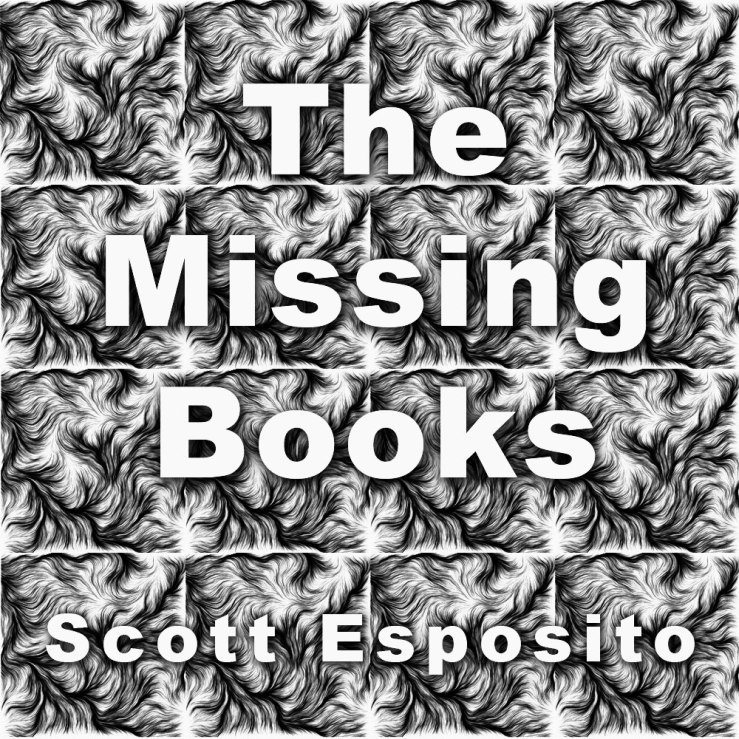
When I first heard about the concept for Scott Esposito’s new book The Missing Books, I thought, Damn. I wish I had thought of that. Then I read it and thought, Damn, I wish I had written that.
The Missing Books is an ongoing e-book project, “a curated directory of books that do not exist, but should.” The first version features missing books from “Cormac McCarthy, the Oulipo, Margaret Atwood, Stephen King, JM Coetzee, Roberto Bolaño, Vladimir Nabokov, Mario Bellatín, Jose Saramago, Philip K. Dick, Christian Bök, Kenneth Goldsmith, Gerald Murnane, Jorge Luis Borges, László Krasznahorkai, Edouard Levé,” and many others. It’s a joy for bibliophiles.
Esposito is the co-author of The End of Oulipo? (with Lauren Elkin) and the author of The Surrender. His book The Doubles is forthcoming in 2017. He’s a frequent contributor to the Times Literary Supplement and the San Francisco Chronicle. His blog is Conversational Reading. He was kind enough to talk with me about The Missing Books over a series of emails.
Biblioklept: When and how did the idea for The Missing Books come to you?
Scott Esposito: The concept of The Missing Books came together over the summer while I was trying to figure out a good concept for an ebook to release to my core fans.
Let me take a small step back to explain: I’m a big fan of hip hop music, and one of the things I’ve really taken note of about that scene is how rappers use mixtapes to stay relevant between projects, increase their fan base, try out new concepts, etc, etc. I think rappers are geniuses at marketing their concepts and getting attention for them in the world—they’re some of the best in terms of speaking in ways that the internet can understand—and mixtapes are a true innovation in this regard. I’ve long admired this. So I had the idea that I could try to create something like a mixtape in the literary world.Last fall I tried it out by releasing an ebook project titled The Latin American Mixtape, which was well-received. Like any good mixtape, it had some old content that was repurposed for the project, plus some things that were completely new and strictly Mixtape-only.
With the success of The Latin American Mixtape, I decided to do another one this year, so I began to try out concepts that might work for such a venture. Ebook-native projects are up against some barriers that don’t pertain to print titles, so I knew that in order to make this work, it would have to be a fairly catchy idea that could translate into various sorts of memes. Eventually when I hit upon the idea of doing missing books, I had the feeling that this was definitely a concept that could work in that way.
Of course, this wasn’t just about outreach. Lost books, non-existent books, book criticism, biographies of fictitious entities—these are all very much my aesthetic. I like what Borges says, along the lines of preferring to write about a novel instead of writing the novel itself, that you can have all of the essential features there in a condensed form, and it’s even better because you can dispense with all that unnecessary stuff. I feel an affinity for that kind of commentary that stands in for a book, that can be a way of grasping the inherent mystery and excitement of a book at a glance. And this is what I’ve tried to offer in The Missing Books, little chunks of what these books might have been, since we can’t actually read them.
I’ve also long been fascinated by the Oulipo, whose whole idea of writing “potential books” is very much in league with the project. (I had formerly wanted to title The Missing Books something along the lines of Potential Books, but I had to discard that, as it was too close to sounding like the Oulipo.) And just in general, I love to find out about the curiosities of the world, the oddities, those things that were epic failures, that drove writers to the end of their career, that never quite got completed, or that are so bizarre that they can only exist inside of other books. Those things have always appealed to my imagination.
Lastly, making The Missing Books electronic-only allows me to easily integrate a feature I really wanted to have in there: revisions. One of the core ideas of The Missing Books is that it grows and updates as I find out more about this world of nonexistent titles, and as the books themselves change their lost status. While this could be done in print, it’s much more practical to do this electronically. Moreover, it allows The Missing Books itself to be a missing book: a book that is always getting a little bit closer to completion, but who says I’ll ever finish it?
Biblioklept: When I first heard of The Missing Books, I thought it might be a work of fiction, like Bolaño’s Nazi Literature in the Americas, or Borges’s work in general.
Scott Esposito
SE: It’s a little bit of both. That was one of the fun things with a project like this. It was really fun to research (it got a little addicting to try and find more and more “missing books”; it was a great way to relax after hours of writing), but then it also opened a lot of doors to invent or embellish within the boundaries of the project. In the end, I don’t think it kind of defies definition as either nonfiction or fiction. I think there’s a little of the spirit of Borges in there, where if you write it maybe one day it finds a way to become true, or maybe the fiction is just better than the truth.
First off, I should say that there’s a lot in The Missing Books that’s based on solid fact, like the book Truman Capote never finished writing, or Georges Perec’s long lost first novel, which was recently discovered, translated, and published in English. That’s all pretty firm nonfiction—these things really happened, you can look it up—although in some places, I tread into fiction. Like, for instance, where I imply that someone should complete Kenneth Goldsmith’s conceptual art project to print out the Internet. That’s insane! I don’t really think anyone’s going to do that, or necessarily should. So there I’m playing with the unreliability of the voice and hinting that people who read The Missing Books might not take everything in it completely truthfully.
Then there’s a gray zone, books that may exist at some point in the future, like Cormac McCarthy’s The Passenger. There’s a lot of hearsay and rumor involved in that section, and of course what we regard as “facts” about these titles will change as dictated by future events. So I’d say those titles are rooted in nonfiction, but aren’t exactly nonfiction, something more along the lines of “speculative nonfiction,” stuff that you wouldn’t necessarily commit to print (or even e-print) but that is appropriate to a work like this, where the understanding is that it’s a living, updating document that often thrives on speculation and half-truths.
Then there are the books that themselves come from works of fiction, which turn into an even grayer zone. These are in some weird kind of ontological status, but where they come from fiction, and where in the context of The Missing Books I treat them like fact, even though we both probably know that these aren’t actual books. Except, in some cases they are: like H.P. Lovecraft’s Necronomicon, a fairly minor invention of Lovecraft’s that developed a huge and devoted following after his death and which now has been written into existence (multiple times) by other people. Or even a book found in Philip K. Dick, which someone self-published on the Amazon Kindle. What are these things? Fact or fiction? Are these books theNecronomicon? Could such a thing even exist, aside from some unstable and uncommitted concept in the mind of Lovecraft fans?
For fun and to add to the poeticism of the project a bit, I admit to embellishing or adding a few twists of my own to certain of these book-from-books, although fairly minor things that might be hard to detect. And—and this is something that to my knowledge no one has picked up on yet—I have invented a few titles in The Missing Books. Maybe some day they’ll come into existence in one way or another.
Biblioklept: My experience in reading The Missing Books was very much that strange mix of recognition and then its immediate opposite—for example, nodding in recognition at the entry on PK Dick’s The Owl in Daylight, but also puzzling over the veracity of Thomas Bernhard’s Breathing.
You brought up “the books that themselves come from works of fiction.” This is a potentially enormous section (just check out Wikipedia’s list of fictional books). How did you go about deciding what to include (and what to leave out) in this section?
SE: Oh yeah, it’s a ridiculously large category. Just the books listed in Bolaño’s Nazi Literature in the Americas is enough to make up a document five times as long as The Missing Books. Then you could start to bring in all the fake books in authors like Eco, Lem, and popular authors like Stephen King, and it all gets excessive very quickly.
I started off with a simple rule: I was only going to consider things from the beginning of the 20th century forward. So that right there slices off quite a bit, but it still leaves a whole lot. So to pare it down even further, I chose to only list items that I felt had some kind of story to tell us. One easy rule to follow was: do I find this interesting? If I can’t become intrigued by the story behind a missing book, that’s a pretty good indication that no one else is going to either, and that it probably doesn’t have anything of interest to communicate to us.
With those rules in place, I began to get together a fairly substantial group of projects, and some general themes and arcs of the project began to naturally emerge. Once that started happening, I began to purposely look for missing books based on how well they played off of what was already there. Like, for instance, The True Son of Job by Harry Sibelius, which is found in Bolaño’s Nazi Literature—it’s quite reminiscent of The Grasshopper Lies Heavy by Hawthorne Abendsen, found in Philip K. Dick’s Man in the High Castle, and I know that Bolaño was a big Dick fan, so it seems possible that there was some influence there. At the very least the similarities are striking enough that it’s interesting to situate them close to one another. And then from there, it seemed worthwhile to include various works by Phoebus K. Dank, which begins to comment on how the idea of the “Philip K. Dick” author has grown into a trope of his own.
I was also always interested in books that seemed to push up against the boundaries of the categories. Like The Book of Disquiet by Fernando Pessoa, which I place under the heading of “lost books”—is it really lost, or did Pessoa complete it? Well obviously Pessoa never “finished” it in the sense that most books are finished, but then again, Pessoa’s life project arguably rebuts the whole notion of finished books as we tend to construe them. And also, The Book of Disquiet is arguably a journal of sorts, and are those ever completed? George Steiner also makes an interesting case when he argues for Disquiet as a complete work by telling us that “As Adorno famously said, the finished work is, in our times and climate of anguish, a lie.” So I was also always on the lookout for titles that seem to render these categories less stable, the better to contemplate what they actually mean and whether or not there really is such a thing as a “missing book.”
Biblioklept: On the other side (if there is an “other” side) are the books that we never finish reading (even if we read all the words on all the pages)…there are books I return to again and again and richer, deeper, changed since the last time I read them. Do you experience this? Are there “missing,” unfinished books that you have, as a reader, “finished,” yet return to anew?
SE: For sure, it would be a disappointing kind of literature that didn’t permit those sorts of repeats. What immediately comes to mind is the author Stephen Marche, who claims to have read Hamlet over a hundred times, or Gerald Murnane, who avowed in his writing of the early 2000s that he would spend what time remained to him as a reader contemplating a handful of the mot profound texts in his life.
Certainly there are lots of books of theory that I have only begun to understand, writers like Heidegger or Lacan or Deleuze and Guattari, who have tried pushing language to challenging places in order to say things that it cannot currently say. Or a writer like Adorno, who wrote in such a way as to frustrate simple meanings or conclusions. These are people whose ideas can easily be summed up but whose actual work must simply be experienced as such and wrestled with for a long period of time.
In terms of literature, I think of writers like Pynchon, who writes in such a dense and maximalist and frustrating way that his books require long engagement, or someone like Proust, who understood humanity so deeply and extensively that one continually gains new insight as one becomes more and more experienced as a human being. But then there is also something to be said for the minimalism of a Coetzee or a Bioy or a Kafka, whose constructs seem to me like some kind of a simple-but-intricate object that one keeps staring at, trying to understand how it is built and what it means.
I would also add the category of books that I refuse to return to, books whose first experience was so bewildering and mysterious—and also so poetically infused with my life circumstances at the time—that I am fearful of destroying the impression they have left in my mind.
Biblioklept: Do you have a timeline for how the different versions of The Missing Books will come out? Or are you working on the project more organically?
SE: I very much want it to grow organically. I don’t have timetables other than to keep each new version somewhat spaced out in order to give readers a chance to chew over each edition of The Missing Books before the next one comes out. Also, I want to give the titles themselves a little time to move around and change status, as well as for new titles to emerge through the news cycle, so making the updates too frequent would be counterproductive. And of course, there’s a fairly heavy research component to each update, as I don’t want to release a new version without making some substantial additions. I’m also toying around with adding a new title grouping for Version 2, but I’ll have to see about that—it might be a little early for that sort of thing.
Right now, I’ve been more or less eyeing a spring release date for the next version.
Biblioklept: Which of the titles in The Missing Books do you most want to read?
SE: Wow, this is one of the hardest questions anyone has ever asked me. There are so many titles in The Missing Books that would greatly alter my sense of literature, that could change my life, that would put entirely new angles on writers I love…I think were I to pick just one, I would select the universal dictionary of all known human languages. I love reference books; when I was a kid I would just read volumes of the encyclopedia like they were novels, and to this day I spend obscene amounts of time reading random entries on Wikipedia, or Stanford’s online Encyclopedia of Philosophy. Dictionaries are great too in this way, although they offer a very different reading experience from the encyclopedias. I think it would be too much to pass up, the opportunity to be able to pore over all of the weird words and parts of grammar and ideas and what have you that have been embodied in the languages that humans have created to express themselves in over the course of our few thousand years of being writing, speaking beings on this planet.
Biblioklept: Have you ever stolen a book?
SE: No, definitely not. I’m fortunate in that books are one of those minor luxuries that I’ve always had the means to support for myself, so I’ve never been anywhere near the position of needing to steal them. When I was young my parents would always buy me any books I needed, and now it’s not an onerous expense to purchase the books I read. There are review copies, of course, there’s no getting around the need for them, but I make it a priority to support presses with purchases in at least some cases where I’d probably be “entitled” to a review copy. Especially nowadays, when my colleagues include many people at independent presses and bookstores, I try to do what I can to support their work financially.
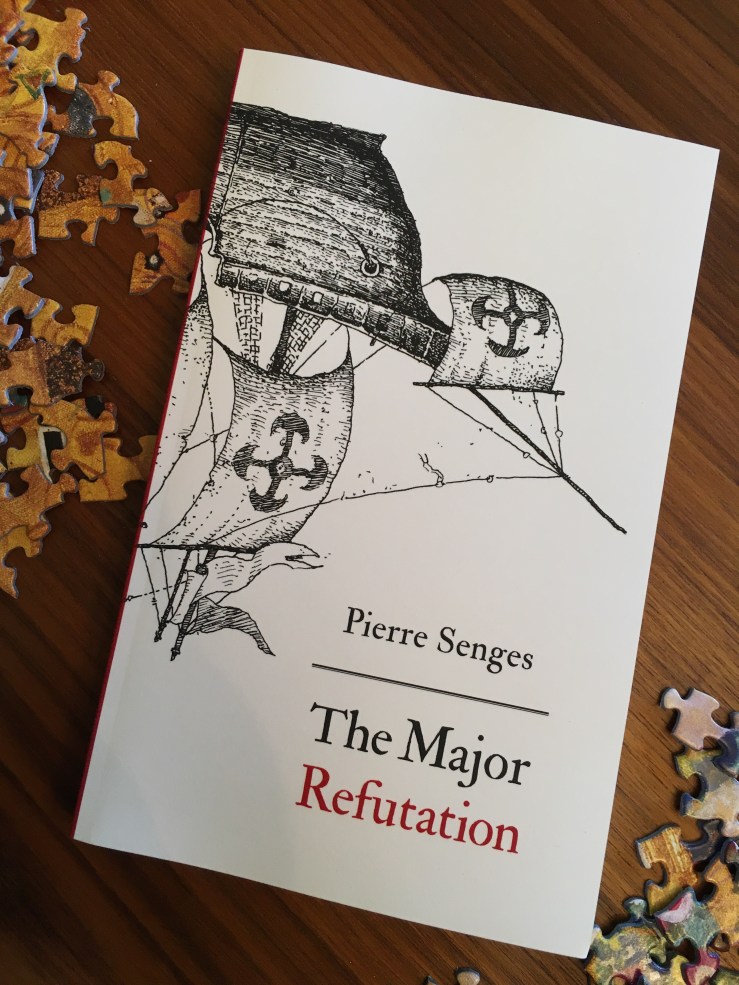
Pierre Senges’s novel The Major Refutation is new in English translation by Jacob Siefring from Contra Mundum Press. It looks pretty cool. Here’s their full “blurb”:
“Few or none of them heard of a book entitled Refutatio major, falsely attributed to Don Antonio de Guevara, in which the aforementioned Guevara avers that there does not exist a New World, but only chimaeras, malevolent rumors, and inventions spread by schemers. These same persons affirm that the reasons set forth by the aforementioned Guevara are highly disconcerting.” — Bonaventura d’Arezzo, Treatise on Shadows (1531)
“If this new world actually existed, if its measure could be had in hectares and in tons, or more maliciously in carats to reflect the value of its diamond mines, or in nautical miles because it is seemingly capable of devouring an entire hemisphere as a crab would, going from north to south and from east to west — if this were the case, then adventurers would have set foot there long ago, smugglers failing to find a better use for their discovery would have taken it as their refuge, and instead of traffickers by nature mute about their rallying points, we would have heard the cries of one thousand boasters, one thousand returning voyagers.” — The Major Refutation
Here is a book that unites all books: adventure book, historical panorama, satirical tale, philosophical summa, polemical mockery, geographical treatise, political analysis.
This edition of The Major Refutation is followed by a scholarly afterword discussing the conditions of the text’s genesis.
Pierre Senges is the author of fifteen books. His long novel, Fragments of Lichtenberg, is forthcoming in English from Dalkey Archive Press in 2017.
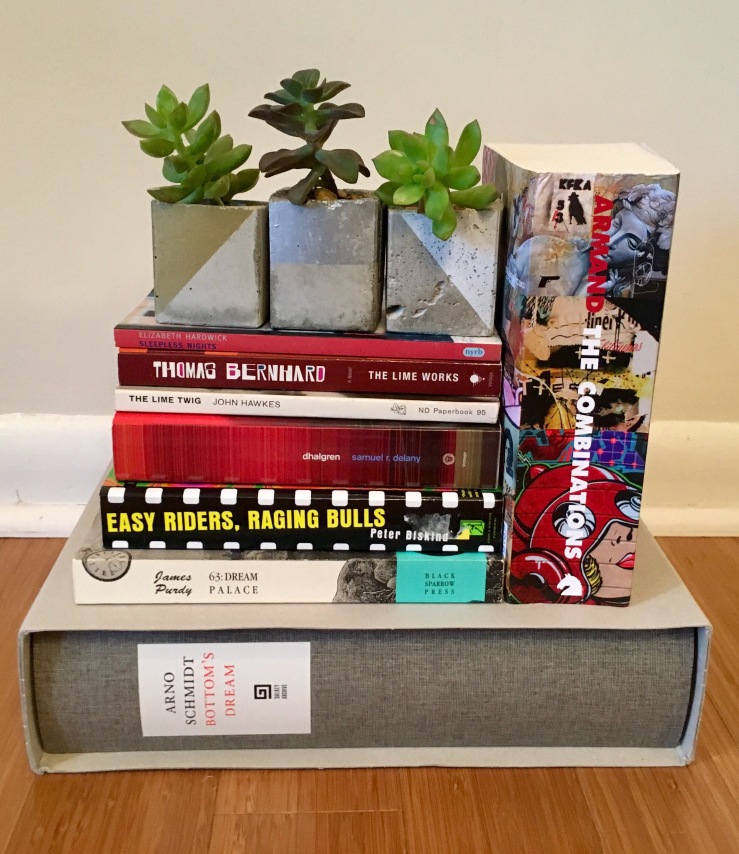
That big guy down on the bottom there, Arno Schmidt’s Bottom’s Dream (Eng. trans. by John Woods)?—I didn’t so much abandon it as I was told to put it away before we served Thanksgiving dinner at our house. There really isn’t a place for me to read the damn thing besides the dining room table. I’m sure I’ll dip into it more and I’m pretty sure I’ll never finish it in this lifetime. But I haven’t abandoned it forever. Earlier this year I wrote about the anxiety Bottom’s Dream produces in me.
Louis Armand’s The Combinations had the misfortune to show up as I was in the middle of a third reading of Gravity’s Rainbow. I read the first two chapters of Armand’s 888 page opus, then some other stuff showed up at the house in the mail, and then The Combinations got pushed to the back of the reading stack. The novel still interests me, but I’m not sure if I have the stamina right now.
Most of my reading experiences have as much to do with the time and the place that I read the book as they do with the form and content of the book. This year was not the time or the place for me to read Elizabeth Hardwick’s Sleepless Nights, a strange book I really, really, really wanted to love, but abandoned maybe 35 pages in.
I actually read a large portion of Peter Biskind’s history of the New Hollywood movement of the 1970s, Easy Riders, Raging Bulls. I broke down and finally bought it this summer after multiple viewings of William Friedkin’s film Sorcerer and two trips through Michael Cimino’s Heaven’s Gate. Biskind’s style is insufferable—gossipy and tawdry—and he swings wildly from venerating the book’s heroes (Bogdanovich, Coppola, Nichols, Scorsese, Malick, De Palma) to tearing them down (um, yeah, they were assholes). But there is an index which is of some use (although in reading Easy Riders, Raging Bulls you’re more likely to find out about a director’s drug problems or sex problems or money problems than you are to find out about, like, filmmaking). The worst part of Biskind’s book though is its repetitive insistence that not only did the Baby Boomers save Hollywood filmmaking, but also that the Boomers’ films were the last real outsider art ever to come out of Hollywood. Yeesh.
The first several stories in James Purdy’s short story collection 63: Dream Palace made me feel very, very sad, so I shelved it.
I read the first 258 pages of Samuel Delany’s novel Dhalgren. The book is 801 pages long and I couldn’t see it improving any. The book might be as great as everyone says it is, but it was mostly a boring mess (pages and pages of a character moving furniture around). On page 258, a character declares “There’s no reason why all art should appeal to all people.” I took that as a sign to ditch.
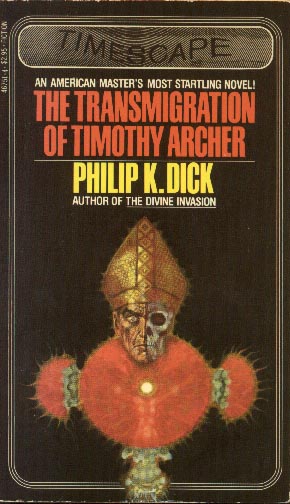
Suffering is the core of The Transmigration of Timothy Archer, a novel published just months after Philip Dick’s death in 1982. This is a book written by an author sure of his abilities, one who could confidently make this novel about big ideas turn on his characters’ struggles to control the trivialities of their day to day lives. While they attempt to make sense of the nature of God and unravel the mysteries of Christian teaching, they confront the questions that must have puzzled even Jesus’ own early advocates: is joy possible when good people are randomly confronted with confusion, pain, and death? Dick tries to locate a mushy but viable middle ground in this sad, nimble, and touching novel. Opening on the date of John Lennon’s assassination, Dick writes to commemorate the grinders, the survivors who manage to keep waking up, day after day, despite knowing that life often destroys those who dream too large.
The book is ostensibly based on the life and times of Timothy Archer, the iconoclastic American Episcopalian bishop of California in the 1960s whose unending search for truth led to his becoming friends with Robert Kennedy and Martin Luther King, Jr., advocating for the rights of women, homosexuals, and the transgendered, and time in the national spotlight. The quest for knowledge led him also to adopt a number of intellectual positions that conflicted directly with his duties as a representative of the Episcopalian church — for example, he was brought to trial for heresy for openly questioning the existence of hell and the Holy Ghost. The character of Bishop Archer was based almost entirely on the life of Bishop James Pike, Dick’s friend, who, like his fictional counterpart, died of exposure in Israel’s Dead Sea Desert searching for the sources of early Christian doctrine. Bishop Archer is the bright flame in this book, the Gatsby who pulls in everyone he encounters — not because he’s influential and wealthy, but because his personality is that rare combination of knowledge and empathy, a true man of God who recognizes no difference between the important writer and the indigent cancer patient. The actions of Bishop Archer form the arc of the book, and his deeds are a mirror to the other characters. They struggle to shape their own individual visions for their lives because they must work in the shadow cast by a giant they love.
Angel Archer, the bishop’s daughter-in-law and the narrator of the novel, becomes one of Dick’s most realistically drawn characters. She’s tough, articulate, and well-read. While those around her succumb to suicidal impulses and mental illness she survives by searching her mind for poems and plays she’s read and committed to memory. She finds uncomfortable parallels between books and her life. She values her education and her self-identification as a “Berkeley intellectual” but makes light of her own pretension, telling us that she’s read all the long books but remembers nothing about them. Do we become apathetic to our own experiences if we’ve read previously about something similar? Angel fears ennui but describes her own artistic awakening as a ridiculous mixture of pleasure and pain — an agonizing night spent reading Dante’s Commedia while drinking a bottle of bourbon to dampen the pain of an abscessed tooth. Aware that intellectual exercises and games both trivial and consequential have led to the deaths of her husband, the bishop, and his mistress, she still can’t escape her own self-made prison of words. “The problem with introspection,” she states while contemplating her own death, “is that it has no end.” When nobody is left, she soldiers on, dedicating herself, a fragile shell, to driving and working and walking and talking, a person “who records on a notepad the names of those who die.”
Like the narrator, this book reveals its depth rapidly, in spurts of astounding erudition and scholarship. Dick writes masterfully about nuances of early Judaic law and the formation of Christian thought, illustrates the petty jealousy, kindness, and warmth that seems inherent to certain friendships between between intelligent, rival women, and indicts our perception and treatment of mental illness. He quotes John Donne, Henry Vaughn, and discusses Virgil and Goethe without arrogance and without disturbing the flow of his story. Like his best works — A Scanner Darkly, The Man in the High Castle, and Do Androids Dream of Electric Sheep? — The Transmigration of Timothy Archer is fully drawn and completely real. His best works seem to be filled with screwed up people trying to get by in a world that has been arbitrarily fucked up by war or technology or drug abuse. This one is distinctly alive not because it’s set in an alternative world, but in sunny California that existed just three decades ago, close to the environs we currently abide. A beautiful, moving coda from a man whose vision and prose changed and continues to challenge American writers.
[Ed. note: Biblioklept originally published a version of this review in 2011. Today is PKD’s birthday].
Roberto Bolaño on Philip K. Dick. from New Directions’ collection of Bolaño’s newspaper columns, forewords, and other ephemera Between Parentheses)—
Dick was a schizophrenic. Dick was a paranoiac. Dick is one of the ten best American writers of the 20th century, which is saying a lot. Dick was a kind of Kafka steeped in LSD and rage. Dick talks to us, in The Man in the High Castle, in what would become his trademark way, about how mutable reality can be and therefore how mutable history can be. Dick is Thoreau plus the death of the American dream. Dick writes, at times, like a prisoner, because ethically and aesthetically he really is a prisoner. Dick is the one who, in Ubik, comes closest to capturing the human consciousness or fragments of consciousness in the context of their setting; the correspondence between what he tells and the structure of what’s told is more brilliant than similar experiments conducted by Pynchon or DeLillo.
I read a lot of great books this year but had a hard time writing full reviews for all of them. These are some of the ones I liked the most.
Woodcutters, Thomas Bernhard
I finished Woodcutters just the other night, reading most of it in three sittings. (Actually, I was lying down. And it was very late at night, each time. I couldn’t pick the book up during daylight hours). Anyway, I finished Bernhard’s novel just the other night, so maybe I’ll muster something on it, but for now: I think this may be my favorite Bernhard novel so far! I can only think of a handful of writers so masterful at mimicking the operations of consciousness, of replicating consciousness (and conscience) reflecting on consciousness. (I even had to stop and do a too-hasty read of Ibsen’s play The Wild Duck, a plot point of Woodcutters). What happens in Woodcutters? A man sits in a chair remembering things. It’s fucking amazing.
White Mythology is comprised of two novellas, Skinner Boxed and Love’s Alchemy. The first and longer novella, Skinner Boxed, takes place over a few days in the life of a psychiatrist; it’s a zany zagging yarn, crowded with MacGuffins and red herrings (a missing wife, a bastard son, a new anti-depressant drug, etc.). Oh, and it’s a Christmas story! Did I mention that? (Skinner Boxed takes its epigram from A Christmas Carol…and another from Gravity’s Rainbow). Love’s Alchemy is a kind of time-arrangement, or locale-arrangement—a story in pieces that the reader has to assemble. I enjoyed White Mythology (especially Skinner Boxed, which, typing this out, I realize I’d like to read again).
The Dick Gibson Show, Stanley Elkin
The Franchiser, Stanley Elkin
Somehow I’d made it to 2016 without reading Elkin. I read these two back-to-back. The best parts of The Dick Gibson show are as good as anything any of those other big postmodern dudes have written. (Okay. If not as good, nearly as good). I didn’t review The Dick Gibson Show because Elkin basically did it for me in his Paris Review interview.The Franchiser is a comic tragedy—or do I mean tragic comedy? It does all that inversion stuff: high-low/low-high. A novel of things and colors, both mythic and predictive, The Franchiser feels simultaneously ahead of its time and yet still very much bound to the 1970s, when it was first published.
Bear, Marian Engel
This slim novel is somehow simultaneously lucid and surreal, conventional and bizarre, romantic and ironic, heady and dry. And wet. A bibliographer travels to a remote island in Ontario to index an old library. I’m going to read this one again.
(Oh, the bibliographer has a sexual relationship with a bear. Like, a real bear. Not a metaphorical bear. A real one).
Collected Stories, William Faulkner
I didn’t read them all because I’m not a greedy pig. I read a lot of them though. Lord.
There Is a Tree More Ancient Than Eden, Leon Forrest
I will read Leon Forrest’s There Is a Tree More Ancient Than Eden again in the first quarter of 2017 and I will write a proper Thing on it. I read it in a two-day blur, drinking up the sentences greedily, perhaps not (no, strike that perhaps) comprehending the plot so much as sucking up a feeling, a place, a mood, a vibe. But there’s so much history reverberating behind the novel’s lens. Like I said (wrote): I need to read it again, which will kinda sorta be like reading it for the first time. Which is a thing one might say of any great novel.
I read this really early in the year and I only remember the impression of reading it—not the plot itself, but the language—I remember horror, cruelty, pain. And this is why I need to write about the books I read.
The Inheritors, William Golding
A colleague told me to read Golding’s account of telepathic Neanderthals and their eventual encounter with predatory Homo sapiens. I’ll admit that I’d unfairly written off Golding as YA stuff, but the evocation of a prelingual (and postlingual) consciousness is fascinating here. It’s also a ripping quest narrative starring the Holy Fool Lok, who laughs in terror and joy. What stands out most in my memory, beyond the premise, is Golding’s concrete prose. I’m glad my colleague told me to read The Inheritors.
I read Herrera’s The Transmigration of Bodies in a blurry weekend (sensing a pattern here) and enjoyed it very much: Grimy neon noir poured into mythological contours. Lovely.
The Leopard, Giuseppe di Lampedusa
This was the best novel I read in 2016 that I’d never read before. So good that I reread it immediately (the only two books I can recall doing that with in recent memory areBlood Meridian and Gravity’s Rainbow). It was even better the second time. The Leopard is the story of Prince Fabrizio of Sicily who witnesses — and takes part in — the end of the old order era during the Italian reunification. Fiery and lascivious but also intellectual and stoic, Fabrizio the Leopard is the most engrossing character I read this year. Di Lampedusa’s novel takes us through his mind, through his age—places he himself isn’t fully cognizant of at times. I can’t recommend this novel enough: History, religion, death, sex. Sense and psyche, pleasure and loss, crammed with rich, dripping set pieces: dances and dinners and games of pleasure (light sadomasochism!) in summer estates. But its plots and poisons and pieces are not the main reason for The Leopard—read it for the language, the sentences, the sumptuous words. Its final devastating images are still soaked and sunken into my addled brains.
I wedged these poems into the end of my third proper trip through Gravity’s Rainbow; I was also dipping into Rilke’s Duino Elegies and the Rider-Waite tarot. It’s all crammed together in a surreal web in my memory: shimmering horror, broken badlands, entropy and degradation—but life.
Cow Country (not pictured above because I listened to the audiobook) is a bizarre, disjointed satire of community colleges in particular and educational administration in general. (And: a satire on our slavish sensibilities of time ). It’s also a wonderful send-up of dialectical methodology—or rather the dialectical impulse to, like, resolve things. And by things, I mean Jones Pearson (or is it AJP? Or Adrian Ruggles Pearson? Or A.J. Perry? Or—nevermind)—Our Author (whoever) breaks down the way that all of our breakdowns breakdown under any real scrutiny.
Hilda and the Stone Forest, Luke Pearson
I read all of the Hilda books this year with my kids. And I read them by myself. And my kids read them by themselves. More than once. Hilda and the Stone Forest is the best one yet—richer, denser, funnier, and more devastating than anything Pearson’s done yet. The Stone Forest is stuffed with miniature epics and minor gags, and the central story of Hilda and her mother in the titular stone forest is somehow both bleak and heartwarming. Great stuff.
Strange, violent, funny, and ultimately devastating, this Marketa Lazarova is a medieval tale of family loyalty, kidnapping, and love. Nothing I can do here would be a substitute for Vančura’s vivid, surreal voice—a voice that guides the story cynically, ironically, but also energetically, buoyantly. One of the best things I read all year.
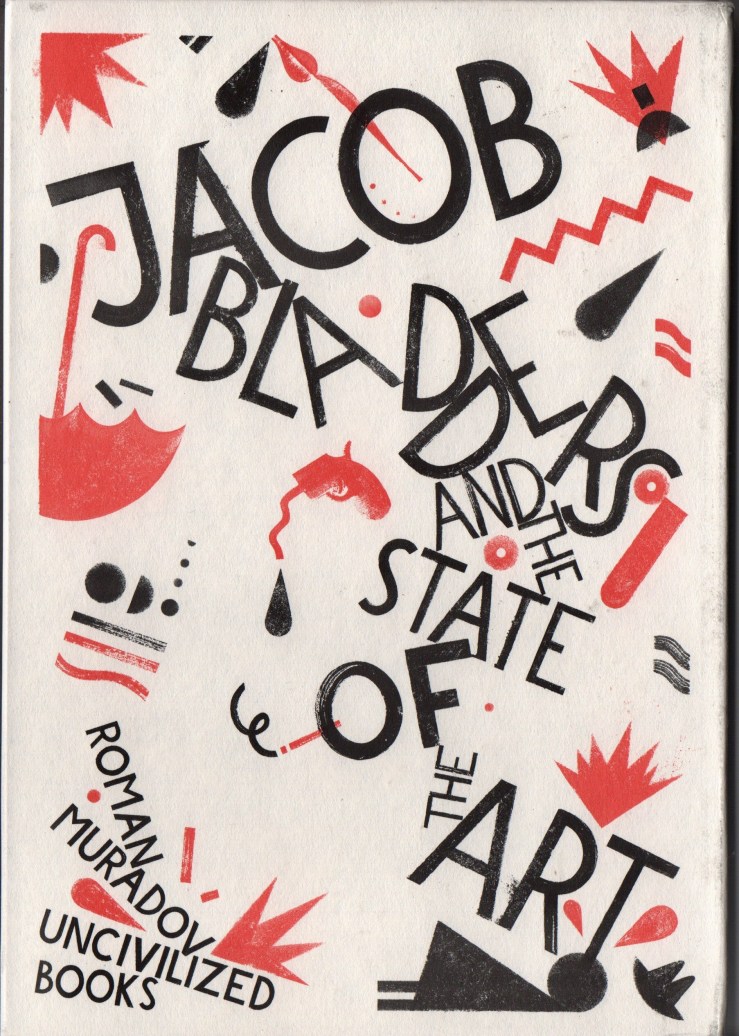
Roman Muradov’s newest graphic novella, Jacob Bladders and the State of the Art (Uncivilized Books, 2016), is the brief, shadowy, surreal tale of an illustrator who’s robbed of his artwork by a rival.
There’s more of course.
In a sense though, the plot is best summarized in the first line of Jacob Bladders:
Okay.
Maybe that’s too oblique for a summary (or not really a summary at all, if we’re being honest).
But it’s a fucking excellent opening line, right?
Like I said, “There’s more” and if the more—the plot—doesn’t necessarily cohere for you on a first or second reading, don’t worry. You do have worth, reader, and Muradov’s book believes that you’re equipped to tangle with some murky noir and smudgy edges. (It also trusts your sense of irony).
The opening line is part of a bold, newspaperish-looking introduction that pairs with a map. This map offers a concretish anchor to the seemingly-abstractish events of Jacob Bladders.
The map isn’t just a plot anchor though, but also a symbolic anchor, visually echoing William Blake’s Jacob’s Ladder (1805). Blake’s illustration of the story from Genesis 28:10-19 is directly referenced in the “Notes” that append the text of Jacob Bladders. There’s also a (meta)fictional “About the Author” section after the end notes (“Muradov died in October of 1949”), as well as twin character webs printed on the endpapers.
Along with the intro and map, these sections offer a set of metatextual reading rules for Jacob Bladders. The map helps anchor the murky timeline; the character webs help anchor the relationships between Muradov’s figures (lots of doppelgänger here, folks); the end notes help anchor Muradov’s satire.
These framing anchors are ironic though—when Muradov tips his hand, we sense that the reveal is actually another distraction, another displacement, another metaphor. (Sample end note: “METAPHOR: A now defunct rhetorical device relying on substitution of a real-life entity with any animal”).
It’s tempting to read perhaps too much into Jacob Bladder’s metatextual self-reflexivity. Here is writing about writing, art about art: an illustrated story about illustrating stories. And of course it’s impossible not to ferret out pseudoautobiographical morsels from the novella. Roman Muradov is, after all, a working illustrator, beholden to publishers, editors, art-directors, and deadlines. (Again from the end notes: “DEADLINE: A fictional date given to an illustrator to encourage timely delivery of the assignment. Usually set 1-2 days before the real (also known as ‘hard’) deadline”). If you’ve read The New Yorker or The New York Times lately, you’ve likely seen Muradov’s illustrations.
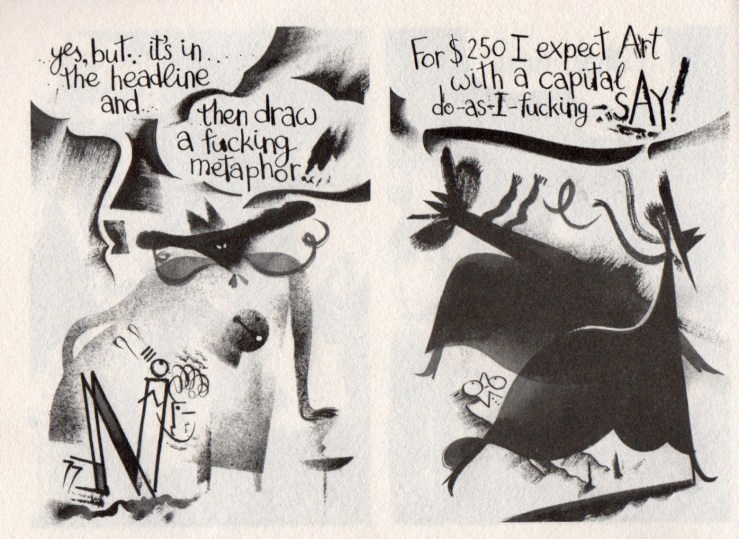
So what to make of the section of Jacob Bladders above? Here, a nefarious publisher commands a hapless illustrator to illustrate a “career ladders” story without using an illustration of a career ladder (From the end notes: “CAREER LADDER: An illustration of a steep ladder, scaled by an accountant in pursuit of a promotion or a raise. The Society of Illustrators currently houses America’s largest collection of career ladders, including works by M.C. Escher, Balthus, and Marcel Duchamp”).
Draw a fucking metaphor indeed. (I love how the illustrator turns into a Cubist cricket here).
Again, it’s hard not to find semi-autobiographical elements in Jacob Bladders’s publishing satire. Muradov couches these elements in surreal transpositions. The first two panels of the story announce the setting: New York / 1947—but just a few panels later, the novella pulls this move:
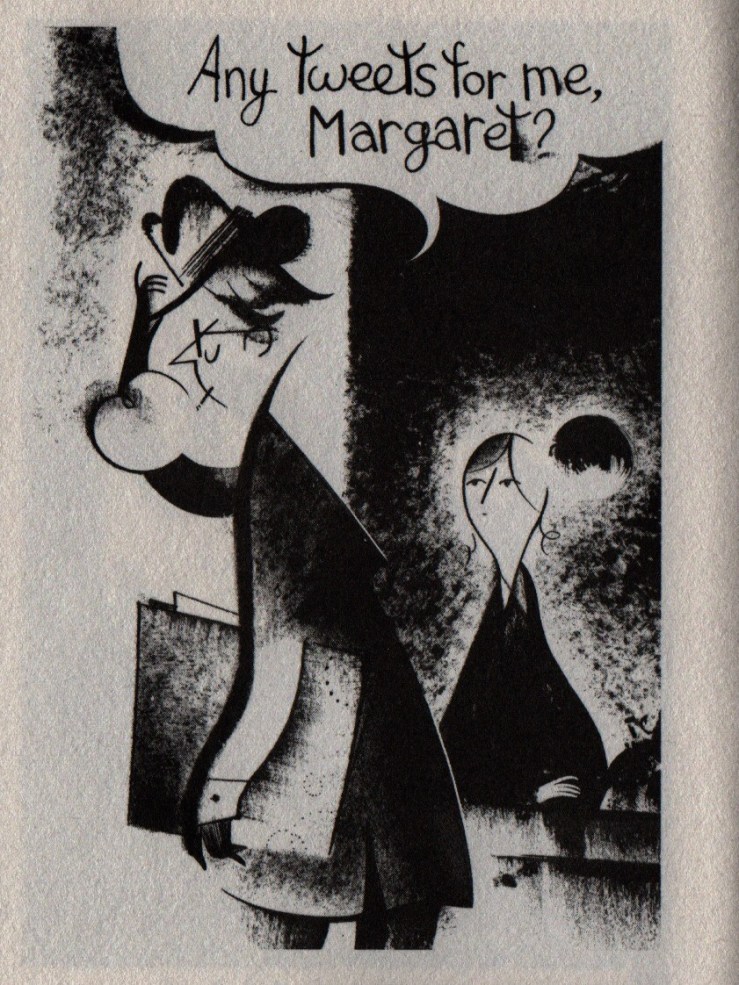
Here’s our illustrator-hero Jacob Bladders asking his secretary (secretary!) for “any tweets”; he seems disappointed to have gotten “just a retweet.” In Muradov’s transposition, Twitter becomes “Tweeter,” a “city-wide messaging system, established in 1867” and favored by writers like E.B. White and Dorothy Parker.
I do. Which makes it, again, kinda hard for me not to root out those autobiographical touches. (He sometimes tweets on the illustration biz, y’see).
But I’m dwelling too much on these biographical elements I fear, simply because, it’s much, much harder to write compellingly about the art of it all, of how Muradov communicates his metatextual pseudoautobiographical story. (Did I get enough postmoderny adjectives in there? Did I mention that I think this novella exemplary of post-postmodernism? No? These descriptions don’t matter. Look, the book is fucking good).
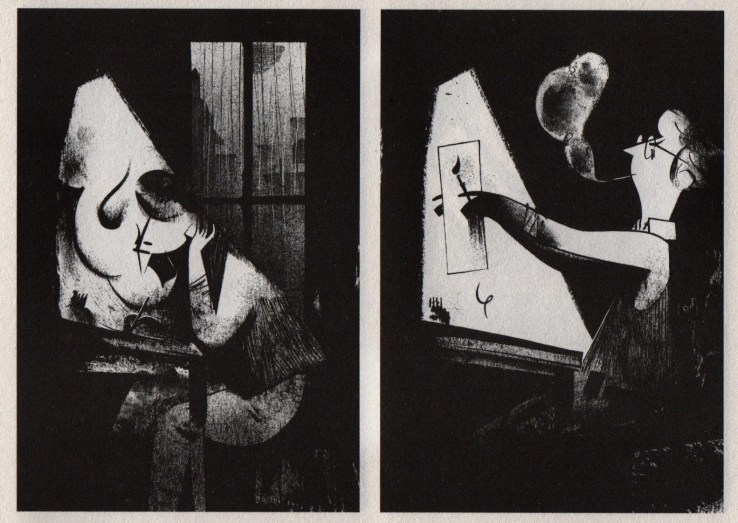
Muradov’s art is better appreciated by, like, looking at it instead of trying to describe it (this is an obvious thing to write). Look at this spread (click on it for biggeration):
The contours, the edges, the borders. The blacks, the whites, the notes in between. This eight-panel sequence gives us insides and outsides, borders and content, expression and impression. Watching, paranoia, a framed consciousness.
And yet our reading rules—again, from the end notes: “SPOTILLO: Spot illustration. Most commonly a borderless ink drawing set against white background”; followed by “CONSTRAINT: An arbitrary restriction imposed on a work of art in order to give it an illusion of depth”.
Arbitrary? Maybe. No. Who cares? Look at the command of form and content here, the mix and contrast and contradistinctions of styles: Cubism, expressionism, impressionism, abstraction: Klee, Miro, Balthus, Schjerfbeck: Robert Wiene and Fritz Lang. Etc. (Chiaroscuro is a word I should use somewhere in this review).
But also cartooning, also comix here—Muradov’s jutting anarchic tangles, often recoiling from the panel proper, recall George Herriman’s seminal anarcho-strip Krazy Kat. (Whether or not Muradov intends such allusions is not the point at all. Rather, what we see here is a continuity of the form’s best energies). Like Herriman’s strip, Muradov’s tale moves under the power of its own dream logic (more of a glide here than Herriman’s manic skipping).
That dream logic follows the lead (lede?!) of that famous Romantic printmaker and illustrator William Blake, whose name is the last “spoken” word of the narrative (although not the last line in this illustrated text). Blake is the illustrator of visions and dreams—visions of Jacob’s Ladder, Jacob Bladders. Jacob Bladders and the State of the Art culminates in the Romantic/ironic apotheosis of its hero. The final panels are simultaneously bleak and rich, sad and funny, expressive and impressive. Muradov ironizes the creative process, but he also points to it as an imaginative renewal. “Imagination is the real,” William Blake advised us, and Muradov, whether he’d admit it or not, makes imagination real here. Highly recommended.
Sitting in the wing chair, I reflected that I had pretended to be shocked by Joana’s suicide and pretended to accept the Auersbergers’ invitation to their artistic dinner. When I accepted it I was only pretending, I now thought, yet in spite of this I had acted upon it. The idea is nothing short of grotesque, I thought, yet at the same time it amused me. Actually I’ve always dissembled with the Auersbergers, I thought, sitting in the wing chair, and here I am again, sitting in their wing chair and dissembling once more: I’m not really here in their apartment in the Gentzgasse, I’m only pretending to be in the Gentzgasse, only pretending to be in their apartment, I said to myself. I’ve always pretended to them about everything—I’ve pretended to everybody about everything. My whole life has been a pretense, I told myself in the wing chair—the life I live isn’t real, it’s a simulated life, a simulated existence. My whole life, my whole existence has always been simulated—my life has always been pretense, never reality, I told myself. And I pursued this idea to the point at which I finally believed it. I drew a deep breath and said to myself, in such a way that the people in the music room were bound to hear it: You’ve always lived a life of pretense, not a real life—a simulated existence, not a genuine existence. Everything about you, everything you are, has always been pretense, never genuine, never real. But I must put an end to this fantasizing lest I go mad, I thought, sitting in the wing chair, and so I took a large gulp of champagne.
From Thomas, Bernhard’s novel 1984 Woodcutters; English translation by David McLinktock.
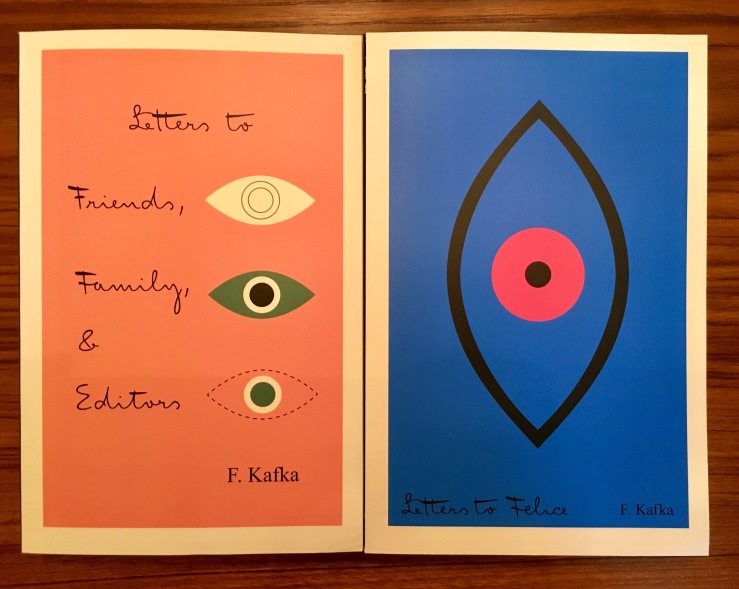
Collected after his death by his friend and literary executor Max Brod, here are more than two decades’ worth of Franz Kafka’s letters to the men and women with whom he maintained his closest personal relationships, from his years as a student in Prague in the early 1900s to his final months in the sanatorium near Vienna where he died in 1924.
Sometimes surprisingly humorous, sometimes wrenchingly sad, they include charming notes to school friends; fascinating accounts to Brod about his work in its various stages of publication; correspondence with his publisher, Kurt Wolff, about manuscripts in progress, suggested book titles, type design, and late royalty statements; revealing exchanges with other young writers of the day, including Martin Buber and Felix Weltsch, on life, literature, and girls; and heartbreaking reports to his parents, sisters, and friends on the declining state of his health in the last months of his life.
And Felice:
Franz Kafka met Felice Bauer in August 1912, at the home of his friend Max Brod. Energetic, down-to-earth, and life-affirming, the twenty-five-year-old secretary was everything Kafka was not, and he was instantly smitten. Because he was living in Prague and she in Berlin, his courtship was largely an epistolary one—passionate, self-deprecating, and anxious letters sent almost daily, sometimes even two or three times a day. But soon after their engagement was announced in 1914, Kafka began to worry that marriage would interfere with his writing and his need for solitude.
The more than five hundred letters Kafka wrote to Felice—through their breakup, a second engagement in 1917, and their final parting in the fall of that year, when Kafka began to feel the effects of the tuberculosis that would eventually claim his life—reveal the full measure of his inner turmoil as he tried, in vain, to balance his desire for human connection with what he felt were the solitary demands of his craft.
The fact that Germany had produced a Beethoven, Russia a Tolstoy, Italy a Verdi, or Spain a Cervantes, was wholly irrelevant to the fact that all these countries experienced brutal dictatorships in the twentieth century. High cultural achievements across the centuries did not render a descent into political barbarism more inexplicable than their absence would have done; culture and politics simply do not impinge on each other in so simple and direct a manner. If the experience of the Third Reich teaches us anything, it is that a love of great music, great art and great literature does not provide people with any kind of moral or political immunization against violence, atrocity, or subservience to dictatorship.
From: Richard J. Evans’s The Coming of the Third Reich (2003).
Today is Black Friday in America. I don’t think it’s necessary to remark at length on the bizarre disjunction between this exercise in consumerism-as-culture and the intended spirit of the Thanksgiving holiday that precedes it. Indeed, I think that the cognitive dissonance that underwrites Black Friday—the compulsion to suffer (and cause suffering), both physically and mentally, to “save” money on “consumer goods” (sorry for all the scare quotes, but these terms are euphemisms and must be placed under suspicion)—I think that this cognitive dissonance is nakedly apparent to all who choose to (or are forced to) actively engage in Black Friday. The name itself is dark, ominous, wonderfully satanic.
Rereading “The Subliminal Man,” I was struck by how presciently J.G. Ballard anticipated not only the contours of consumerist culture—urban sprawl, a debt-based economy, the mechanization of leisure, the illusion of freedom of choice—but also how closely he intuited the human, psychological responses to the consumerist society he saw on the horizon. Half a century after its publication, “The Subliminal Man” seems more relevant than ever.
The premise of the tale is fairly straightforward and fits neatly with the schema of many other early Ballard stories: Franklin, an overworked doctor, is approached by Hathaway, a “crazy beatnik,” who refuses to take part in the non-stop consumerism of contemporary society. Hathaway can “see” the subliminal messages sent through advertising. He asks for Franklin’s help in stopping the spread of these messages. Hathaway reasons that the messages are intended to enforce consumerist society:
Ultimately we’ll all be working and spending twenty–four hours a day, seven days a week. No one will dare refuse. Think what a slump would mean – millions of lay–offs, people with time on their hands and nothing to spend it on. Real leisure, not just time spent buying things . . .
The fear of a slump. You know the new economic dogmas. Unless output rises by a steady inflationary five per cent the economy is stagnating. Ten years ago increased efficiency alone would raise output, but the advantages there are minimal now and only one thing is left. More work. Subliminal advertising will provide the spur.
Franklin is unconvinced, even though he is already working Saturdays and Sunday mornings to payoff TVs, radios, and other electronic goods that he and his wife replace every few months. Soon, however, he realizes that something is wrong:
He began his inventory after hearing the newscast, and discovered that in the previous fortnight he and Judith had traded in their Car (previous model 2 months old) 2 TV sets (4 months) Power mower (7 months) Electric cooker (5 months) Hair dryer (4 months) Refrigerator (3 months) 2 radios (7 months) Record player (5 months) Cocktail bar (8 months)
Franklin finally sees the truth, but only after Hathaway takes to blowing up signs’ switch boxes (the word “terrorism” is of course not used in the text, although it surely would be today):
Then the flicker of lights cleared and steadied, blazing out continuously, and together the crowd looked up at the decks of brilliant letters. The phrases, and every combination of them possible, were entirely familiar, and Franklin knew that he had been reading them for weeks as he passed up and down the expressway.
BUY NOW BUY NOW BUY NOW BUY NOW BUY NEW CAR NOW NEW CAR NOW NEW CAR NOW
YES YES YES YES YES YES YES YES YES YES
Like many Ballard stories, “The Subliminal Man” ends on a pessimistic note, with Franklin choosing to ignore his brief enlightenment and give in. Ballard drives his criticism home in the final image of the story, with Franklin and his wife heading out to shop:
They walked out into the trim drive, the shadows of the signs swinging across the quiet neighbourhood as the day progressed, sweeping over the heads of the people on their way to the supermarket like the blades of enormous scythes.
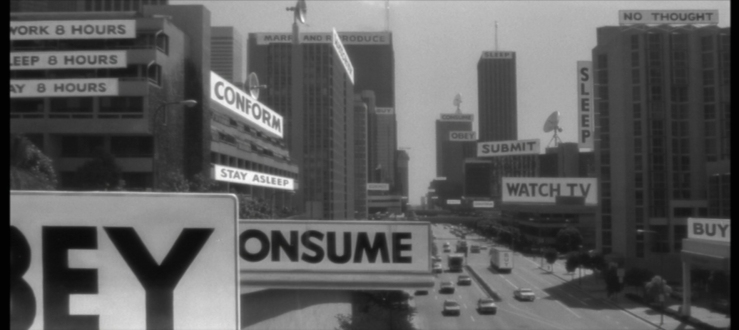
“The Subliminal Man” offers a critique of consumerism that John Carpenter would make with more humor, violence, and force in his 1988 film They Live. In Carpenter’s film, the hero John Nada (played by Roddy Piper) finds a pair of sunglasses that allow him to see through the ads, billboards, and other commercials he’s exposed. What’s underneath? Naked consumerism:
The images here recall the opening lines of “The Subliminal Man”: ‘The signs, Doctor! Have you seen the signs?’ Like Ballard’s story, Carpenter’s film is about waking up, to seeing the controlling messages under the surface.
In his film The Pervert’s Guide to Ideology, Slavoj Žižek offers a compelling critique of just how painfulit is to wake up to these messages:
It’s worth pointing out that Carpenter offers a far more optimistic vision than Ballard. Ballard’s hero gives in—goes back to sleep, shuts his eyes. Carpenter’s hero Nada resists the subliminal messages—he actually takes up arms against them. This active resistance is possible because Carpenter allows his narrative an existential escape hatch: In They Live, there are real, genuine bad guys, body-snatching ugly-assed aliens—others that have imposed consumerism on humanity to enslave them. That’s the big trick to They Live: It’s not us, it’s them.
Ballard understands that there is no them; indeed, even as the story skirts around the idea of a conspiracy to dupe consumers into cycles of nonstop buying, working, and disposing, it never pins that conspiracy on any individual or group. There’s no attack on corporations or government—there’s not even a nebulous “them” or “they” that appears to have controlling agency in “The Subliminal Man.” Rather, Ballard’s story posits ideology as the controlling force, with the only escape a kind of forced suicide.
I don’t think that those who engage in consumerism-as-sport, in shopping-as-a-feeling are as blind as Ballard or Carpenter represent. I think they are aware. Hell, they enjoy it. What I think Ballard and Carpenter (and others, of course) really point to is the deep dissatisfaction that many of us feel with this dominant mode of life. For Ballard, we have resistance in the form of the beatnik Hathaway, an artist, a creator, a person who can perceive what real leisure would mean. For Carpenter, Nada is the resister—an outsider, a loner, a weirdo too. It’s somehow far more satisfying to believe that those who engage in spectacle consumerism are brainwashed by aliens than it is to have to come to terms with the notion that these people are acting through their own agency, of their own will and volition. Happy shopping everyone!
Ed. note: Biblioklept published a version of this post a few years ago. It is offered again now in the spirit of Thanksgiving leftovers.
I 1 think that there is a terrible possibility now, in the World 2. We may not brush it away, we must look at it. It is possible that They 3 will not die. That it is now within the state of Their art to go on forever 4—though we, of course, will keep dying as we always have. Death 5 has been the source of Their power. It was easy enough for us to see that. If we are here once, only once 6, then clearly we are here to take what we can while we may 7. If They have taken much more, and taken not only from Earth but also from us 8 —well, why begrudge Them, when they’re just as doomed to die as we are? All in the same boat, all under the same shadow…yes…yes. But is that really true? Or is it the best, and the most carefully propagated, of all Their lies, known and unknown? 9
1 The speaker here is Father Rapier, a very minor character, one of Pynchon’s heroes of the Counterforce, the Preterite who rally (if that is the right verb, which it isn’t) around the unraveling spirit of Slothrop against the Elect.
Father Rapier is “a Jesuit . . . here to preach, like his colleague Teilhard de Chardin, against return. Here to say that critical mass cannot be ignored. Once the technical means of control have reached a certain size, a certain degree of being connected one to another, the chances for freedom are over for good.”
Rapier preaches his “Critical Mass” in a cottage in the bizarro-Limbo headquarters of the Counterforce; his shack is appropriately beshingled with the sign “DEVIL’S ADVOCATE.”
Pynchon’s Counterforce points to a coming community. Indeed, Gravity’s Rainbow might be seen as an imaginative study of postwar communities, of new forms of social organization (social organizations tellingly organized against the They): The Counterforce of disaffected rebels; the Sudwest Hereros assembling their 00001 rocket; the Argentine anarchists; the homosexuals liberated from Dora; the Anubis orgiasts (orgiers? orgy-goers? What’s the word for orgy participants?)—etc. Each of these coming communities attempts to synthesize the detritus of the War into Something New. And speaking of synthesis—
Rapier’s “colleague [Pierre] Teilhard de Chardin” (1881-1955) tried to synthesize science and spirituality in what he called an Omega Point, a spiritual/physical singularity, a condensation of spirit and mass into a “supreme consciousness”: Christ: God: Logos. Or, in Pynchon’s Rapier wit: Critical Mass.
Rapier rails against systems of control: The Elect will not fight the coming postWar Preterite communities directly, but rather enslave them via byzantine bureaucracies.
2
The World tarot card by Pamela Colman Smith, 1909
Cf. A.E. Waite’s The Pictorial Key to Tarot (1910), one of Pynchon’s sources for Gravity’s Rainbow. Some of the language here (which I’ve taken the liberty of highlighting) echoes Rapier’s Critical Mass/de Chardin’s Omega Point:
It represents also the perfection and end of the Cosmos, the secret which is within it, the rapture of the universe when it understands itself in God. It is further the state of the soul in the consciousness of Divine Vision, reflected from the self-knowing spirit. But these meanings are without prejudice to that which I have said concerning it on the material side. It has more than one message on the macrocosmic side and is, for example, the state of the restored world when the law of manifestation shall have been carried to the highest degree of natural perfection. But it is perhaps more especially a story of the past, referring to that day when all was declared to be good, when the morning stars sang together and all the Sons of God shouted for joy.
The World is what Pynchon and Gravity’s Rainbow are most interested in—both its past and its coming communities.
Significantly, The World is the final card in Captain Dominus Blicero Weissmann’s tarot (see page 746):
Weissmann’s tarot
In his thorough physical description of the World tarot card, A.E. Waite describes the central figure surrounded by “an elliptic garland…a chain of flowers intended to symbolize all sensible things.” I cannot help but see in the card an impossible ouroboros; an ouroboros with four heads corresponding to the “four living creatures of the Apocalypse and Ezekiel’s vision, attributed to the evangelists in Christian symbolism” which we find in the card’s corners. The ouroboros is minor trope in Gravity’s Rainbow.
3 The Elect. The baddies.
4 Rapier will, a few lines later, compare Them to vampires.
Here—and elsewhere in Pynchon (most clearly and perhaps most cogently in Against the Day)—the Elect—the They—manipulate and monopolize the earth’s resources in order to prolong their dominance. Those resources include humans: The Preterite: the low: the feebs.
5
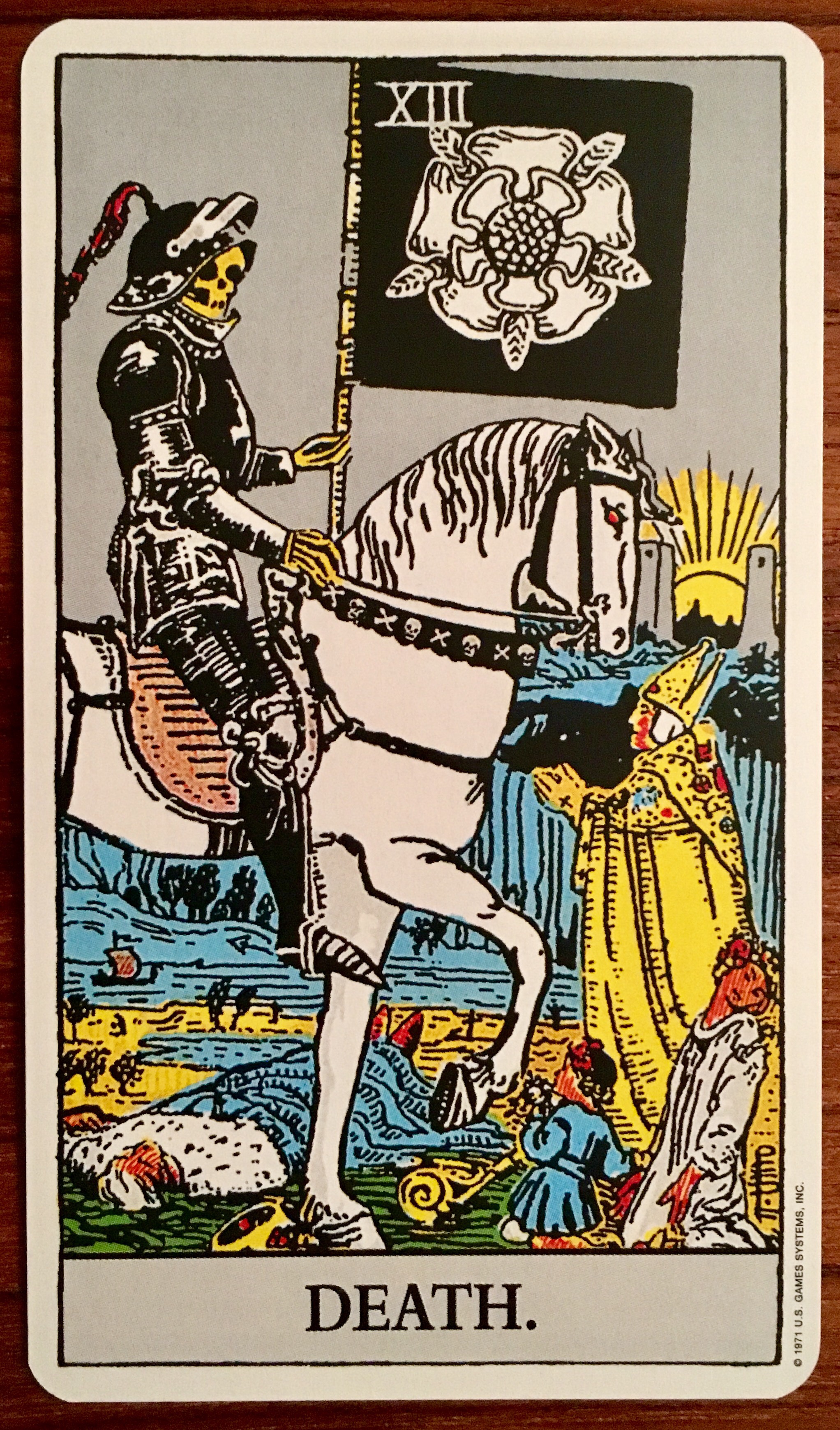
Death tarot card by Pamela Colman Smith, 1909
A.E. Waite again; again, I’ve highlighted in boldface phrases that suit my own purposes for this riff:
The veil or mask of life is perpetuated in change, transformation and passage from lower to higher, and this is more fitly represented in the rectified Tarot by one of the apocalyptic visions than by the crude notion of the reaping skeleton. Behind it lies the whole world of ascent in the spirit. The mysterious horseman moves slowly, bearing a black banner emblazoned with the Mystic Rose, which signifies life. Between two pillars on the verge of the horizon there shines the sun of immortality. The horseman carries no visible weapon, but king and child and maiden fall before him, while a prelate with clasped hands awaits his end. … The natural transit of man to the next stage of his being either is or may be one form of his progress, but the exotic and almost unknown entrance, while still in this life, into the state of mystical death is a change in the form of consciousness and the passage into a state to which ordinary death is neither the path nor gate. The existing occult explanations of the 13th card are, on the whole, better than usual, rebirth, creation, destination, renewal, and the rest.
6 If we are here once (only once), then eternal recurrence is a nonstarter.
The phrase clearly echoes lines from one of Pynchon’s major GR sources, Rainer Maria Rilke’s mystical Duino Elegies (1923). From “Ninth Elegy”:
Everyone once, once only. Just once and no more.
And we also once, Never again. But this having been once, although only once, to have been of the earth,
seems irrevocable.
Once, only once, and once for all,
his precious life he gave;
before the cross in faith we fall,
and own it strong to save.
7 In “To the Virgins, to Make Much of Time, Robert Herrick (1591-1674) advised
Gather ye rosebuds while ye may,
Old Time is still a-flying;
And this same flower that smiles today
Tomorrow will be dying.
Seems like a Preterite Sermon.
8 Cf. note 4. Throughout GR, the exploitation of the earth’s natural resources is a persistent if minor theme. Gravity’s Rainbow’s ecological critiques are overlooked perhaps because it’s a given in Pynchon’s critique that They would use ecological capital and human capital without regard. Consider the Slothrop family, which made its non-fortune by milling trees into “Money, shit, and The Word” — papers the real value of which Pynchon invites us to interrogate.
9 Pynchon’s mouthpieces often hedge their bets in eithers and ors, zeroes and ones. We systems and They systems, in the parlance of the Counterforce. Are we all under the same shadow (of Death? of the falling rocket?) Are we all in the same boat?—which is to say, are we all working together toward the same coming community—are we rowing in the same direction?











 Biblioklept