I was looking for something else today—a book that might have been one of Pynchon’s sources for the Kabbalah stuff in Gravity’s Rainbow—when I came across this Penguin edition, Witchcraft and Sorcery, 1970, ed. Max Marwick. (I found a Pynchonian connection—easy to do, I know—when I opened the book to an essay entitled “Witchcraft amongst the Germanic and Slavonic Peoples”).
The sky of U.S.A.’s desert was clotted with blue stars. Now it was deep at night. Only above the U.S.A. city was the sky blank of stars; its color was pearly and blank. Marathe shrugged. ‘Perhaps in you is the sense that citizens of Canada are not involved in the real root of the threat.’
Steeply shook the head in seeming annoyance. ‘What’s that supposed to mean?’ he said. The lurid wig of him slipped when he moved the head with any abrupt force.
The first way Marathe betrayed anything of emotion was to smooth rather too fussily at the blanket on his lap. ‘It is meaning that it will not of finality be Québecers making this kick to l’aine des Etats Unis. Look: the facts of the situation speak loudly. What is known. This is a U.S.A. production, this Entertainment cartridge. Made by an American man in the U.S.A. The appetite for the appeal of it: this also is U.S.A. The U.S.A. drive for spectation, which your culture teaches. This I was saying: this is why choosing is everything. When I say to you choose with great care in loving and you make ridicule it is why I look and say: can I believe this man is saying this thing of ridicule?’ Marathe leaned slightly forward on his stumps, leaving the machine pistol to use both his hands in saying. Steeply could tell this was important to Marathe; he really believed it.
Marathe made small emphatic circles and cuts in the air while he spoke: ‘These facts of situation, which speak so loudly of your Bureau’s fear of this samizdat: now is what has happened when a people choose nothing over themselves to love, each one. A U.S.A. that would die — and let its children die, each one — for the so-called perfect Entertainment, this film. Who would die for this chance to be fed this death of pleasure with spoons, in their warm homes, alone, unmoving: Hugh Steeply, in complete seriousness as a citizen of your neighbor I say to you: forget for a moment the Entertainment, and think instead about a U.S.A. where such a thing could be possible enough for your Office to fear: can such a U.S.A. hope to survive for a much longer time? To survive as a nation of peoples? To much less exercise dominion over other nations of other peoples? If these are other peoples who still know what it is to choose? who will die for something larger? who will sacrifice the warm home, the loved woman at home, their legs, their life even, for something more than their own wishes of sentiment? who would choose not to die for pleasure, alone?’
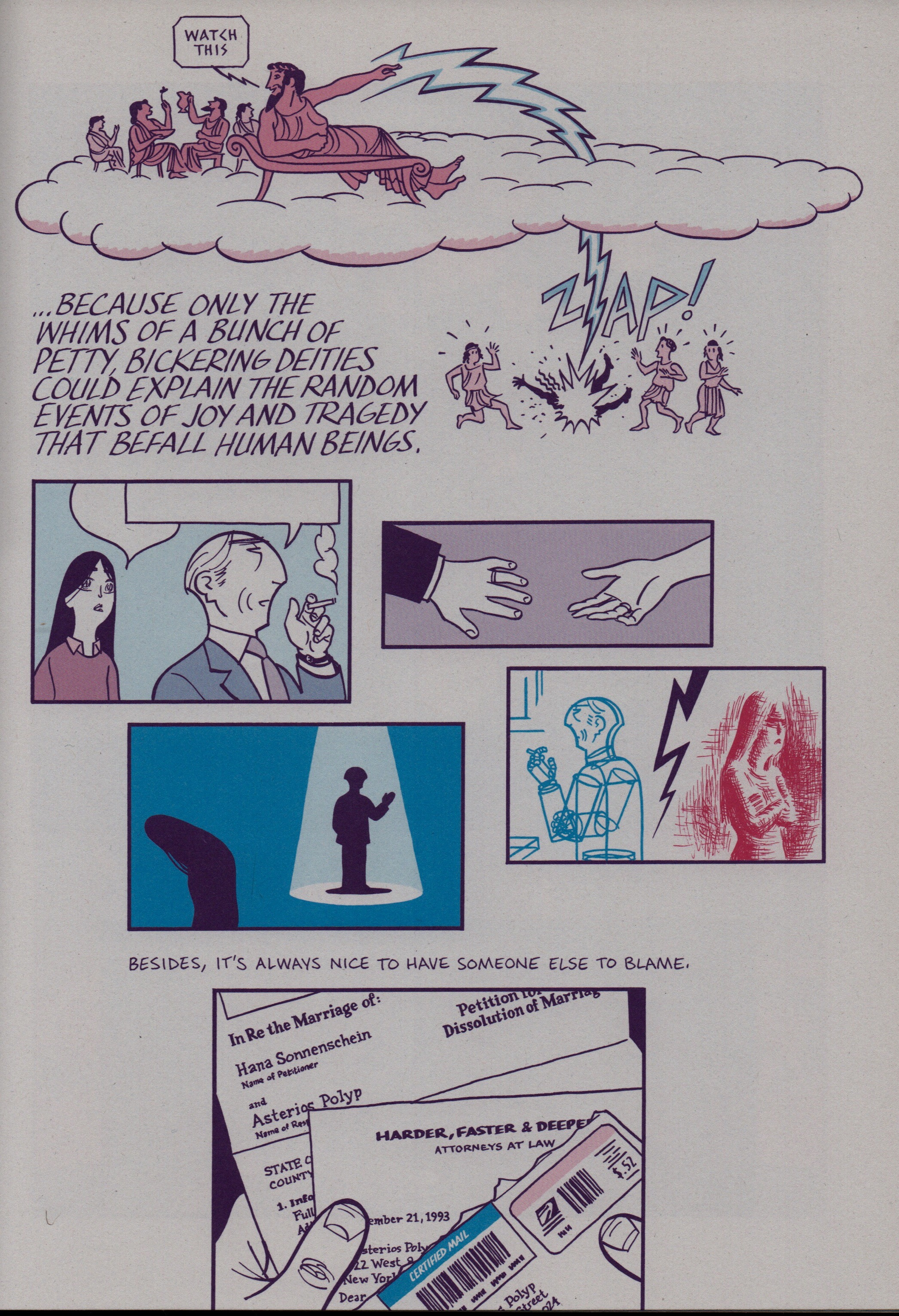
Let’s get a few things straight from the get-go: David Mazzuchelli’s graphic novel Asterios Polyp is a masterpiece, an unequivocal advancement of its medium, and an unqualified joy to read. It’s also not only one of the best books we’ve read this year, but also this decade. While such breathless enthusiasm might seem suspect, even a cursory look over Asterios Polyp will reveal that Mazzucchelli has produced a fully-realized work, one that fundamentally reimagines what a graphic novel is, and how it might be read.
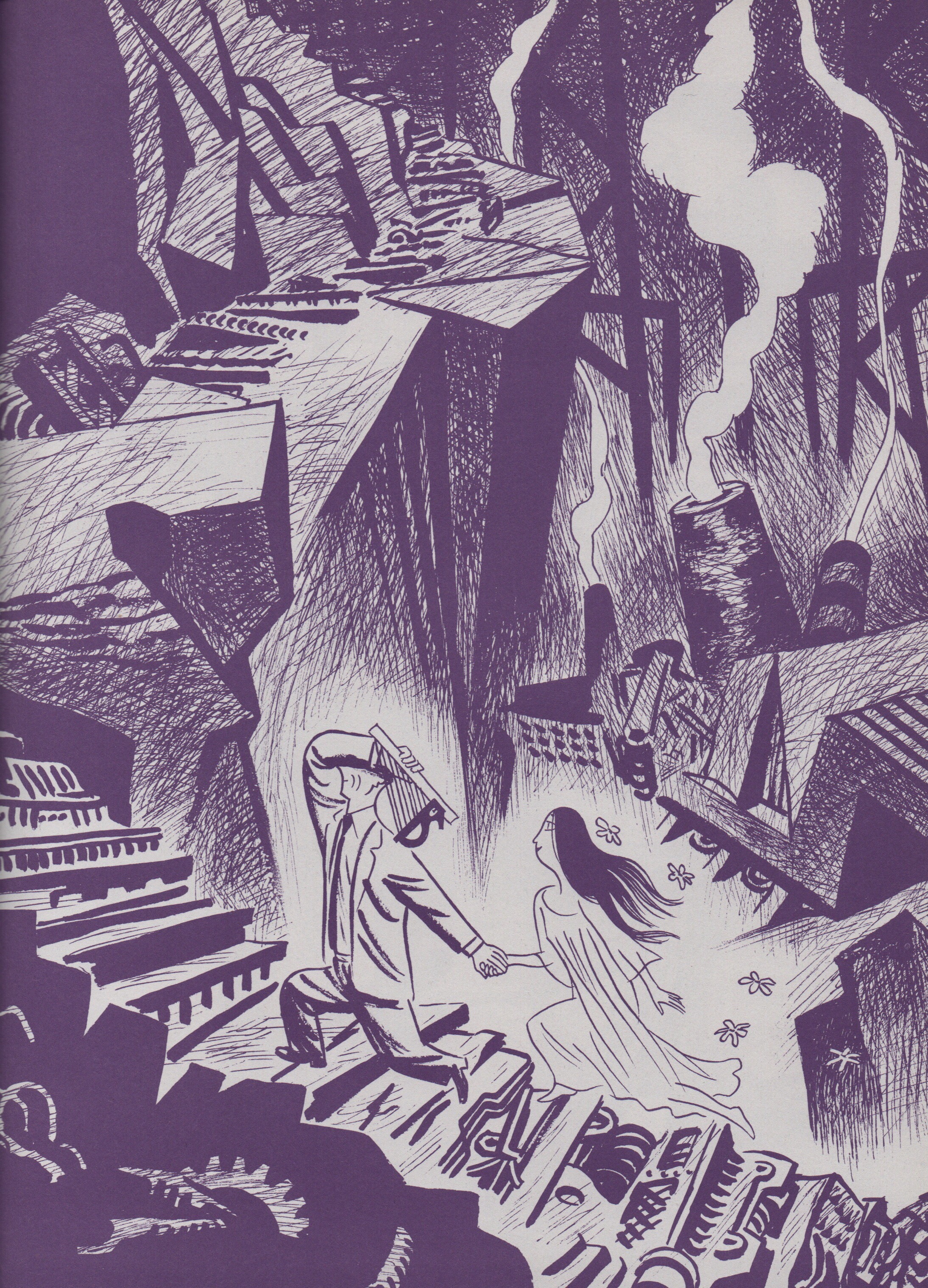
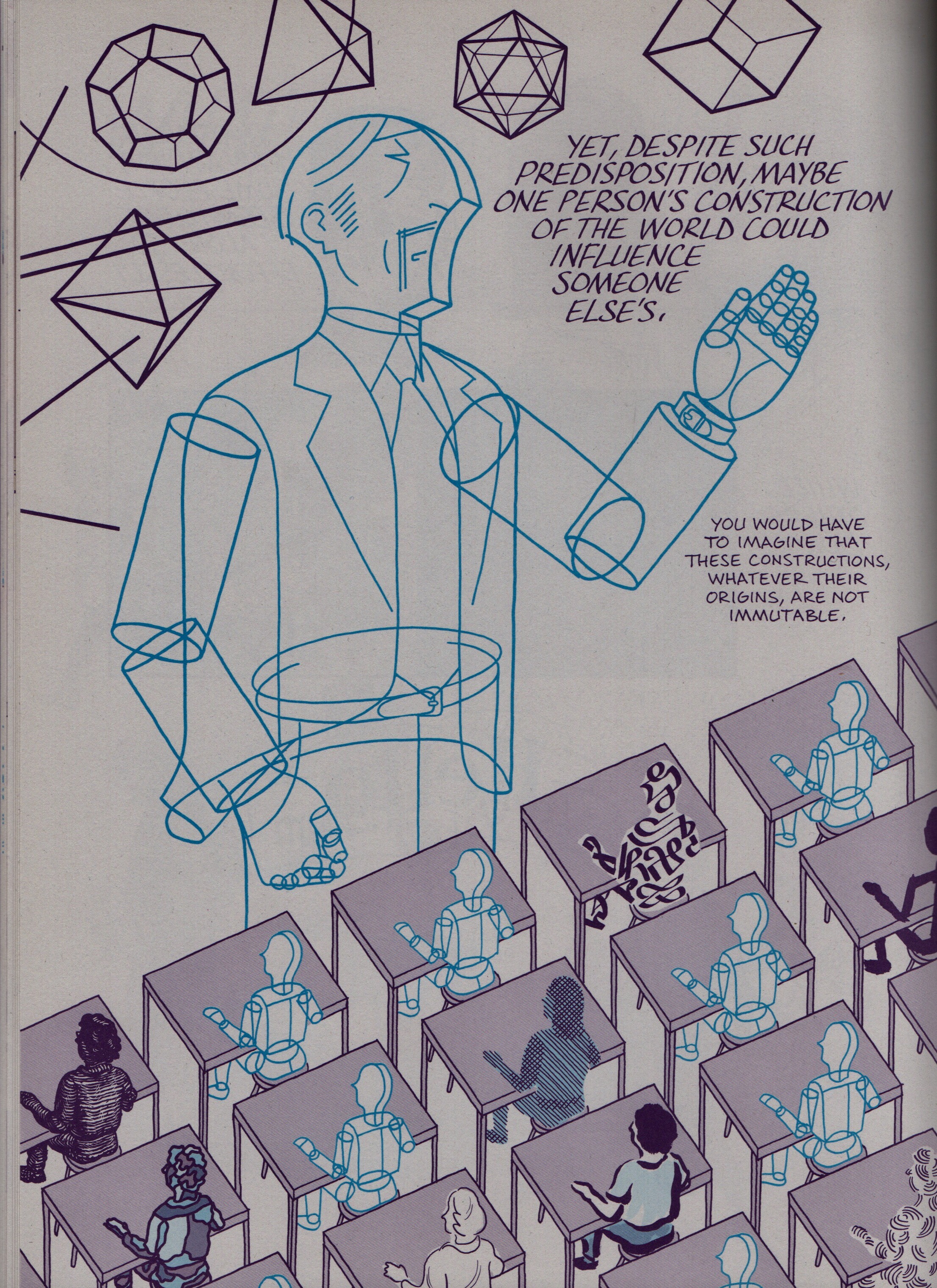
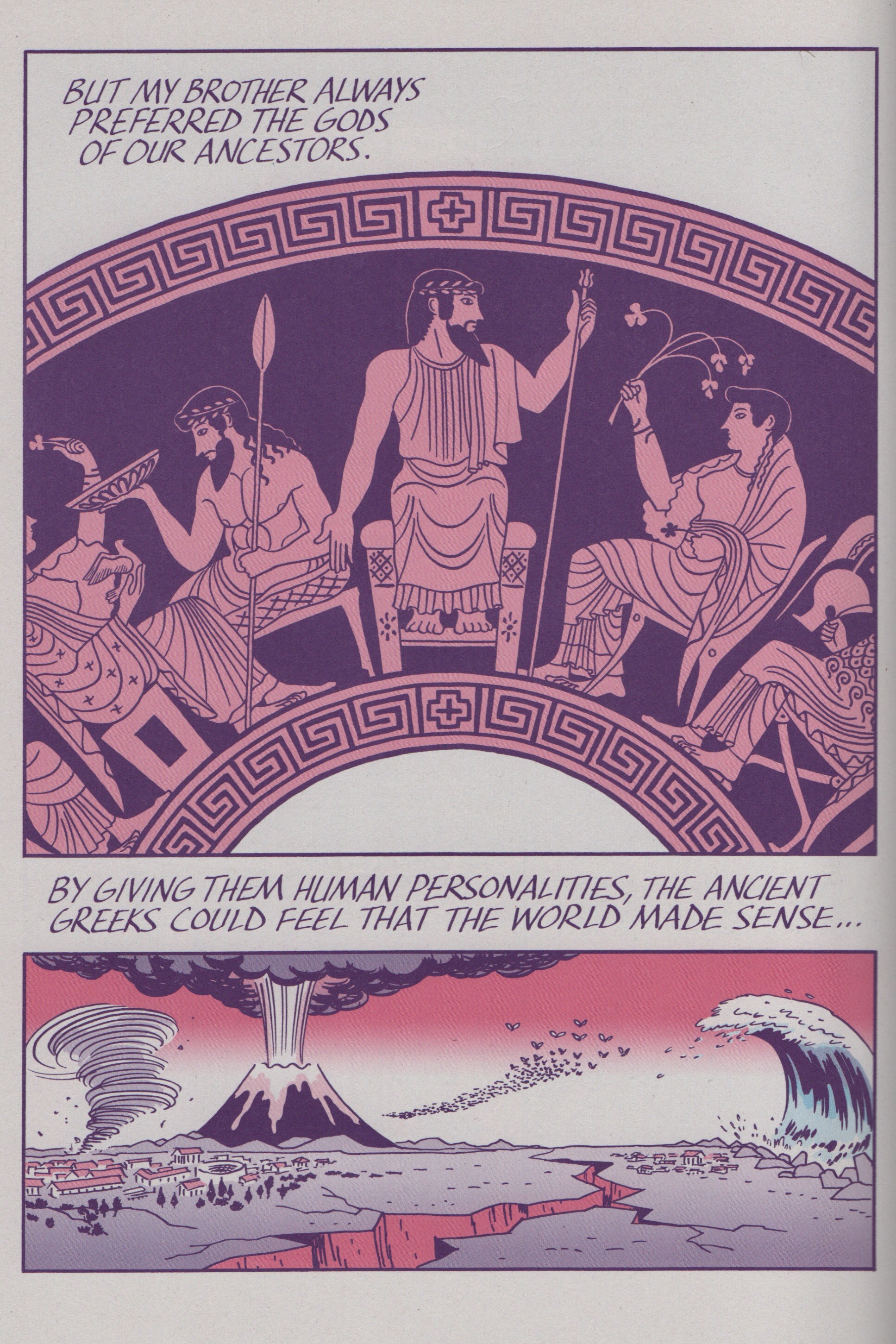
Asterios Polyp is a boorish, solipsistic “paper architect” and tenured professor (none of his designs have ever actually been built) whose life goes to shambles after his sensitive wife Hana leaves him. The novel opens with a lightning strike that literally destroys everything that Asterios owns. He grabs three key items–his father’s old lighter, a magnetically-powered watch he bought as a child, and a Swiss Army knife he found on the beach–and hits the road, heading into the great, normal Midwest, where he takes a job as an auto mechanic (in a lovely scene, Asterios the autodidact, after accepting his new job, heads to the library to learn auto repair in an hour). Asterios’s kindly boss Stiff and his hippie wife Ursula take in the poor soul/arrogant prick. As the plot unfolds, Mazzucchelli contrasts Asterios’s past, full of faculty cocktail parties, affairs with grad students, and highbrow conversations, with his incremental rebirth into a more concrete world. “Be not simply good; be good for something,” said Henry David Thoreau–a lesson that Asterios slowly learns as he finally applies his skill and genius to real-world applications, like building a tree house for the couple’s son and creating a solar-powered Cadillac. Asterios’s emergence as a fully-realized human being contrasts sharply with hist past. Although he clearly loved his wife Hana, he was unable to appreciate her as anything other than a prop in relation to himself–how she complimented him, added to him, reflected on him. The flashback scenes with Hana are keenly realistic and loaded with genuine pathos. They are the heart of the novel. Continue reading “Sunday Comics”→
At the Uffizi, in Florence, is this odd painting by Titian. For a while, no one knew who the artist was. First the work was attributed to Leonardo and then to Sebastiano del Piombo. Though there’s still no absolute proof, today the critics are inclined to credit it to Titian. In the painting we see a man, still young, with long dark curly hair and a beard and mustache perhaps slightly tinged with red, who, as he poses, gazes off toward the right, probably toward a window that we can’t see, but still a window that somehow one imagines is closed, yet with curtains open or parted enough to allow a yellow light to filter into the room, a light that in time will become indistinguishable from the varnish on the painting.
The young man’s face is beautiful and deeply thoughtful. He’s looking toward the window, if he’s looking anywhere, though probably all he sees is what’s happening inside his head. But he’s not contemplating escape. Perhaps Titian told him to turn like that, to turn his face into the light, and the young man is simply obeying him. At the same time, one might say that all the time in the world stretches out before him. By this I don’t mean that the young man thinks he’s immortal. On the contrary. The young man knows that life renews itself and that the art of renewal is often death. Intelligence is visible in his face and his eyes, and his lips are turned down in an expression of sadness, or maybe it’s something else, maybe apathy, none of which excludes the possibility that at some point he might feel himself to be master of all the time in the world, because true as it is that man is a creature of time, theoretically (or artistically, if I can put it that way) time is also a creature of man.
In fact, in this painting, time — sketched in invisible strokes — is a kitten perched on the young man’s hands, his gloved hands, or rather his gloved right hand which rests on a book: and this right hand is the perfect measure of the sick man, more than his coat with a fur collar, more than his loose shirt, perhaps of silk, more than his pose for the painter and for posterity (or fragile memory), which the book promises or sells. I don’t know where his left hand is.
How would a medieval painter have painted this sick man? How would a non-figurative artist of the twentieth century have painted this sick man? Probably howling or wailing in fear. Judged under the eye of an incomprehensible God or trapped in the labyrinth of an incomprehensible society. But Titian gives him to us, the spectators of the future, clothed in the garb of compassion and understanding. That young man might be God or he might be me. The laughter of a few drunks might be my laughter or my poem. That sweet Virgin is my friend. That sad-faced Virgin is the long march of my people. The boy who runs with his eyes closed through a lonely garden is us.
‘There’s something very interesting about civics and selfishness, and we get to ride the crest of it. Here in the US, we expect government and law to be our conscience. Our superego, you could say. It has something to do with liberal individualism, and something to do with capitalism, but I don’t understand much of the theoretical aspect—what I see is what I live in. Americans are in a way crazy. We infantilize ourselves. We don’t think of ourselves as citizens—parts of something larger to which we have profound responsibilities. We think of ourselves as citizens when it comes to our rights and privileges, but not our responsibilities. We abdicate our civic responsibilities to the government and expect the government, in effect, to legislate morality. I’m talking mostly about economics and business, because that’s my area.’
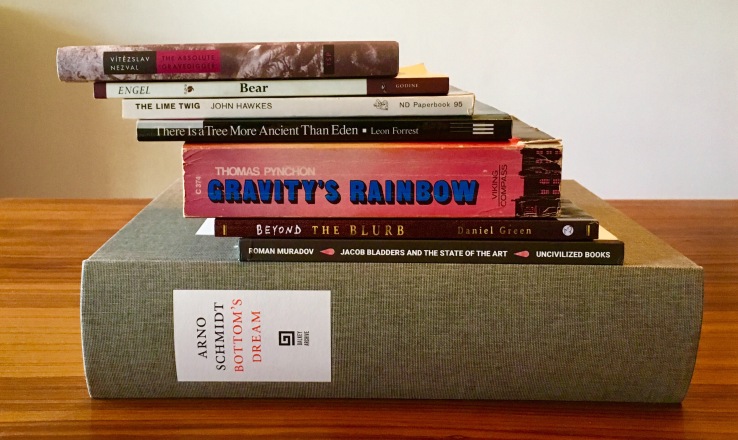
It’s easier to work from what’s outside of me lately, so I’ve been doing these Gravity’s Rainbow annotations; I “finished” (not the right verb) a third reading this weekend and then dipped back into it again—this time in the middle. I was thinking of doing a “how to read Gravity’s Rainbow” post but that seems fucking pretentious. I love the book though.
This stack looks big, but it’s not really—most of the other books there are slim volumes I worked into my reread of Gravity’s Rainbow. Little breaks, of a sort.
But not that big book at the bottom.
That big book at the bottom, Bottom’s Dream? Hm. Not sure about this guy. It’s too big to read. I mean physically. It’s unwieldy, uncomfortable, uncurlupwithable. I can’t get a rhythm going there.
Daniel Green’s Beyond the Blurb will also get a review, sort of, soon (the book is a critical survey of literary criticism, making a review of it especially difficult to me). I have n interview with Green in the works.
Not pictured here because it’s an e-book is Scott Esposito’s The Missing Books. Esposito’s book is a continuing project, a “curated directory of books that do not exist, but should.” I read it in one sitting and was frankly jealous that I hadn’t written it.
Leon Forrest’s There Is a Tree More Ancient Than Eden is a novel I read in a blur, a kind of fever dream postmodern pastiche, a narrative unstuck in time and yet wholly about a specific time and place and past and consciousness. I need to read it again; like so many so-called “experimental” novels, a first reading is highly impressionistic but also confusing. Forrest throws you in the deep end. The prose is liquid, viscous, and you’re swimming around for edges, contours to grab onto. Just a marvelous strange read, and it deserves better than I’m giving it here—I mean, I think the novel deserves way more attention, and I’ll attend to it again.
Vítězslav Nezval’s 1937 poetry collection The Absolute Gravedigger is new in English translation by Stephan Delbos and Tereza Novická (Twisted Spoon Press). I hadn’t read Nezval before now, but I did see Jaromil Jireš’s film adaptation of his novel Valerie and Her Week of Wonders; if you know it, you’ll perhaps have an idea of some of Gravedigger’s rich dark weird flavor. There’s something of Bosch or Goya in the spare poems—somehow simultaneously bleak but vivid, morose but witty. The cityscapes, the entropy, the impressionistic details here all melded into my Pynchon-addled brain with the immediate post-War Zone of Gravity’s Rainbow: broken bits of civilization twitching into new combinations of reality.
Marian Engel’s Bear is this wonderfully lucid story of a bibliographer who goes to a remote island to document the contents (and library) of an old semi-famous house. Engel’s sentences are too good; there’s something fresh and restorative about the prose that echoes the plot, which is both simple and bizarre. Also, the bibliographer has a sexual relationship with a bear.
I read the first half of John Hawkes’s The Lime Twig over two short plane rides. I might have finished it, but I had to read every paragraph twice. I haven’t picked it up since the election on Tuesday. Maybe this post will motivate me to pick it up. Here’s Flannery O’Connor’s so very accurate blurb from the back cover:
You suffer The Lime Twig like a dream. It seems to be something that is happening to you, that you want to escape from but can’t. The reader even has that slight feeling of suffocation that you have when you can’t wake up and some evil is being worked on you.
In a corporate State 1, a place must be made for innocence, and its many uses 2. In developing an official version of innocence, the culture of childhood has proven invaluable 3 . Games, fairy-tales, legends from history, all the paraphernalia of make-believe 4 can be adapted and even embodied in a physical place, such as at Zwölfkinder 5. Over the years it had become a children’s resort, almost a spa. If you were an adult, you couldn’t get inside the city limits without a child escort. There was a child mayor 6, a child city council of twelve. Children picked up the papers, fruit peelings and bottles you left in the street, children gave you guided tours through the Tierpark 7, the Hoard of the Nibelungen 8, cautioning you to silence during the impressive re-enactment of Bismarck’s elevation, at the spring equinox of 1871, to prince and imperial chancellor 9,… child police reprimanded you if you were caught alone, without your child accompanying. Whoever carried on the real business of the town—it could not have been children—they were well hidden.10
From page 419 of Thomas Pynchon’s 1973 novel Gravity’s Rainbow.
1 Pynchon, as always, diagnoses not just the past and present, but the future. The state is corporate; They — the oligarchy et al. — run the show. And conceptualizing innocence is part of running that show.
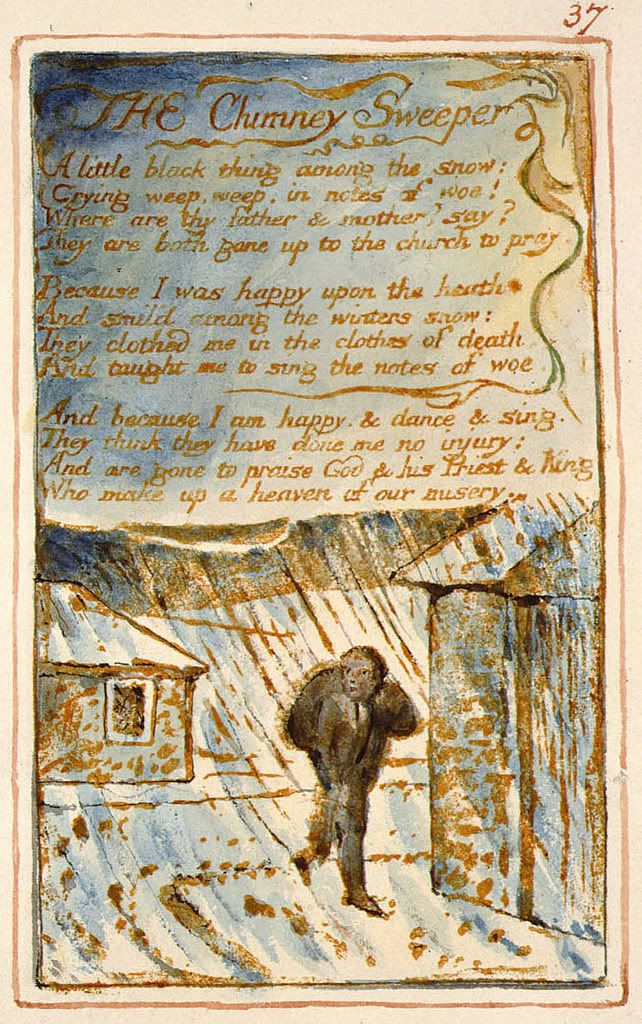
2 Cf. William Blake’s Songs of Innocence and Experience (1789). In The Marriage of Heaven and Hell (1793), Blake wrote: “Without Contraries is no progression.” Without corruption there is no innocence; without abjection there is no purity; without an elect, there is no preterite.
The Chimney Sweeper, William Blake, 1794
Blake’s Songs share much in common with Pynchon’s big novel—both argue for the preterite, pointing out the ways in which industrial technologies exploit the most vulnerable among us; both are wildly, acidly vivid; both employ metaphors of fall and ascent; both foreground the utterly real humanity of their subjects.
Blake’s “The Chimney Sweeper” (from Experience) shows in simple language how the official version of innocence can be used to enforce the dominant and exploitative order. Consider the last stanza:
And because I am happy and dance and sing,
They think they have done me no injury,
And are gone to praise God and his Priest and King,
Who make up a heaven of our misery
Blake’s chimney sweeper asserts his right to happiness, to laughter and joy. The creative impulse is a Counterforce against Them—here, the Priest and King. Yet They co-opt the dancing and joy and convert it into signs of “the official version of innocence”: a lie to cover over the utter corruption of the dominant order.
3 You’ve read Freud, right? Like, those ideas on infantile sexuality that are downright icky, and yet nevertheless reaffirmed and reinforced by the Corporate State? (Oligarchial capitalism simultaneously infantilizes and sexualizes its subjects). Gravity’s Rainbow does a lot of stuff it’s easier (less queasier) to write off as abject than to actually like, think through. But GR also shows that They infantilize and sexualize childhood in the service of control, as a way of establishing (and blurring and “defiling”) official versions of innocence.
Consider Our Poor Hero Tyrone Slothrop, whose conditioning as an infant by Laszlo Jamf (involving the mysterious MacGuffin Imipolex G) leads to erections that predict rocket strikes. (I swear that sentence makes sense).
4 “Games, fairy-tales, legends from history, all the paraphernalia of make-believecan be adapted and even embodied in a physical places” — physical places like Gravity’s Rainbow. Well, okay. I mean, we get a condensation here of Pynchon’s process, his synthesis, his grab-bag of songs and japes and jibes and jokes and tales and etcetera.
But Pynchon’s pointing out other, perhaps more nefarious and venal and corporate uses for the same cultural material he’s massaging: A fucking theme park. Like, uh, Disneyland. Or Disneyworld. Etcetera, you get it—that we—did I just write We?!—I want to say They—that They colonize and corporatize the imagination; that They gobble up the cultural material and excrete it in smooth, digestible, sanitized (yet subtly sexualized)—and consumable, marketable!—segments that we take our kids to queue up to experience in their innocence.
5 As always, Pynchon Wiki does it better than I can:
“Twelve Children” – the name evokes Jacob’s twelve sons (and the daughter who is not one of the official twelve). This pattern is self-consciously repeated in the Grimms’ tale “The Twelve Brothers”, where the boys are to die if their mother gives birth to a girl.
The camp, which is also a quasi-town, may be modelled after Theresienstadt, the Jewish town/Lager set up by the Nazis in what is now the Czech Republic. This is suggested by themes like transit, phoney children’s paradise, as well as the large orchestra, or the number 60,000 (the number of those who “passed through” Zwölfkinder as well the population of Theresienstadt at its peak). It also recalls another totalitarian institution, that of the communist “children’s towns” (large, town-like, somewhat militarized holiday camps for Young Pioneers), whose prototype was Artek in the Soviet Union. (Deutsches Jungvolk also had its summer camps.)
Further, consider Argentina’s Republic of Children, a city proportioned for children, which was created under Juan Peron’s regime and opened in 1951.
The Oedipal plot of Grimms’ “The Twelve Children” repeats throughout Gravity’s Rainbow, and I invite you to look for it lurking in Disney.
“The brothers were full of joy, and embraced her with fondest affection,” Mary Hamilton Fry, 1912
“At the entrance to the town, barring their way, stands the Midget who played the lead in Freaks. The one with the German accent. He is the town sheriff. He is wearing an enormous gold star that nearly covers his chest.”
The little person referenced is Harry Earles who played Hans in Freaks (1932; dir. Tod Browning).
7 The zoo.
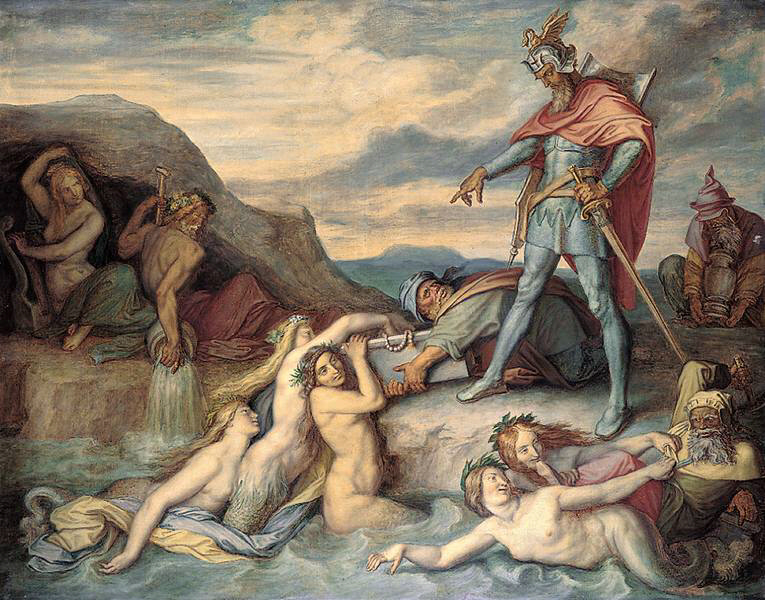
8 A vast treasure hoard, such as Scrooge McDuck might dive into, or Bilbo Baggins and his pals might play upon.
The Nibelungen Hoard, as I’m sure you know, is the treasure of the Nibelungen. (You know Wagner’s Ring Cycle, eh? Or you’ve read Tolkien’s The Lord of the Rings, right?—you get the idea. The titular Nibelung is the dwarf Alberich, by the way).
The tale of that same treasure might well your wonder raise;
’T was much as twelve huge wagons in four whole nights and days
Could carry from the mountain down to the salt-sea bay,
If to and fro each wagon thrice journeyed every day.
It was made up of nothing but precious stones and gold;
Were all the world bought from it, and down the value told,
Not a mark the less thereafter were left, than erst was scored.
Good reason sure had Hagan to covet such a hoard.
Hagen Orders Servants to Sink the Hoard in the Rhine, Peter von Cornelius (1859)
In the Nibelungenlied, Hagen murders the hero Siegfried and then steals and hides the Nibelung hoard.
9 Otto von Bismarck, 1815-1898, who unified Germany through technocracy and, uh, war.
10 “…they were well hidden”: A précis of Pynchonian paranoia, perhaps.
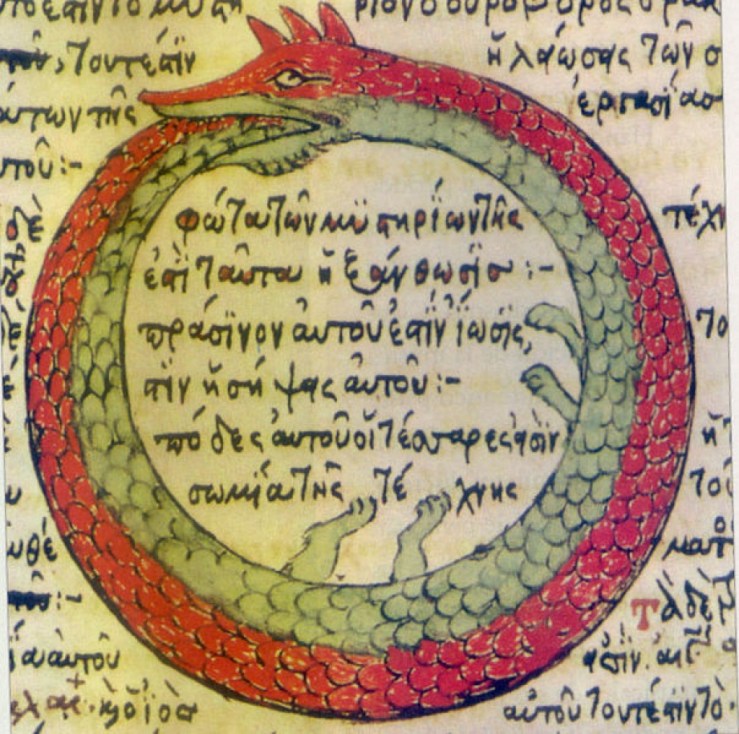
Kekulé 1 dreams 2 the Great Serpent holding its own tail in its mouth, the dreaming Serpent which surrounds the World 3. But the meanness, the cynicism with which this dream is to be used 4. The Serpent that announces, “The World is a closed thing, cyclical, resonant, eternally-returning,” 5 is to be delivered into a system 6 whose only aim is to violate the Cycle. Taking and not giving back, demanding that “productivity” and “earnings” keep on increasing with time, the System removing from the rest of the World these vast quantities of energy to keep its own tiny desperate fraction showing a profit: and not only most of humanity—most of the World, animal, vegetable and mineral, is laid waste in the process 7 . The System may or may not understand that it’s only buying time. And that time is an artificial resource to begin with, of no value to anyone or anything but the System, which sooner or later must crash to its death, when its addiction to energy has become more than the rest of the World can supply 8 , dragging with it innocent souls all along the chain of life. Living inside the System is like riding across the country in a bus driven by a maniac bent on suicide… though he’s amiable enough, keeps cracking jokes 9 back through the loudspeaker, “Good morning folks, this is Heidelberg 10 here we’re coming into now, you know the old refrain, ‘I lost my heart in Heidelberg,’ 11 well I have a friend who lost both his ears here! Don’t get me wrong, it’s really a nice town, the people are warm and wonderful—when they’re not dueling. Seriously though, they treat you just fine, they don’t just give you the key to the city, they give you the bung-starter!” 12 u.s.w. 13 On you 14 roll, across a countryside whose light is forever changing 15 —castles, heaps of rock, moons of different shapes and colors come and go. There are stops at odd hours of the mornings, for reasons that are not announced: you get out to stretch in lime-lit courtyards where the old men sit around the table under enormous eucalyptus trees you can smell in the night, shuffling the ancient decks oily and worn, throwing down swords and cups 16 and trumps major in the tremor of light while behind them the bus is idling, waiting—passengers will now reclaim their seats and much as you’d like to stay, right here, learn the game, find your old age around this quiet table, it’s no use 17 : he is waiting beside the door of the bus in his pressed uniform, Lord of the Night he is checking your tickets, your ID and travel papers 18 , and it’s the wands of enterprise 19 that dominate tonight… as he nods you by, you catch a glimpse of his face, his insane, committed eyes, and you remember then, for a terrible few heartbeats, that of course it will end for you all in blood, in shock, without dignity 20 —but there is meanwhile this trip to be on… over your own seat, where there ought to be an advertising plaque, is instead a quote from Rilke: “Once, only once…” 21 One of Their favorite slogans. No return, no salvation, no Cycle—that’s not what They, nor Their brilliant employee Kekulé, have taken the Serpent to mean. No: what the Serpent means is—how’s this—that the six carbon atoms of benzene are in fact curled around into a closed ring, just like that snake with its tail in its mouth, GET IT? 22
From pages 412-13 of Thomas Pynchon’s novel Gravity’s Rainbow.
1 Friedrich August Kekulé, 1829–1896, German chemist—the “father of organic chemistry.” (Our arts and sciences must be fathered, it seems).
East German Kekulé, postage stamp (with the benzene compound), 1979
[11], 397-433. This long chapter, consisting mostly of one long recollection, narrated in the past tense, tells the story of Franz Pökler […] Pökler dreamed about the history of Friedrich August Kekulé, father of organic chemistry (410-13), and about Kekulé’s dream: a serpent with its tail in its mouth. We learn how this dream was misused by the System, as the foundation for understanding the benzine ring. All this is lectured on by “Pökler’s old prof,” Laszlo Jamf.
A neat little summary, yes.
Kekulé’s most notable contribution to chemistry—and capitalism!—is in his work on describing the structure of that valuable petrochemical benzene.
Formule chimique développée du benzène inscrite dans le dessin de l’Ouroboros (serpent qui se mord la queue), Haltopub, 2013
Kekulé’s dream-image-symbol is clearly compelling for both the reader and, I think, for Pynchon. Gravity’s Rainbow is very much about the overlap between physical and metaphysical, and Kekulé’s vision points to the convergence of dream and experience, magic and science.
3Ouroboros is literally tail-devouring in Greek, but through surreal etymological phonological dream-time leaps, we can get to tale-devouring (why not?—okay, I guess maybe that’s mythosboros or something like that, but hell—–).
In any case, the serpent, or Serpent, here strikes me as one of Pynchon’s Moves Against Them—he taps into an older myth, one that elevates the Scaly and Low—the Preterite?—into an Elect position that the Christian Tradition simply doesn’t care for, what with the Tempting Serpent and all. No, no shedding of the skin, no eternal return…no, no return at all. Cf. a few lines later in the passage cited above: “No return, no salvation, no Cycle—that’s not what They, nor Their brilliant employee Kekulé, have taken the Serpent to mean.”
Horapollo, referring to the serpent symbol, says of it:— ‘When the Egyptians would represent the Universe they delineate a serpent bespeckled with variegated scales, devouring its own tail, the scales intimating the stars in the Universe. The animal is extremely heavy, as is the earth, and extremely slippery like the water, moreover, it every year puts off its old age with its skin, as in the Universe the annual period effects a corresponding change and becomes renovated, and the making use of its own body for food implies that all things whatever, which are generated by divine providence in the world, undergo a corruption into them again.’
4 Used by Them.
Gravity’s Rainbow is clearly about paranoia of Them, and as such (necessarily), Pynchon’s targets are…nebulous. (Although technology and the Military-Industrial-Entertainment Complex that technology works through might be a manifest if not wholly concrete villain in GR.). Pynchon’s big novel Against the Day offers a more specific locus for everything wrong with Them in its awful villain Scarsdale Vibe and his henchmen and lackeys.
5 You are of course familiar with the concept of eternal recurrence, no?
6 Oligarchial capitalism.
7 Pynchon seems to describe the past few centuries here, and probably the future.
8Gravity’s Ranbow was published in 1973, folks…
9 …but of course, Pynchon is also describing now, which is to say, his narrative’s own future.
10 A charming German city famous for its university.
12 A wooden mallet for opening the bung of a cask (or wine or beer). I visited Heidelberg when I was 16 and drank copious quantities of ale.
13 “u.s.w.” — German acronym for und so weiter; translates to etcetera. Pynchon allows the tape to roll on in his reader’s head.
14 Always beware Gravity’s Rainbow’s shifts into second-person! Look at this ride that Pynchon’s put us on…but wait…we’re already on the ride.
15 A rainbow image.
16 Tarot references abound in Gravity’s Rainbow.
3 of Swords, Sola-Busca Tarot (1491; reprint by Wolfgang Mayer, 1998)
17 The preterite’s complaint: Wisdom shall not be found, order will not reveal itself, meaning will be suspended indefinitely.
18 Our wacky busdriver is actually “the Lord of the Night,” an ominous and perhaps self-explanatory title (and one that resonates with the passage’s mythological overtones and tarot motif). The Lords of the Night are figures in both the Mayan and Aztec calendars, but I’m not sure if Pynchon’s referencing them here—although this passage is deeply concerned with the apprehension and management of time. This Lord of the Night, you’ll note—a stickler for paperwork—is awfully bureaucratic.
19 Oligarchial capitalism. The wands are another suit in the tarot deck. (The upright three of wands is associated with enterprise).
20 The strange trip here echoes Gravity’s Rainbow’s bewildering opening “evacuation” sequence, and the line I’ve noted recalls to me a line I’ve cited at least twice now in these annotations.
From the novel’s sixth paragraph:
“You didn’t really believe you’d be saved. Come, we all know who we are by now. No one was ever going to take the trouble to save you, old fellow. . . .”
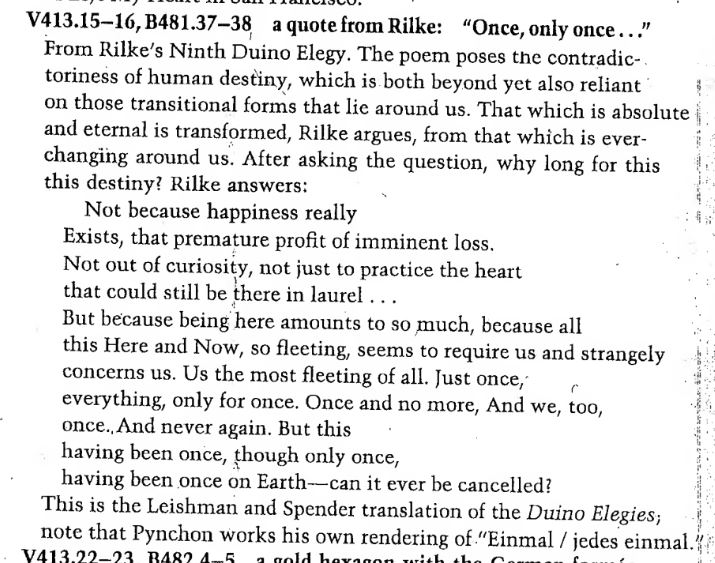
21 In A Gravity’s Rainbow Companion, Weisenburger provides the following context for the Rilke quote:
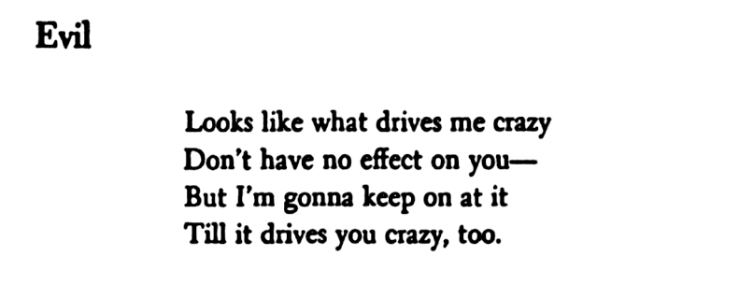
From Zora Neale Hurston’s novelization of folklore, Mules and Men:
It was slavery time, Zora, when Big Sixteen was a man. They called ‘im Sixteen cause dat was de number of de shoe he wore. He was big and strong and Ole Massa looked to him to do everything.
One day Ole Massa said, “Big Sixteen, Ah b’lieve Ah want you to move dem sills Ah had hewed out down in de swamp.
“I yassuh, Massa.”
Big Sixteen went down in de swamp and picked up dem 12 X 12’s and brought ’em on up to de house and stack ,em. No one man ain’t never toted a 12 X 12 befo’ nor since.
So Ole Massa said one day, “Go fetch in de mules. Ah want to look ’em over.”
Big Sixteen went on down to, de pasture and caught dem mules by de bridle but they was contrary and balky and he tore de bridles to pieces pullin’ on ’em, so he picked one of ’em up under each arm and brought ’em up to Old Massa.
He says, “Big Sixteen, if you kin tote a pair of balky mules, you kin do anything. You kin ketch de Devil.”
“Yassuh, Ah kin, if you git me a nine-pound hammer and a pick and shovel!”
Ole Massa got Sixteen de things he ast for and tole ‘im to go ahead and bring him de Devil.
Big Sixteen went out in front of de house and went to diggin’. He was diggin’ nearly a month befo’ he got where he wanted. Then he took his hammer and went and knocked on de Devil’s door. Devil answered de door hisself.
“Who dat out dere?”
“It’s Big Sixteen.”
“What you want?”
“Wanta have a word wid you for a minute.”
Soon as de Devil poked his head out de door, Sixteen him over de head wid dat hammer and picked ‘im up and carried ‘im back to Old Massa.
Ole Massa looked at de dead Devil and hollered, “Take dat ugly thing ‘way from here, quick! Ah didn’t think you’d, ketch de Devil sho ’nuff.”
So Sixteen picked up de Devil and throwed ‘im back down de hole.
Way after while, Big Sixteen died and went up to Heben. But Peter looked at him and tole ‘im to g’wan ‘way from dere. He was too powerful. He might git outa order and there wouldn’t be nobody to handle ‘im. But he had to, go somewhere so he went on to hell.
Soon as he got to de gate de Devil’s children was playin’ in de yard and they seen ‘im and run to de house, says, “Mama, mama! Dat man’s out dere dat kilt papa!”
So she called ‘im in de house and shet de door. When Sixteen got dere she handed ‘im a li’l piece of fire and said, “You ain’t comin’ in here. Here, take dis hot coal and g’wan off and start you a hell uh yo’ own.”
So when you see a Jack O’Lantern in de woods at night you know it’s Big Sixteen wid his piece of fire lookin’ for a place to go.
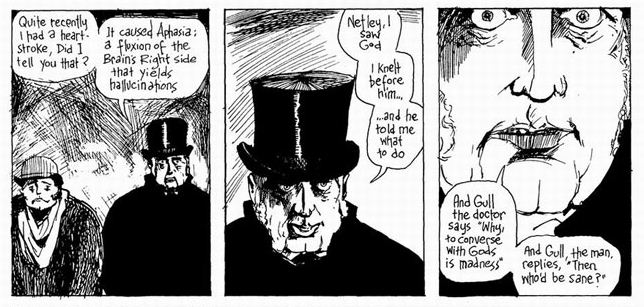
From Hell, Alan Moore and Eddie Campbell’s epic revision of the Jack the Ripper story, posits Sir William Gull, a physician to Queen Victoria, as the orchestrator of the Ripper murders that terrified Londoners at the end of the 19th century. The murders initially arise as a means to cover up an illegitimate son begat by foolish Prince Albert, Victoria’s grandson. However, for Gull the murders represent much more. The murders are part of the continued forces of “masculine rationality” that will constrain “lunar female power.” Gull is a high-level Mason; during a stroke, he experiences a vision of the Masonic god Jahbulon, one which prompts him to his “great work”–namely, the murders that will reify masculine dominance.
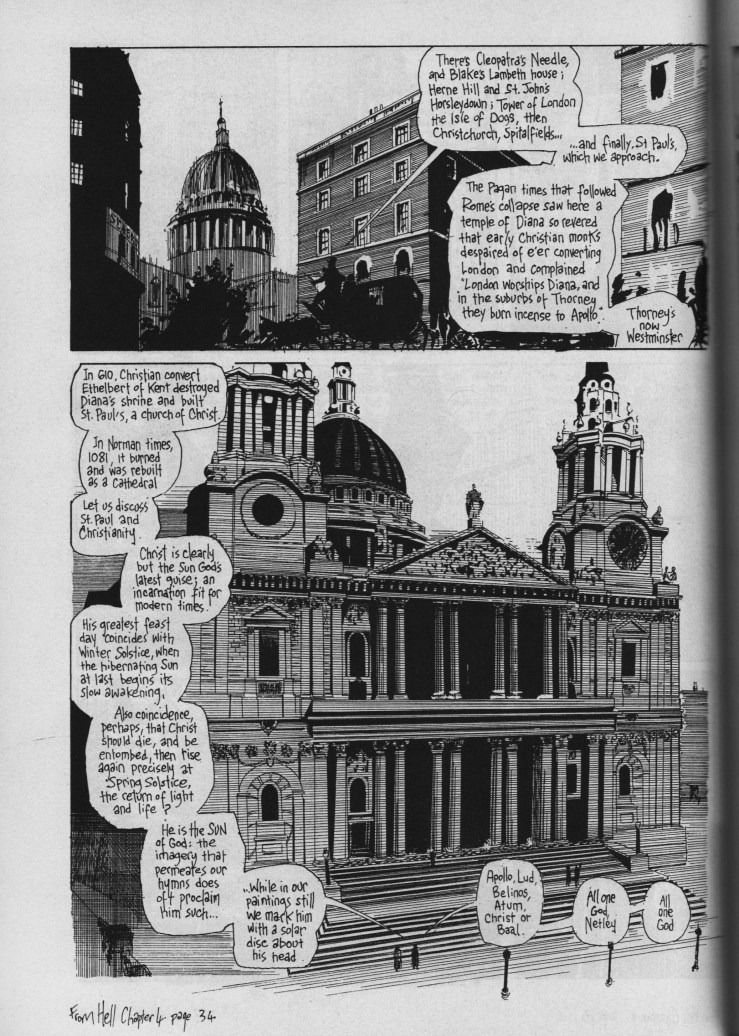
One of the standout chapters in the book is Gull’s tour of London, with his hapless (and witless) sidekick Netley. In a trip that weds geography, religion, politics, and mythology, Gull riffs on a barbaric, hermetic history of London, revealing the gritty city as an ongoing site of conflict between paganism and orthodoxy, artistic lunacy and scientific rationality, female and male, left brain and right brain. The tour ends with a plan to commit the first murder.
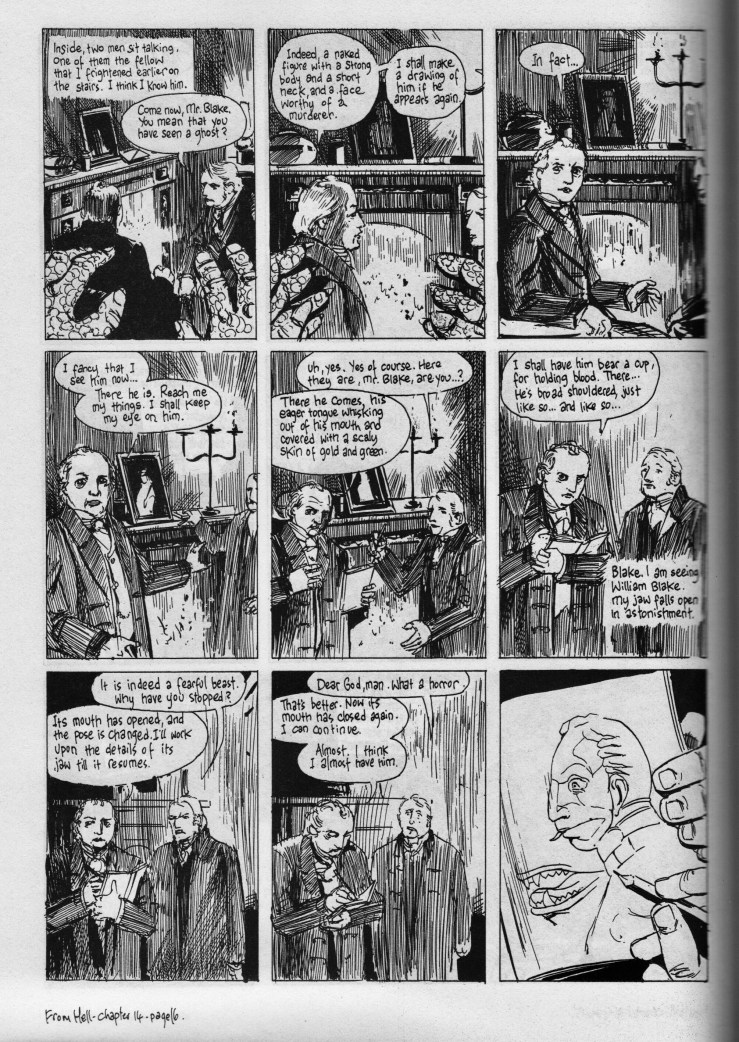
From there, the book picks up the story of Frederick Abberline, the Scotland Yard inspector charged with solving the murders. Of course, the murders are unsolvable, as the hierarchy of London–from the Queen down to the head of police–are well aware of who the (government-commissioned) murderer is. The police procedural aspects of the plot are fascinating and offer a balanced contrast with Gull’s mystical visions–visions that culminate in a climax of a sort of time-travel. Gull goes backwards (William Blake sees him in a vision and turns that vision into Ghost of Flea) and Gull goes forwards: he sees London at the end of the twentieth century, and receives a guarantee that his murder plot has had its intended effect.
From Hell takes many of its cues from the idea that history is shaped not by random events, but rather by tragic conspiracies that force people to willingly give up freedom to a “rational” authority. The book points repeatedly to the 1811 Ratcliffe Highway murders, which led directly to the world’s first modern police force. In our own time, if we’re open to conspiracy theories, we might find the same pattern in the 21st century responses to terrorism.
Although From Hell features moments of supernatural horror in Gull’s mysticism, it is the book’s grimy realism that is far more terrifying. London in the late 1880s is no place you want to be, especially if you are poor, especially if you are a woman. The city is its own character, a labyrinth larded with ancient secrets the inhabitants of which cannot hope to plumb. Despite the nineteenth century’s claims for enlightenment and rationality, this London is bizarrely cruel and deeply unfair. Campbell’s style evokes this London and its denizens with a surreal brilliance; his dark inks are by turns exacting and then erratic, concentrated and purposeful and then wild and severe. The art is somehow both rich and stark, like the coal-begrimed London it replicates. Although Moore has much to say, he allows Campbell’s art to forward the plot whenever possible. Moore is erudite and fascinating; even when one of his characters is lecturing us, it’s a lecture we want to hear. His ear for dialog and tone lends great sympathy to each of the characters, especially the unfortunate women who must turn to prostitution to earn their “doss” money. And while Abberline’s frustrations at having to solve a crime that no higher-ups want solve make him the hero of this story, Gull’s mystic madness makes him the narrative’s dominant figure.
From Hell is a fantastic starting place for anyone interested in Moore’s work, more self-contained than his comics that reimagine superhero myths, like Watchmen or Swamp Thing, and more satisfying and fully achieved than Promethea or V Is for Vendetta. Be forewarned that it is a graphic graphic novel, although I do not believe its violence is gratuitous or purposeless. Indeed, From Hell aspires to remark upon the futility and ugliness of cyclical violence, and it does so with wisdom and verve. Highly recommended.
Dracula is a character in Roberto Bolaño’s dark opus 2666.
Specifically, I’m suggesting that Dracula (like, theCount Dracula) is the unnamed SS officer in “The Part About Archimboldi” who hosts a strange party in a Romanian castle.
II. I’m willing to concede that my idea is probably full of holes and more than a little silly, but I think there’s some textual support for such a claim.
III. I’ve already suggested on this blog that 2666 is full of lycanthropic transformations, and in that earlier essay, I linked werewolves to vampires (using the work of mythologist Sabine Baring-Gould).
It’s a work of mesmerism and transformation—vampire powers. Dracula showing up is a winking sick joke, a satire.
IV. In his post “Castle Dracula” at Infinite Zombies, Daryl L. L. Houston connects the many strands of vampirism that run through 2666, suggesting that “Bolaño is using the vampirism in the story, and Dracula in particular, to tie together some of the threads he’s been unwinding pertaining to insiders and outsiders, parasitism and consumption of people, and a sort of larger parasitism of nations.” Hence Aztec blood rituals, the Holocaust, the murder of helpless, marginalized women in Santa Teresa . . .
V. Okay, so back to that thesis. Let’s start with the first appearance of the unnamed SS officer:
At midmorning they came to a castle. The only people there were three Romanians and an SS officer who was acting as butler and who put them right to work, after serving them a breakfast consisting of a glass of cold milk and a scrap of bread, which some soldiers left untouched in disgust. Everyone, except for four soldiers who stood guard, among them Reiter, whom the SS officer judged ill suited for the task of tidying the castle, left their rifles in the kitchen and set to work sweeping, mopping, dusting lamps, putting clean sheets on the beds.
Fairly banal, right? Also, “midmorning” would entail, y’know, sunlight, which is poison for most vampires. Let me chalk this up to the idea that the SS officer is inside the castle, which is sufficiently gloomy and dark enough to protect him (I’m not going to get into any vampire rules that might spoil my fun, dammit!). In any case, hardly noteworthy. Indeed, the SS officer—a butler commanding house chores—seems hardly a figure of major importance.
VI. Next, we get the Romanian castle explicitly identified as “Dracula’s castle” and meet the actors for this milieu:
“And what are you doing here, at Dracula’s castle?” asked the baroness.
“Serving the Reich,” said Reiter, and for the first time he looked at her.
He thought she was stunningly beautiful, much more so than when he had known her. A few steps from them, waiting, was General Entrescu, who couldn’t stop smiling, and the young scholar Popescu, who more than once exclaimed: wonderful, wonderful, yet again the sword of fate severs the head from the hydra of chance.
(I love Popescu’s line here).
VII. Our principals soon take a tour of castle and environs, led by the SS officer (boldface emphasis is mine):
Soon they came to a crypt dug out of the rock. An iron gate, with a coat of arms eroded by time, barred the entrance. The SS officer, who behaved as if he owned the castle, took a key out of his pocket and let them in. Then he switched on a flashlight and they all ventured into the crypt, except for Reiter, who remained on guard at the door at the signal of one of the officers.
So Reiter stood there, watching the stone stairs that led down into the dark, and the desolate garden through which they had come, and the towers of the castle like two gray candles on a deserted altar. Then he felt for a cigarette in his jacket, lit it, and gazed at the gray sky, the distant valleys, and thought about the Baroness Von Zumpe’s face as the cigarette ash dropped to the ground and little by little he fell asleep, leaning on the stone wall. Then he dreamed about the inside of the crypt. The stairs led down to an amphitheater only partially illuminated by the SS officer’s flashlight. He dreamed that the visitors were laughing, all except one of the general staff officers, who wept and searched for a place to hide. He dreamed that Hoensch recited a poem by Wolfram von Eschenbach and then spat blood. He dreamed that among them they had agreed to eat the Baroness Von Zumpe.
He woke with a start and almost bolted down the stairs to confirm with his own eyes that nothing he had dreamed was real.
When the visitors returned to the surface, anyone, even the least astute observer, could have seen that they were divided into two groups, those who were pale when they emerged, as if they had glimpsed something momentous down below, and those who appeared with a half smile sketched on their faces, as if they had just been reapprised of the naivete of the human race.
Bolaño concludes the crypt passage by highlighting an essential ambiguity that courses throughout the entire “Castle Dracula” episode, a strange axis of horror/humor, romance/banality. What has been revealed in the crypt? We don’t know, of course, but our surrogate Reiter allows us access to a few visions of what might have happened, including terror and fear and cannibalism. (He employs Hawthorne’s escape hatch too—it was all a dream).
The Knight of Death, Salvador Dali
VIII. Then, supper time:
That night, during dinner, they talked about the crypt, but they also talked about other things. They talked about death. Hoensch said that death itself was only an illusion under permanent construction, that in reality it didn’t exist. The SS officer said death was a necessity: no one in his right mind, he said, would stand for a world full of turtles or giraffes. Death, he concluded, served a regulatory function.
Clearly it’s easy to link any of the dinnertime comments about death to Dracula, but note that the SS officer’s idea that death is a “regulatory function” is terribly banal, is quite literally regular—this idea contrasts with Hoensch’s more poetic notion that death is an illusion (an illusion that the SS officer, if he is in fact Count Dracula, would realize in a perfectly mundane way that foreclosed the necessity of metaphor).
IX. Dinner conversation turns to murder—obviously one of the central themes of 2666:
The SS officer said that murder was an ambiguous, confusing, imprecise, vague, ill-defined word, easily misused.
Again, ambiguity: on one hand, sure, an SS officer’s job was in large part about coordinating and executing mass murder. At the same time, we might appreciate that murder is a vague term if people are one’s lunch.
X. Then conversation turns to culture:
The SS officer said culture was the call of the blood, a call better heard by night than by day, and also, he said, a decoder of fate.
I’m pretty sure that this was the moment I started entertaining the fancy that the SS officer might be Dracula.
XI. Popescu the intellectual also seems to reconsider the SS officer:
The intellectual Popescu remained standing, next to the fireplace, observing the SS officer with curiosity.
XII. Then, they finally riff on Dracula. Significantly, the SS officer believes that Dracula is a good German (bold emphasis mine):
First they praised the assortment of little cakes and then, without pause, they began to talk about Count Dracula, as if they had been waiting all night for this moment. It wasn’t long before they broke into two factions, those who believed in the count and those who didn’t. Among the latter were the general staff officer, General Entrescu, and the Baroness Von Zumpe. Among the former were Popescu, Hoensch, and the SS officer, though Popescu claimed that Dracula, whose real name was Vlad Tepes, aka Vlad the Impaler, was Romanian, and Hoensch and the SS officer claimed that Dracula was a noble Teuton, who had left Germany accused of an imaginary act of treason or disloyalty and had come to live with some of his loyal retainers in Transylvania a long time before Vlad Tepes was born, and while they didn’t deny Tepes a real historical or Transylvanian existence, they believed that his methods, as revealed by his alias or nickname, had little or nothing to do with the methods of Dracula, who was more of a strangler than an impaler, and sometimes a throat slitter, and whose life abroad, so to speak, had been a constant dizzying spin, a constant abysmal penitence.
The SS officer is the noble Teuton. More importantly, we get language that connects Dracula to the murders in Santa Teresa, most of which are stranglings; we also get the idea that Dracula has had a “life abroad”—one outside of time—a life that might see his spirit inhabit and ventriloquize an industrial city in the north of Mexico. (Or not. I know. Look, I’m just riffing here).
We also get the idea of an abyss (this is the structure of 2666), as well as the idea of Dracula as a penitent of sorts.
So, let us recall that early in “The Part About the Crimes,” detective Juan de Dios Martinez is searching for a criminal dubbed The Penitent who desecrates churches and has committed a few murders in the process. He goes to psychologist Elvira Campos for help:
Sacraphobia is fear or hatred of the sacred, of sacred objects, especially from your own religion, said Elvira Campos. He thought about making a reference to Dracula, who fled crucifixes, but he was afraid the director would laugh at him. And you believe the Penitent suffers from sacraphobia? I’ve given it some thought, and I do. A few days ago he disemboweled a priest and another person, said Juan de Dios Martinez.
This is the first mention of Dracula in 2666, and he’s explicitly likened to the Penitent; later, as we see above, Dracula will be explicitly linked to penitence.
(I’m not suggesting that the Penitent is Dracula traveled to Mexico to piss in churches. What I want to say is that Dracula’s dark spirit ventriloquizes the text of 2666).
(I’m also suggesting, again, that 2666 be read intertextaully).
Riding with Death, Jean-Michel Basquiat
XIII. Our other principals continue to discuss Dracula, but I won’t belabor that discussion (I’d prefer you, dear reader, to return to the text).
I will summarize though: Popescu sees Dracula in nationalistic terms (“a Romanian patriot” who repels the Turks), and General Entrescu goes on a long rant about heroism and villainy and history, culminating in a lengthy digression on Jesus Christ (recall now that Entrescu will be crucified JC-style by his men).
One aside on the SS officer bears mentioning: we learn that “the fastidious SS officer” is the most sober conversant as he “scarcely wet his lips with alcohol.” (Because he’s a vampire who prefers blood! Muahahahaha!)
XIV. Fast forward a few hours. Our man Reiter, among fellow soldiers, sets out to explore the secret crannies and passageways of Castle Drac and play voyeur:
The room they came to was empty and cold, as if Dracula had just stepped out. The only thing there was an old mirror that Wilke lifted off the stone wall, uncovering a secret passageway.
Dracula’s spirit leaves the room, creating an opening, behind the ever-symbolic mirror. (Muahahahaha!). (2666: Mirror, tunnels, chambers, labyrinths).
They enter the passageway and come first upon our supposed Dracula, the SS officer:
And so they were able to look into the room of the SS officer, lit by three candles, and they saw the SS officer up, wrapped in a robe, writing something at a table near the fireplace. The expression on his face was forlorn. And although that was all there was to see, Wilke and Reiter patted each other on the back, because only then were they sure they were on the right path. They moved on.
XV. Dracula, the epistolary novel. Count Dracula, troubled writer of letters, will author the following scenes, his spirit ventriloquizing the principals all: Here, we find Reiter and his homeboy Wilke, lurking in a secret passage, jerking off to werewolf-cum-Jesus-Christ-figure Gen. Entrescu screwing the lovely Baroness Von Zumpe and reciting poetry (emphasis per usual mine):
Then Wilke came on the wall and mumbled something too, a soldier’s prayer, and soon afterward Reiter came on the wall and bit his lips without saying a word. And then Entrescu got up and they saw, or thought they saw, drops of blood on his penis shiny with semen and vaginal fluid, and then Baroness Von Zumpe asked for a glass of vodka, and then they watched as Entrescu and the baroness stood entwined, each with a glass in hand and an air of distraction, and then Entrescu recited a poem in his tongue, which the baroness didn’t understand but whose musicality she lauded, and then Entrescu closed his eyes and cocked his head as if to listen to something, the music of the spheres, and then he opened his eyes and sat at the table and set the baroness on his cock, erect again (the famous foot-long cock, pride of the Romanian army), and the cries and moans and tears resumed, and as the baroness sank down onto Entrescu’s cock or Entrescu’s cock rose up into the Baroness Von Zumpe, the Romanian general recited a new poem, a poem that he accompanied by waving both arms (the baroness clinging to his neck), a poem that again neither of them understood, except for the word Dracula,which was repeated every four lines, a poem that might have been martial or satirical or metaphysical or marmoreal or even anti-German, but whose rhythm seemed made to order for the occasion, a poem that the young baroness, sitting astride Entrescu’s thighs, celebrated by swaying back and forth, like a little shepherdess gone wild in the vastness of Asia, digging her nails into her lover’s neck, scrubbing the blood that still flowed from her right hand on her lover’s face, smearing the corners of his lips with blood, while Entrescu, undeterred, continued to recite his poem in which the word Dracula sounded every four lines, a poem that was surely satirical, decided Reiter (with infinite joy) as Wilke jerked off again.
I contend that the poem is the work of the SS officer, psychic mesmerist, the poet Dracula, a poem no one in the scene can understand, a dark satire that might also be a war poem or a love poem or an elegy, but definitely a dark satire, written in violence and sex and blood, a poem that ventriloquizes not only Entrescu, phallic delivery device, but also the baroness, and also Reiter and Wilke. And perhaps the reader.
XVI. Where to go after such a climax? Maybe point out that Dracula infects Reiter and Wilke, of whom we learn:
Some of their battalion comrades dubbed them the vampires.
(But better to return I think to our strange figure, the SS officer).
XVII. Here, his last appearance:
The next morning the detachment left the castle after the departure of the two carloads of guests. Only the SS officer remained behind while they swept, washed, and tidied everything. Then, when the officer was fully satisfied with their efforts, he ordered them off and the detachment climbed into the truck and headed back down to the plain. Only the SS officer’s car—with no driver, which was odd—was left at the castle. As they drove away, Reiter saw the officer: he had climbed up to the battlements and was watching the detachment leave, craning his neck, rising up on tiptoe, until the castle, on the one hand, and the truck, on the other, disappeared from view.
Dracula stays in Dracula’s castle; his spirit, his seed, his blood seeps out.
In Yoko Ogawa’s new collection Revenge, eleven stories of fascinating morbidity intertwine at oblique angles. Tale extends into tale: characters, settings, and images float intertextually from chapter to chapter, layering and reticulating themes of death, crime, consumption, and creation. (And revenge, of course. Let’s not forget revenge). Not quite a story cycle or a novel-in-tales, Revenge’s sum is nevertheless greater than its parts. It’s a brisk, engaging read, and as I worked my way to the final story, I already anticipated returning to the beginning to pull at the motifs threading through the book.
The book’s dominant motifs of death and food arrive in the first tale, “Afternoon Bakery,” where a mother tries to buy strawberry shortcakes for her dead son’s birthday—only the baker is too busy bawling to attend to sales. We learn why this baker is crying in “Fruit Juice,” the second story, a tale that ends inexplicably with an abandoned post office full of kiwi fruit. The third story, “Old Mrs. J” (one of Revenge’s stand-outs) perhaps answers where those kiwis came from. More importantly, “Old Mrs. J,” with its writer-protagonist, elegantly introduces the thematic textual instability of the collection. There’s a haunting suspicion here that the characters who glide from one tale to the next aren’t necessarily the silent extras they seem to be on the surface. Our characters, background and fore, are doppelgängers, ghost writers, phantoms.
The penultimate tale “Tomatoes and the Full Moon” lays the ghosting bare. Its protagonist is a magazine writer, whose “articles” really amount to little more than advertising. Staying at a seaside resort, he’s pestered by an old woman, one of the many witches who haunt Revenge. The old woman claims to be a novelist, and points out one of her books in the resort’s library:
Later, in my room, I read ‘Afternoon at the Bakery.’ It was about a woman who goes to buy a birthday cake for her dead son. That was the whole story. I should have gone back to my article, but I read her novel through twice, finishing for the second time at 3:00 a.m. The prose was unremarkable, as were the plot an characters, but there was an icy current running under her words, and I found myself wanting to plunge into it again and again.
The final line is perhaps a description of Revenge’s haunting intertextual program—although to be clear, Ogawa’s plot and characters are hardly “unremarkable,” and her prose, in Stephen Snyder’s English translation, is lucid and descriptive. It’s the “icy current running under her words” that makes Ogawa’s tales stick so disconcertingly in the reader’s psychic gullet. And if her prose is at times “unremarkable,” it’s all in the service of creating a unifying tone. All eleven tales are narrated in first-person, and each narrator is bound to the limits of his or her own language.
These limitations of language bump up against the odd, the spectacular, the alien, as in “Sewing for the Heart”:
She had explained that she was born with her heart outside of her chest—as difficult as that might be to imagine.
The line is wonderful in its mundane trajectory: Our narrator, an artisan bagmaker, witnesses this woman who lives with her heart outside her chest and concedes that such a thing might be “difficult . . . to imagine”! There’s something terribly paltry in this, but it’s also purposeful and controlled: Here we find the real in magical realism.
But this bagmaker can imagine, as we see in an extraordinary passage that moves from the phenomenological world of sight and sound and into the realm of our narrator’s strange desires:
She began to sing, but I could not make out the words. It must have been a love song, to judge from the slightly pained expression on her face, and the way she tightly gripped the microphone. I noticed a flash of white skin on her neck. As she reached the climax of the song, her eyes half closed and her shoulders thrown back, a shudder passed through her body. She moved her arm across her chest to cradle her heart, as though consoling it, afraid it might burst. I wondered what would happen if I held her tight in my arms, in a lovers’ embrace, melting into one another, bone on bone . . . her heart would be crushed. The membrane would split, the veins tear free, the heart itself explode into bits of flesh, and then my desire would contain hers—it was all so painful and yet so utterly beautiful to imagine.
Painful and utterly beautiful: Another description of Revenge.
Sometimes the matter-of-fact tone of the stories accounts for marvelous little eruptions of humor, as in “The Last Hour of the Bengal Tiger”:
At fifteen, I took an overdose of sleeping pills. I must have had a good reason for wanting to kill myself, but I’ve forgotten what it was. Perhaps I was just fed up with everything. At any rate, I slept for eighteen hours straight, and when I woke up I was completely refreshed. My body felt so empty and purified that I wondered whether I had, in fact, died. But no one in my family even seemed to have noticed that I had attempted suicide.
The scene is simultaneously devastating and hilarious, an evocation of abyssal depression coupled with mordant irony. The scene also underscores the dramatic uncertainty that underpins so many of the tales, where the possibility that the narrator is in fact a ghost or merely a character in someone else’s story is always in play.
There’s no postmodern gimmickry on display here though. Ogawa weaves her tales together with organic ease, her control both powerful and graceful. Her narrators contradict each other; we’re offered perspectives, glimpses, shades and slivers of meaning. A version of events recounted differently several stories later seems no more true than an earlier version, but each new detail adds to the elegant tangle. Like David Lynch and Roberto Bolaño, Ogawa traffics in beautiful, venomous, bizarre dread. Like those artists, she offers a discrete world we sense is complete and unified, even as our access to it is broken and discontinuous. And like Angela Carter, Ogawa channels the icy current seething below the surface of our darkest fairy tales, those stories that, with their sundry murders and crimes, haunt readers decades after first readings.
What I like most about Revenge is its refusal to relieve the reader. The book can be grisly at times, but Ogawa rarely goes for the lurid image. Instead, the real horror (and pleasure) of Revenge is the anxiety it produces in the reader, who becomes implicated in the crimes cataloged in the text. Witness to first-person narratives that often omit key clues, the reader plays detective—or perhaps accomplice. Recommended.
Revenge is new in handsome trade paperback from Picador; Picador also released Ogawa’s novel Hotel Iris in 2010.
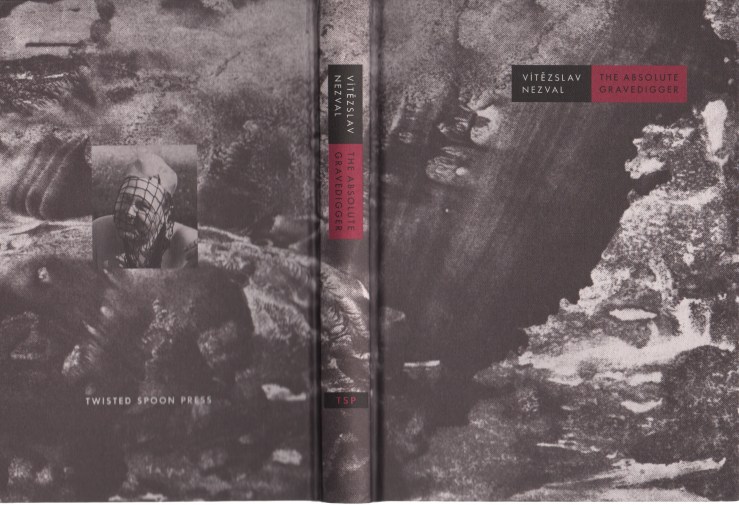
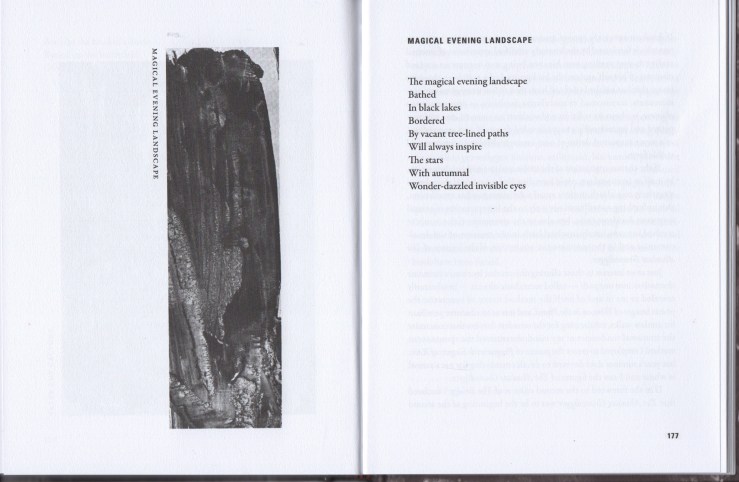
Vítězslav Nezval’s 1937 poetry collection The Absolute Gravedigger is new in English translation by Stephan Delbos and Tereza Novická, thanks to Twisted Spoon Press. As usual, Twisted Spoon’s edition is a beauty, including some of Nezval’s original illustrations.
The Absolute Gravedigger seems comprised of seven “books,” and I ended up barreling through one of them, Bizarre Town, in one sitting. Nezval’s surrealist poems are seemingly spare, but the parts jar against each other in unsettling ways; Bizarre Town evokes Bosch, or Goya’s etchings.
You might know Nezval as the author of Valerie and Her Week of Wonders, which was adapted into a marvelously disturbing 1970 film by Jaromil Jireš.
More to come as I read more, but for now, here’s Twisted Press’s blurb:
The Absolute Gravedigger, published in 1937, is in many ways the culmination of Vítězslav Nezval’s work as an avant-garde poet, combining the Poetism of his earlier work and his turn to Surrealism in the 1930s with his political concerns in the years leading up to World War II. It is above all a collection of startling verbal and visual inventiveness. And while a number of salient political issues emerge from the surrealistic ommatidia, Nezval’s imagination here is completely free-wheeling and untethered to any specific locale, as he displays mastery of a variety of forms, from long-limbed imaginative free verse narratives to short, formally rhymed meditations in quatrains, to prose and even visual art (the volume includes six of his decalcomania images).
Together with Nezval’s prior two collections, The Absolute Gravedigger forms one of the most important corpora of interwar Surrealist poetry. Yet here his wild albeit restrained mix of absolute freedom and formal perfection has shifted its focus to explore the darker imagery of putrefaction and entropy, the line breaks in the shorter lyric poems slicing the language into fragments that float in the mind with open-ended meaning and a multiplicity of readings. Inspired by Salvador Dalí’s paranoiac-critical method, the poems go in directions that are at first unimaginable but continue to evolve unexpectedly until they resolve or dissolve – like electron clouds, they have a form within which a seemingly chaotic energy reigns. Nezval’s language, however, is under absolute control, allowing him to reach into the polychromatic clouds of Surrealist uncertainty to form shapes we recognize, though never expected to see, to meld images and concepts into a constantly developing and dazzling kaleidoscope.












 Biblioklept