A review of Ishmael Reed’s sharp satire The Last Days of Louisiana Red

img_2323

Ishmael Reed’s 1974 novel The Last Days of Louisiana Red is a sharp, zany satire of US culture at the end of the twentieth century. The novel, Reed’s fourth, is a sequel of sorts to Mumbo Jumbo (1972), and features that earlier novel’s protagonist, the Neo-HooDoo ghost detective Papa LaBas.

In Mumbo Jumbo, Reed gave us the story of an uptight secret society, the Wallflower Order, and their attempt to root out and eradicate “Jes’ Grew,” a psychic virus that spreads freedom and takes its form in arts like jazz and the jitterbug. The Last Days of Louisiana Red also employs a psychic virus to drive its plot, although this transmission is far deadlier. “Louisiana Red” is a poisonous mental disease that afflicts black people in the Americas, causing them to fall into a neo-slave mentality in which they act like “Crabs in the Barrel…Each crab trying to keep the other from reaching the top.”

The Last Days of Louisiana Red begins with Ed Yellings, “an american negro itinerant who popped into Berkeley during the age of Nat King Cole. People looked around one day and there he was.” Yellings is the West Coast counterpart to New-York-based Papa LeBas, a fellow Worker of Neo-HooDoo who fights against the secret forces of psychic slavery.

Sliding into the mythological motif that ripple through Louisiana Red, Reed writes,

When Osiris entered Egypt, cannibalism was in vogue. He stopped men from eating men. Thousands of years later when Ed Yellings entered Berkeley, there was a plague too, but not as savage. After centuries of learning how to be subtle, the scheming beast that is man had acquired the ability to cover up.

Yellings’ mission is to destroy the psychic cannibalism that afflicts his people. He gets to it, and earns “a reputation for being not only a Worker [of the voodoo arts] but a worker too.” Yellings’ working class bona fides helps solidify his sympathies and his mission:

Since he worked with workers, he gained a knowledge of the workers’ lot. He knew that their lives were bitter. He experienced their surliness, their downtroddenness, their spitefulness and the hatred they had for one another and for their wives and their kids. He saw them repeatedly go against their own best interests as they were swayed and bedazzled by modern subliminal techniques, manipulated by politicians and corporate tycoons, who posed as their friends while sapping their energy. Whose political campaigns amounted to: “Get the Nigger.”

As always, Reed’s diagnosis of late 20th-century American culture seems to belong, unfortunately, just as much to our own time, giving his novels a perhaps-unintended sheen of prescience. Reed’s work points to dystopia, even as his heroes work for freedom and justice. And yet Reed gives equal air time to the forces that oppress freedom and justice, forces that find expression in “Louisiana Red”:

Louisiana Red was the way they related to one another, oppressed one another, maimed and murdered one another., carving one another while above their heads, fifty thousand feet, billionaires few in custom-made jet planes equipped with saunas tennis courts swimming pools discotheques and meeting rooms decorated like a Merv Griffin Show set….

The miserable workers were anti-negro, anti-chicano, anti-puerto rican, anti-asian, anti-native american, had forgotten their guild oaths, disrespected craftsmanship; produced badly made cars and appliances and were stimulated by gangster-controlled entertainment; turned out worms in the tuna fish, spiders in the soup, inflamatory toys, tumorous chickens, d.d.t. in fish and the brand new condominium built on quicksand.

As a means to fight the culture of erosion, decay, and entropy, Yellings founds the Solid Gumbo Works. Here, he manufactures a gumbo—a spell, really—to combat “Louisiana Red.” In the process he manages to cure cancer, which pisses off a lot of big corporations, and pretty soon Yellings is murdered. Papa LeBas is sent in from New York to solve the case.

Papa LeBas runs into trouble pretty quickly, mostly by way of Yellings’ adult children: Wolf, Street, Sister, and the provocative and gifted Minnie, who leads a group of militants called the Moochers. Each of the children seem to embody an allegorical parallel to some aspect of the American counterculture of the late sixties and seventies, allowing Reed to mash up genres and skewer ideologies. There are a lot flavors in this gumbo: voodoo lore and California history bubble in the same pot as riffs on astrology and Cab Calloway’s hit “Minnie the Moocher.” Reed frequently compares and contrasts East with West, New York with California, underscoring the latter’s anxieties of influence about being the New World of the New World. Throughout the novel, we get routines on Amos & Andy, slapstick pastiches straight out of George Herriman’s Krazy Kat comix, hysterical nods to Kafka. Reed plays off early blaxploitation films like Sweet Sweetback’s Baadasssss Song and Superfly (not to mention Putney Swope), and synthesizes these tropes with kung fu imagery and neo-Nazi nostalgia garb. He turns Aunt Jemima into a loa at one point.

Reed’s prose ping-pongs between genres, skittering from pulp fiction noir to surrealist frenzies, from bizarre sex to raucous action, from political essaying to postmodernist mythologizing. Through these stylistic shifts, Reed satirizes a host of ideologies that feed into “Louisiana Red.” Aspects of the Berkeley youth movement, radical feminism, free love, and intellectual hucksterism all get skewered, but through an allegorical lens—Reed dares us, often explicitly (by way of a character named Chorus) to read Louisiana Red as an allegorical retelling of Sophocles’ Antigone.

This retelling is both tragic and comic though, premodern and postmodern, a carnival of varied voices. The chapters are short, the sentences sting, and the plot shuttles along, pivoting from episode to episode with manic picaresque glee. Reed’s narrator is always way out there in front of both the reader and the novel’s characters, hollering at us to keep up.

Ultimately, The Last Days of Louisiana Red is a bit of a shaggy dog. It’s not that it doesn’t have a climax—it does, it has lots of climaxes, some quite literal. And it’s not that the novel doesn’t have a point—it very much does. Rather, it’s that Reed employs his detective story as a frame for the larger argument he wants to make about American culture. Sure, Papa LaBas gets to the bottom of Yellings’ murder, but that’s not ultimately what the narrative is about.

When we get to the final chapter, we find LaBas, sitting alone “on a plain box” in the empty offices of the Solid Gumbo Works reflecting on the case in a way that, in short, sums up what The Last Days of Louisiana Red is about:

He thought of the eaters and the eaten of this parable on Gumbo…all ‘oppressed people’ who often, like Tod Browning ‘Freaks,’ have their own boot on their own neck. They exist to give the LaBases, Wolfs and Sisters of these groups the business, so as to prevent them from taking care of Business, Occupation, Work. They are the moochers who cooperate with their ‘oppression,’ for they have the mentality of the prey who thinks his destruction at the fangs of the killer is the natural order of things and colludes with his own death. The Workers exist to tell the ‘prey’ that they were meant to bring down killers three times their size, using the old morality as their guide: Voodoo, Confucianism, the ancient Egyptian inner duties, using the technique of camouflage, independent camouflages like the leopard shark, ruler of the seas for five million years. Doc John, ‘the black Cagliostro,’ rises again over the American scene. The Workers conjure and command the spirit of Doc John to walk the land.

So here, near the end of The Last Days of Louisiana Red, Papa LeBas—and Ishmael Reed, of course—conjures up the spirit of Doctor John, the voodoo healer who escaped slavery and brought knowledge of the hoodoo arts to his people. There’s a promise of hope and optimism here at the novel’s end, despite its many bitter flavors. But the passage cited above is not the final moments of Louisiana Red—no, the novel, ends, despite what I wrote about its being a shaggy dog story, with a marvelous punchline.

Ishmael Reed remains an underappreciated novelist whose early work seems as vital as ever. The Last Days of Louisiana Red is probably not the best starting place for him, but it’s a great novel to read right after Mumbo Jumbo, which is a great starting place to read Reed. In any case: Read Reed. Highly recommended.

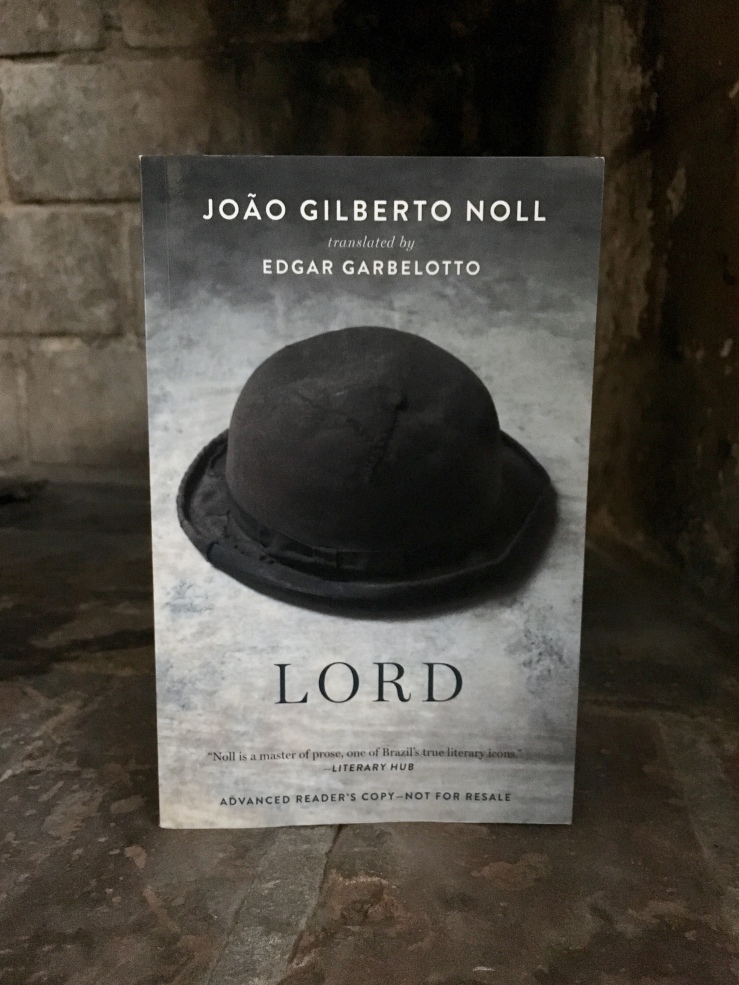
A review of Lord, João Gilberto Noll’s abject novel of dissolving identity

img_2336

João Gilberto Noll’s short novel Lord is an abject and surreal tale of madness. Madness is perhaps not the correct term, although it does point towards Lord’s gothic and abject modes. Perhaps it’s more accurate to say that in Lord, Noll gives us a consciousness dissolving and reconstituting itself, a first-person voice shifting from one reality to the next with absurdly picaresque energy.

That first-person voice is “a Brazilian who wrote books that were mostly well received by critics but not the public.” The Brazilian novelist travels to cold winter London on an unspecified “mission.” Indeed, the mission remains unspecified to both reader and narrator alike, although it does seem to involve an English university. The man who arranges for the narrator to come to London is himself a shifting cipher in Lord, transforming into different entities—at least in the narrator’s (often paranoid) view. We get the sense in Lord that consciousness is always under radical duress, that a state of being might collapse at any time or give way to some other, unknown state of being.

Throughout Lord, Noll dramatizes abject consciousness in turmoil. Early on, the narrator, already feeling uncertain about why he has moved halfway across the world, arrives at a university’s Portuguese department. In a book-lined office, he attempts to stabilize himself through the textual “reality” of printed matter:

The walls were covered with books. I trailed my hand over them as if to confirm the reality I was living in. Though I knew I was not living an unreality per se—like those born out of a simple dream and ending up in a nightmare, which we can only escape from when we wake up sweaty, trembling, and confused.

The irony is that the narrator has not fully comprehended yet that he is living an unreality, that he is actually narrating the nightmare. Noll’s hero is an unfixed voice, a voice that can’t square the signifiers around him with any stable signified meaning in his consciousness.

Slowly (but not too slowly—Lord moves at a steady clip), the narrator embraces this abjection and wills the dissolution of his self and its reformation into some new other. “My tiredness did not demand sleep, but, damn!, how I craved some indistinguishability between bodies, volumes, and formats,” he tells us.

The narrator carries his project of transformation even farther, applying cosmetics and hair dye to alter his appearance and “find a new source for [his] new formation”:

My lack of definition was already greater than me, although I had lost myself and begun to suspect that even my English boss couldn’t do anything to bring me back to me. I needed to keep up this task of being every- one somehow, because without it I wouldn’t even make it as far as the corner: without asking anyone, I happened to have overcome being the individual whom I had mechanically created for other people. I had to find a new source for my new formation, even now in my fifties, and that fountain would come from him, that light brown-haired man with makeup on, who lived in London for the time being without exactly remembering why.

Lord’s narrator takes this new version of himself on various London adventures, most of which are lurid and gross, and many of which are downright horny. Our Brazilian writer (who is slowly unbecoming a Brazilian writer) visits museums and has weird sex encounters, sleeps on the streets and takes a soapy bath with a Professor of Latin American Studies. Lord moves at a rapid and occasionally bewildering pace, giving the narrator’s quest a mock-ironic urgency. In Edgar Garbeletto’s capable English translation from the Portuguese, the paragraphs go on for pages but the sentences are choppy, riddled with colons and dashes, lurches and leaps, falls and stops.

Through this turbulent rhetoric, Lord’s narrator channels other voices, sublimating them into the text proper. The narrator absorbs bits and pieces of the other voices he encounters, dissolving his consciousness into and out of them as he strives for transformation. He also absorbs bits and pieces of bodies—fluids and other detritus, other abject bits of our human borders.

Our narrator is obsessed with borders, but his transgression of them has little to do with a moral framework. For the narrator, moral semblance is simply the result of an “individual…mechanically created for other people.” Rather, the narrator is fascinated by what makes a consciousness conscious. However, he’s not yet willing to cross the ultimate border, despite his fascination. In one little episode of Lord, our hero happens upon a dying man on the street. He watches the man pass from life:

I squeezed his hand. His mouth opened, and I could see the pool of blood that had overflowed his rotten teeth. That death, in some way, in some corner of my mind, gave me tremendous satisfaction. Someone was not afraid to go all the way to the end. To do for others what everyone tried to avoid. I wished I could follow him, but I didn’t have his bravery; I lacked the necessary elements to consummate the act. I needed that hug today.

A strange hug indeed!

The apparent finality of death as cessation-of consciousness holds a certain appeal to Lord’s narrator, whose quest is perhaps to overcome abjection via transformation. But it’s not easy,

It’s not just a snap, man: it’s being stuck in this limbo between staying in England and going back to South America that made me unrecognizable to myself anymore, it didn’t let me transfigure myself, it wouldn’t let me leave this stupid little body here, vomit myself out in disgust, or turn me into someone else.

Indeed, the quest in Lord might be summarized by that phrase: “vomit myself out in disgust.” While the voice in Lord remains untethered by the normal strictures of narrative (or even moral) logic, it is hardly free or disembodied. Indeed, the relationship between bodies and consciousness is perhaps the primary problem of Lord. Our narrator’s voice has a body that can’t catch up to what’s happening in its consciousness. Hence the novel’s preoccupation with the corporeal reality of bodies: blood, urine, semen, sweat, vomit…all the leaking stuff of humanity spurting out, transgressing the apparent borders and showing those borders are but a moral fiction.

In one abject episode, our narrator attempts to dispel London himself from his consciousness:

On a corner in Bloomsbury, a totally unexpected need to vomit hit me. I wiped myself with a sheet of newspaper that was fluttering by. But I couldn’t stop; I realized it was London I was throwing up, London with its ghosts and impossible missions, already entirely unsuccessful.

Tellingly, the narrator grasps a newspaper that just happens to be “fluttering by” to clean himself, to restore the moral fiction of an arranged, presentable self. The newspaper, like the books in the university office, is another nod to Lord’s metatextual motif. The written word proves to be illusory as an anchor in Noll’s novel—it cannot codify consciousness, it cannot fix meaning. Hence, the novel’s strange, disruptive rhetorical program, which takes first-person consciousness and literally deconstructs it.

The fact that Noll’s hero is/was a writer, “a Brazilian who wrote books that were mostly well received by critics but not the public,” suggests another metatextual nod. Lord’s narrator is a strange cipher of Noll himself. In 2004, the year Lord was published, Noll  served as writer-in-residence at the Centre for the Study of Brazilian Culture and Society at King’s College London. But the narrator is a cipher of Noll only—a voice that deconstructs and reconstructs itself, autofiction that dissolves the self.

This abject voice tries to reinvent itself from the outside in, only to vomit the inside back out again. Utter disintegration seems fatally imminent; madness seems inescapable. As one reaches the final pages of Lord, one senses that the narrative might fall apart into nothing—which, to be clear, it doesn’tLord sticks its ending a strangely and suitably satisfying way. I won’t give away the end, but instead reverse the course of my previous sentence: Lord falls apart into something.

Like Quiet Creature on the Corner and Atlantic Hotel (the other Noll books currently available in English translation),  Lord is propelled on its own dream-nightmare logic. It’s fucked-up, gross, abject, and surreal. It’s permeated by a vague horror. Reading it might make parts of your stomach hurt. I like these particular flavors, and I particularly like a book that doesn’t just upset me with its themes and its plot, but also with its style and its rhetoric. Lord certainly isn’t for everyone, but I loved it, and I think that there’s an audience of weirdos out there like me who will really dig this book too. Highly recommended.

João Gilberto Noll’s Lord is new from Two Lines Press. It is the third novel by Noll Two Lines has published. I hope they publish more. 


Reviews, riffs, anti-reviews, etc., January and February 2019 (and an unrelated fox)

I kicked of the New Year by riffing on some reading plans for 2019. (I’ve already read four of the seven books on that list—uncharacteristically on track for me).

At The Comics Journal, I reviewed NYRB’s reissue of Saul Steinberg’s The Labyrinth. I included The Labyrinth on my list of favorite comix of 2018, which ran as part of a feature at The Comics Journal. This is what I wrote about The Labyrinth on the list:

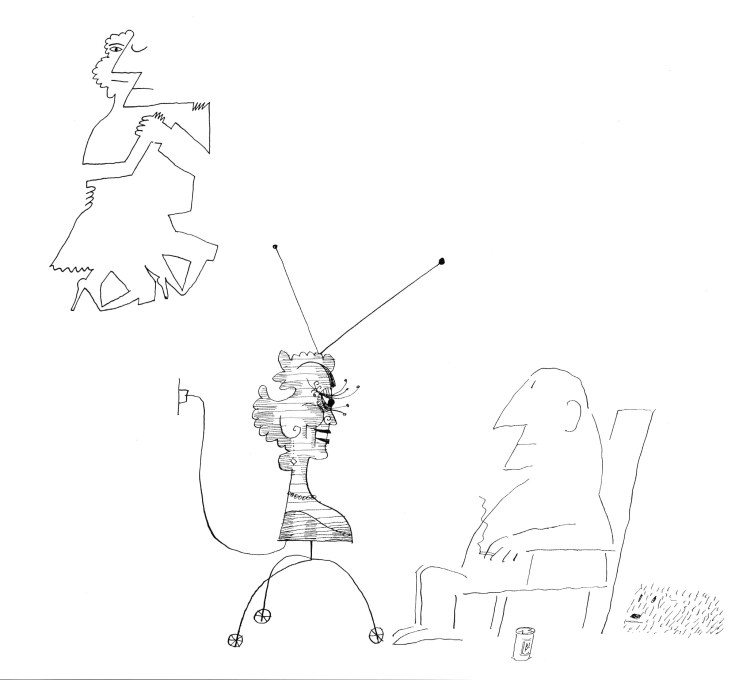
The Labyrinth by Saul Steinberg. (NYRB) First published in 1960 and back in print again from the NRYB this year, Saul Steinberg’s The Labyrinth condenses the modern and the mythic. “Steinberg was a lyricist of the metal nib—a twirler of nonverbal non sequiturs,” notes novelist Nicholson Baker in his introduction to the new volume. Steinberg’s lyrical non sequiturs evince in squiggles and dots, tangles and loops which turn into well-dressed men and staid women, cityscapes and night scenes, cocktail parties and art shows. Steinberg turns Abraham Lincoln into Don Quixote, with Santa as his Sancho Panza. He takes us out of urbane New York and into midcentury America, land of motor courts and baseball parks, a knotty chaotic chorus of life. Steinberg could seemingly do anything with ink, as the range of styles in The Labyrinth shows, but what he ultimately did was utterly-Steinbergian. The Labyrinth echoes Whitman’s Leaves of Grass, which sought a century earlier, to find a new language to describe a new country. Steinberg looked at America through new eyes, and, like Whitman before him, found a new language of expression—the language of labyrinthine lines on paper.

I wrote about a metatextual moment at the end of William Gaddis’s novel The Recognitions.

I reviewed (again at The Comics Journal) Paul Kirchner’s collection Hieronymus & Bosch.

I riffed a little on Angela Carter’s surreal horny abject picaresque novel, The Infernal Desire Machines of Doctor Hoffman, along with Remedio Varo’s letters and more.

I wrote a review of Yevgeny Zamyatin’s prescient novel We, essentially arguing that it’s the ur-text of dystopian fiction.

I also reviewed Lucia Berlin’s collection Evening in Paradise.

My review of  Roberto Bolaño’s latest posthumous novel The Spirit of Science Fiction was as much a cataloging of that novel’s place (and other unreleased early novels) in the Bolañoverse as it was anything else—although I did write about the book, of course:

Indeed, for many Bolaño fans, reading these early novels feels like its own project—winnowing for seeds, pulling at the threads that will cohere into something grander in the Bolaño’s future (which, from a readerly perspective, is the past). So when FS&G published Wimmer’s translation of Woes of the True Policeman in 2012, it was hard for many readers to see the novel as anything but ancillary materials for 2666—it was hard to read the novel as a discrete work, on its own. Instead, the question Woes asked Bolaño fans was, Where does this fit in the Bolañoverse?

The same question is in play for the latest posthumous Bolaño release, The Spirit of Science Fiction (Penguin, Wimmer). A simple read, and one that is not incorrect, is that The Spirit of Science Fiction feels like a trial run at The Savage Detectives. In particular, Spirit blueprints the first and third sections of The Savage Detectives, sections that revolve around the immature adventures of two would-be poets in Mexico City in the 1970s. Instead of Arturo Belano and Ulisses Lima though, we get Jan Schrella (“alias Roberto Bolaño”) and Remo. These two heroes divide Bolaño’s literary ambitions into poetry and prose, posterity and potboiler pulp fiction. In The Savage Detectives, Arturo Belano and Ulisses Lima will synthesize these ambitions more grandly in their literary quest.

I also riffed a little bit on Jon McNaught’s Kingdom and the act of reading physical books.

The last longer piece I managed in February was a take on the final scenes of True Detective Season 3.

Unrelated fox by Ohara Koson, c. 1930:

fox_in_the_reeds

Blog about the last three scenes of True Detective Season 3

Screenshot 2019-02-25 at 4.03.14 PM

I enjoyed Season 3 of True Detective, and thought the season finale, which aired last night on HBO, was especially good. Like the season as a whole, this eighth episode, “Now Am Found,” was rich, sad, ironic, often menacingly sinister, and ultimately ambiguous. “Now Am Found” showed that, like the two seasons that preceded it, True Detective’s third season was ultimately not about the criminal investigation purportedly at its center. Rather, True Detective is about the people who investigate the crimes, and how the investigations impact their relationships.

Three relationships drive the third season of True Detective: the relationship between Detective Wayne Hays (Mahershala Ali) and his partner Detective Roland West (Stephen Dorff); the relationship between Hays and his girlfriend and then wife Amelia Reardon (Carmen Ejogo); and the strange relationship between iterations of Hays himself, primarily versions of himself from 1980, 1990, and 2015. Like Season 1 of True Detective, Season 3 employs multiple timelines, often to a purposefully confounding effect.

Looping timelines are part of True Detective’s DNA. In Season 1, Rustin Cohle (Matthew McConaughey) proclaims that “time is a flat circle,” paraphrasing Nietzsche’s idea of eternal recurrence. Our souls will infinitely repeat everything we have ever done or will do. Season 3 dramatizes Cohle’s proclamation via its viewpoint character, Wayne Hays, who is, to borrow a phrase of Kurt Vonnegut’s “unstuck in time.” Hays is in the early stages of a creeping dementia in the 2015 timeline, and throughout the series his consciousness veers between the years.

In 1980, Hays and West begin investigating the murder of Will Purcell and the kidnapping of his sister, Julie Purcell. Hays also meets his future wife Amelia in this investigation. In 1990, a second investigation into the Purcell case is under way; Hays and West attempt to right some of the wrongs that went down in the 1980 case. In 2015, Hays and West initiate a third Purcell investigation (not letting the fact that they are no longer police officers stand in their way). True Detective Season 3 unspools, tangles, and ties these threads into a bewildering and often thrilling tapestry, ultimately depicting a man whose mind is falling apart.

Like the episodes before it, “Now Am Found” dips freely from timeline to timeline. However, this final episode is bookended by two scenes that deviate from the main 1980-1990-2015 plotlines. The opening scene seems to be set a few years after 1990—perhaps in ’94 or ’95. Amelia is teaching English at the University of Arkansas, where Hays is now the head of campus security. In an idyllic moment that restages their initial meeting in 1980, Hays sticks his head into Amelia’s classroom to hear her read a bit of Delmore Schwartz’s poem “Calmly We Walk through This April’s Day.” This moment is the only glimpse we get of this timeline, a timeline that Amelia and Hays promise to create for themselves roughly half way through “Now Am Found.” In a scene that caps the end, or an end (there are no tidy ends in True Detective) to the 1990 timeline, Amelia and Hays agree that their relationship has been inextricably bound up in the Purcell case; their partnership’s genesis was rooted in murder and mystery. They elect to start anew, to write their own conclusion. The episode’s beginning delivers this conclusion, an ironic inversion that represents the season’s approach to linear time.

The second scene that deviates from the 1980-1990-2015 plotlines is the very last shot, which I will come to momentarily. First though, let me address the third-to-last and second-to-last scenes (which, after all, is what this blog’s title promised).

The season’s third-to-last scene comes after Hays follows one last lead as to where Julie Purcell might be. The lead comes from a vision of Amelia (prompted by reading a snippet of the true crime book she wrote about the case, which Hays has never fully read). The vision is a phantom, a ghost emanating from his own consciousness, and it directs him to write another conclusion in the Purcell case—a happy ending with a family restored. However, when Hays finally makes it to the woman whom he believes is Julie Purcell, his dementia undoes him. He calls his son, who arrives along with Hays’ daughter, to bring the old man home. Hays hands over the last clue to the Purcell case—the address he drove to—to his son, who is also a detective. The loop remains open.

Screenshot 2019-02-25 at 3.57.42 PM

Hays and his grown children return to Hays’ son’s house. This third-to-last scene plays out as a glowing, bright fantasy of familial reconciliation, extending that reconciliation to Hays’ once-estranged partner West. The family (including West) gaze on their children from the porch, iced teas in hand, rocking softly, their hands touching. It’s almost too godddamn corny for words.

The scene swells with menace though. The sun promises to set, and we pan to a shot of Hays’ grandchildren, boy and girl on bikes. The shot echoes the first episode’s shots of Will and Julie Purcell riding their bikes into the night, into peril. Hays will never get outside of the circle in which his consciousness is circumscribed.

Screenshot 2019-02-25 at 3.57.51 PM

Through Hays’ consciousness we depart the scene entirely. In a fantastic shot, we see Hays’ face submerge into time. Mahershala Ali is excellent in True Detective Season 3, and his eyes are especially expressive, signalling shifts in consciousness, in realization and unrealization.

Screenshot 2019-02-25 at 3.58.58 PM

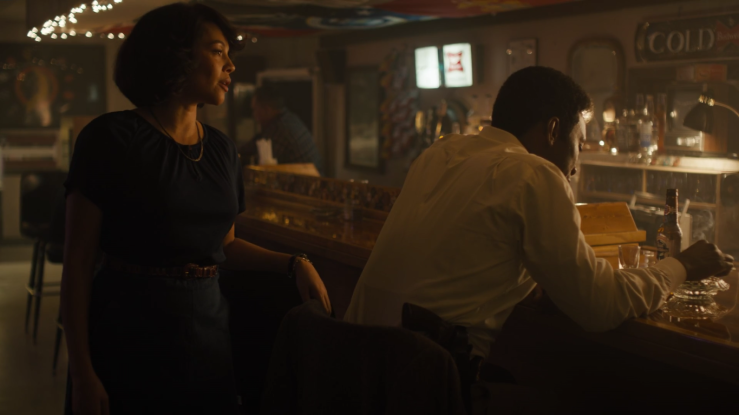
The third-to-last scene transitions to the second-to-last scene through Hays’ eyeball. We end up at the VFW bar, all the way back in 1980, to reconcile with the person missing from the family reunion depicted in 2015: Amelia.

Screenshot 2019-02-25 at 3.59.53 PM

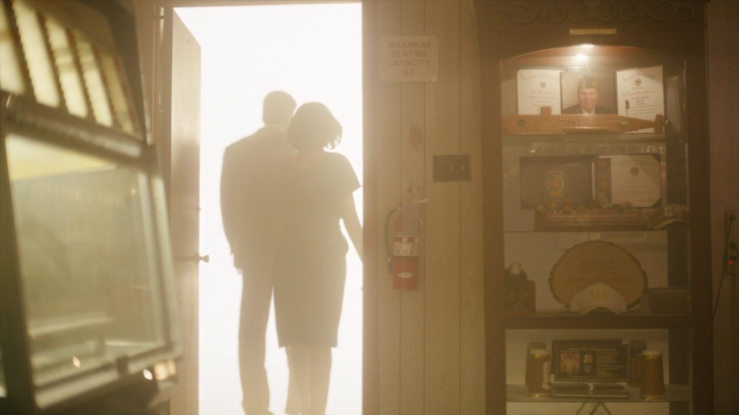
Amelia, like West, was both partner and rival to Hays. Their partnership seemed doomed after the fallout of the 1980 investigation. Amelia, also a true detective, authors an article that damns Hays’ career. This point of resentment boils throughout the season, particularly during the 1990 strands; resentment and competition are seeded into their partnership. And yet when Amelia arrives at the VFW bar, searching for a resolution, a conclusion if not a reconciliation, she opens something new in Hays, who cries before her and then asks her to marry him. The two exit into a glowing light, off to repeat their parts in a circle to which the viewers have already borne witness. This scene too is coded in subtle irony. Their new beginning will not set them free from the arc of their circle.

Screenshot 2019-02-25 at 4.02.57 PM

The light resolves into darkness, and we find ourselves some place utterly new yet wholly recognizable. Amelia is gone; the family is gone. This scene is Hays alone, somewhere in the jungles of Vietnam. It’s likely some time around 1965. Hays turns and looks directly toward the camera, but also, perhaps, directly at some version of himself, some version from 1980, 1990, 2015. He seems to gaze forward at the eye that gazed backward at him from half a century in the future.

Screenshot 2019-02-25 at 3.56.03 PM

Wayne Hays then turns and walks into the enveloping jungle. He disappears. Season 3 of True Detective is over.

The moment that Hays disappears into a Vietnamese jungle is ambiguous, sure. But given True Detective’s formal thesis that “time is a flat circle,” we can also read this ending as a suggestion that Hays is bound to repeat his arc. The Vietnam War is in many ways the founding unaddressed trauma of Hays’ life, and the series in a bleakly ironic gesture puts him right back there at the ending.

The title of “Now Am Found” clearly alludes to “Amazing Grace,” but the episode’s events ironically show that Hays can never be found. True, there are momentary gestures of reconciliation, of “being found” — by his son and daughter, by Amelia, by his partner West — but Hays is a consciousness in fragments, a kind of damned loop of a person suffering through a purgatory he doesn’t fully have the language to describe, let alone communicate to another person.

Screenshot 2019-02-25 at 4.03.46 PM

Some viewers may have found the final shot of “Now Am Found” bewildering, inexplicable, or unnecessary. I thought it was a sad, rich image that provided a vital coda for a sad, rich television show. The final image serves to reinforce the series’ trope of eternal recurrence, undoing (or, more charitably simply complicating) the episode’s opening scene, in which we saw a peaceful, happy Hays and Amelia. But if the final scene in Vietnam undoes the domestic bliss that Hays and Amelia authored for themselves, it also points to the promise of futurity, of a future that goes on and on and on.


A review of Yevgeny Zamyatin’s prescient dystopian novel We

img_2163

Set millennia in the future, Yevgeny Zamyatin’s 1921 dystopian novel We tells the story of a man whose sense of self shatters when he realizes he can no longer conform to the ideology of his totalitarian government. Zamyatin’s novel is a zany, prescient, poetic tale about resisting the forces of tyranny, conformity, and brute, unimaginative groupthink.

We is narrated by D-503. D-503 is an engineer building a spacecraft, the Integral, which will expand the domain of OneState. Although OneState has conquered earth (after the apocalyptic Two Hundred Years War), they seek to expand their empire of conformity to the stars, perhaps replicating their giant city-state on planets yet unknown. In its physical form, OneState is a glass panopticon surrounded by a great Glass Wall that keeps the wild natural world out. In its ideological form, OneState mandates uniformity, mechanization, and mathematical precision. The denizens of OneState conform to this ideology at all times. They wear uniforms — “yunies” — that bear the numbers that serve as their names. Indeed, they are “Numbers,” not people. The Numbers wake and sleep at the exact same hour. They march in unison and live and work in glass buildings. They “vote” to elect the same Benefactor each year, who runs unchallenged. They eat foods made from petroleum and produce children in a machine-like process that follows a system of “Maternal and Paternal Norms.” Numbers that don’t meet these Norms are forbidden from reproducing, but any Number can register for intercourse with another Number on Sex Day. A secret police force, the Bureau of Guardians, monitors the population, but it’s ultimately groupthink that keeps the Numbers in line.

One-State’s groupthink ideology is neatly summed up in propaganda that D-503 shares late in the novel:

Here’s the headline that glowed from page one of the State Gazette:

REJOICE!

For henceforth you are perfect! Up until this day your offspring, the machines, were more perfect than you.

IN WHAT WAY?

Every spark of the dynamo is a spark of purest reason. Every stroke of the piston is an immaculate syllogism. But do you not also contain this same infallible reason? The philosophy of the cranes, the presses, and the pumps is as perfect and clear as a circle drawn with a compass. But is your philosophy any less perfect? The beauty of the mechanism is in the precise and invariable rhythm, like that of the pendulum. …But think of this: The mechanism has no imagination.

Imagination is the ultimate enemy of the machine, and the Benefactor and his Guardians have a plan to finally root it out and exterminate it.

Throughout much of We, D-503 is very much attuned to this ideology. D-503 thinks of OneState as “our glass paradise.” What we see as dystopia he sees as utopia, he initially constructs We as a testament to OneState’s glory that he will include as part of the cargo of the Integral. However, as the narrative unfolds, D-503 unravels. His sense of self divides as signs of mental illness emerge–first dreams, then an imagination, and then—gasp!—a soul.

D-503’s internal conflict stems from discovering his own innate irrationality—namely, a soul which cannot be measured in numbers or weighed in physical facts. This internal conflict drives much of the narrative of We. Zamyatin delivers this conflict in D-503’s first-person consciousness, a consciousnesses that contracts and expands, a consciousness that would love to elide its own first-person interiority completely and subsume itself wholly to a third-person we—but he can’t. Consider the following passage;

I lie in the bed thinking … and a logical chain, extraordinarily odd, starts unwinding itself.

For every equation, every formula in the superficial world, there is a corresponding curve or solid. For irrational formulas, for my √—1, we know of no corresponding solids, we’ve never seen them…. But that’s just the whole horror—that these solids, invisible, exist. They absolutely inescapably must exist. Because in mathematics their eccentric prickly shadows, the irrational formulas, parade in front of our eyes as if they were on a screen. And mathematics and death never make a mistake. And if we don’t see these solids in our surface world, there is for them, there inevitably must be, a whole immense world there, beneath the surface.

I jumped up without waiting for the bell and began to run around my room. My mathematics, up to now the only lasting and immovable island in my entire dislocated life, had also broken loose and floated whirling off. So does this mean that that stupid “soul” is just as real as my yuny, as my boots, even though I can’t see them now (they’re behind the mirror of the wardrobe door)? And if the boots are not a disease, why is the “soul” a disease?

What initiates D-503’s anti-quest for a soul? It is a woman of course. I-330 interrupts D-503’s routine life, puncturing his logic with irrational passions, taking him on transgressive trips to the Old House—and eventually, leading him to the greatest transgression of all. You see, there’s an underground movement, a secret resistance force—one that not uncoincidentally needs access to the Integral—and this resistance plans to…but I shouldn’t spoil more.

Or really, could I even spoil the plot of We? So many novels and films have borrowed heavily from (or at least echoed) its premise that you already know what it’s about. The major examples are easy—Huxley’s Brave New World (1932), Lang’s Metropolis (1927), Orwell’s 1984 (1949), Vonnegut’s Player Piano (1955), etc. Then there are all their followers—the cheap sci-fi paperbacks of the sixties and seventies, their corresponding films—Logan’s RunSoylent Green–and so on and so on, well into our Now (Running ManTotal RecallThe Matrix, The Hunger Games, etc. forever).

You get the point: We is a generative text. And after reading We, I couldn’t immediately think of a clear generative text that generated it. From what materials did Zamyatin craft his tale?  The closest predecessor I could initially think of was Jack London’s The Iron Heel (1907), or maybe bits of H.G. Wells’ The Time Machine (1895), neither of which feel as thoroughly modern as We does. However, cursory research (uh, skimming Wikipedia) turned up Jerome K. Jerome’s 1891 short story, “The New Utopia,” which does feature some of the tropes we find in We. Set in city of the future, “The New Utopia” features uniformed, nameless, numbered people whose government attempts to destroy the human imagination. Here, the “Destiny of Humanity” has become an egalitarian nightmare.

While it’s likely that “The New Utopia” furnished Zamyatin some of the tropes he needed to construct We, Jerome’s story simply doesn’t have the same epic themes of underground resistance to technological bureaucracy that have became the stock of so much 20th and 21st-century science fiction. (I rewatched Terry Gilliam’s Brazil (1985) while reading We, and the parallels are remarkable—but the same can be said for any number of sci-fi films of the last sixty or so years).

More significantly, Jerome’s “The New Utopia” is beholden to a rhetorical scheme that makes it feel closer to an essay than a finished work of art. The story is essentially a one-sided dialogue—a man falls asleep, wakes up a few thousand years later, and gets the skinny on the utopian nightmare city he’s awoken in from an enthusiastic Future Person. Reading “The New Utopia” reminded me of reading London’s The Iron Heel, which essentially works in the same way—London’s plot often feels like an excuse to stitch together Marxist readings into monologues posing as dialogues.

Zamyatin’s book, in contrast, is Something New. We is a work of Modernism, not just a collection of new tropes, but a new configuration of those tropes. Zamyatin’s D-503 is a consciousness in crisis, a self that simultaneously dissovles and resolves into something new—a creature with a soul. Consider D-503’s recollection of a nightmare:

It’s night. Green, orange, blue; a red “royal” instrument; a yellow-orange dress. Then, a bronze Buddha; suddenly it raised its bronze eyelids and juice started to flow, juice out of the Buddha. Then out of the yellow dress, too: juice. Juices ran all over the mirror, and the bed began to ooze juice, and then it came from the children’s little beds, and now from me, too—some kind of fatally sweet horror….

The prose here showcases Zamyatin’s vivid style. We, crammed with colors, often evokes Expressionist and Futurist paintings. We get here a painterly depiction of D-503’s abjection, his sense of a self leaking out in “some kind of fatally sweet horror” — his boundaries overflowing. The dream-synthesis here is at once joyful, terrifying, and utterly bewildering to our poor hero. It is also poetic in his rendering. D-503 laments early in his narrative that he is not a poet so that he cannot properly celebrate OneState in writing for his readers. But later, his friend R-13—a poet himself—tells him that he has “no business being a mathematician. You’re a poet…a poet!”

R-13 is correct: D-503 is a poet, a poet who cannot abide all the metaphysics gumming up his mathematical mind. This poetry is rendered wonderfully in the English translation I read by Clarence Brown (1993), and is showcased in the very “titles” of each chapter (or “Record,” in the book’s terms). Each “Record” begins with phrases culled from the chapter. Here are a few at random:

An Author’s Duty

Swollen Ice

The Most Difficult Love


Through Glass

I Died

Hallways


Fog

Familiar “You”

An Absolutely Inane Occurrence


Letter

Membrane

Hairy Me

These are the titles of four random chapters, but I suppose we could string together the whole series and arrive at a Dadaist poem, one that might also serve as an oblique summary of We.

And yet for all its surrealist tinges and techno-dystopian themes, the poem that We most reminded me of was, quite unexpectedly, Walt Whitman’s Song of Myself (1855). Whitman’s poem sought a new language and a new form to tell the story of a new land, a new people. He wanted to be everyone and no one at the same time, himself a kosmos, form and void, an I, a you, a we. Whitman addressed his poem to both the you of his readership, an immortal future readership beyond him (“Listener up there!”) as well as himself, famously declaring: “I loaf and invite my soul.”

D-503 presents almost as an anti-Whitman. He directly addresses his “unknown readers” in nearly every chapter, and with a Whitmanesque turn, like this one: “You, my unknown readers, you will be told everything (right now you are just as dear, as close, and as unapproachable…).” His ebullience and optimism are ironic of course—they are honest performances that crack under the increasing reality of his emerging soul. Unlike Walt Whitman, D-503 cannot loaf and invite his soul. He can’t sustain the negative capabilities Whitman’s poem engenders. His we cannot reconcile with an I, even as it seeks a mediating you in its dear readers.

And yet for all its bitter ironies and for all its hero’s often feckless struggle, We is a comedy. The book is a cartoon-poem-satire, its comedy sustained in the careening voice of D-503. It’s somewhat well known that George Orwell used We as a template for 1984 (he began that novel less than a year after penning a review of a French translation of We). Orwell’s novel though falls into the same essaying that we see in The Iron Heel and “The New Utopia.” It’s also awfully dour. In contrast, We shuttles along with zany elan, inviting us to laugh at modern absurdity. Indeed, Zamyatin posits laughter as resistance to tyranny, myopia, and brutish closed-mindedness. Late in the novel, D-503 arrives at the following epiphany:

And that was when I learned from my own experience that a laugh can be a terrifying weapon. With a laugh you can kill even murder itself.

I could end by cataloging the various parallels that might be drawn between We and our own dystopian age, but I think that they are too obvious, and, as I’ve noted, have been repeated (with degrees of difference) throughout the body of dystopian narratives that We has helped generate. What the book does though—or I should say, what it did for me—is offer the strange comfort. A century after Zamyatin diagnosed the emergence of another modern world, the human position remains essentially unchanged, and in times of despair we can remember to laugh—and imagine to imagine. Very highly recommended.

A review of Paul Kirchner’s Hieronymus & Bosch, a slapstick comedy set in Hell

hb

My review of Paul Kirchner’s latest collection Hieronymus & Bosch is up at The Comics Journal. Here is the first paragraph of the review:

Paul Kirchner’s Hieronymus & Bosch collects over eighty comic strips that riff on the afterlife of a “shameless ne’er-do-well named Hieronymus” and his faithful wooden toy duck, Bosch. The hapless pair are trapped in Hell, the primary setting for most of the strips (although we do get a bit of heaven and earth thrown in here and there). Kirchner’s Hell is a paradise of goofy gags. The one-pagers in Hieronymus & Bosch cackle with burlesque energy, propelled by a simple plot: our hero Hieronymus tries to escape, fails, and tries again.

Read the whole review.

A review of Hayao Miyazaki’s film Porco Rosso

porco-rosso

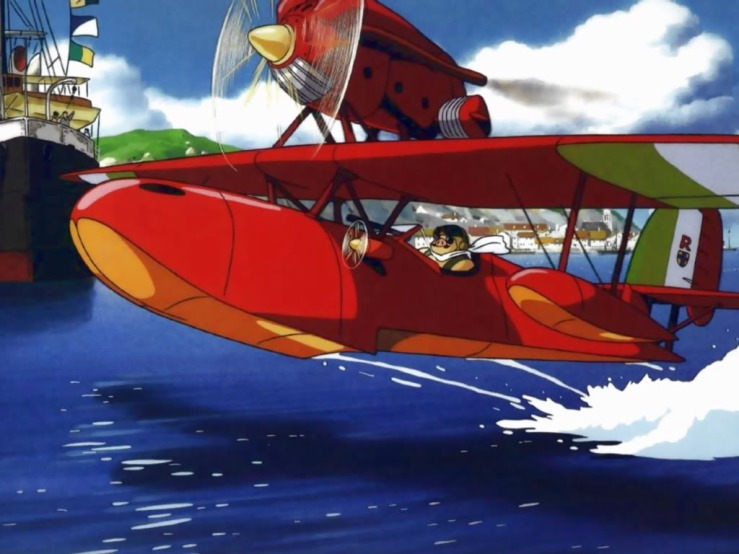
Hayao Miyazaki’s Porco Rosso (1992) is one of my favorite films, and I was able to see it this summer for the first time on the big screen thanks to Studio Ghibli Fest 2018. Although I’ve seen Porco Rosso maybe a dozen times, seeing its rich, deep, bold animation on an enormous screen felt like seeing it for the first time.

Porco Rosso takes place in and around various islands in the Adriatic Sea during the thin slice of years between the First and Second World Wars. Italy, like much of the world, is in the midst of a severe economic depression, and is slowly sliding into fascism. World War II is clearly on the horizon. Miyazaki pushes these problems to the margins of his film, conjuring instead a romanticized Mediterranean. However, this romantic space is always under the pressure of a coming disaster—fascism and a new war.

porcorosso5

The hero of Porco Rosso is Marco Pagot (called Marco Rossolini in the American dub). Marco is an ex-military pilot, an aviation ace who fought with honor for the Italian air force in the Great War. He now spends his days drinking red wine and smoking cigarettes on a beautiful deserted island, occasionally taking jobs as a bounty hunter, retrieving hostages and other stolen goods from the nefarious and unwashed air pirates who plunder the ships of the Adriatic. Marco makes occasional concessions to civilization by taking a meal at the Hotel Adriano, a charming resort run by his oldest friend Gina. Gina is love with Marco and we come to realize Marco is in love with Gina, but he cannot come out and say this. Marco is a pig.

20130812-161255

Marco is literally a pig. He is the victim of a curse that the film never explicitly names or addresses, although a late scene late in which Marco essentially survives an attack that should have killed him—an event that gives him a dramatic glimpse of a heaven of pilots—may be a clue to the origins of Marco’s porcine curse. In any case, Marco’s pigman existence is the film’s only concession to the kind of mythical and magical fantasy that otherwise permeates Miyazaki’s canon (with the notable exception of The Wind Rises (2013), which in some ways is a sequel to Porco Rosso).

This isn’t to say that Porco Rosso isn’t a fantasy though. Miyazaki’s world of air pirates and bounty hunters, attractive hoteliers and hotshot engineers, and seaplanes dueling in a radiant sky, brims with an effervescent energy that counterbalances the grim specter of the Great War that preceded the film’s narrative action and the Second World War—and a Fascist Italy—that the narrative’s “real” time must eventually intersect. Ever the lone pig, Marco seeks to fly away from the social and historical forces that would constrain him.

Unfortunately for Marco, luxurious isolation remains an impossibility. The air pirates hire a hotshot American to take out the damned Crimson Pig once and for all. Donald Curtis (hailing from Alabama in the Japanese version and Texas in the American) exemplifies American cockiness. His enormous jaw precedes the rest of his swaggering body, he falls in love at first sight with any beautiful woman he sees, and he’s brash and impetuous. He wants to transition to Hollywood and eventually become the President of the United States! Curtis shoots up Marco’s plane early in the film, but our porcine hero escapes to Milan, where he rebuilds his plane with the help of a whiskered mechanic named Piccolo and his charming granddaughter Fio. Fio redesigns the plane and eventually becomes Marco’s sidekick, traveling with him back to the Adriatic and helping him face Curtis and the air pirates.

2_porco_rosso

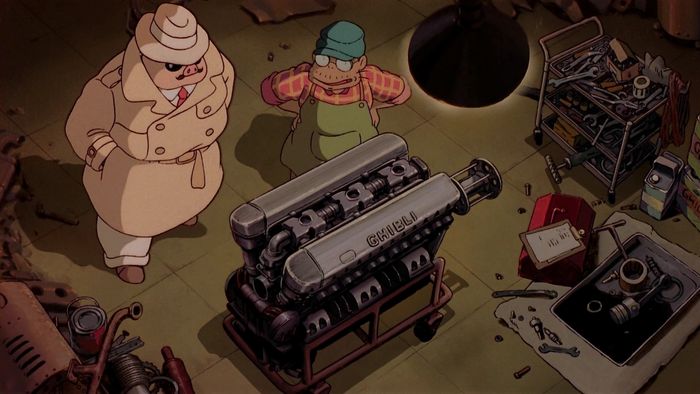
Fio, whose character design recalls Nausicaa of Nausicaä of the Valley of the Wind (1984), is another of Miyazaki’s prominent female protagonists. In some ways she is the secret hero of the film; she takes over the narration at the end, implicitly assuming Porco Rosso’s mantle. Fio has earned Marco’s trust after he is initially dubious of her ability because of her age and his sexism. Fio leads an all-female team of builders and engineers to recreate a superior version of Marco’s plane. This workshop sequence is one of the film’s finest. Miyazaki often foregrounds labor in his films, but Porco Rosso explicitly shows how a complex work—whether it’s a plane, or, y’know, a film—is never the singular work of a gifted genius, but rather the concentrated effort of a team. Miyazaki underscores the connection between the creative process of plane-building and film-making, stamping his studio’s name on Marco’s new engine. (Studio Ghibli was named after an Italian war plane, the Caproni Ca.309, which was nicknamed Ghibli—“Desert Wind”).

85268fc75512cda8cc331109c81ec95c

While in Milan, Marco realizes that the fascist secret police are after him. The Fascists in Porco Rosso (who want to conscript Marco—or take his plane) are far more ominous than Curtis. Curtis serves as an actual antagonist for Marco to face, and the fight between the two at the end of Porco Rosso, although violent, plays with a light comic touch. Miyazaki references the “gentlemen pilots” of World War I here. The Fascists, in contrast, are a spectral force lurking behind the narrative, threatening Marco’s individuality and autonomy. The film affirms itself as a comedy that resists encroaching fascism in a conclusion that sees Marco, Fio, Gina Curtis, the air pirates, and every other member of this strange Adriatic paradise working together to escape their approaching air force.

The film’s denouement is a retreat into the romantic Adriatic community, a kind of gauzy, rosy vision of an isolated paradise untouched by war or fascism. The fantasy reminds one of an island from some lost book of The Odyssey, a tranquil paradise unbothered by Trojans or Greeks. Marco—Porco—too feels like a figure from the margins of The Odyssey, a hero transfigured into a pig. The end of Porco Rosso refuses to give us a direct answer as to what happens to Porco. Does he regain his human form? Or, perhaps more importantly, is there a happy ending for Porco and Gina? The film offers a number of clues, some explicit and some implicit, but a first viewing may feel ambiguous for many viewers. However, subsequent viewings reveal a clearer picture as to what happens to Gina and Marco. Why the ambiguity then? Porco Rosso is (apart from The Wind Rises) the Miyazaki film with the strongest historicity. The historical reality of a looming World War II threatens to devour the romance of Gina and Porco—so Miyazaki and the inhabitants of his secret Adriatic world conspire to hide it. Lovely stuff.


[Ed. note–Biblioklept ran a version of this review in the summer of 2018].

A review of Saul Steinberg’s The Labyrinth

My review of NYRB’s reissue of Saul Steinberg’s Labyrinth is up at The Comics Journal. First paragraph:

First published in 1960 and back in print again from the New York Review of Books, Saul Steinberg’s The Labyrinth condenses the modern and the mythic into 250 pages of strange and wonderful cartoons. The fourth of Steinberg’s seven major compilations, The Labyrinth covers his work between 1954 and 1960, loosely distilling the state of American mid-century cartooning. Quirky, obliquely intellectual, cosmopolitan, and deeply ironic, Steinberg’s modernist approach addresses many of the major cultural changes in America during the 1950s. The Labyrinth touches on urbanization and suburbanization, the expansion of ready-made mass culture, the post-War shift in the relationship between men and women, the advent of televisual mass media, and the zany paranoia of the Cold War zeitgeist.

J.G. Ballard’s “The Subliminal Man,” John Carpenter’s They Live, and Black Friday

Today is Black Friday in America. I don’t think it’s necessary to remark at length on the bizarre disjunction between this exercise in consumerism-as-culture and the intended spirit of the Thanksgiving holiday that precedes it. Indeed, I think that the cognitive dissonance that underwrites Black Friday—the compulsion to suffer (and cause suffering), both physically and mentally,  to “save” money on “consumer goods” (sorry for all the scare quotes, but these terms are euphemisms and must be placed under suspicion)—I think that this cognitive dissonance is nakedly apparent to all who choose to (or are forced to) actively engage in Black Friday. The name itself is dark, ominous, wonderfully satanic.

Rereading “The Subliminal Man,” I was struck by how presciently J.G. Ballard anticipated not only the contours of consumerist culture—urban sprawl, a debt-based economy, the mechanization of leisure, the illusion of freedom of choice—but also how closely he intuited the human, psychological responses to the consumerist society he saw on the horizon. Half a century after its publication, “The Subliminal Man” seems more relevant than ever.

The premise of the tale is fairly straightforward and fits neatly with the schema of many other early Ballard stories: Franklin, an overworked doctor, is approached by Hathaway, a “crazy beatnik,” who refuses to take part in the non-stop consumerism of contemporary society. Hathaway can “see” the subliminal messages sent through advertising. He asks for Franklin’s help in stopping the spread of these messages. Hathaway reasons that the messages are intended to enforce consumerist society:

Ultimately we’ll all be working and spending twenty–four hours a day, seven days a week. No one will dare refuse. Think what a slump would mean – millions of lay–offs, people with time on their hands and nothing to spend it on. Real leisure, not just time spent buying things . . .

The fear of a slump. You know the new economic dogmas. Unless output rises by a steady inflationary five per cent the economy is stagnating. Ten years ago increased efficiency alone would raise output, but the advantages there are minimal now and only one thing is left. More work. Subliminal advertising will provide the spur.

Franklin is unconvinced, even though he is already working Saturdays and Sunday mornings to payoff TVs, radios, and other electronic goods that he and his wife replace every few months. Soon, however, he realizes that something is wrong:

He began his inventory after hearing the newscast, and discovered that in the previous fortnight he and Judith had traded in their Car (previous model 2 months old) 2 TV sets (4 months) Power mower (7 months) Electric cooker (5 months) Hair dryer (4 months) Refrigerator (3 months) 2 radios (7 months) Record player (5 months) Cocktail bar (8 months)

Franklin finally sees the truth, but only after Hathaway takes to blowing up signs’ switch boxes (the word “terrorism” is of course not used in the text, although it surely would be today):

Then the flicker of lights cleared and steadied, blazing out continuously, and together the crowd looked up at the decks of brilliant letters. The phrases, and every combination of them possible, were entirely familiar, and Franklin knew that he had been reading them for weeks as he passed up and down the expressway.

BUY NOW BUY NOW BUY NOW BUY NOW BUY NEW CAR NOW NEW CAR NOW NEW CAR NOW

YES YES YES YES YES YES YES YES YES YES

Like many Ballard stories, “The Subliminal Man” ends on a pessimistic note, with Franklin choosing to ignore his brief enlightenment and give in. Ballard drives his criticism home in the final image of the story, with Franklin and his wife heading out to shop:

They walked out into the trim drive, the shadows of the signs swinging across the quiet neighbourhood as the day progressed, sweeping over the heads of the people on their way to the supermarket like the blades of enormous scythes.

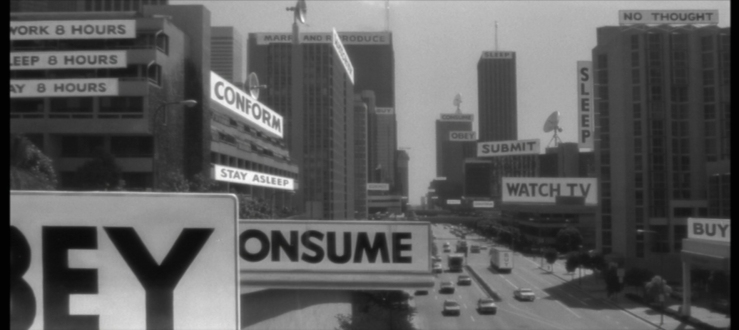
“The Subliminal Man” offers a critique of consumerism that John Carpenter would make with more humor, violence, and force in his 1988 film They Live. In Carpenter’s film, the hero John Nada (played by Roddy Piper) finds a pair of sunglasses that allow him to see through the ads, billboards, and other commercials he’s exposed. What’s underneath? Naked consumerism:

they-live-billboard

The images here recall the opening lines of “The Subliminal Man”: ‘The signs, Doctor! Have you seen the signs?’ Like Ballard’s story, Carpenter’s film is about waking up, to seeing the controlling messages under the surface.

In his film The Pervert’s Guide to Ideology, Slavoj Žižek offers a compelling critique of just how painful it is to wake up to these messages:

It’s worth pointing out that Carpenter offers a far more optimistic vision than Ballard. Ballard’s hero gives in—goes back to sleep, shuts his eyes. Carpenter’s hero Nada resists the subliminal messages—he actually takes up arms against them. This active resistance is possible because Carpenter allows his narrative an existential escape hatch: In They Live, there are real, genuine bad guys, body-snatching ugly-assed aliens—others that have imposed consumerism on humanity to enslave them. That’s the big trick to They Live: It’s not us, it’s them.

Ballard understands that there is no them; indeed, even as the story skirts around the idea of a conspiracy to dupe consumers into cycles of nonstop buying, working, and disposing, it never pins that conspiracy on any individual or group. There’s no attack on corporations or government—there’s not even a nebulous “them” or “they” that appears to have controlling agency in “The Subliminal Man.” Rather, Ballard’s story posits ideology as the controlling force, with the only escape a kind of forced suicide.

I don’t think that those who engage in consumerism-as-sport, in shopping-as-a-feeling are as blind as Ballard or Carpenter represent. I think they are aware. Hell, they enjoy it. What I think Ballard and Carpenter (and others, of course) really point to is the deep dissatisfaction that many of us feel with this dominant mode of life. For Ballard, we have resistance in the form of the beatnik Hathaway, an artist, a creator, a person who can perceive what real leisure would mean. For Carpenter, Nada is the resister—an outsider, a loner, a weirdo too. It’s somehow far more satisfying to believe that those who engage in spectacle consumerism are brainwashed by aliens than it is to have to come to terms with the notion that these people are acting through their own agency, of their own will and volition. Happy shopping everyone!

Ed. note: Biblioklept published a version of this post a few years ago. It is offered again now in the spirit of Thanksgiving leftovers.

Blog about some recent reading

img_1305

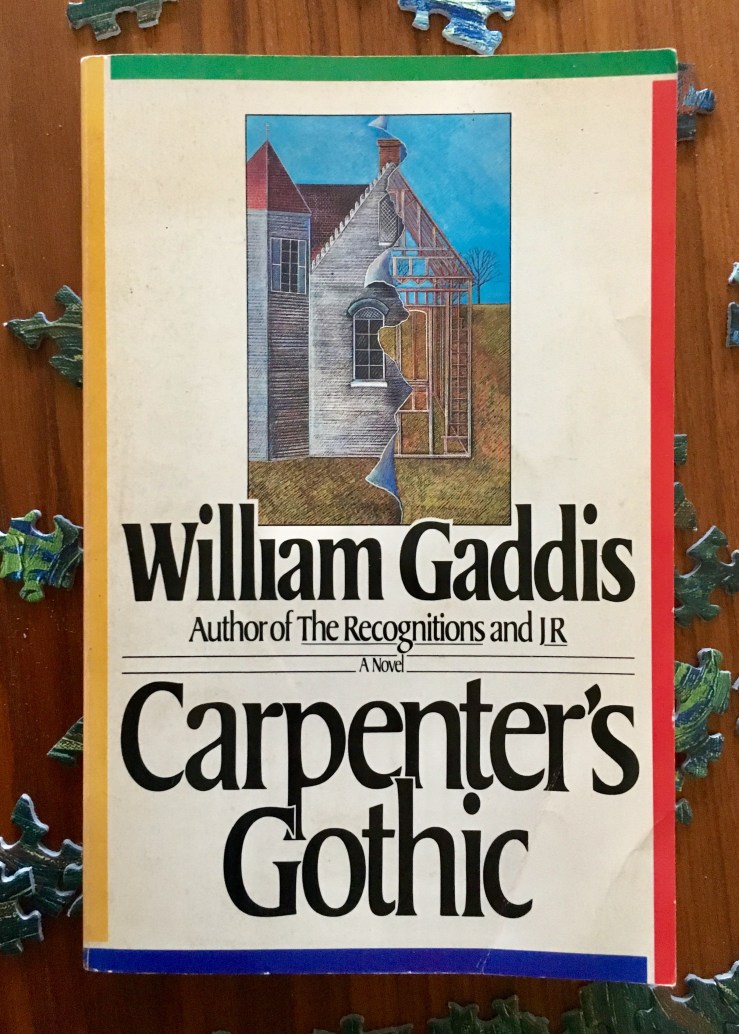
I ended up reading the last two chapters of William Gaddis’s novel Carpenter’s Gothic a few times, trying to figure out exactly what happened. I then read Steven Moore’s excellent essay on the novel, “Carpenter’s Gothic or, The Ambiguities.” (If you have library access to the Infobase database Bloom’s Literature, you can find the essay there; if not, here’s a .pdf version). Moore offers a tidy summary of Carpenter’s Gothic—a summary which should be avoided by anyone who wants to read the novel. Because Carpenter’s Gothic isn’t so much about what happens but how it happens. Moore writes:

As is the case with any summary of a Gaddis novel, this one not only fails to do justice to the novel’s complex tapestry of events but also subverts the manner in which these events are conveyed. Opening Carpenter’s Gothic is like opening the lid of a jigsaw puzzle: all the pieces seem to be there, but it is up to the reader to fit those pieces together. …Even after multiple readings, several events remain ambiguous, sometimes because too little information is given, sometimes because there are two conflicting accounts and no way to confirm either.

Moore then lays out the novel’s theme in clear, precise language:

Such narrative strategies are designed not to baffle or frustrate the reader but to dramatize the novel’s central philosophic conflict, that between revealed truth versus acquired knowledge. Nothing is “revealed” by a godlike omniscient narrator in this novel; the reader learns “what really happens” only through study, attention, and the application of intelligence.

Quite frankly, Moore has written an essay that I wish I had written myself. I had been sketching parallels between Carpenter’s Gothic and Leslie Fiedler’s classic study Love and Death in the American Novel all throughout my reading; Moore ends up citing Fiedler a few times in his essay, in particularly working from Fiedler’s idea of how Gothicism manifests in American writing. (Moore does not bring up Fiedler’s critique of masculinity though, which opens up an occasion for me to write—once I’ve reread the puzzle though).

Anyway—I loved loved loved Carpenter’s Gothic, and I read it at just about the right time: It’s a Halloween novel. Great stuff.

In line with the Halloween theme: I had been working on a post about horror, about how I love scary films, grotesque literature, and weird art, because fantasy evocations of terror offer a reprieve from anxiety, from true dread, etc. Like, you know, a climate change report—I mean, that’s genuinely horrifying. But scary films and scary stories almost never really scare me. So I was thinking about literature that does produce dread in me, anxiety in me, and listing out examples in my draft, and so well anyway I reread Roberto Bolaño’s short story “Last Evenings on Earth.” I wrote about the collection named for the story almost a decade ago on this blog, focusing on the “ebb and flow between dread and release, fear and humor, ironic detachment and romantic idealism” in the tales:

In “Last Evenings on Earth,” B takes a vacation to Acapulco with his father. Bolaño’s rhetoric in this tale is masterful: he draws each scene with a reportorial, even terse distance, noting the smallest of actions, but leaving the analytical connections up to his reader. Even though B sees his holiday with his dad heading toward “disaster,” toward “the price they must pay for existing,” he cannot process what this disaster is, or what paying this price means. The story builds to a thick, nervous dread, made all the more anxious by the strange suspicion that no, things are actually fine, we’re all just being paranoid here. (Not true!)

I’m not sure if I’ll get the essay I was planning together any time soon, but I’m glad I reread “Last Evenings.”

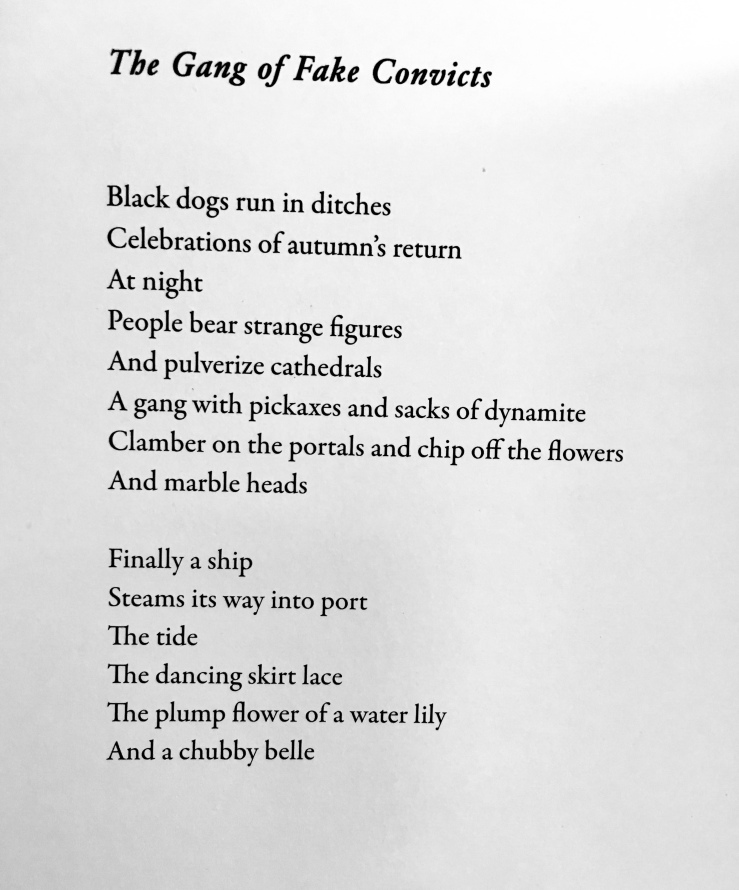
There’s a strange background plot in “Last Evenings” in which Bolaño’s stand-in “B” dwells over a book of French surrealist poets, one of whom disappears mysteriously. Jindřich Štyrský isn’t French—he’s Czech—but he was a surrealist poet (and artist and essayist and etc.), so I couldn’t help inserting him into Bolaño’s story. I’ve been reading Dreamverse, which ripples with sensual horror. I wrote about it here. Here’s one of Štyrský’s poems (in English translation by Jed Slast); I think you can get the flavor from this one:

img_1307

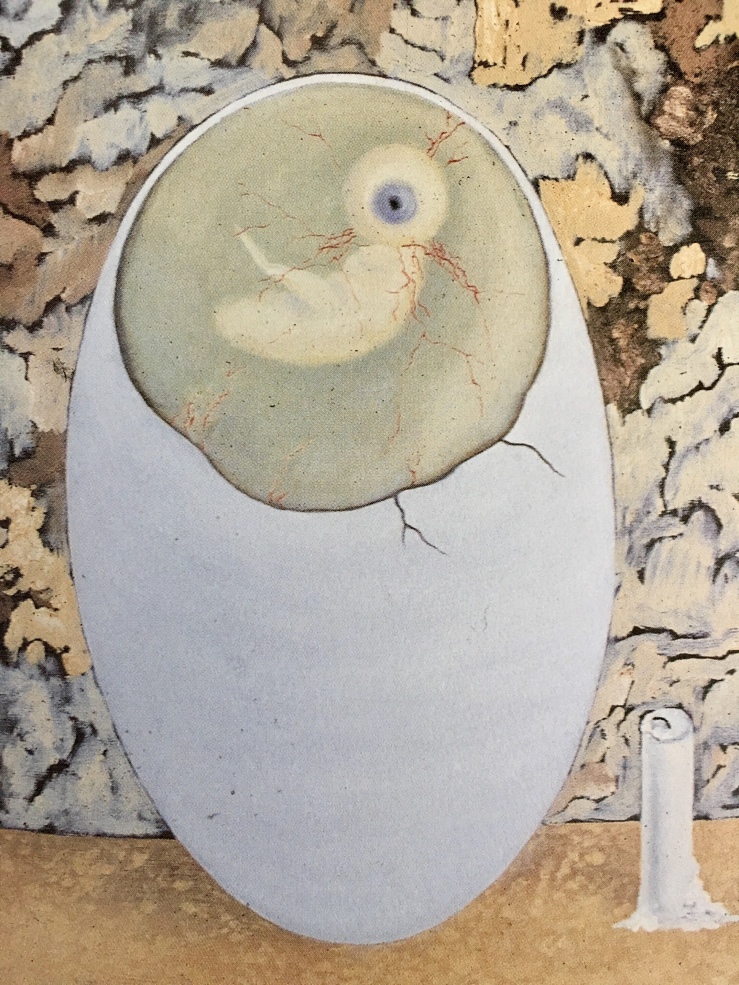
And here’s a detail from his 1937 painting Transformation:

img_1308

I’ve finished the first section of David Bunch’s Moderan, which is a kind of post-nuke dystopia satire on toxic masculinity. While many of the tropes for these stories (most of which were written in the 1960s and ’70s) might seem familiar—cyborgs and dome homes, caste systems and ultraviolence, a world of made and not born ruled by manunkind (to steal from E.E. Cummings)—it’s the way that Bunch conveys this world that is so astounding. Moderan is told in its own idiom; the voice of our narrator Stronghold-10 booms with a bravado that’s ultimately undercut by the authorial irony that lurks under its surface. I will eventually write a proper review of Moderan, but the book seems equal to the task of satirizing the trajectory of our zeitgeist.

I started Angela Carter’s novel The Infernal Desire Machines of Doctor Hoffman last night and the first chapter is amazing.

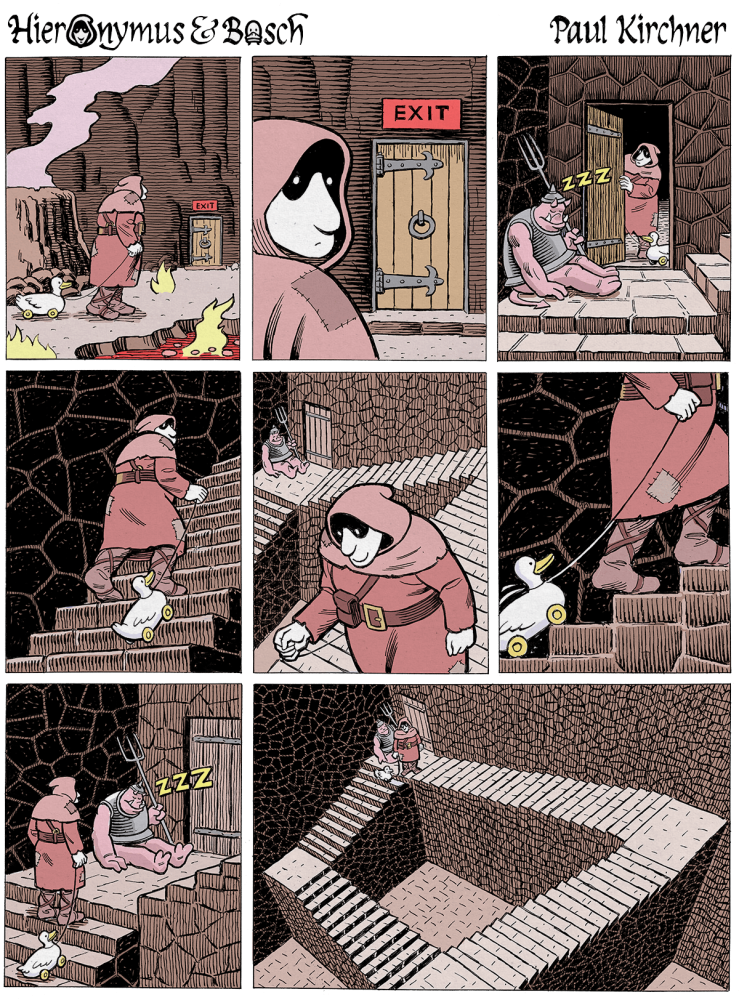
Finally, I got a hard copy of Paul Kirchner’s new collection, Hieronymus & Bosch which finds humor in the horror of hell. The collection is lovely—I should have a post about it here later this week and hopefully a review at The Comics Journal later this month. For now though, a sample strip:

hieronymus26bosch-angels-laugh36

Blog about the first 96 pages of William Gaddis’s novel Carpenter’s Gothic

img_1155

I have blazed through the first three (unnumbered) chapters of William Gaddis’s third novel Carpenter’s Gothic (1985) this weekend, consuming the prose with an urgency I did not expect. After all, Gaddis is (at least according to Jonathan Franzen) “Mr. Difficult,” right?

But Carpenter’s Gothic is not especially difficult, or does not feel that way to me, anyway—although I’m sure I find it so readable in large part because I’ve read Gaddis’s second novel  J R twice already, and Carpenter’s Gothic is written in the same style as J R. The first time I read J R did find its style tremendously challenging. Gaddis strips almost all exposition and scene-setting in J R. The novel’s 726 pages are comprised primarily in dialogue, often unattributed, leaving the reader to play director, producer, and cinematographer. Reading it a second time was, in a way, like reading it for the first time, revealing one of the best and arguably most important American novels of the second-half of the twentieth century.

In any case, reading J R has taught me how to read Carpenter’s Gothic, which is told in the same style. Carpenter’s Gothic is a smaller novel though, both literally (around 250 pages) and figuratively. While J R sports a large cast, sprawling and interlinked plots, divergent tones, and a wide array of themes, Carpenter’s Gothic is restrained to a few talking characters, whom Gaddis keeps confined to an isolated house somewhere in New England. (It is from this house’s architectural design that the novel gets its title).

The central character is Elizabeth Booth, 33, an heiress locked out of her inheritance. Elizabeth is married to an awful abusive man named Paul, a racist Vietnam Veteran who embodies almost every characteristic of what we now think of as toxic masculinity. Elizabeth is recovering from an as-yet-unspecified accident, and spends most of her time confined to her rented house, fielding phone calls. Some of these phone calls are from folks related to her husband’s latest scheme with a televangelist. Other calls are from her friend Edith who has run off to sunny Jamaica—a prospect of escape that entices Elizabeth. Even more calls come for the mysterious owner of the house, McCandless, who eventually shows up in the third chapter.

McCandless’s visit sparks something in Elizabeth. She gets to glance into his locked study, crammed with papers and books and even a piano, and she takes him for a writer, but he claims he’s a geologist. His short visit inspires Elizabeth to dig up the draft of a book, or something like a book, she’s been working on, and add a few notes. The romantic impulse is eventually punctured by her husband’s return.

Carpenter’s Gothic’s relentless interiority and inherent bitterness can give the novel a claustrophobic feeling, and reading it often reminds me of the scenes in J R that are set in the ramshackle 96th Street apartment shared by Bast and Gibbs. And yet its interiority always branches outward, evoking an exotic and pulsating world that Elizabeth might love to experience. There’s Montego Bay, there’s Orson Welles in Jane Eyre, there’s the nomadic Masai of central east Africa. Etc. But Elizabeth’s experiences are mediated by newspapers, magazine articles, phone calls, and old movies on television. It’s quite sad and frustrating.

Elizabeth thus far fits neatly into American literature’s motif of the confined woman: Walt Whitman’s 29th bather, Kate Chopin’s Mrs. Mallard, William Carlos Williams’ young housewife, Charlotte Perkins Gilman’s distressed and nervous heroine. There are many, many more, of course.  I’m not quite half way through Carpenter’s Gothic–no spoilers from you please, readers!—and curious what Gaddis will do with his heroine. Will there be an escape? Freedom? A happy ending?

So many 19th and 20th century American writers seemed unsure of what to do with their heroines, even after they had freed them (Kate Chopin’s Edna Pontellier is a particularly easy go-to example, but again: there are more). Carpenter’s Gothic seems set on a tragic track, but Gaddis has a way of making his readers recognize the farcical contours in tragedy.

I haven’t given a taste of Gaddis’s prose yet. I will share, as a closing, the novel’s opening two-sentence paragraph, which I think is simply marvelous, and which I had to read at least three times before I could turn to the novel’s second page. Here it is:

The bird, a pigeon was it? or a dove (she’d found there were doves here) flew through the air, its colour lost in what light remained. It might have been the wad of rag she’d taken it for at first glance, flung at the smallest of the boys out there wiping mud from his cheeks where it hit him, catching it up by a wing to fling it back where one of them now with a broken branch for a bat hit it high over a bough caught and flung back and hit again into a swirl of leaves, into a puddle from rain the night before, a kind of battered shuttlecock moulting in a flurry at each blow, hit into the yellow dead end sign on the corner opposite the house where they’d end up that time of day.

Blog about Evan Dara’s two-act play Provisional Biography of Mose Eakins

Screenshot 2018-10-06 at 1.38.52 PM

Evan Dara’s latest work is a two-act play called Provisional Biography of Mose Eakins. Set “c. 2015” on a stage “As bare as you can stand it,” Dara’s play follows Mose Eakins, “35-ish and spry,” as he becomes afflicted with a condition that “has come to be known as imparlence.”

Mose’s imparlence erodes his ability to communicate with others. He loses his job, his home, and eventually his girlfriend Zina, from whom he initially hides his condition. Though his life deteriorates, Mose eventually lands a job as the maitre d’ of an overpriced French restaurant. Here, his sympathies extend to the overworked kitchen staff, and he takes a stand against the unjust working conditions, trying to make meaning through his actions, even as his words fail to communicate.

Dara keeps Provisional Biography spare but active, using a device he calls “the swirl” as a kind of Greek Chorus to keep the play shuttling along, even as the narrative threatens to fall apart. And because Mose is our viewpoint character, and because Mose is afflicted with “imparlence,” the narrative of Provisional Biography is under constant threat of its own linguistic erasure. As the swirl helpfully informs the audience, “people with imparlence lose the capacity to infuse their words with intelligible significance.”

Provisional Biography’s opening lines are an especially baffling affront to “intelligible significance.” When we meet Mose, he’s already imparlent, although he does not know it yet. Consider the play’s opening lines:

MOSE: Tell me something, Jeff. Those numbers convincing to you?

(to someone else)

Bring me the swordfish. Not blackened. You got that? Not blackened. Go.

(to someone else, jauntily)

Well, you know what they say…

(to someone else)

Nice, Zina – the chart is really good. Zina, your students will love it!

(to someone else, laughing)

Tell him that and he’s totally going to have a kitten!

The first few pages of the play continue in this line, Mose’s utterances disconnected from any context that might anchor their meaning. A swirl member eventually appears on stage to push the narrative into more traditional territory:

SWIRL MEMBER 1: Hear it here! Mose Eakins (born June 10, 1978) is an American
field-risk analyst working for Concord Oil. Specializing in mid-level hard-soil
extractions, he won the Kamden Prize for his research into adjacent fauna protection and occasionally lectures in his field.

As Mose’s imparlence worsens, the tension between Mose and the world he cannot communicate with increases, erupting in moments both tragic and comic (and farcical and tragicomic). The swirl is often there to assuage him (and the audience), armed with a humorous (and occasionally ironic) quiver of quotes from the likes of Melanie Klein, William H. Gass, Jean Jacques Rousseau, St. Augustine, and television personality Doctor Oz.

The swirl advises our poor hero, suggesting treatments and support groups—and also offering up punchlines when there’s no real hope in sight:

SWIRL MEMBER: There is no known cure. Imparlence is untreatable—

MOSE: But the doctor – the doctor recommended medicine!

(Mose pulls out the paper given by Doctor Mazlane, shows it to the swirl.)

He told me to take this and come see him again! It’s a prescription…

(reads the paper)

…a prescription…to pay him five hundred and twenty dollars… And I thought bleeding patients went out in the nineteenth century.

SWIRL MEMBER: There’s been a strong return to traditional medicine.

(Other jokes don’t land so neatly—in a segment mocking TV drug commercials, a swirl member offers up an absolute groaner with the phrase “irregular vowel movements.” Who knows though? Maybe the joke plays well on the stage).

With all of its humor, Provisional Biography is ultimately a sad, even tragic story, and nowhere is it sadder than in Mose’s revelation that he can communicate to other humans through one medium: economic exchange. He takes to desperately buying Tic Tacs from street vendors simply to communicate intelligibly, and eventually resorts to buying phrases from a fellow homeless person.

And yet these purchased utterances are not true linguistic exchanges—they do not mean outside of their inherent economic content. Mose Eakins despairs:

MOSE: So – so that’s it? That’s it for me? I can only just flapgaggle by myself for the
rest of my days – flapgaggle and hope?

SWIRL MEMBER: Perhaps inevitable. According to Robert Nozick of Harvard, imparlence is just the latest expression of the ownership society.

SWIRL MEMBER: Meaning has been privatized. It’s been made part of the private
sphere.

SWIRL MEMBER: Significance is no longer a publicly-owned utility, a service
provided by a command and control center.

SWIRL MEMBER: This will vastly increase our linguistic productivity—

SWIRL MEMBER: —liberate our potential as creators of meaning—

SWIRL MEMBER: —freeing us from the restrictions and inefficiencies of the nanny
dictionary!

MOSE: But…

The swirl here satirizes the newspeak of late capitalism, imagining language—a thing that makes us inherently human—as yet another commodity to be consumed and sold back to us by a dehumanizing system that seems to operate on its own inscrutable logic. While there’s humor in the little scene, it’s also quite painful.

The idea that late capitalism reduces linguistic exchange to only an economic (and thus inauthentic) exchange is repeated again in a far more painful scene later in the play. Mose pleads for “Something real…A real response – something that speaks from the heart!” from the homeless man he has been buying phrases from, to which the man simply puts out his hand for a coin. “Is that the only thing left?” cries Mose. The swirl is there to offer an out to this existentialist despair: “Salvation–only through action! Guided by further philosophical slivers proffered by the swirl, Mose converts his despair into radical action by the end of the play. The conclusion is fittingly moving and movingly strange.

Provisional Biography of Mose Eakins, in showing a human communication dissolve, follows Dara’s 2013 novel Flee, which shows a town dissolve. Flee is an oblique but devastating address to the 2008 economic collapse in America, and Provisional Biography is a fitting follow-up, continuing Dara’s critique of the human position in the late-capitalist landscape.

Significantly, Dara’s critique of the relationship between language and commerce extends to accessing his play, which can be downloaded for free at his publisher Aurora’s website.  You simply have to give them your email address. Under the “Download” button and above the PayPal button is the following message:

“If you please, reciprocation accepted only after reading. Thank you.”

And what would “reciprocation” mean, in the end? Write your own two-act play about the relationship between language and commerce in the early 21st century and send it to Evan Dara?

I PayPal’d Aurora $11.11.

A review of Anders Nilsen’s comic Tongues

screenshot-2018-08-31-at-4-30-04-pm

Check out my review (at The Comics Journal) of Anders Nilsen’s new comic Tongues. First paragraph:

There’s a lot going on in the first two issues of Anders Nilsen’s new graphic novel-in-progress Tongues. A black eagle plays chess with Prometheus before tearing out the chained god’s liver. A young American ambles aimlessly through a Central Asian desert, a teddy bear strapped to his back. Stealing away from his lover’s tower window, a youth morphs into a black swan and flies into the desert, where he consumes the tongue and throat of a murder victim sprawled in the sand. A little girl chats in Swahili about her assassination plans with a black chicken. (There are lots of black birds in Tongues). There’s also some literal monkey business. It’s all really beautiful stuff.

Read the full review at The Comics Journal.

screenshot-2018-08-31-at-4-34-20-pm

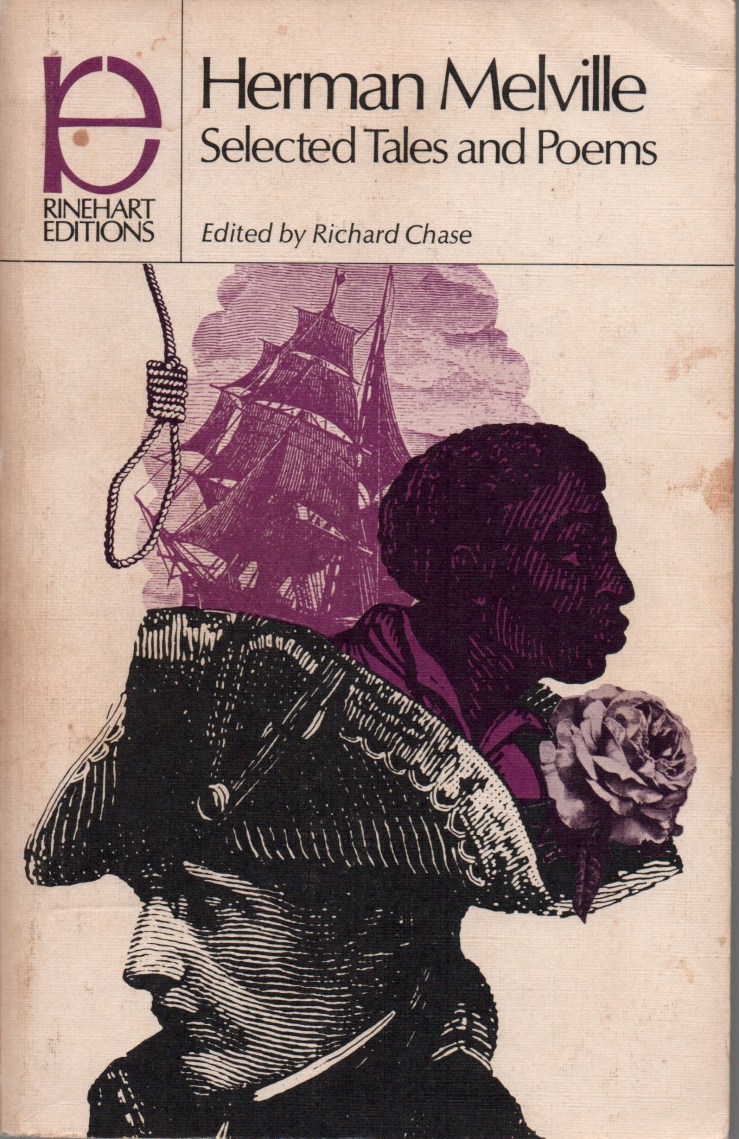
On Herman Melville’s novella Benito Cereno

Near the middle of Herman Melville’s 1855 novella Benito Cereno, our erstwhile protagonist Captain Amasa Delano encounters an old sailor tying a strange knot:

For intricacy, such a knot he had never seen in an American ship, nor indeed any other. The old man looked like an Egyptian priest, making Gordian knots for the temple of Ammon. The knot seemed a combination of double-bowline-knot, treble-crown-knot, back-handed-well-knot, knot-in-and-out-knot, and jamming-knot.

At last, puzzled to comprehend the meaning of such a knot, Captain Delano addressed the knotter:—

“What are you knotting there, my man?”

“The knot,” was the brief reply, without looking up.

“So it seems; but what is it for?”

“For some one else to undo,” muttered back the old man…

This knot serves as a metaphor for the text of Benito Cereno itself. We readers (along with our hapless surrogate Captain Delano) are the ones tasked with unknotting the text’s central mystery.

Part of the great pleasure of reading Benito Cereno for the first time rests in Melville’s slow-burning buildup to the eventual unknotting. I was fortunate enough to have been ignorant of the plot (and eventual revelation) of Benito Cereno when I first read it over a dozen or so years ago (although even then I cottoned on to what was really happening earlier than Captain Delano did). I read the novella again last week and marveled at Melville’s narrative control, enjoying it anew by seeing it anew.

Benito Cereno is a sharply-drawn tale about the limits of first-person consciousness and the cultural blinders we wear that prevent us from seeing what is right in front of us. The book subtly critiques the notion of a naturally-ordered morality in which every person has a right and fitting place, whether that be a place of power or a place of servitude. Melville shows the peril and folly of intrinsically believing in the absolute rightness of such a system. There is comfort in belief, but unquestioning belief makes us radically susceptible to being wrong. When we most believe ourselves right is often when we are the most blinded to the reality around us. We cannot see that we cannot see. And Benito Cereno is about how we see—about how we know what we know. Melville’s novella is also about how seeing entails not seeing, and, further, not seeing what we are not seeing—all that we do not know that we do not know. Melville makes his readers eventually see these unknown unknowns, and, remarkably, shows us that they were right before our eyes the entire time.

Forgive me—much of the previous paragraph is far too general. I want you to read Benito Cereno but I don’t want to spoil the plot. Let’s attempt summation without revelation: The novella is set in 1799 off the coast of Chile. Amasa Delano, captain of the American sealing vessel the Bachelor’s Delight, spies a ship floating adrift aimlessly, apparently in distress. Captain Delano boards one of his whale boats and heads to the San Dominick, a Spanish slaving ship, and quickly sees that the enslaved Africans on board dramatically outnumber the Spanish sailors. Delano offers aid to the San Dominick’s captain, Benito Cereno, who tells Delano that most of the Spanish crew perished in a fever (along with the “owner” of the slaves, Alexandro Aranda). Benito Cereno himself seems terribly ill and not entirely fit to command, so Delano waits aboard the San Dominick while his men fetch food and water from the Bachelor’s Delight. In the meantime, he tours the ship and talks with Benito Cereno and Cereno’s enslaved valet Babo.

Delano is frequently troubled by what he sees on the ship, but his good nature always affords him a natural and acceptable answer that assuages the sinister tension tingling in the background. Even though he’s troubled by the “half-lunatic Don Benito,” Delano’s “good-natured” sense of moral authority can explain away what he sees with his own eyes:

At last he began to laugh at his former forebodings; and laugh at the strange ship for, in its aspect, someway siding with them, as it were; and laugh, too, at the odd-looking blacks, particularly those old scissors-grinders, the Ashantees; and those bed-ridden old knitting women, the oakum-pickers; and almost at the dark Spaniard himself, the central hobgoblin of all.

For the rest, whatever in a serious way seemed enigmatical, was now good-naturedly explained away by the thought that, for the most part, the poor invalid scarcely knew what he was about…

These paragraphs not only summarize some of the images that give Delano pause, they also show Melville’s remarkable prose style, which follow’s Delano’s psychological state: laughing dismissal returns back to anxious image; anxious image gives way again to relieved certitude. All that is “enigmatical” in life can be “good-naturedly explained away.” And yet as the narrative progresses, good-natured explanations will fail to answer to visceral reality. Melville’s slow burn catches fire, burning away the veils of pretense.

The rest of this post (after the image) contains significant spoilers. I highly recommend Benito Cereno, which is reprinted in any number of Melville collections (I read it again in Rinehart’s Selected Tales and Poems), including The Piazza Tales (which you can download for free at Project Gutenberg). While I think that Benito Cereno has gained more recognition in recent years, it remains under-read compared to Melville’s more famous novellas Bartleby and Billy Budd. Those are great books too, but I’d argue that Benito Cereno, with its critique of white supremacy, is more timely than ever. Check it out. (Again, spoilers ahead).

IMG_0160

Continue reading “On Herman Melville’s novella Benito Cereno”

Selections from One-Star Amazon Reviews of Melville’s Moby-Dick

[Ed. note: The following citations come from one-star Amazon reviews of Herman Melville’s novel Moby-Dick. To be very clear, I think Moby-Dick is fantasticbut I also enjoy seeing what people compelled to write negative reviews of the book on Amazon had to say. What follows are selections of one-star Amazon reviews; I’ve preserved the reviewers’ unique styles of punctuation and spelling].


Yechh.

It made for a smashing movie.

If you want to read lots of meaningless whale trivia read the book.

Boy gets whale. Boy loses whale. Boy gets whale. Spawns yawns

I think if you made it into a short comic strip, you would have liked it.

I bought this book for a friend in jail. Alas, he was unable to read it because the font was too small.

Ray Bradbury, who wrote the screenplay for this novel, (a la Gregory Peck) couldn’t even finish the damn thing!

If you like a story with nonessential information and an author that is entirely to verbose, then this book is for you.

I am quite the fan of stories which involve man eating sea creatures, such as Jaws. Moby Dick is nothing compared to such classics, I fear.

Throughout the book, you may read one chapter with some action only to be followed by 5 or 6 chapters of tangents that are not necessary to understand the story.

Moby Dick, was a horrible waiste of time. Along with its wordy paragraphs, it also talked about uninteresting issues. It is also to long, and you don’t hear of them encountering the whale until the end of the book.

The only people who like this book are english teachers who derive a feeling of moral superiority from forcing others to read this incredibly bad novel.

First of all, classiflying it as fiction is a mistake. Probably a good 60% of the book is non-fiction – chapter after chapter dedicated to every imaginable detail of the biology of the whale and every imaginable nuance of whaling.

I love literatur just as much as the next guy but we must face it 100 years or so ago American literature was reall weak and lagging from the rest of the world, perhaps now they’re starting to catch up with writers like Ann Rice and them.

I have seen better writing in a Hallmark card! Boring! Give me a good ole copy of Elvis and Me! A true story that really tugs at your heart strings! I sleep with that one under my pillow! Keep Moby Dick away from my bed!

Those chapters about Ishmael sleeping with whatever his name was and Ishamel had such a good time with the other guy’s arm over him and leg over him that he didn’t know if he was straight or gay any more.

i personally didn’t enjoy the philosophical or deep side of the book, i have read much much better books in that regard.

There is no suspense, and I find the idea of people hunting whales offensive. Offensive with a capital O.

Honestly, Over 400 pages devoted to killing a whale because it ate your hand? Come on.

It is hard to read. like work. Doubt he could get published today.

What is the whales motivation? You dont know.

It is 540somepages of boring whaling details.

No wonder Melville flopped as a writter.

OMG, this is tedious and torture to read.

I HATE this book. Why? It’s BORING!

Moby Ick’s more like it.

A review of Roberto Bolaño’s novella By Night in Chile

djhkew-vaaavpst

Toward the end of the 130 page monologue that is Roberto Bolaño’s novella By Night in Chile, narrator Father Sebastián Urrutia Lacroix claims that “An individual is no match for history.” His statement neatly encapsulates (what might be) the dominant theme of By Night in Chile, namely an individual person’s capacity and ability to correctly–and sanely–somehow measure, attest to, confront, and witness the horror and brutality of history. In this case, Bolaño’s narrator, a Catholic priest–and conservative literary critic (and, of course, failed poet)–Father Urrutia, via a sweeping deathbed confession of sorts, recounts his life story, leading inexorably to Pinochet’s coup and its attendant subsequent draconian reforms and abuses. While it would be a mistake to reduce Bolaño’s rich novella to one conflict, I think the root of Urrutia’s struggle emanates from his inability to come to terms with his role as an intellectual (let alone an artist, critic, or priest) complicit somehow in Pinochet’s crimes. Throughout the book, from the very beginning, Urrutia blames his inner turmoil on a “wizened youth” (I don’t want to spoil this antagonist’s identity, but puzzling out that paradoxical appellation provides a major clue), a kind of idealist who stands apart from the dying priest, mocking and taunting him. After his claim that “An individual is no match for history,” Urrutia avers that “The wizened youth has always been alone, and I have always been on history’s side.” For Urrutia, this is of paramount importance, not just as a Catholic priest (which, it must be pointed out, is a role he doesn’t seem particularly suited for) but also as a literary critic and intellectual: Urrutia wants to systematize and critique history, to be “on the right side of history,” to quote Barack Obama. And yet his own attempt to narrativize his own life ironizes and critiques this very possibility at every turn–he is a sham, a charlatan, motivated and prompted by fear and even hate.

And on that attempt to narrativize a life: I would call By Night in Chile an anti-bildungsroman. Although Urrutia relates a life story, the free flow of psychic impressions that characterizes his telling slip and sail and rock and crash throughout years and over decades, often flowing backwards and forwards, sometimes spending pages on what could only be considered inconsequential minutiae, while at times glossing over the profoundest events with little more than a word or two. It is often what Urrutia does not remark upon that characterizes what is of the greatest importance in this work, and this is a testament to the power of Bolaño’s writing, to his command of voice. In one of the greatest performances of the novel, Urrutia describes the time right before, during, and after Pinochet’s coup. The passage is less than four pages, and for every contemporary action of immediate consequence, Urrutia seems to provide twice as many examples of his retreat into the past: ” . . . the first anti-Allende march was organized, with people banging pots and pans, and I read Aeschylus and Sophocles and Euripides, all the tragedies, and Alkaios of Mytilene and Aesop and Hesiod and Herodotus . . . .” Urrutia doesn’t bother to scrutinize or analyze the visceral reality of history in the making around him, regressing instead to the comfort of established philosophical tradition–the history of Herodotus in favor of the chaos, anarchy, and brutality happening around him. He’s really quite a terrible priest, and as an intellectual he refuses to be engaged. Confident that he will always be “on history’s side,” he refuses to actively even try come to terms with history until he’s dying. And thus we get the narrative of By Night in Chile.

This reckoning with the past takes the form of a long monologue but, as those familiar with Bolaño will attest, there are plenty of other voices here, stories nested within stories like Russian dolls. The force and vitality of Urrutia’s speech is astonishing; one envisions the monologue as a single immediate and discrete exhalation, a stream of memory, the living wail of a dying man. Bolaño’s rhetorical style here conveys this ironic energy. He employs long (very, very long) sentences, sometimes going on for several pages, and often uses little or no transitions between what should be major shifts of space and time. There are plenty of references to writers, of course, many obscure, and more motifs and leitmotifs than I can work out here (or elsewhere, to be honest). I’m going to go out on a limb and suggest that the book is probably even more intense in the original Spanish, although I think Chris Andrews has done a brilliant job translating here, just as he did in Last Evenings on Earth. And since I’ve brought up that book, I’m going to make another suggestion: if you’ve yet to read Bolaño, you should, and Last Evenings of Earth (or 2666 if nearly a thousand pages doesn’t seem too daunting)is probably the best place to start–which is kind of another way of saying that By Night in Chile is not the best entry point to Bolaño–at least not for anyone intimately familiar with Latin American history. It’s not that By Night is particularly challenging or hard to read. However, I think that this particular book will probably be better enjoyed with more context. As Rodrigo Fresán points out in his essay “The Savage Detective,” (published in the March 2007 issue of The Believer), By Night in Chile could be (should be?) read as part of one cohesive book along with Amulet and Distant Star. Indeed, as many critics have pointed out, Bolaño’s works seem to coalesce into one great work, a secret universe parallel to Tolkien’s Middle Earth or Faulkner’s Yoknapatawpha. Urrutia’s voice enriches this universe, but one must have something of a foothold on Bolaño’s themes in order to appreciate the complex ironies of By Night in Chile. Or maybe not. Maybe this is a great entry point to Bolaño. Either way, great book. Highly recommended.


Editorial note: Biblioklept ran the original version of this review in July of 2010. I saw the new cover for By Night in Chile today in a bookstore I was visiting in a town that I do not live in, and the new cover—the picture of which is the only new “content” for this review—is the occasion for republishing this Bolaño review.

Blog about Denis Johnson’s story “Strangler Bob”

Screenshot 2018-07-25 at 5.28.36 PM
Detail from Newgate Exercise Yard by Gustave Dore, 1872

Denis Johnson’s story “Strangler Bob” is the third selection in The Largesse of the Sea Maiden. At about 20 pages, it’s also the shortest piece in the collection (the other four stories run between 40 and 50 pages). While still a bit longer than the stories in Johnson’s seminal collection Jesus’ Son, “Strangler Bob” nevertheless seems to pulse from that same vein, its narrator Dink another iteration of Jesus’ Son’s Fuckhead. Indeed, “Strangler Bob” feels a bit like an old sketch that’s been reworked by Johnson into something that fits thematically into Largesse.

Here’s the opening paragraph of “Strangler Bob” in full, which gives us the basic premise and setting (and you can’t beat those two opening sentences):

You hop into a car, race off in no particular direction, and blam, hit a power pole. Then it’s off to jail. I remember a monstrous tangle of arms and legs and fists, with me at the bottom gouging at eyes and doing my utmost to mangle throats, but I arrived at the facility without a scratch or a bruise. I must have been easy to subdue. The following Monday I pled guilty to disturbing the peace and malicious mischief, reduced from felony vehicular theft and resisting arrest because—well, because all this occurs on another planet, the planet of Thanksgiving, 1967. I was eighteen and hadn’t been in too much trouble. I was sentenced to forty-one days.

Those forty-one days take us from Thanksgiving to the New Year, with the story’s spiritual climax occurring on Christmas Eve.

Before we get to that climax Johnson builds an unexpectedly rich world in the county lockup, populating it with young toughs who can’t yet see how bad the paths they’ve chosen will be. The men of Johnson’s jail aren’t simply down on their luck or somehow morally misunderstood. They are jovial young fuck-ups who plan to continue fucking up their lives the minute they get out.

A lot of the stage-setting and background characterization in “Strangler Bob” reads like picaresque sketches that Johnson had lying about unused from decades ago. Much of the early part of the story is dedicated to “the blond sociopathic giant Jocko,” a sort of prince of the jail who saves a crazy kid from being murdered by the other inmates. Such scenes give the story a ballast of baroque energy and even an unexpectedly-comic realism, but they don’t fully fit into the main theme of the story, which is hunger.

On his first day in the jail the narrator Dink is warned not to oversleep or he will have his breakfast stolen. Hardheaded, he sleeps in anyway, but learns from his mistake:

After that I had no trouble rousing myself for the first meal, because other than the arrival of food we had nothing in our lives to look forward to, and the hunger we felt in that place was more ferocious than any infant’s. Corn flakes for breakfast. Lunch: baloney on white. For dinner, one of the canned creations of Chef Boyardee, or, on lucky days, Dinty Moore. The most wonderful meals I’ve ever tasted.

Hunger in “Strangler Bob” is an expression of the deep boredom the prisoners feel, and mealtimes become the only way these men measure the passing of time. The hunger in “Strangler Bob” is not just a desire for food, but rather something to fill up the void, the space, the empty feeling. In this world, romantic adventure is ironized into confined torpor:

Dundun, BD and I formed a congress and became the Three Musketeers—no hijinks or swashbuckling, just hour upon hour of pointless conversation, misshapen cigarettes, and lethargy.

Dundun and BD are perhaps unlikely friends for Dink—

Dundun was short and muscled, I was short and puny, and BD was the tallest man in the jail, with a thick body that tapered up toward freakishly narrow shoulders.

—but their fellowship holds together because they had “long hair and chased after any kind of intoxicating substance.” Thanks to BD they get their mitts on some LSD:

BD told us he had a little brother, still in high school, who sold psychedelic drugs to his classmates. This brother came to visit BD and left him a hotrod magazine, one page of which he’d soaked in what he told BD was psilocybin, but was likelier just, BD figured, LSD plus some sort of large-animal veterinary tranquilizer. In any case: BD was most generous. He tore the page from the magazine, divided it into thirds, and shared one third with me and one with Donald Dundun, offering us this shredded contraband as a surprise on Christmas Eve.

The ink from the newsprint turns their tongues black. Narrator Dink seems to think that the LSD was not evenly distributed on the page though—BD trips the hardest, seeing snow falling indoors, but Dink seems to think he’s mostly unaffected, while Dundun denies any effect at all. However, consider this exchange between Dink and Dundun, which suggests that they might be tripping harder than they think:

“I’m feeling all the way back to my roots. To the caves. To the apes.” He turned his head and looked at us. His face was dark, but his eyeballs gave out sparks. He seemed to be positioned at the portal, bathed in prehistoric memories. He was summoning the ancient trees—their foliage was growing out of the walls of our prison, writhing and shrugging, hemming us in.

A sloppy and unnecessary Freudian analysis of the three kids parcels them out easily as id (Dundun the apeman), super ego (BD the strange moralist), and ego, our narrator who rejects any kind of spirituality in a world where “Asian babies fried in napalm.”

Dink’s cellmate, the eponymous Strangler Bob, poses a challenge to the narrator’s easy nihilism though. Even though Dink believes that he’s not affected by the LSD, his encounter with Bob on Christmas Eve reads like a bad trip:

The only effect I felt seemed to coalesce around the presence of Strangler Bob, who laughed again—“Hah!”—and, when he had our attention, said, “It was nice, you know, it being just the two of us, me and the missus. We charcoaled a couple T-bone steaks and drank a bottle of imported Beaujolais red wine, and then I sort of killed her a little bit.”

To demonstrate, he wrapped his fingers around his own neck while we Musketeers studied him like something we’d come on in a magic forest.

Dundun then exclaims that Strangler Bob is “the man who ate his wife” — but Bob admonishes that his cannibalism was greatly exaggerated:

Strangler Bob said, “That was a false exaggeration. I did not eat my wife. What happened was, she kept a few chickens, and I ate one of those. I wrung my wife’s neck, then I wrung a chicken’s neck for my dinner, and then I boiled and ate the chicken.”

The hunger in Strangler Bob is perverse and abject; his crime is of a moral magnitude far more intense than the malicious hijinks the youthful Musketeers have perpetrated–it’s taboo, a challenge to all moral order. He’s also an oracle of strange dooms:

He said, “I have a message for you from God. Sooner or later, you’ll all three end up doing murder.” His finger materialized in front of him, pointing at each of us in turn—“Murderer. Murderer. Murderer”

We learn in the final melancholy paragraphs of the story that Bob’s prophecy comes true, more or less. In those paragraphs too there is a moment of grace, albeit a grace hard purchased. Of the latter part of his life, the Dink tells us:

I was constantly drunk, treated myself as a garbage can for pharmaceuticals, and within a few years lost everything and became a wino on the street, drifting from city to city, sleeping in missions, eating at giveaway programs.

It’s worth noting that if Dink were 18 in the fall of 1967, he would likely have been born in 1949, the year that Denis Johnson was born. The narrators of two other stories in Largesse are also born in or around 1949, and it’s my belief that all of the narrators are essentially the same age, and all are pseudoautofictional iterations of Johnson.

In “Strangler Bob,” Dink is an iteration that fails to thrive, that can’t survive addiction and recovery and enter into a new life. He does not heed Bob’s warning, and at the end of the story he laments that he is a poisoned person who has poisoned others:

When I die myself, B.D. and Dundun, the angels of the God I sneered at, will come to tally up my victims and tell me how many people I killed with my blood.

These final lines push the narrator into a place of bare remorse and regret, as he reflects back on his time in the jail, which he describes in retrospect as “some kind of intersection for souls.” Dink now sees that he’s failed to acknowledge the messengers that might have sent him on a better path. Angels come in strange forms.

Very early Christmas morning on the planet of 1967, after “the festival of horrors” that constituted the LSD trip, Strangler Bob gives one last message, a strange delivered in Dink’s grandmother’s voice:

I studied him surreptitiously over the edge of the bunk, and soon I could see alien features forming on the face below me, Martian mouth, Andromedan eyes, staring back at me with evil curiosity. It made me feel weightless and dizzy when the mouth spoke to me with the voice of my grandmother: “Right now,” Strangler Bob said, “you don’t get it. You’re too young.” My grandmother’s voice, the same aggrieved tone, the same sorrow and resignation.

“You’re too young” — wisdom is purchased through folly, pain, terrible mistakes, crimes and sins. The narrator’s grandmother ventriloquizes Strangler Bob, but she doesn’t have a moral message, just tired pain.

The voice here is Denis Johnson’s voice too, inhabiting a mad oracle, warning some version of himself that exists today.


You can read “Stranger Bob” online here.

I wrote about the title story in The Largesse of the Sea Maiden here.

I wrote about the second story, “The Starlight on Idaho” here.