A review of Ishmael Reed’s sharp satire The Last Days of Louisiana Red

img_2323

Ishmael Reed’s 1974 novel The Last Days of Louisiana Red is a sharp, zany satire of US culture at the end of the twentieth century. The novel, Reed’s fourth, is a sequel of sorts to Mumbo Jumbo (1972), and features that earlier novel’s protagonist, the Neo-HooDoo ghost detective Papa LaBas.

In Mumbo Jumbo, Reed gave us the story of an uptight secret society, the Wallflower Order, and their attempt to root out and eradicate “Jes’ Grew,” a psychic virus that spreads freedom and takes its form in arts like jazz and the jitterbug. The Last Days of Louisiana Red also employs a psychic virus to drive its plot, although this transmission is far deadlier. “Louisiana Red” is a poisonous mental disease that afflicts black people in the Americas, causing them to fall into a neo-slave mentality in which they act like “Crabs in the Barrel…Each crab trying to keep the other from reaching the top.”

The Last Days of Louisiana Red begins with Ed Yellings, “an american negro itinerant who popped into Berkeley during the age of Nat King Cole. People looked around one day and there he was.” Yellings is the West Coast counterpart to New-York-based Papa LeBas, a fellow Worker of Neo-HooDoo who fights against the secret forces of psychic slavery.

Sliding into the mythological motif that ripple through Louisiana Red, Reed writes,

When Osiris entered Egypt, cannibalism was in vogue. He stopped men from eating men. Thousands of years later when Ed Yellings entered Berkeley, there was a plague too, but not as savage. After centuries of learning how to be subtle, the scheming beast that is man had acquired the ability to cover up.

Yellings’ mission is to destroy the psychic cannibalism that afflicts his people. He gets to it, and earns “a reputation for being not only a Worker [of the voodoo arts] but a worker too.” Yellings’ working class bona fides helps solidify his sympathies and his mission:

Since he worked with workers, he gained a knowledge of the workers’ lot. He knew that their lives were bitter. He experienced their surliness, their downtroddenness, their spitefulness and the hatred they had for one another and for their wives and their kids. He saw them repeatedly go against their own best interests as they were swayed and bedazzled by modern subliminal techniques, manipulated by politicians and corporate tycoons, who posed as their friends while sapping their energy. Whose political campaigns amounted to: “Get the Nigger.”

As always, Reed’s diagnosis of late 20th-century American culture seems to belong, unfortunately, just as much to our own time, giving his novels a perhaps-unintended sheen of prescience. Reed’s work points to dystopia, even as his heroes work for freedom and justice. And yet Reed gives equal air time to the forces that oppress freedom and justice, forces that find expression in “Louisiana Red”:

Louisiana Red was the way they related to one another, oppressed one another, maimed and murdered one another., carving one another while above their heads, fifty thousand feet, billionaires few in custom-made jet planes equipped with saunas tennis courts swimming pools discotheques and meeting rooms decorated like a Merv Griffin Show set….

The miserable workers were anti-negro, anti-chicano, anti-puerto rican, anti-asian, anti-native american, had forgotten their guild oaths, disrespected craftsmanship; produced badly made cars and appliances and were stimulated by gangster-controlled entertainment; turned out worms in the tuna fish, spiders in the soup, inflamatory toys, tumorous chickens, d.d.t. in fish and the brand new condominium built on quicksand.

As a means to fight the culture of erosion, decay, and entropy, Yellings founds the Solid Gumbo Works. Here, he manufactures a gumbo—a spell, really—to combat “Louisiana Red.” In the process he manages to cure cancer, which pisses off a lot of big corporations, and pretty soon Yellings is murdered. Papa LeBas is sent in from New York to solve the case.

Papa LeBas runs into trouble pretty quickly, mostly by way of Yellings’ adult children: Wolf, Street, Sister, and the provocative and gifted Minnie, who leads a group of militants called the Moochers. Each of the children seem to embody an allegorical parallel to some aspect of the American counterculture of the late sixties and seventies, allowing Reed to mash up genres and skewer ideologies. There are a lot flavors in this gumbo: voodoo lore and California history bubble in the same pot as riffs on astrology and Cab Calloway’s hit “Minnie the Moocher.” Reed frequently compares and contrasts East with West, New York with California, underscoring the latter’s anxieties of influence about being the New World of the New World. Throughout the novel, we get routines on Amos & Andy, slapstick pastiches straight out of George Herriman’s Krazy Kat comix, hysterical nods to Kafka. Reed plays off early blaxploitation films like Sweet Sweetback’s Baadasssss Song and Superfly (not to mention Putney Swope), and synthesizes these tropes with kung fu imagery and neo-Nazi nostalgia garb. He turns Aunt Jemima into a loa at one point.

Reed’s prose ping-pongs between genres, skittering from pulp fiction noir to surrealist frenzies, from bizarre sex to raucous action, from political essaying to postmodernist mythologizing. Through these stylistic shifts, Reed satirizes a host of ideologies that feed into “Louisiana Red.” Aspects of the Berkeley youth movement, radical feminism, free love, and intellectual hucksterism all get skewered, but through an allegorical lens—Reed dares us, often explicitly (by way of a character named Chorus) to read Louisiana Red as an allegorical retelling of Sophocles’ Antigone.

This retelling is both tragic and comic though, premodern and postmodern, a carnival of varied voices. The chapters are short, the sentences sting, and the plot shuttles along, pivoting from episode to episode with manic picaresque glee. Reed’s narrator is always way out there in front of both the reader and the novel’s characters, hollering at us to keep up.

Ultimately, The Last Days of Louisiana Red is a bit of a shaggy dog. It’s not that it doesn’t have a climax—it does, it has lots of climaxes, some quite literal. And it’s not that the novel doesn’t have a point—it very much does. Rather, it’s that Reed employs his detective story as a frame for the larger argument he wants to make about American culture. Sure, Papa LaBas gets to the bottom of Yellings’ murder, but that’s not ultimately what the narrative is about.

When we get to the final chapter, we find LaBas, sitting alone “on a plain box” in the empty offices of the Solid Gumbo Works reflecting on the case in a way that, in short, sums up what The Last Days of Louisiana Red is about:

He thought of the eaters and the eaten of this parable on Gumbo…all ‘oppressed people’ who often, like Tod Browning ‘Freaks,’ have their own boot on their own neck. They exist to give the LaBases, Wolfs and Sisters of these groups the business, so as to prevent them from taking care of Business, Occupation, Work. They are the moochers who cooperate with their ‘oppression,’ for they have the mentality of the prey who thinks his destruction at the fangs of the killer is the natural order of things and colludes with his own death. The Workers exist to tell the ‘prey’ that they were meant to bring down killers three times their size, using the old morality as their guide: Voodoo, Confucianism, the ancient Egyptian inner duties, using the technique of camouflage, independent camouflages like the leopard shark, ruler of the seas for five million years. Doc John, ‘the black Cagliostro,’ rises again over the American scene. The Workers conjure and command the spirit of Doc John to walk the land.

So here, near the end of The Last Days of Louisiana Red, Papa LeBas—and Ishmael Reed, of course—conjures up the spirit of Doctor John, the voodoo healer who escaped slavery and brought knowledge of the hoodoo arts to his people. There’s a promise of hope and optimism here at the novel’s end, despite its many bitter flavors. But the passage cited above is not the final moments of Louisiana Red—no, the novel, ends, despite what I wrote about its being a shaggy dog story, with a marvelous punchline.

Ishmael Reed remains an underappreciated novelist whose early work seems as vital as ever. The Last Days of Louisiana Red is probably not the best starting place for him, but it’s a great novel to read right after Mumbo Jumbo, which is a great starting place to read Reed. In any case: Read Reed. Highly recommended.

Blog about Ishmael Reed’s The Last Days of Louisiana Red (Book acquired 27 Feb. 2019)

img_2323

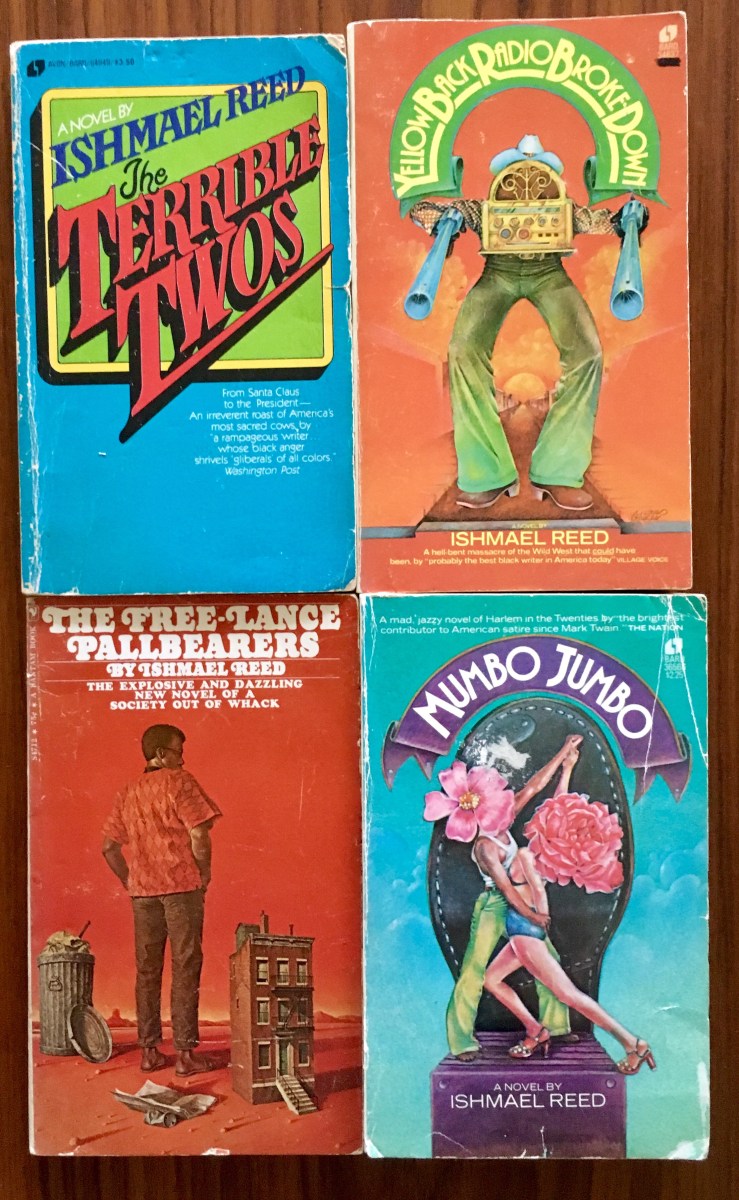
A few weeks ago I went to my favorite used bookstore to pick up a copy of Ishmael Reed’s follow up to Mumbo Jumbo, 1974’s The Last Days of Louisiana Red. The store had a few copies of it, but they were all Dalkey Archive editions with ugly covers and bad binding, so I broke down and ordered a first edition Random House hardback online. (I was tempted to pick up the Avon Bard paperback version to match the covers of the other Reed books I own, which are so beautiful I’ll share them here again):

img_2351

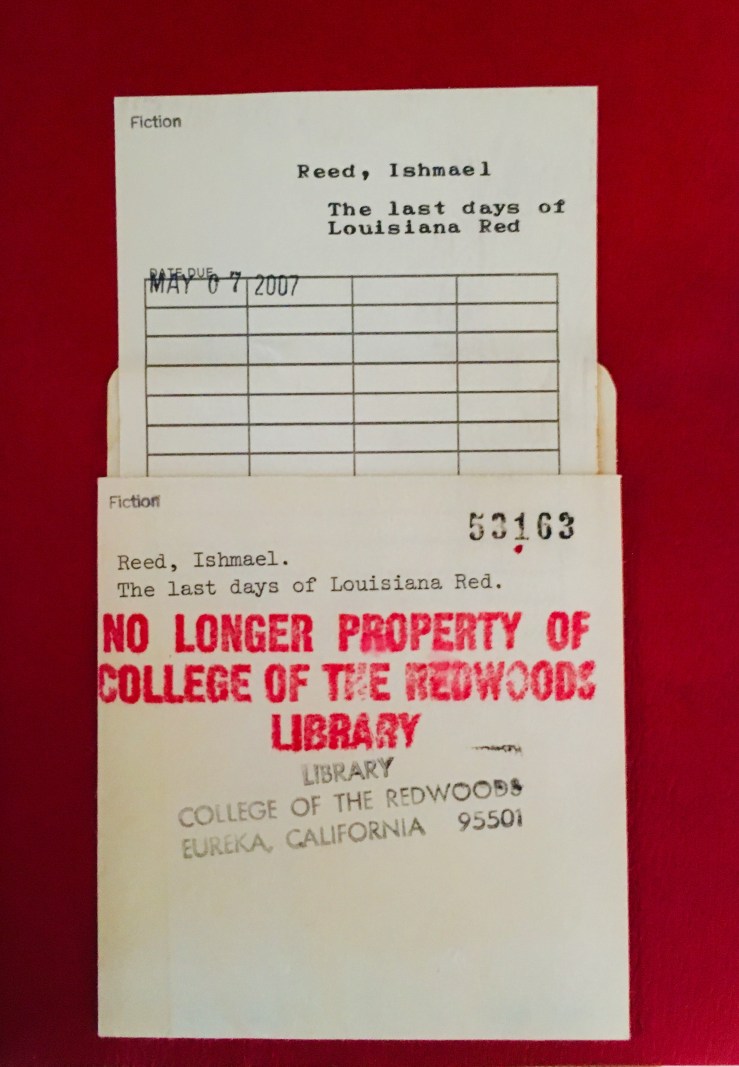
Anyway, I did the design of the hardback the came in, which the jacket flap credits as Reed’s own suggestion. Oh, and it’s an old library book:

img_2349

I read the first half of The Last Days of Louisiana Red this weekend. Reed’s writing is bitter, prescient, zany, and mythological, telegraphed in a range of comic and tragic voices. The chapters are short, and the sentences sting. The plot—well, in Louisiana Red, Reed brings back Papa LaBas the Neo-HooDoo hero of Mumbo Jumbo, and sends him to the West Coast, to Berkeley, Carlifornia to investigate the murder of Ed Yellings. Yellings, a Neo-HooDoo man himself, has discovered the cure for cancer through his mysterious enterprise, the Solid Gumbo Works. Yellings’ gumbo is also a cure for “Louisiana Red,” a poisonous mental disease that afflicts black people in the Americas. Papa LeBas is alternately helped and hindered by Yellings’ adult children: Wolf, Street, Sister, and the provocative and gifted Minnie, who leads a group of militants called the Moochers.

I’m really digging Louisiana Red, which, like the other early Reed novels I’ve read, synthesizes the history, folklore, mythology, and intellectual traditions of the African diaspora into a slapstick satire of USA at the end of the twentieth century. Reed cooks his gumbo with a wide variety of ingredients: voodoo lore and California history bubble in the same pots as riffs on astrology and Cab Calloway’s hit “Minnie the Moocher.” Reed satirizes the Berkeley youth movement, radical feminism, and intellectual hucksterism, all through an allegorical lens—he dares us, often explicitly (by way of a character named Chorus) to read Louisiana Red as an allegorical retelling of Sophocles’ Antigone. While Papa LaBas appears to be the moral center of Reed’s novel, delivering righteous condemnation after righteous condemnation of the Moochers and other persons afflicted with Louisiana Red, Reed nevertheless gives expression to a multitude of opposing viewpoints in the novel. It is a speaking novel, a novel that is both of its time but transcends it, as most of the problems and perils it diagnoses are, unfortunately, still with us. More to come.


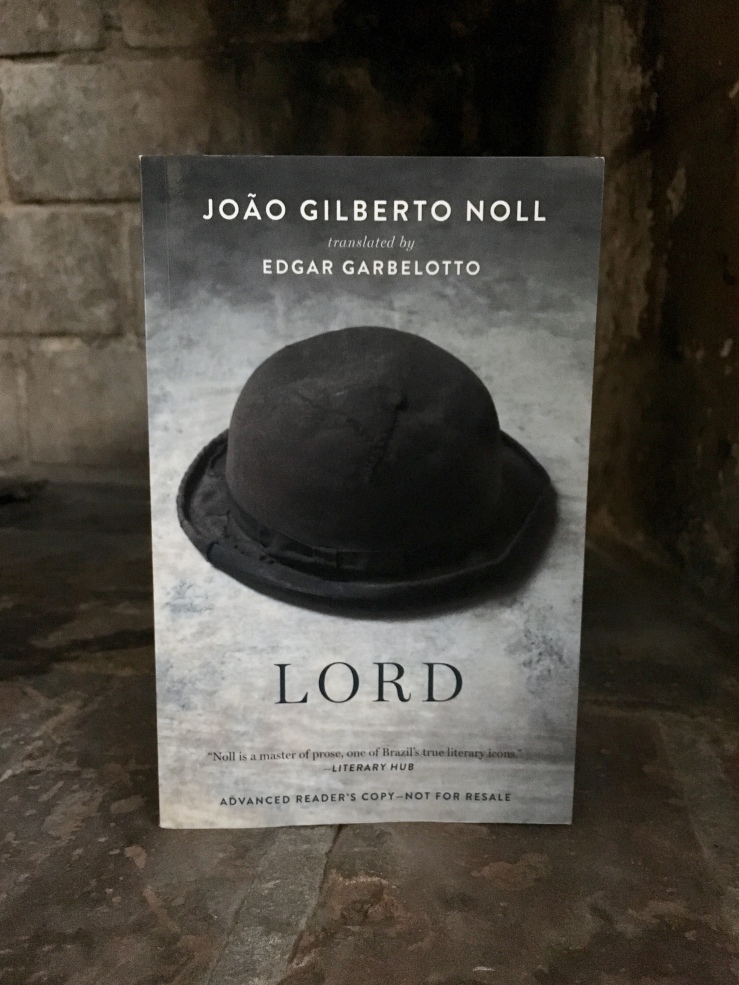
A review of Lord, João Gilberto Noll’s abject novel of dissolving identity

img_2336

João Gilberto Noll’s short novel Lord is an abject and surreal tale of madness. Madness is perhaps not the correct term, although it does point towards Lord’s gothic and abject modes. Perhaps it’s more accurate to say that in Lord, Noll gives us a consciousness dissolving and reconstituting itself, a first-person voice shifting from one reality to the next with absurdly picaresque energy.

That first-person voice is “a Brazilian who wrote books that were mostly well received by critics but not the public.” The Brazilian novelist travels to cold winter London on an unspecified “mission.” Indeed, the mission remains unspecified to both reader and narrator alike, although it does seem to involve an English university. The man who arranges for the narrator to come to London is himself a shifting cipher in Lord, transforming into different entities—at least in the narrator’s (often paranoid) view. We get the sense in Lord that consciousness is always under radical duress, that a state of being might collapse at any time or give way to some other, unknown state of being.

Throughout Lord, Noll dramatizes abject consciousness in turmoil. Early on, the narrator, already feeling uncertain about why he has moved halfway across the world, arrives at a university’s Portuguese department. In a book-lined office, he attempts to stabilize himself through the textual “reality” of printed matter:

The walls were covered with books. I trailed my hand over them as if to confirm the reality I was living in. Though I knew I was not living an unreality per se—like those born out of a simple dream and ending up in a nightmare, which we can only escape from when we wake up sweaty, trembling, and confused.

The irony is that the narrator has not fully comprehended yet that he is living an unreality, that he is actually narrating the nightmare. Noll’s hero is an unfixed voice, a voice that can’t square the signifiers around him with any stable signified meaning in his consciousness.

Slowly (but not too slowly—Lord moves at a steady clip), the narrator embraces this abjection and wills the dissolution of his self and its reformation into some new other. “My tiredness did not demand sleep, but, damn!, how I craved some indistinguishability between bodies, volumes, and formats,” he tells us.

The narrator carries his project of transformation even farther, applying cosmetics and hair dye to alter his appearance and “find a new source for [his] new formation”:

My lack of definition was already greater than me, although I had lost myself and begun to suspect that even my English boss couldn’t do anything to bring me back to me. I needed to keep up this task of being every- one somehow, because without it I wouldn’t even make it as far as the corner: without asking anyone, I happened to have overcome being the individual whom I had mechanically created for other people. I had to find a new source for my new formation, even now in my fifties, and that fountain would come from him, that light brown-haired man with makeup on, who lived in London for the time being without exactly remembering why.

Lord’s narrator takes this new version of himself on various London adventures, most of which are lurid and gross, and many of which are downright horny. Our Brazilian writer (who is slowly unbecoming a Brazilian writer) visits museums and has weird sex encounters, sleeps on the streets and takes a soapy bath with a Professor of Latin American Studies. Lord moves at a rapid and occasionally bewildering pace, giving the narrator’s quest a mock-ironic urgency. In Edgar Garbeletto’s capable English translation from the Portuguese, the paragraphs go on for pages but the sentences are choppy, riddled with colons and dashes, lurches and leaps, falls and stops.

Through this turbulent rhetoric, Lord’s narrator channels other voices, sublimating them into the text proper. The narrator absorbs bits and pieces of the other voices he encounters, dissolving his consciousness into and out of them as he strives for transformation. He also absorbs bits and pieces of bodies—fluids and other detritus, other abject bits of our human borders.

Our narrator is obsessed with borders, but his transgression of them has little to do with a moral framework. For the narrator, moral semblance is simply the result of an “individual…mechanically created for other people.” Rather, the narrator is fascinated by what makes a consciousness conscious. However, he’s not yet willing to cross the ultimate border, despite his fascination. In one little episode of Lord, our hero happens upon a dying man on the street. He watches the man pass from life:

I squeezed his hand. His mouth opened, and I could see the pool of blood that had overflowed his rotten teeth. That death, in some way, in some corner of my mind, gave me tremendous satisfaction. Someone was not afraid to go all the way to the end. To do for others what everyone tried to avoid. I wished I could follow him, but I didn’t have his bravery; I lacked the necessary elements to consummate the act. I needed that hug today.

A strange hug indeed!

The apparent finality of death as cessation-of consciousness holds a certain appeal to Lord’s narrator, whose quest is perhaps to overcome abjection via transformation. But it’s not easy,

It’s not just a snap, man: it’s being stuck in this limbo between staying in England and going back to South America that made me unrecognizable to myself anymore, it didn’t let me transfigure myself, it wouldn’t let me leave this stupid little body here, vomit myself out in disgust, or turn me into someone else.

Indeed, the quest in Lord might be summarized by that phrase: “vomit myself out in disgust.” While the voice in Lord remains untethered by the normal strictures of narrative (or even moral) logic, it is hardly free or disembodied. Indeed, the relationship between bodies and consciousness is perhaps the primary problem of Lord. Our narrator’s voice has a body that can’t catch up to what’s happening in its consciousness. Hence the novel’s preoccupation with the corporeal reality of bodies: blood, urine, semen, sweat, vomit…all the leaking stuff of humanity spurting out, transgressing the apparent borders and showing those borders are but a moral fiction.

In one abject episode, our narrator attempts to dispel London himself from his consciousness:

On a corner in Bloomsbury, a totally unexpected need to vomit hit me. I wiped myself with a sheet of newspaper that was fluttering by. But I couldn’t stop; I realized it was London I was throwing up, London with its ghosts and impossible missions, already entirely unsuccessful.

Tellingly, the narrator grasps a newspaper that just happens to be “fluttering by” to clean himself, to restore the moral fiction of an arranged, presentable self. The newspaper, like the books in the university office, is another nod to Lord’s metatextual motif. The written word proves to be illusory as an anchor in Noll’s novel—it cannot codify consciousness, it cannot fix meaning. Hence, the novel’s strange, disruptive rhetorical program, which takes first-person consciousness and literally deconstructs it.

The fact that Noll’s hero is/was a writer, “a Brazilian who wrote books that were mostly well received by critics but not the public,” suggests another metatextual nod. Lord’s narrator is a strange cipher of Noll himself. In 2004, the year Lord was published, Noll  served as writer-in-residence at the Centre for the Study of Brazilian Culture and Society at King’s College London. But the narrator is a cipher of Noll only—a voice that deconstructs and reconstructs itself, autofiction that dissolves the self.

This abject voice tries to reinvent itself from the outside in, only to vomit the inside back out again. Utter disintegration seems fatally imminent; madness seems inescapable. As one reaches the final pages of Lord, one senses that the narrative might fall apart into nothing—which, to be clear, it doesn’tLord sticks its ending a strangely and suitably satisfying way. I won’t give away the end, but instead reverse the course of my previous sentence: Lord falls apart into something.

Like Quiet Creature on the Corner and Atlantic Hotel (the other Noll books currently available in English translation),  Lord is propelled on its own dream-nightmare logic. It’s fucked-up, gross, abject, and surreal. It’s permeated by a vague horror. Reading it might make parts of your stomach hurt. I like these particular flavors, and I particularly like a book that doesn’t just upset me with its themes and its plot, but also with its style and its rhetoric. Lord certainly isn’t for everyone, but I loved it, and I think that there’s an audience of weirdos out there like me who will really dig this book too. Highly recommended.
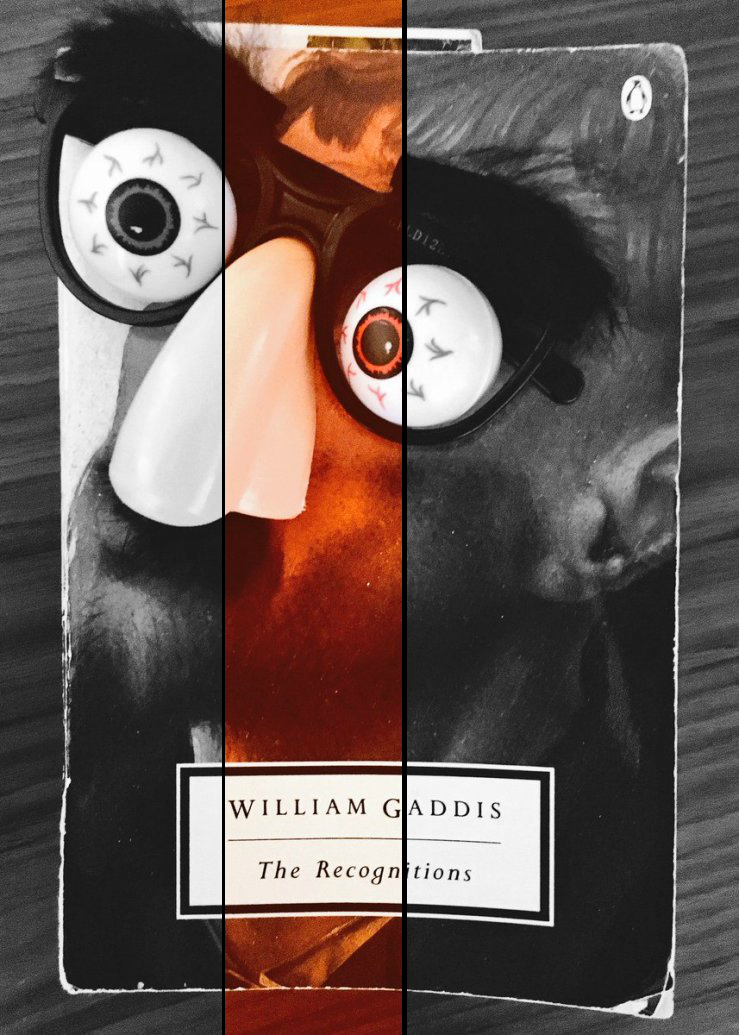
João Gilberto Noll’s Lord is new from Two Lines Press. It is the third novel by Noll Two Lines has published. I hope they publish more. 


Reviews, riffs, anti-reviews, etc., January and February 2019 (and an unrelated fox)

I kicked of the New Year by riffing on some reading plans for 2019. (I’ve already read four of the seven books on that list—uncharacteristically on track for me).

At The Comics Journal, I reviewed NYRB’s reissue of Saul Steinberg’s The Labyrinth. I included The Labyrinth on my list of favorite comix of 2018, which ran as part of a feature at The Comics Journal. This is what I wrote about The Labyrinth on the list:

The Labyrinth by Saul Steinberg. (NYRB) First published in 1960 and back in print again from the NRYB this year, Saul Steinberg’s The Labyrinth condenses the modern and the mythic. “Steinberg was a lyricist of the metal nib—a twirler of nonverbal non sequiturs,” notes novelist Nicholson Baker in his introduction to the new volume. Steinberg’s lyrical non sequiturs evince in squiggles and dots, tangles and loops which turn into well-dressed men and staid women, cityscapes and night scenes, cocktail parties and art shows. Steinberg turns Abraham Lincoln into Don Quixote, with Santa as his Sancho Panza. He takes us out of urbane New York and into midcentury America, land of motor courts and baseball parks, a knotty chaotic chorus of life. Steinberg could seemingly do anything with ink, as the range of styles in The Labyrinth shows, but what he ultimately did was utterly-Steinbergian. The Labyrinth echoes Whitman’s Leaves of Grass, which sought a century earlier, to find a new language to describe a new country. Steinberg looked at America through new eyes, and, like Whitman before him, found a new language of expression—the language of labyrinthine lines on paper.

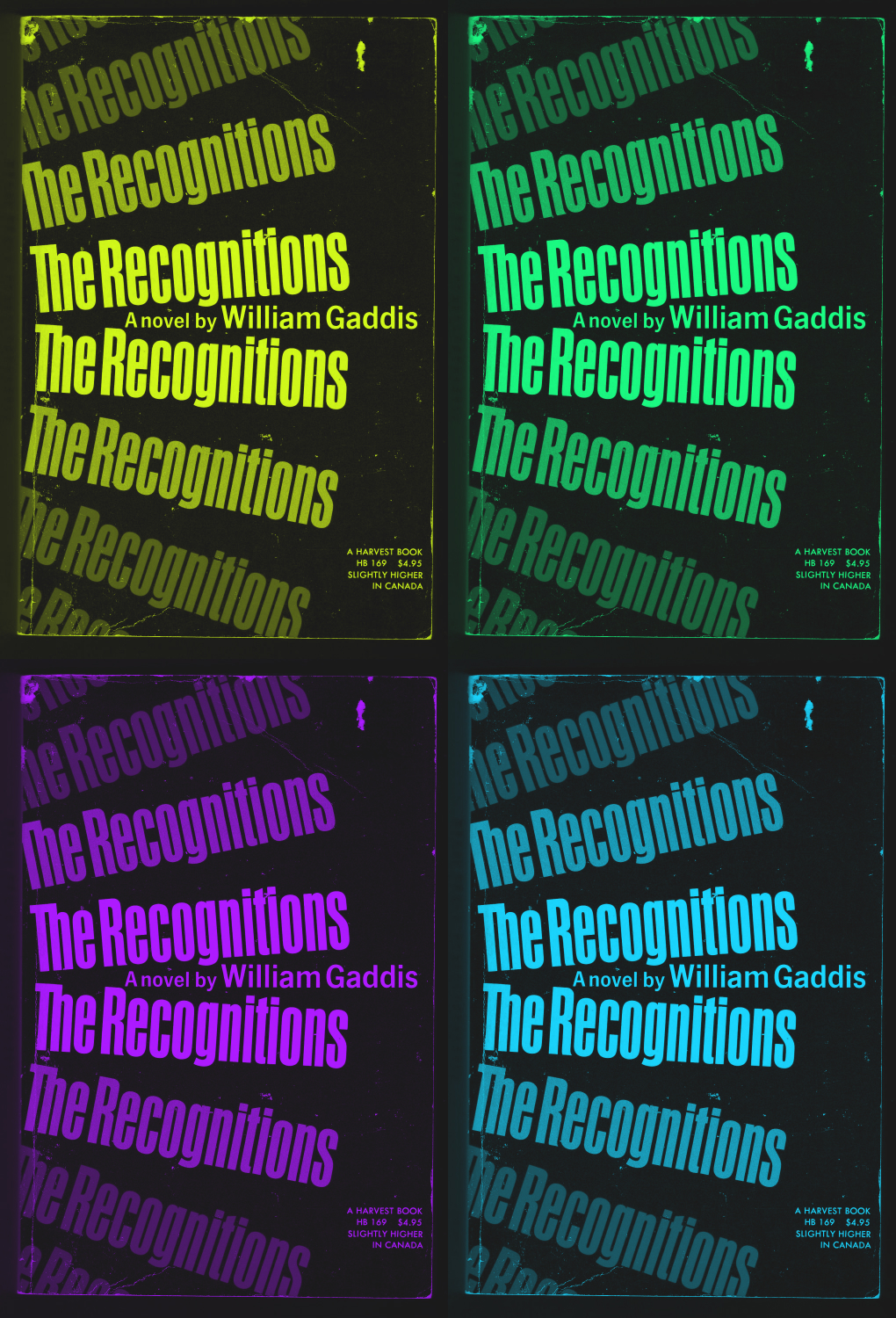
I wrote about a metatextual moment at the end of William Gaddis’s novel The Recognitions.

I reviewed (again at The Comics Journal) Paul Kirchner’s collection Hieronymus & Bosch.

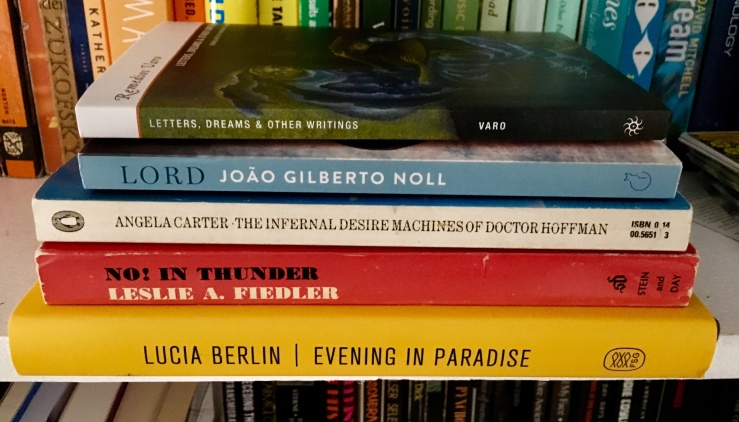
I riffed a little on Angela Carter’s surreal horny abject picaresque novel, The Infernal Desire Machines of Doctor Hoffman, along with Remedio Varo’s letters and more.

I wrote a review of Yevgeny Zamyatin’s prescient novel We, essentially arguing that it’s the ur-text of dystopian fiction.

I also reviewed Lucia Berlin’s collection Evening in Paradise.

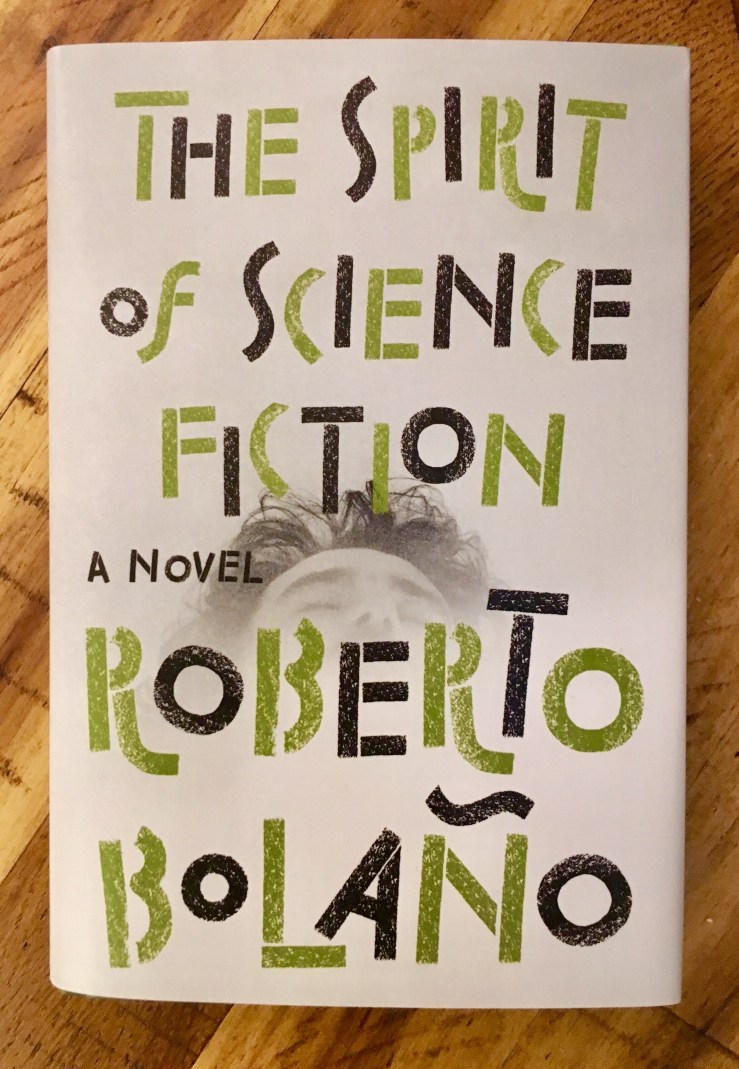
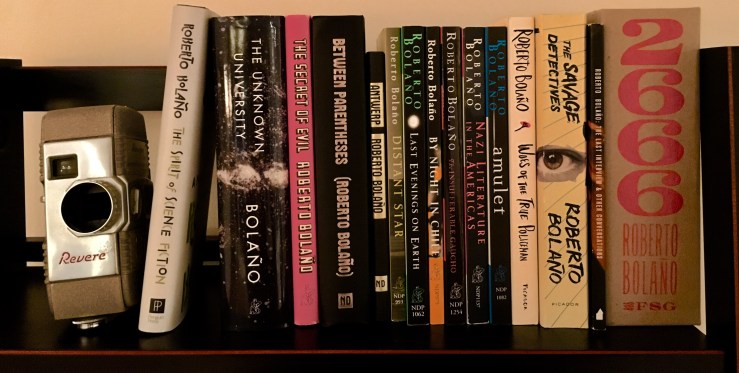
My review of  Roberto Bolaño’s latest posthumous novel The Spirit of Science Fiction was as much a cataloging of that novel’s place (and other unreleased early novels) in the Bolañoverse as it was anything else—although I did write about the book, of course:

Indeed, for many Bolaño fans, reading these early novels feels like its own project—winnowing for seeds, pulling at the threads that will cohere into something grander in the Bolaño’s future (which, from a readerly perspective, is the past). So when FS&G published Wimmer’s translation of Woes of the True Policeman in 2012, it was hard for many readers to see the novel as anything but ancillary materials for 2666—it was hard to read the novel as a discrete work, on its own. Instead, the question Woes asked Bolaño fans was, Where does this fit in the Bolañoverse?

The same question is in play for the latest posthumous Bolaño release, The Spirit of Science Fiction (Penguin, Wimmer). A simple read, and one that is not incorrect, is that The Spirit of Science Fiction feels like a trial run at The Savage Detectives. In particular, Spirit blueprints the first and third sections of The Savage Detectives, sections that revolve around the immature adventures of two would-be poets in Mexico City in the 1970s. Instead of Arturo Belano and Ulisses Lima though, we get Jan Schrella (“alias Roberto Bolaño”) and Remo. These two heroes divide Bolaño’s literary ambitions into poetry and prose, posterity and potboiler pulp fiction. In The Savage Detectives, Arturo Belano and Ulisses Lima will synthesize these ambitions more grandly in their literary quest.

I also riffed a little bit on Jon McNaught’s Kingdom and the act of reading physical books.

The last longer piece I managed in February was a take on the final scenes of True Detective Season 3.

Unrelated fox by Ohara Koson, c. 1930:

fox_in_the_reeds

Blog about the last three scenes of True Detective Season 3

Screenshot 2019-02-25 at 4.03.14 PM

I enjoyed Season 3 of True Detective, and thought the season finale, which aired last night on HBO, was especially good. Like the season as a whole, this eighth episode, “Now Am Found,” was rich, sad, ironic, often menacingly sinister, and ultimately ambiguous. “Now Am Found” showed that, like the two seasons that preceded it, True Detective’s third season was ultimately not about the criminal investigation purportedly at its center. Rather, True Detective is about the people who investigate the crimes, and how the investigations impact their relationships.

Three relationships drive the third season of True Detective: the relationship between Detective Wayne Hays (Mahershala Ali) and his partner Detective Roland West (Stephen Dorff); the relationship between Hays and his girlfriend and then wife Amelia Reardon (Carmen Ejogo); and the strange relationship between iterations of Hays himself, primarily versions of himself from 1980, 1990, and 2015. Like Season 1 of True Detective, Season 3 employs multiple timelines, often to a purposefully confounding effect.

Looping timelines are part of True Detective’s DNA. In Season 1, Rustin Cohle (Matthew McConaughey) proclaims that “time is a flat circle,” paraphrasing Nietzsche’s idea of eternal recurrence. Our souls will infinitely repeat everything we have ever done or will do. Season 3 dramatizes Cohle’s proclamation via its viewpoint character, Wayne Hays, who is, to borrow a phrase of Kurt Vonnegut’s “unstuck in time.” Hays is in the early stages of a creeping dementia in the 2015 timeline, and throughout the series his consciousness veers between the years.

In 1980, Hays and West begin investigating the murder of Will Purcell and the kidnapping of his sister, Julie Purcell. Hays also meets his future wife Amelia in this investigation. In 1990, a second investigation into the Purcell case is under way; Hays and West attempt to right some of the wrongs that went down in the 1980 case. In 2015, Hays and West initiate a third Purcell investigation (not letting the fact that they are no longer police officers stand in their way). True Detective Season 3 unspools, tangles, and ties these threads into a bewildering and often thrilling tapestry, ultimately depicting a man whose mind is falling apart.

Like the episodes before it, “Now Am Found” dips freely from timeline to timeline. However, this final episode is bookended by two scenes that deviate from the main 1980-1990-2015 plotlines. The opening scene seems to be set a few years after 1990—perhaps in ’94 or ’95. Amelia is teaching English at the University of Arkansas, where Hays is now the head of campus security. In an idyllic moment that restages their initial meeting in 1980, Hays sticks his head into Amelia’s classroom to hear her read a bit of Delmore Schwartz’s poem “Calmly We Walk through This April’s Day.” This moment is the only glimpse we get of this timeline, a timeline that Amelia and Hays promise to create for themselves roughly half way through “Now Am Found.” In a scene that caps the end, or an end (there are no tidy ends in True Detective) to the 1990 timeline, Amelia and Hays agree that their relationship has been inextricably bound up in the Purcell case; their partnership’s genesis was rooted in murder and mystery. They elect to start anew, to write their own conclusion. The episode’s beginning delivers this conclusion, an ironic inversion that represents the season’s approach to linear time.

The second scene that deviates from the 1980-1990-2015 plotlines is the very last shot, which I will come to momentarily. First though, let me address the third-to-last and second-to-last scenes (which, after all, is what this blog’s title promised).

The season’s third-to-last scene comes after Hays follows one last lead as to where Julie Purcell might be. The lead comes from a vision of Amelia (prompted by reading a snippet of the true crime book she wrote about the case, which Hays has never fully read). The vision is a phantom, a ghost emanating from his own consciousness, and it directs him to write another conclusion in the Purcell case—a happy ending with a family restored. However, when Hays finally makes it to the woman whom he believes is Julie Purcell, his dementia undoes him. He calls his son, who arrives along with Hays’ daughter, to bring the old man home. Hays hands over the last clue to the Purcell case—the address he drove to—to his son, who is also a detective. The loop remains open.

Screenshot 2019-02-25 at 3.57.42 PM

Hays and his grown children return to Hays’ son’s house. This third-to-last scene plays out as a glowing, bright fantasy of familial reconciliation, extending that reconciliation to Hays’ once-estranged partner West. The family (including West) gaze on their children from the porch, iced teas in hand, rocking softly, their hands touching. It’s almost too godddamn corny for words.

The scene swells with menace though. The sun promises to set, and we pan to a shot of Hays’ grandchildren, boy and girl on bikes. The shot echoes the first episode’s shots of Will and Julie Purcell riding their bikes into the night, into peril. Hays will never get outside of the circle in which his consciousness is circumscribed.

Screenshot 2019-02-25 at 3.57.51 PM

Through Hays’ consciousness we depart the scene entirely. In a fantastic shot, we see Hays’ face submerge into time. Mahershala Ali is excellent in True Detective Season 3, and his eyes are especially expressive, signalling shifts in consciousness, in realization and unrealization.

Screenshot 2019-02-25 at 3.58.58 PM

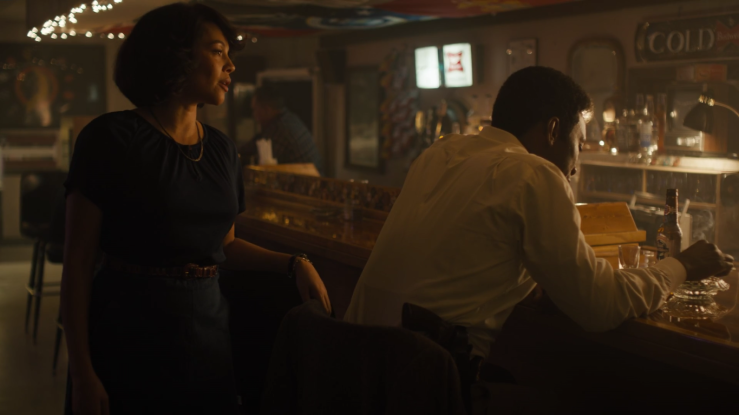
The third-to-last scene transitions to the second-to-last scene through Hays’ eyeball. We end up at the VFW bar, all the way back in 1980, to reconcile with the person missing from the family reunion depicted in 2015: Amelia.

Screenshot 2019-02-25 at 3.59.53 PM

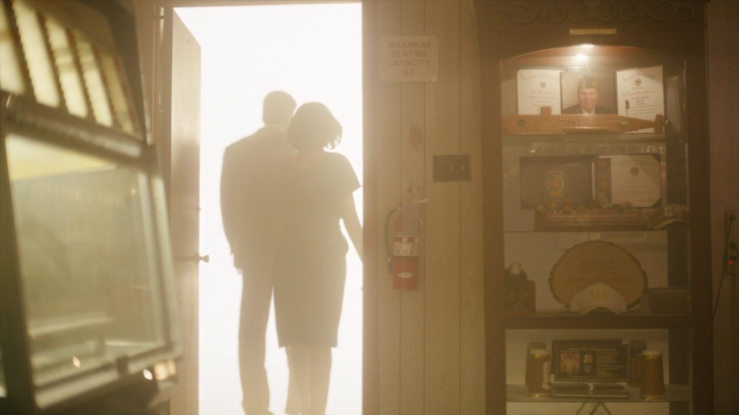
Amelia, like West, was both partner and rival to Hays. Their partnership seemed doomed after the fallout of the 1980 investigation. Amelia, also a true detective, authors an article that damns Hays’ career. This point of resentment boils throughout the season, particularly during the 1990 strands; resentment and competition are seeded into their partnership. And yet when Amelia arrives at the VFW bar, searching for a resolution, a conclusion if not a reconciliation, she opens something new in Hays, who cries before her and then asks her to marry him. The two exit into a glowing light, off to repeat their parts in a circle to which the viewers have already borne witness. This scene too is coded in subtle irony. Their new beginning will not set them free from the arc of their circle.

Screenshot 2019-02-25 at 4.02.57 PM

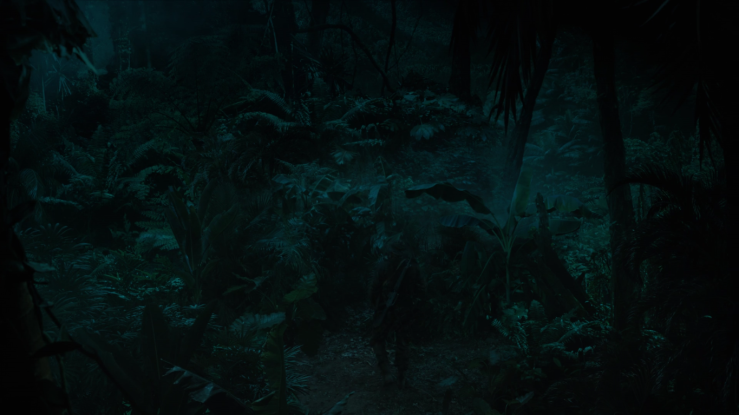
The light resolves into darkness, and we find ourselves some place utterly new yet wholly recognizable. Amelia is gone; the family is gone. This scene is Hays alone, somewhere in the jungles of Vietnam. It’s likely some time around 1965. Hays turns and looks directly toward the camera, but also, perhaps, directly at some version of himself, some version from 1980, 1990, 2015. He seems to gaze forward at the eye that gazed backward at him from half a century in the future.

Screenshot 2019-02-25 at 3.56.03 PM

Wayne Hays then turns and walks into the enveloping jungle. He disappears. Season 3 of True Detective is over.

The moment that Hays disappears into a Vietnamese jungle is ambiguous, sure. But given True Detective’s formal thesis that “time is a flat circle,” we can also read this ending as a suggestion that Hays is bound to repeat his arc. The Vietnam War is in many ways the founding unaddressed trauma of Hays’ life, and the series in a bleakly ironic gesture puts him right back there at the ending.

The title of “Now Am Found” clearly alludes to “Amazing Grace,” but the episode’s events ironically show that Hays can never be found. True, there are momentary gestures of reconciliation, of “being found” — by his son and daughter, by Amelia, by his partner West — but Hays is a consciousness in fragments, a kind of damned loop of a person suffering through a purgatory he doesn’t fully have the language to describe, let alone communicate to another person.

Screenshot 2019-02-25 at 4.03.46 PM

Some viewers may have found the final shot of “Now Am Found” bewildering, inexplicable, or unnecessary. I thought it was a sad, rich image that provided a vital coda for a sad, rich television show. The final image serves to reinforce the series’ trope of eternal recurrence, undoing (or, more charitably simply complicating) the episode’s opening scene, in which we saw a peaceful, happy Hays and Amelia. But if the final scene in Vietnam undoes the domestic bliss that Hays and Amelia authored for themselves, it also points to the promise of futurity, of a future that goes on and on and on.


More Bolaño: A review of Roberto Bolaño’s novel The Spirit of Science Fiction

img_2270

Roberto Bolaño died at the young age of 50 in 2003, just as his work was beginning to gain a wider audience and broader critical acclaim. It wasn’t until after his death that his work was published in English. Just a few months after Bolaño died, New Directions published By Night in Chile in translation by Chris Andrews. A year later, they published Andrews’ translation of Distant Star, and completed the loose trilogy of these short novels with the publication of Amulet in early 2007. A few months after the publication of Amulet, FS&G published Natasha Wimmer’s translation of The Savage Detectives, which had been originally published in Spain a decade earlier. By the time Wimmer’s translation of 2666 hit the shelves in 2008, Bolaño had become a literary sensation in the U.S., only half a decade after his death.

2666 is arguably Bolaño’s masterpiece, and certainly one of the defining books of the first decade of the 21st century. I read the book in a fevered rush, and then read it again, and then again. As far as I can tell, there are more essays and reviews about 2666 on Biblioklept than any other book. It was the second book I read by Bolaño—admittedly, a first reading of The Savage Detectives left me a perplexed and cold, but I’ve since returned to that novel with a broader understanding and appreciation of Bolaño’s project, a project that seemed to expand yearly after Bolaño’s demise.

Indeed, it became something of a joke in literary circles, What, another Bolaño? He drops books from beyond the grave like Tupac drops albums! There are the short story collections (translated by Andrews) that trickled out between 2007 and 2012, along with harder to classify collections, like The Secret of Evil (Andrews, 2012) and Nazi Literature in the Americas (Andrews, 2008), a jangling set of keys to the Bolañoverse. Another set of keys came in the wonderful collection The Unknown University, a compendium of Bolaño’s poetry in translation by Laura Healy published by New Directions in 2013.

img_2273

Then there are the novels that seemed to arrive every year or so: The Skating Rink (Andrews, 2009), Monsieur Pain (Andrews, 2010), Antwerp (Wimmer, 2010), The Third Reich (Wimmer, 2011), A Little Lumpen Novelita (Wimmer, 2014). Bolaño composed these pieces primarily in the 1980s, when he still thought of himself as a poet. These novels lack the vitality and vibrancy of his later work—the short story collections, the trilogy of short novels that began with Distant Star, and his big books, The Savage Detectives and 2666.

Indeed, for many Bolaño fans, reading these early novels feels like its own project—winnowing for seeds, pulling at the threads that will cohere into something grander in the Bolaño’s future (which, from a readerly perspective, is the past). So when FS&G published Wimmer’s translation of Woes of the True Policeman in 2012, it was hard for many readers to see the novel as anything but ancillary materials for 2666—it was hard to read the novel as a discrete work, on its own. Instead, the question Woes asked Bolaño fans was, Where does this fit in the Bolañoverse?

The same question is in play for the latest posthumous Bolaño release, The Spirit of Science Fiction (Penguin, Wimmer). A simple read, and one that is not incorrect, is that The Spirit of Science Fiction feels like a trial run at The Savage Detectives. In particular, Spirit blueprints the first and third sections of The Savage Detectives, sections that revolve around the immature adventures of two would-be poets in Mexico City in the 1970s. Instead of Arturo Belano and Ulisses Lima though, we get Jan Schrella (“alias Roberto Bolaño”) and Remo. These two heroes divide Bolaño’s literary ambitions into poetry and prose, posterity and potboiler pulp fiction. In The Savage Detectives, Arturo Belano and Ulisses Lima will synthesize these ambitions more grandly in their literary quest.

Jan and Remo’s questing in Spirit isn’t quite as grand. Remo wants to figure out why there are so many literary magazines in Mexico City; Jan spends his days writing to American science fiction writers. They manage to get mixed up with a set of sisters and their friend—poets of course. (Everyone in the novel is a poet, even—especially—a skinny motorcycle mechanic). The sisters prefigure the Font sisters of The Savage Detectives, and much of their plot feels like a sketch for that richer work.

Their friend Laura is a more interesting figure—a bit sinister, a cipher really, an iteration of the Lisas and Lupes that we find elsewhere in Bolaño’s fiction—in particular in some of the poetry collected in The Unknown Univeristy. Indeed, the final section of The Spirit of Science Fiction, “Mexican Manifesto,” was originally published in a different form in that collection. Some of the best parts of Spirit feel like failed poems, poems that want to be prose, unpoetical, mad, howling, jolly poems. Like 2666 or The Savage Detectives, the plot of Spirit careens, splinters, dares the reader to put the fragments together.

There is structure though: The main of the novel is told in first-person perspective by Remo. He’s seventeen, and has come from Chile to Mexico City with his friend Jan to live destitute in a garret and write bad articles under a pseudonym while he pursues his poetry. He gets sidetrack by love and other matters.

Running counter to this narrative are the letters that Jan writes to American sci-fi authors like Ursula K. Le Guin and Alice Sheldon. In a metatextual nod, Jan (“alias Roberto Bolaño”) also writes to Sheldon’s alias James Tiptree, Jr. Jan’s letters are a highlight of the novel, setting youthful arrogance and romantic idealism against a kind of quasi-tragic pathos. In a letter to Philip José Farmer, Jan (alias Roberto) suggests that a literary sci-fi anthology called American Orgasms in Space be published as a means to end war and cultivate brotherhood between Latin Americans and North Americans. The punchline to the letter is hilarious. Before signing off (“Warmly”), Jan informs the author of the Riverworld series that, “A week ago, I lost my virginity.”

A third strand runs throughout Spirit. In a series of segments set in some presumable future, a female journalist interviews Jan in the middle of a bizarre drunken party somewhere in the dark woods. Jan has won a prize for a sci-fi novel that he summarizes for the journalist who listens, downing vodka after vodka. Jan’s prize-winning sci-fi novel meshes elements that will be familiar to Bolaño’s readers—apocalyptic desolation, failed communication, esoteric histories of Latin America, mystery authors. Etc. It’s even partially set in the Unknown University. The interview segments seem perched on the edge of their own sinister apocalypse, a typically-Bolañoesque move, as if a seemingly-normal situation might topple over into malevolence at any moment. Unfortunately though, these sections seem to have been abandoned.

Indeed, much of Spirit reads like a patchwork of abandoned drafts, riddled with material and ideas that will pop up in later novels—the tabletop gaming of The Third Reich, the fascination of Nazi iconography we see in Nazi Literature in the Americas, the reckoning of post-colonialism which belongs to The Savage Detectives in particular, as well as the Bolañoverse as a whole. Too, Spirit shares the ominous swells and sinister reverberations that we identify with both Bolaño’s prose and poetry—the book shows the joyful optimism of youth poised on the cusp of unnameable disaster.

And there are plenty of great sections in The Spirit of Science Fiction: Jan desribing the entirety of a Gene Wolfe space novella to his friend, but mashing it into a vision of the screenwriter Thea von Harbou and her Nazi sympathies; the story of a Belgian-occupied village in the Congo that falls into a madness of woodworking, a madness that leads to general slaughter; a nervous late-night ride on a stolen motorcycle named the Aztec Princess; “the story of how Georges Perec, as a boy, prevented a duel to the death between Isidore Isou and Altagor in an old neighborhood in Paris”; a grotesque and enthralling final sequence in a semi-legal Mexico City bathhouse that channels the dark ghost of William S. Burroughs.

In short, there’s a lot of great writing in The Spirit of Science Fiction—plenty of moments that satisfy, if only temporarily, our cravings for more Bolaño. And yet the novel is clearly unfinished, which, if you’ve read Bolaño—and I’m assuming if you’ve hung out this far into this review, you’ve read Bolaño, and like, if you haven’t read Bolaño, I think he’s great, and a great starting point for reading him would be Distant Star or the short story collection Last Evenings on Earth—and, where was I? Okay: The Spirit of Science Fiction is clearly an unfinished piece, which, if you’ve read Bolaño, may seem like a Bolañoesque feature—his works point to an indeterminancy, an oblique, inconclusive, resolutely unfinishedness. (Think of the final lines/images of The Savage Detectives, for example).

And yet Spirit’s unfinishedness is not of a piece with the general aporia that belongs to Bolaño’s finished unfinished works—it seems, rather, an abandoned project, a draft to be repurposed later. Which, of course, it was—we already got the material that Spirit helped inspirit—in The Savage Detectives, in Nazi Literature, in 2666—in Bolaño’s best materials.

Paradoxically then, The Spirit of Science Fiction leaves the reader—by which I mean the Bolaño fan—by which I mean, let’s be honest, this Bolaño fan—Spirit leaves this reader hungry for more, for the pages to gallop on and on, to careen into more dread and manic joy and bad poetry and good poetry and pilfered stories and excessive metaphors. More: More Bolaño.

And then how could this review be a complaint? Well it isn’t. I enjoyed The Spirit of Science Fiction, was hungry for it before I even touched it, and then left hungry, wanting more: More Bolaño.

A review of Yevgeny Zamyatin’s prescient dystopian novel We

img_2163

Set millennia in the future, Yevgeny Zamyatin’s 1921 dystopian novel We tells the story of a man whose sense of self shatters when he realizes he can no longer conform to the ideology of his totalitarian government. Zamyatin’s novel is a zany, prescient, poetic tale about resisting the forces of tyranny, conformity, and brute, unimaginative groupthink.

We is narrated by D-503. D-503 is an engineer building a spacecraft, the Integral, which will expand the domain of OneState. Although OneState has conquered earth (after the apocalyptic Two Hundred Years War), they seek to expand their empire of conformity to the stars, perhaps replicating their giant city-state on planets yet unknown. In its physical form, OneState is a glass panopticon surrounded by a great Glass Wall that keeps the wild natural world out. In its ideological form, OneState mandates uniformity, mechanization, and mathematical precision. The denizens of OneState conform to this ideology at all times. They wear uniforms — “yunies” — that bear the numbers that serve as their names. Indeed, they are “Numbers,” not people. The Numbers wake and sleep at the exact same hour. They march in unison and live and work in glass buildings. They “vote” to elect the same Benefactor each year, who runs unchallenged. They eat foods made from petroleum and produce children in a machine-like process that follows a system of “Maternal and Paternal Norms.” Numbers that don’t meet these Norms are forbidden from reproducing, but any Number can register for intercourse with another Number on Sex Day. A secret police force, the Bureau of Guardians, monitors the population, but it’s ultimately groupthink that keeps the Numbers in line.

One-State’s groupthink ideology is neatly summed up in propaganda that D-503 shares late in the novel:

Here’s the headline that glowed from page one of the State Gazette:

REJOICE!

For henceforth you are perfect! Up until this day your offspring, the machines, were more perfect than you.

IN WHAT WAY?

Every spark of the dynamo is a spark of purest reason. Every stroke of the piston is an immaculate syllogism. But do you not also contain this same infallible reason? The philosophy of the cranes, the presses, and the pumps is as perfect and clear as a circle drawn with a compass. But is your philosophy any less perfect? The beauty of the mechanism is in the precise and invariable rhythm, like that of the pendulum. …But think of this: The mechanism has no imagination.

Imagination is the ultimate enemy of the machine, and the Benefactor and his Guardians have a plan to finally root it out and exterminate it.

Throughout much of We, D-503 is very much attuned to this ideology. D-503 thinks of OneState as “our glass paradise.” What we see as dystopia he sees as utopia, he initially constructs We as a testament to OneState’s glory that he will include as part of the cargo of the Integral. However, as the narrative unfolds, D-503 unravels. His sense of self divides as signs of mental illness emerge–first dreams, then an imagination, and then—gasp!—a soul.

D-503’s internal conflict stems from discovering his own innate irrationality—namely, a soul which cannot be measured in numbers or weighed in physical facts. This internal conflict drives much of the narrative of We. Zamyatin delivers this conflict in D-503’s first-person consciousness, a consciousnesses that contracts and expands, a consciousness that would love to elide its own first-person interiority completely and subsume itself wholly to a third-person we—but he can’t. Consider the following passage;

I lie in the bed thinking … and a logical chain, extraordinarily odd, starts unwinding itself.

For every equation, every formula in the superficial world, there is a corresponding curve or solid. For irrational formulas, for my √—1, we know of no corresponding solids, we’ve never seen them…. But that’s just the whole horror—that these solids, invisible, exist. They absolutely inescapably must exist. Because in mathematics their eccentric prickly shadows, the irrational formulas, parade in front of our eyes as if they were on a screen. And mathematics and death never make a mistake. And if we don’t see these solids in our surface world, there is for them, there inevitably must be, a whole immense world there, beneath the surface.

I jumped up without waiting for the bell and began to run around my room. My mathematics, up to now the only lasting and immovable island in my entire dislocated life, had also broken loose and floated whirling off. So does this mean that that stupid “soul” is just as real as my yuny, as my boots, even though I can’t see them now (they’re behind the mirror of the wardrobe door)? And if the boots are not a disease, why is the “soul” a disease?

What initiates D-503’s anti-quest for a soul? It is a woman of course. I-330 interrupts D-503’s routine life, puncturing his logic with irrational passions, taking him on transgressive trips to the Old House—and eventually, leading him to the greatest transgression of all. You see, there’s an underground movement, a secret resistance force—one that not uncoincidentally needs access to the Integral—and this resistance plans to…but I shouldn’t spoil more.

Or really, could I even spoil the plot of We? So many novels and films have borrowed heavily from (or at least echoed) its premise that you already know what it’s about. The major examples are easy—Huxley’s Brave New World (1932), Lang’s Metropolis (1927), Orwell’s 1984 (1949), Vonnegut’s Player Piano (1955), etc. Then there are all their followers—the cheap sci-fi paperbacks of the sixties and seventies, their corresponding films—Logan’s RunSoylent Green–and so on and so on, well into our Now (Running ManTotal RecallThe Matrix, The Hunger Games, etc. forever).

You get the point: We is a generative text. And after reading We, I couldn’t immediately think of a clear generative text that generated it. From what materials did Zamyatin craft his tale?  The closest predecessor I could initially think of was Jack London’s The Iron Heel (1907), or maybe bits of H.G. Wells’ The Time Machine (1895), neither of which feel as thoroughly modern as We does. However, cursory research (uh, skimming Wikipedia) turned up Jerome K. Jerome’s 1891 short story, “The New Utopia,” which does feature some of the tropes we find in We. Set in city of the future, “The New Utopia” features uniformed, nameless, numbered people whose government attempts to destroy the human imagination. Here, the “Destiny of Humanity” has become an egalitarian nightmare.

While it’s likely that “The New Utopia” furnished Zamyatin some of the tropes he needed to construct We, Jerome’s story simply doesn’t have the same epic themes of underground resistance to technological bureaucracy that have became the stock of so much 20th and 21st-century science fiction. (I rewatched Terry Gilliam’s Brazil (1985) while reading We, and the parallels are remarkable—but the same can be said for any number of sci-fi films of the last sixty or so years).

More significantly, Jerome’s “The New Utopia” is beholden to a rhetorical scheme that makes it feel closer to an essay than a finished work of art. The story is essentially a one-sided dialogue—a man falls asleep, wakes up a few thousand years later, and gets the skinny on the utopian nightmare city he’s awoken in from an enthusiastic Future Person. Reading “The New Utopia” reminded me of reading London’s The Iron Heel, which essentially works in the same way—London’s plot often feels like an excuse to stitch together Marxist readings into monologues posing as dialogues.

Zamyatin’s book, in contrast, is Something New. We is a work of Modernism, not just a collection of new tropes, but a new configuration of those tropes. Zamyatin’s D-503 is a consciousness in crisis, a self that simultaneously dissovles and resolves into something new—a creature with a soul. Consider D-503’s recollection of a nightmare:

It’s night. Green, orange, blue; a red “royal” instrument; a yellow-orange dress. Then, a bronze Buddha; suddenly it raised its bronze eyelids and juice started to flow, juice out of the Buddha. Then out of the yellow dress, too: juice. Juices ran all over the mirror, and the bed began to ooze juice, and then it came from the children’s little beds, and now from me, too—some kind of fatally sweet horror….

The prose here showcases Zamyatin’s vivid style. We, crammed with colors, often evokes Expressionist and Futurist paintings. We get here a painterly depiction of D-503’s abjection, his sense of a self leaking out in “some kind of fatally sweet horror” — his boundaries overflowing. The dream-synthesis here is at once joyful, terrifying, and utterly bewildering to our poor hero. It is also poetic in his rendering. D-503 laments early in his narrative that he is not a poet so that he cannot properly celebrate OneState in writing for his readers. But later, his friend R-13—a poet himself—tells him that he has “no business being a mathematician. You’re a poet…a poet!”

R-13 is correct: D-503 is a poet, a poet who cannot abide all the metaphysics gumming up his mathematical mind. This poetry is rendered wonderfully in the English translation I read by Clarence Brown (1993), and is showcased in the very “titles” of each chapter (or “Record,” in the book’s terms). Each “Record” begins with phrases culled from the chapter. Here are a few at random:

An Author’s Duty

Swollen Ice

The Most Difficult Love


Through Glass

I Died

Hallways


Fog

Familiar “You”

An Absolutely Inane Occurrence


Letter

Membrane

Hairy Me

These are the titles of four random chapters, but I suppose we could string together the whole series and arrive at a Dadaist poem, one that might also serve as an oblique summary of We.

And yet for all its surrealist tinges and techno-dystopian themes, the poem that We most reminded me of was, quite unexpectedly, Walt Whitman’s Song of Myself (1855). Whitman’s poem sought a new language and a new form to tell the story of a new land, a new people. He wanted to be everyone and no one at the same time, himself a kosmos, form and void, an I, a you, a we. Whitman addressed his poem to both the you of his readership, an immortal future readership beyond him (“Listener up there!”) as well as himself, famously declaring: “I loaf and invite my soul.”

D-503 presents almost as an anti-Whitman. He directly addresses his “unknown readers” in nearly every chapter, and with a Whitmanesque turn, like this one: “You, my unknown readers, you will be told everything (right now you are just as dear, as close, and as unapproachable…).” His ebullience and optimism are ironic of course—they are honest performances that crack under the increasing reality of his emerging soul. Unlike Walt Whitman, D-503 cannot loaf and invite his soul. He can’t sustain the negative capabilities Whitman’s poem engenders. His we cannot reconcile with an I, even as it seeks a mediating you in its dear readers.

And yet for all its bitter ironies and for all its hero’s often feckless struggle, We is a comedy. The book is a cartoon-poem-satire, its comedy sustained in the careening voice of D-503. It’s somewhat well known that George Orwell used We as a template for 1984 (he began that novel less than a year after penning a review of a French translation of We). Orwell’s novel though falls into the same essaying that we see in The Iron Heel and “The New Utopia.” It’s also awfully dour. In contrast, We shuttles along with zany elan, inviting us to laugh at modern absurdity. Indeed, Zamyatin posits laughter as resistance to tyranny, myopia, and brutish closed-mindedness. Late in the novel, D-503 arrives at the following epiphany:

And that was when I learned from my own experience that a laugh can be a terrifying weapon. With a laugh you can kill even murder itself.

I could end by cataloging the various parallels that might be drawn between We and our own dystopian age, but I think that they are too obvious, and, as I’ve noted, have been repeated (with degrees of difference) throughout the body of dystopian narratives that We has helped generate. What the book does though—or I should say, what it did for me—is offer the strange comfort. A century after Zamyatin diagnosed the emergence of another modern world, the human position remains essentially unchanged, and in times of despair we can remember to laugh—and imagine to imagine. Very highly recommended.

Blog about some recent reading

img_2128

I finished Angela Carter’s surreal fantasia The Infernal Desire Machines of Doctor Hoffman a week or so ago, in a bit of a fever at its depraved horniness. Hoffman sprints along with an out-of-the-frying-pan-into-the-fire energy. The story is essentially a picaresque adventure—our narrator Desiderio sets out on a mission to assassinate Dr. Hoffman, a not-really-mad scientist who’s waging war on reality. Desiderio falls in love with Hoffman’s daughter Albertina though, complicating matters. All kinds of wild shit happens in each episode of the book—indeed, each chapter feels like it could stand on its own as a short story. I loved it, and it deserves a proper review, but for now I’ll lazily compare it to a bunch of other books I loved: Voltaire’s Candide, Réage’s Story of O, Le Guin’s The Farthest Shore, Kafka’s The Castle, Acker’s Don Quixote, any of Robert Coover’s fables, Kristeva’s Powers of Horror, and Swift’s Gulliver’s Travels. Oh, and video games. Someone could make a fantastic video game out of The Infernal Desire Machines of Doctor Hoffman.

I read the first half of João Gilberto Noll’s novel Lord (new in English translation by Edgar Garbeletto) on Sunday. The book is seriously weird. The narrator is “a Brazilian who wrote books that were mostly well received by critics but not the public.” The Brazilian novelist (a strange cipher of Noll himself) arrives in London in the winter on a “mission.” What that mission is is completely unclear, but it seems to involve an English university. Like the other Noll books I’ve read, Quiet Creature on the Corner and Atlantic Hotel,  Lord moves on its own dream logic. The narrator seems unstuck in both time and space. He’s an abject voice trying to reinvent himself from the outside in—but his disintegration seems fatally imminent.

I’ve also started in on the latest Lucia Berlin collection, Evening in Paradise, reading the first three stories. The first two, “The Musical Vanity Boxes” (which I’d read before in Homesick) and “Sometimes in Summer” are memoir pieces set in Berlin’s childhood home of El Paso (or, more properly I suppose, El Paso–Juárez). There’s a frankness to these tales that’s remarkable, an artistry of storytelling that never announces itself as such. The stories read like vivid recollections, and center on a very young Lucia and her best friend Hope, a Syrian immigrant. There’s an underlying menace here, too, a sense that these two friends might fall into disaster at any given moment. (In this way, these stories recalled the young female friends at the center of Elena Ferrante’s My Brilliant Friend who slowly come into consciousness of the real world around them). The third story in the collection “Andado: A Gothic Romance” is written in the third-person, although its hero “Laura” is clearly a stand-in for a teenage Lucia. Laura, like Lucia was, is an ex-pat teenager living in Chile. “Andado” too offers a slow swelling malice, as we perceive the dangers that Laura cannot. The story culminates in an impressionistic dreamlike sequence that matches Laura’s shaken psyche. I’m trying to restrain myself from reading all of these stories too fast.

I’ve poked about in Leslie Fiedler’s collection No! In Thunder, reading first his essay on Walt Whitman, and then his essay on Faulkner (it trapped me with its title: “William Faulkner, Highbrows’ Lowbrow”).

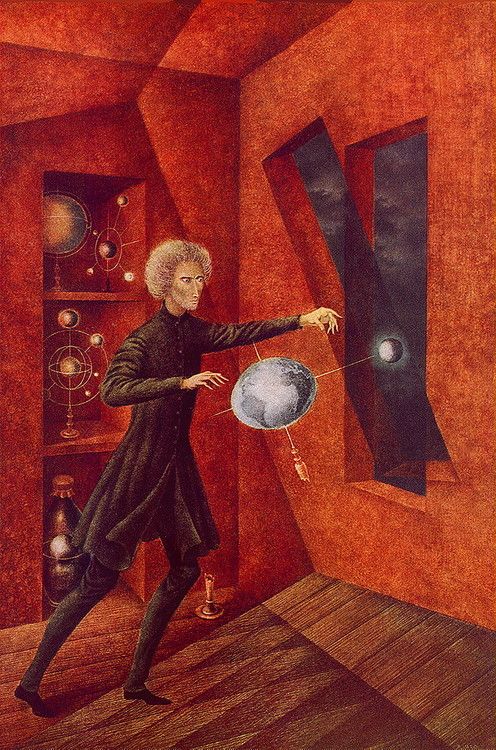
Finally, I’ve been reading Letters, Dreams & Other Writings by Remedios Varo (translated by Margaret Carson) in bits and pieces. I really dig the book and am happy Carson translated it and Wakefield Press published it. There’s a neat section where Varo describes her paintings—like this, for example:

Phenomenon of Weightlessness, 1963

The Earth escapes from its axis and its center of gravity to the great surprise of the astronomer, who tries to keep his balance with his left foot standing in one dimension and his right foot standing in another.

aeb34488236480657dc6aba97fc2d00d

A review of Paul Kirchner’s Hieronymus & Bosch, a slapstick comedy set in Hell

hb

My review of Paul Kirchner’s latest collection Hieronymus & Bosch is up at The Comics Journal. Here is the first paragraph of the review:

Paul Kirchner’s Hieronymus & Bosch collects over eighty comic strips that riff on the afterlife of a “shameless ne’er-do-well named Hieronymus” and his faithful wooden toy duck, Bosch. The hapless pair are trapped in Hell, the primary setting for most of the strips (although we do get a bit of heaven and earth thrown in here and there). Kirchner’s Hell is a paradise of goofy gags. The one-pagers in Hieronymus & Bosch cackle with burlesque energy, propelled by a simple plot: our hero Hieronymus tries to escape, fails, and tries again.

Read the whole review.

Blog about a metatextual moment at the end of William Gaddis’s novel The Recognitions

dqx3nv9u0aaq8m4

In the epilogue of his 1955 novel The Recognitions, William Gaddis checks in on the book’s enormous background cast, tying up loose ends, but also leaving many of the characters frayed, burned out, or destroyed. There’s a remarkable metatextual moment in this epilogue in which two minor characters are revealed to be carrying copies of a book that bears more than a passing resemblance to The Recognitions itself. These characters are both literary counterfeiters—Mr. Feddle, a faker who forges book jackets with his name in the author’s position and slips them over classic novels, and “the critic in the green wool shirt,” who doesn’t bother to read the books he reviews.

Meeting at a tailor’s shop, Feddle and the critic peer at each other, “fix[ing] the book the other was carrying with a look of myopic recognition.” The passage continues with the following acerbically ironic exchange:

—You reading that? both asked at once, withdrawing in surprise. —No. I’m just reviewing it, said the taller one, hunching back in his green wool shirt.

—A lousy twenty-five bucks. It’ll take me the whole evening tonight. You didn’t buy it, did you? Christ, at that price? Who the hell do they think’s going to pay that much just for a novel. Christ, I could have given it to you, all I need is the jacket blurb to write the review.

The exchange here accurately anticipates exactly how The Recognitions would be received by its contemporary critics—or “hacks,” as Jack Green repeatedly calls them in his infamous 1962 screed Fire the Bastards! For almost 80 pages, Green details the failures of the 55 critics who reviewed the book upon its release. Some of these major failures include—

failing to recognize the greatness of the book

failing to convey to the reader what the book is like, what its essential qualities are

counterfeiting this with stereotyped preconceptions—the standard cliches about a book that is “ambitious,” “erudite,” “long,” “negative,” etc

counterfeiting competence with inhuman jargon

Green’s repeated use of the word “counterfeit” not just here but throughout his tract demonstrates the essential realism of The Recognitions: Gaddis conceived how his novel of counterfeiters, poseurs, plagiarists, and hacks would be misread, misremembered, and misrecognized by counterfeiters, poseurs, plagiarists, and hacks. The green-wool-shirted critic’s declaration that all he needs “is the jacket blurb to write the view” transcends its original satirical contours—it is a prophecy that comes true.

This satirical metatextual prognostication finds fruition in the review of The Recognitions published in The Louisville Courier-Journal. In Fire the Bastards!, Green details how the reviewer plagiarized his review of The Recognitions from the novel’s jacket blurb. The metatextuality here is magical: Gaddis conjures the character of an unnamed counterfeiter critic who will (not-)review a book that appears to be The Recognitions itself; this character becomes real by (not-)reviewing the book in an unsigned review in The Louisville Courier-Journal that plagiarizes the book’s blurb.

But perhaps I’ve neglected to demonstrate that the book that Feddle the faker and the critic in the green wool shirt are both not reading is in fact a version of The Recognitions itself. Here is the next paragraph in the episode:

It was in fact quite a thick book. A pattern of bold elegance, the lettering on the dust1M5vpxx wrapper stood forth in stark configurations of red and black to intimate the origin of design. (For some crotchety reason there was no picture of the author looking pensive sucking a pipe, sans gêne with a cigarette, sang-froid with no necktie, plastered across the back.)

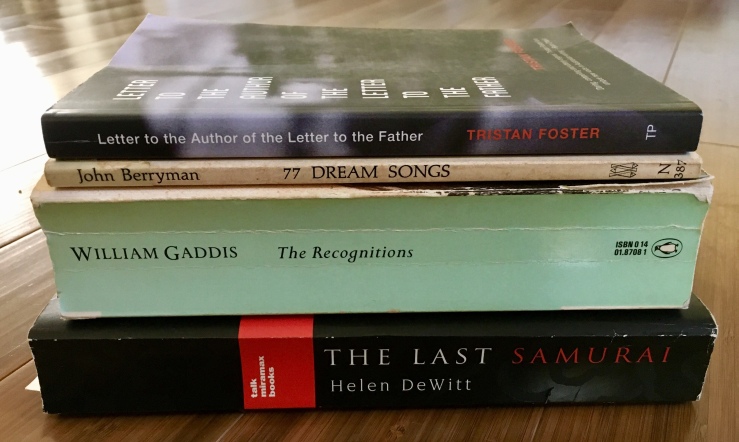
In his invaluable work A Reader’s Guide to William Gaddis’s The Recognitions, Steven Moore gives the following annotation to these lines:

 the description is of the first edition of R [The Recognitions]. Martin Dworkin’s photograph of Gaddis “sans gêne with a cigarette, sang-froid with no necktie” appeared in both the Time and Newsweek reviews.

Jack Green is more succinct in Fire the Bastards!: “the book the stubby
poet [Feddle] has is the recognitions [sic] itself.” And what is “the stubby poet” doing with such a bigass book? Reading it?

—Reading it? Christ no, what do you think I am? I just been having trouble sleeping, so my analyst told me to get a book and count the letters, so I just went in and asked them for the thickest book in the place and they sold me this damned thing, he muttered looking at the book with intimate dislike.

At least Feddle’s dislike is “intimate.” If he’d bothered to read it he might have gotten some weird alarming joy from this (meta)Recognitions. Or, even better, he might reread it—which is really the only way to read The Recognitions, I’m convinced, after my second full read. The book is more precise, more artfully constructed—more stuffed with motifs and symbols, doubled, tripled, quadrupled—than I had realized on first reading.

Jack Green made rereading The Recognitions a significant part of his life. He was an evangelist for the text, going so far as to take out a full page ad in The Village Voice in 1962 when the book was reprinted in paperback. His advertisement is five short paragraphs. The second paragraph is a proper, original blurb. The second paragraph is an argument for rereading. Here they are:

“The Recognitions” is a 956-page novel whose main theme is vanity or forgery—of Old Masters, $20 bills, slings, personality, everything. It is like a painting with a few primary figures presented in depth and an army of caricatures in the background. The main characters are unforgettable and, as is usually true, give the book most of its greatness. The minor characters, including the author himself who has a bit part, are very funny.

Like “Ulysses,” Gaddis’s book can be read the first time with enjoyment (my advice: don’t work at it) and then reread for years with increasing fascination. It has an intricate network of thousands of cross-references which give it a unique time-sense: as the connections are gradually recognized on rereading, the book appears to grow like a living being.

“Grow like a living being.” I think that’s about right.

A review of Ishmael Reed’s Christmas satire, The Terrible Twos

Christmas approaches, so let me recommend a Christmas novel for you: Ishmael Reed’s The Terrible Twos (1982). I read it back in unChristmasy August and dipped into it a bit again today, looking for a passage or two to share. Maybe the bit where Santa Claus starts an anti-capitalist riot in Times Square?, or where the First Lady is electrocuted while lighting the White House Christmas tree?, or where the idiot U.S. President meets Harry Truman in A Christmas Carol tour of hell? I scrounged for a big fat citation that works on its own, but I kept wanting to build a frame, set a stage, and ended up with this instead, a “review,” a recommendation. A stage setting.  Of course, Ishmael Reed’s novels create their own stages, their own contexts and rhythms, and each paragraph, each sentence, each note fits into that context, blaring or humming or blasting the reader. Reed’s satire is simultaneously bitter and salty and sweet and sharp sharp sharp, the sort of strange rich dish you gobble up too fast and then, Hell!, it gives you weird dreams. For months.

But nice fat slices of Reed’s prose can be served on their own, as John Leonard’s 1982 NYT  review of The Terrible Twos shows. Leonard’s review is ten paragraphs long and he quotes Reed in full for two of those paragraphs, including this one, the longest paragraph in the piece:

Two-year-olds are what the id would look like if the id could ride a tricycle. That’s the innocent side of 2, but the terrible side as well. A terrible world the world of 2-year-olds. The world of the witch’s door you knock on when your mother told you not to go near the forest in the first place. Pigs building houses of straw. Vain and egotistic gingerbread men who end up riding on the nose of a fox. Nightmares in the closet. Someone is constantly trying to eat them up. The gods of winter crave them – the gods of winter who, some say, are represented by the white horse that St. Nicholas, or St. Nick, rides as he enters Amsterdam, his blackamoor servant, Peter, following with his bag of switches and candy. Two-year-olds are constantly looking over their shoulders for the man in the shadows carrying the bag. Black Peter used to carry them across the border into Spain.

Leonard (who describes the paragraph as “a kind of jive transcendence”— I’ll settle for “transcendence”) offers up this nugget as a condensation of Reed’s themes and mythologies. The paragraph neatly conveys the central idea of Reed’s novel, that American capitalism refuses to allow its subjects to Grow Up. It’s a tidyish paragraph. Tidyish. Reed always sprawls into some new mumbo jumbo. The anarchic energy of his prose digs up old mythologies, boots skeletons out closets, and makes all the old ghosts of Western history sing and dance.

So there’s a lot going in The Terrible Twos’ not-quite 200 pages. Should I take a stab at unjumbling the plot? Okay, so: Reagan is elected president. Things are bad. Rough for, like, the people. Fast forward a few terms, to the early/mid-nineties (Reed’s future…this is a sci-fi fantasy). Former fashion model Dean Clift ascends to the Presidency. Only he’s just a puppet for his cabinet, a cabal of war-profiteering zealots secretly planning a genocidal operation that would not only destroy a nuclear-armed African nation, but also “rid America of surplus people.” Surplus = poor. After Clift’s wife dies in a freak (not-really-freak) Christmas-tree-lighting accident, his life changes, and Saint Nicholas (like, the real Santa) comes to visit him. Santa takes the President on a Dantean-cum-Dickensian trip through the hell of American past. The poor dumb idiot President transforms his soul. Hearing Truman lament the bombing of Hiroshima might do that (not that that’s the only horror that haunts this novel—but a nuclear winter is not a winter wonderland, and Reed’s characters, despite their verve, are all suffering from Cold War Blues). Clift goes on TV and advocates a Christmas Change—but too late. The conspiracy cabinet hits him with the 25th Amendment to the United States Constitution. Reed gives a history lesson to the highest office of the land, changes the man’s life, and then imprisons him in a sanatorium. Satire at its cruelest.

But hell, what am I doing here, foregrounding President Clift? Or even Santa? There’s so much more going on in The Terrible Twos: the secret sect of Nicolites who worship Saint Nick; devotees of Black Peter (a version of the Dutch tradition of “Zwarte Piet”); the North Pole syndicate; secret agents, thugs, and sundry assassins; punk rioters; a rasta dwarf (um, Black Peter). And somehow I’ve left out the novel’s semi-hapless hero, Nance Saturday…

Look, the plot—the picaresque, mumbo-jumbo, always-mutating plot of The Terrible Twos is, yes, fun—but it’s the prose, the energy, the commentary, and, yes, the prescience of the novel that makes it so engrossing and fun and terrifying. This is a book that begins: “By Christmas, 1980, the earth had had enough and was beginning to send out hints,” a book that has the American President meeting with the American Nazi Party in the Oval Office, a book that has one character comment to another, on the election of Reagan, that “It feels good to be a white man again with him in office.” The satire’s prescience is painful, but Reed’s wisdom—the ballast of this ever-shifting picaresque—anchors the commentary in a deeper condemnation: It has always been this way. Ishmael Reed seems so prescient because we keep failing the past. Same as it ever was. Thus The Terrible Twos plays out in a series of plots and schemes, retaliations and riots—but also wry comments and righteous resistance. And so if Reed’s analysis of American history is unbearably heavy, it also points towards a negation of that heavy history, towards a vision of something better.

I shall give the last words to Reed’s Santa:

Two years old, that’s what we are, emotionally—America, always wanting someone to hand us some ice cream, always complaining, Santa didn’t bring me this and why didn’t Santa bring me that…Nobody can reason with us. Nobody can tell us anything. Millions of people are staggering about and passing out in the snow and we say that’s tough. We say too bad to the children who don’t have milk….I say it’s time to pull these naughty people off their high chairs and get them to clean up their own shit. Let’s hit them where it hurts, ladies and gentlemen. In their pockets. Let’s stop buying their war toys, their teddy bears, their dolls, tractors, wagons, their video games, their trees. Trees belong in the forest.

A riot ensues.

Very highly recommended.

[Editorial note: Biblioklept ran a version of this review in December, 2017].

Gaddis Contra Carnegie | How to Win Friends and Influence People in The Recognitions

img_1858

The second episode of Part II, Ch. 5 of William Gaddis’s 1955 novel The Recognitions returns to the consciousness of sadsack everyman Mr. Pivner. Through milquetoast Mr. Pivner (the long-lost father of poseur-supreme Otto), Gaddis critiques the banal emptiness and rank venality of post-war life in America. In this particular section of The Recognitions, Gaddis reinforces one of his novel’s central themes: modern commerce has supplanted culture in contemporary America. Indeed, commerce is culture in America.

The episode begins as Papa Pivner prepares to meet Otto for the first time (their estrangement has not yet been explained in the narrative). They arrange to meet in a hotel restaurant, their recognition of each other secured in a promise to wear matching green scarves. Gaddis weaves this father-son plot into the schemes of the counterfeiter Frank Sinisterra, who plans to offload his oh-so-artistic fraudulent currency to “a spreader” who will disseminate “the queer” bills. Ever the conman, Sinisterra disguises himself before heading to the meetup, which is to be held in a hotel restaurant. He dons a green scarf, by which his contact will recognize him. You get it: Sinisterra misrecognizes Otto for the spreader, Otto misrecognizes Sinisterra for his long-lost father, tragicomedy ensues, and Gaddis multiplies the strands of deferred and displaced father figures threaded through his bigass too-big too-long novel. This paternity motif is underlined even more when we remember Otto’s competition with Sinisterra’s son Chaby for the affections of Esme. But such deferrals and displacements are the material for a different riff. Let us shift back to Papa Pivner, sad soul, Gaddis’s little manikin-symbol-thing of paternal cultural authority cuckolded by commercial masscult modernity.

As he preps to meet his boy Otto, Mr. Pivner skims through Dale Carnegie’s 1936 utlrabestseller How to Win Friends and Influence People, a self-help book that Gaddis beats up for nearly ten straight pages in The Recognitions(Not incidentally, Gaddis had his students at Bard College read Carnegie’s book as part of a class he taught called “The Theme of Failure in American Literature”). Carnegie’s book is the AntiRecognitions, and Gaddis delights in savaging its self-help hucksterism by setting How to Win Friends against the Western canon:

Mr. Pivner sat staring through rimless glasses at a kindly book-jacket face which returned his amorphous gaze. He was preparing to meet his son, to win him as a friend, and influence him as a person. As Odysseus had Mentor, Jesus John the Baptist, Cesare Borgia Machiavelli, Faust Mephistopheles, Descartes Father Dinet, Schopenhauer’s dog Schopenhauer, and Schiller his drawerful of rotten apples, Mr. Pivner had Dale Carnegie: he and four million other individuals, that is…

The passage’s bathos exemplifies Gaddis’s techniques in the Pivner episodes. Gaddis inflates the rhetoric with rich allusion and haughty parallelism, only to puncture the verbal balloon with the banality of middlebrow midcentury American values. For Gaddis, Carnegie’s book represented a signal synthesis of these venal values. How to Win Friends and Influence People cannibalized millennia of writings on wisdom, philosophy, ethics—and the strange mystery vibrating underneath these disciplines—and distilled it all into a self-help book centered on selling yourself to others. The contempt is palpable in another bathetic passage:

True, Mr. Pivner might have read Descartes; and, with tutelage, understood from that energetic fellow, well educated in Jesuit acrobatics (cogitans, ergo sum-ing), that everything not one’s self was an IT, and to be treated so. But Descartes, retiring from life to settle down and prove his own existence, was as ephemeral as some Roger Bacon settling down to construct geometrical proofs of God: for Mr. Pivner, a potential buyer (on page 95) who was head of the Hotel Greeters of America (and president of the International Greeters too!) was far more real.

Cribbing and re-appropriating Carnegie’s own words, Gaddis’s narrator notes that How to Win Friends “was not a book of thought, or thoughts, or ideas, but an action book.” Gaddis then ironically resituates the value of such a book:

An action book; and herein lay the admirable quality of this work: it decreed virtue not for virtue’s sake (as weary Stoics had it); nor courtesy for courtesy (an attribute of human dignity, as civilized culture would have it); nor love for love (as Christ had it); nor a faith which is its own explanation and its own justification (as any faith has it); but all of these excellences oriented toward the market place.

Gaddis posits How to Win Friends as the cynical, terminal destination for the radical transcendental values of the previous century. The values of self-determination, self-reliance, and self-making upheld by Henry David Thoreau, whose writings are alluded to in The Recognitions, are converted into self-improvement, which translates into self-selling. Art and philosophy are simply commodities. Gaddis intuits the ways that capitalism glosses its venality over with the promises of culture and transcendence. Consider this passage, which begins with a quote from Carnegie:

“Let me repeat: the principles taught in this book will work only when they come from the heart. I am not advocating a bag of tricks. I am talking about a new way of life.” That was the wonderful thing about this book [. . .] if at first its approach seemed fraught with guile, subterfuge, duplicity, sophistry, and insidious artifice, that feeling soon disappeared, and one had . . . “Ah yes, you are attempting a new way of life.”

The litany of the huckster’s “bag of tricks” — “guile, subterfuge, duplicity, sophistry, and insidious artifice” — doubles back to The Recognitions’ motif of counterfeiting and also bites viciously into Carnegie’s core disingenuousness.

Gaddis not only attacks the content of Carnegie’s book, but also the form and style of the book. Carnegie’s hucksterism evinces in its very rhetoric. Gaddis seems to propose his own novel as the opposite of How to Win Friends and Influence People in both content (searching quest for meaning and authenticity in a degraded commercial world) and form (an unwieldy and often abstruse polyglossic beast of a book). In the following remarkable passage he decidedly (if obliquely) situates The Recognitions as a work contra Carnegie:

Here was no promise of anything so absurd as a void where nothing was, nor so delusive as a chimerical kingdom of heaven: in short, it reconciled those virtues he had been taught as a child to the motives and practices of the man, the elixir which exchanged the things worth being for the things worth having. It was written with reassuring felicity. There were no abstrusely long sentences, no confounding long words, no bewildering metaphors in an obfuscated system such as he feared finding in simply bound books of thoughts and ideas. No dictionary was necessary to understand its message; no reason to know what Kapila saw when he looked heavenward, and of what the Athenians accused Anaxagoras, or to know the secret name of Jahveh, or who cleft the Gordian knot, the meaning of 666. There was, finally, very little need to know anything at all, except how to “deal with people.”

Poor Pivner. He’s really just wanting to win the friendship of the son he’s only just learned he has. Gaddis uses Pivner to indict American culture’s commercially cruel contours, where any entity might be misappropriated and misused in the market place of ideas:

Here were Barnum and the Bible, Charles Schwab, Dutch Schultz and Shakespeare, two Napoleons, Pola Negri, and the National Credit Men’s Association, Capone, Chrysler, Two-Gun Crowley, and Jesus Christ, each in his own way posting the way to the market place. Even Jehovah appeared, if only in brief reversal…

The repeated bathos in II.5 of The Recognitions is wonderfully mean humor, but Pivner doesn’t seem like Gaddis’s main mark—rather, Gaddis shows us that Pivner is Carnegie’s mark. And for all the bathos here, there’s pathos too. We can find a certain sympathy in Pivner’s mild and foiled quest to meet with his progeny. A diabetic (like Chaby Sinisterra, he too uses needles), Pivner waits too long to take his insulin and conks out in the hotel lobby. He is briefly arrested and of course fails to meet Otto.

The next chapter, II.6 is set on Christmas Eve. Pivner receives a Christmas present from Otto, a beautiful and expensive robe (Otto is now flush with plenty of the counterfeit cash). Pivner is deeply moved by the gift, and elects to head back to the hotel to try to meet Otto again. The moment he dons the robe is rendered with disarming pathos. Gaddis’s narrator describes Pivner as a man “whose world was a series of disconnected images, his life a procession of faces reflecting his own anonymity in the street, and faces sharing moments of severe intimacy in the press.” If Pivner is prey to a conman like Carnegie, it is because Pivner is lonely and alienated. The modern condition is one of anxious anonymity, where “intimacy” boils down to reading the same gruesome news that others read. Human connection is mediated through mass media.

When Pivner returns to the hotel, he actually does encounter Otto. They stand next to each other, pissing into urinals in the hotel lobby men’s room, staring straight ahead at the obscene graffiti scrawled on the wall. A pornographic drawing so alarms Pivner that he turns and lowers his head, catching a glimpse of a green scarf poking from the proximal pisser’s pocket. The recognition remains incomplete though: Otto turns his “bloodshot eyes in a desolation of contempt” upon the older man and departs into the night. Pivner is unable to find confirmation of the younger man’s identity, and retreats to the bar to drink orange juice.

The final image of the chapter resonates with sympathetic and lonely despair. It is like something from an Edward Hopper painting. On one end of the bar sits a blonde; next to her Pivner; to his right, a newly-disguised Mr. Sinisterra, hoping too to catch Otto. When the blonde pays for her drink with one of his fake bills, Sinisterra gasps in a moment of recognition. The gasp draws Pivner’s attention and he looks to Sinisterra whose

sharp eyes gleamed at something beyond him, and with such intensity that his own were drawn in a reflex to look to where the blonde paid for her drink. But all Mr. Pivner saw, in the dim light, was a crisp twenty-dollar bill exchange hands: or so it looked to him, moonblind in the tinted gloom of that landscape where the three of them hung, asunder in their similarity, images hopelessly expectant of the appearance of figures, or a figure, of less transient material than their own.

In those final words and images we see the dream behind The Recognitions—the dream of recognizing the metaphysical, the original thing itself comprised of “less transient material” than our own. The final image seems to emanate from Pivner’s consciousness, and to emanate in a moment freed from the ironic bathos the narrator dragged him through before. There’s an emergent if subdued rejection of the market place figures that Dale Carnegie blithely promises his marks can attain, replaced, if fleetingly, for a longing after something more, something mysterious and unnameable. Gaddis conjures a small moment of strange, hopeless expectation—the wish for transcendent recognition.

Riff on some recent reading

img_1804

It seems that for the past two weeks I have been reading mostly final exams and research papers, but I have read some other things too.

I have all but finished Tristan Foster’s collection Letter to the Author of the Letter to the Father, which I think is excellent contemporary fiction. Foster’s pieces do things that I did not know that I wanted contemporary fiction to do until I read the pieces. Read his story/poem/thing “Economies of Scale” to get an illustrating example. Letter to the Author of the Letter to the Father deserves a proper review and I will give it one sooner rather than later. For now let me say that I am jealous of that title.

I’ve continued sifting unevenly through John Berryman’s 77 Dream Songs. Earlier this year I tried reading one Dream Song a day and then realized I didn’t like reading one Dream Song a day. Some days I wanted to read three or five and some days I wanted to read none and some days I felt like skipping ahead to later Dream Songs and some days I got stuck on a few lines or a spare image or an oblique word and then I couldn’t move on. Here is Dream Song 30, which took me two days to read (I got hung up on “Hell talkt my brain awake” for more than a little while):

img_1807

I am still auditing/rereading William Gaddis’s first novel The Recognitions. I riffed on rereading it here and here and here) and hope to riff some more, but I doubt I’ll have anything comprehensible to write about the chapter I just finished, II.3 (Chapter 3 of Section II). The opening of this chapter is a stream-of-consciousness flowing so freely that it overwhelms the reader. Gaddis takes us into Wyatt’s addled brains, a space overstuffed with hurtling esoteric mythopoetic gobbledygook. (The section also strongly recalls Stephen Dedalus’s stroll on the beach in Chapter 3 of Ulyssesalthough Gaddis denied having read Joyce’s opus).

The interior of Wyatt’s skull is frustrating as hell, which is maybe half the point. Things don’t get any simpler when Wyatt goes to his childhood home where no one recognizes him. Or, rather, he is misrecognized, recognized as someone else: an acolyte of Mithras, Prester John, the Messiah. As always with The Recognitions though, there’s a radical ambiguity: Is Wyatt misrecognized? Or is there an originality under the surface that his ersatz fragmented family recognizes?

I have around 100 more pages left to read of Helen DeWitt’s debut novel The Last Samurai. I’ve read the book at such a fast clip that I’m frankly suspicious of it. The book is 530 pages but feels like its 150 pages. I’m not sure what that means. Maybe it means it’s not a particularly dense novel, although it is rich in ideas—ideas about art, language, family. The book won me over when DeWitt steers the narrative into one of its first major side quests, the story of a musician named Kenzo Yamamoto. I recall reading late into the night, overtired but unable to put the book down. I stayed up too late and was too tired the next day, and then sneaked in a few sections during office hours the next morning. I think that means that I like the book very much—but I also find myself irked at times by something in DeWitt’s style—a sort of archness that veers into preciousness, a cleverness that interminably announces itself. The book tries to spin irony into earnestness, which is vaguely exhausting. I think I would have been head over heels in love with this book if I had read it ten or fifteen years ago.

In his recent review of The Last Samurai at Vulture — where the book garnered the dubious prize of being prematurely called “The Best Book of the Century” — Christian Lorentzen wrote that DeWitt’s “novel was never easily subsumed in one of the day’s critical categories, like James Wood’s hysterical realism.” But reading The Last Samurai, I am reminded of the books that Wood thought of as “hysterical realism.” Wood coined the term to describe a trend he saw in literature of the late nineties, literature that combined absurdity with social and cultural realism (at the expense of Wood’s precious psychological realism). Wood specifically applied his description to Zadie Smith’s novel White Teeth (published, like The Last Samurai, in 2000), but slapped it down elsewhere, notably to David Foster Wallace. While I don’t endorse Wood’s scolding use of the phrase “hysterical realism,” I do think that it’s a useful (if perhaps too-nebulous) description for a set of trends in some of the major novels published in the late nineties and early 2000s: Infinite JestMiddlesexThe Corrections, A Heartbreaking Work of Something or Other, etc. And, to come in where I started: The Last Samurai shares a lot of the same features with these texts—the blending of styles and texts and disciplines, etc. DeWitt’s filtering a lot of the same stuff, I guess. I would maybe use the term post-postmodernism in place of “hysterical realism” though—although a novel need not be subsumed by any term, and maybe the best can’t really be described in language at all.

She was the poem | Another riff on William Gaddis’s The Recognitions

An intriguing and confounding section of Chapter 1 of Part II of William Gaddis’s 1955 novel The Recognitions focuses heavily on Esme, the poet who models for Wyatt Gwyon as he paints his forgeries. The episode eventually reveals Esme as one of the heroes of The Recognitions. It begins with Esme cloistering herself, pinning a sign to her door that reads: “Do Not Disturb Me I Am Working Esme.” She begins her “work” in a manic blur, “delighted to be alone.” As her energy shifts, she sews for a bit, before finally switching to attend to her small library:

But before that sewing was done she was up, rearranging her books with no concern but for size. There was, really, little else their small ranks held in common (except color of the bindings, and so they had been arranged, and so too the reason often enough she’d bought them). Their compass was as casual as books left behind in a rooming house; and this book of stories by Stevenson, with no idea where she’d got it, she hadn’t looked into it for years, now could not put it down, and to her now it was the only book she owned.

Esme’s bookshelving is purely aesthetic, and the aesthetic seems arbitrary (and likely temporary). In this little scene she moves from arrangement by color to arrangement by size. Her aesthetic arrangement leads her back to a collection of Robert Louis Stevenson stories (likely The Merry Men, and Other Tales), her current (arbitrary, temporary) aesthetic obsession. The “Esme working” section of II.1 of The Recognitions actually begins with an entire paragraph a Stevenson story, presumably read aloud by Esme. This long quote goes unattributed, but Steven Moore identifies it in his annotations for The Recognitions as part of the Gothic short story “Olalla.”

Screenshot 2018-11-20 at 7.03.40 PM

The passage from “Olalla” quoted in The Recognitions begins with the phrase “What is mine, then, and what am I?” Olalla poses these questions to the narrator of Stevenson’s tale, a nameless Scottish soldier who recuperates from wounds in a Spanish hospital and then in the home of a fallen noble family (Gaddis cribs from this plot in the first chapter of The Recognitions, where Wyatt’s father, the Reverend Gwyon, recovers in a Spanish monastery).

Olalla’s questions are quite literal. She recognizes herself in the paintings of her ancestors, which line the walls of her family’s house, and claims a part of herself in those paintings in a haunting phrase: “Others, ages dead, have wooed other men with my eyes.” Olalla recognizes something in herself that antecedes her ancestors, some essential element that surpasses death and transcends time. She describes herself as “a transitory eddy” in a stream of time (lines not included in Gaddis’s graft from the story): not the original, but the wave that carries the impulse of origination. Her words challenge the notion of a stable, self-present self.

Screenshot 2018-11-20 at 7.04.01 PM

Olalla’s questions — “What is mine, then, and what am I?” — are essentially Esme’s questions. Esme fragments as the novel progresses, and Gaddis rhetorically highlights her looming madness by employing a daunting elliptical prose style in the sections that wander into her consciousness. Consider here, where we learn about Esme the reader:

Even so she had never read for the reasons that most people give themselves for reading. Facts mattered little, ideas propounded, exploited, shattered, even less, and narrative nothing.

This sentence is fairly straightforward—we see how Esme’s reading might differ from the way most of us read. But let’s see where we go next—what does Esme read for?

Only occasional groupings of words held her,

Esme reads discontinuously, perhaps arbitrarily, aesthetically—but let’s let that sentence unwind:

Only occasional groupings of words held her, and she entered to inhabit them a little while, until they became submerged, finding sanctuary in that part of herself which she looked upon distal and afraid, a residence as separate and alien, real or unreal, as those which shocked her with such deep remorse when the features of others betrayed them. An infinite regret, simply that she had seen, might rise in her then, having seen too much unseen; and it brought her eyes down quick.

I’ll admit I find the lines baffling. Esme inhabits the words, which then, strangely, become submerged within her, or a part of her that she has disassociated from her self-present self. The paragraph ends with a shock of recognition. Is this Esme gazing into the abyss? In any case, we see here Gaddis’s rhetorical skill at conjuring complex instability in his subject.

Let’s continue by moving from Esme the aesthetic reader to Esme the aesthetic writer:

The sole way, it seemed to her often enough when she was working at writing a poem, to use words with meaning, would be to choose words for themselves, and invest them with her own meaning: not her own, perhaps, but meaning which was implicit in their shape, too frequently nothing to do with dictionary definition.

And yet it would be too simple to suggest that Esme’s poetry is utterly meaningless, pure sound and shape without content. Rather, her writing is a writing against: A writing against the cheapness of language in a masscult zeitgeist, against newspapers and memos and comic books and flyers and stock ticker tape and museum guides and informational pamphlets and millions and millions of copies of How to Win Friends and Influence People. The paragraph continues, highlighting Gaddis’s fascination with entropy:

The words which the tradition of her art offered her were by now in chaos, coerced through the contexts of a million inanities, the printed page everywhere opiate, row upon row of compelling idiocies disposed to induce stupor, coma, necrotic convulsion; and when they reached her hands they were brittle, straining and cracking, sometimes they broke under the burden which her tense will imposed, and she found herself clutching their fragments, attempting again with this shabby equipment her raid on the inarticulate.

Esme is one of Gaddis’s heroes. Like Jack Gibbs in J R or McCandless in Carpenter’s Gothic or the narrator of Agapē Agape, she forces her will against an entropic dissolving world, and she does so to make art. And in her art she makes her self, or a version of her self, a self apart from the self-present self that might have to haggle and bustle in the tumult of the masscult midcentury metropolis. Esme strives for transcendence from language through language toward a place of pure recognition:

It was through this imposed accumulation of chaos that she struggled to move now: beyond it lay simplicity, unmeasurable, residence of perfection, where nothing was created, where originality did not exist: because it was origin; where once she was there work and thought in causal and stumbling sequence did not exist, but only transcription: where the poem she knew but could not write existed, ready-formed, awaiting recovery in that moment when the writing down of it was impossible: because she was the poem.

hugo_van_der_goes_-_the_fall_of_man_and_the_lamentation_-_google_art_project
The Fall of Man, Hugo van der Goes


Seek it like a dream | Another blog about Gaddis’s The Recognitions

Screenshot 2018-11-18 at 2.44.13 PM

Earlier this week, continuing my audit of William Gaddis’s 1955 novel The Recogntions, I felt a tingling sense of recognition in the following lines from which Basil Valentine reads from “a copy of Thoreau” (this is at the very end of Part I, on page 265):

What you seek in vain for, half your life, one day you come full upon, all the family at dinner. You seek it like a dream, and as soon as you find it you become its prey.

I attributed this tingling recognition to having read The Recognitions before (and to having read Part I once before that)—but then I realized that I’d read the line far, far more recently: It’s the epigraph to Gaddis’s fourth novel A Frolic of His Own, which I’d opened up again just a few weeks ago (and subsequently put back down).

This recognition is nothing special and certainly uninteresting to longtime Gaddis fans, but it motivated me enough to look more into the remark, so I plugged it into Google and quickly found  J. M. Tyree’s essay “Henry Thoreau, William Gaddis, and the Buried History of an Epigraph.” Tyree’s essay was originally published in New England Review but I found it, natch, on Steven Moore’s The Gaddis Annotations.

Tyree’s essay is a fascinating read, tracking the strange history of the line. Thoreau’s words, it turns out, are not exactly Thoreau’s words—rather, they are Emerson’s recollections of a conversation between the pair from a walk in the woods. Additionally, Emerson wrote and attributed these words after Thoreau’s death. The remark initially appeared in Emerson’s literary eulogy “Thoreau,” published in the August 1862 edition of Atlantic Monthly. As Tyree observes,

This detail, which seems highly trivial at first, in fact slyly reinforces the theme of original and copy supersaturating Gaddis’s novel. The very nature of authorship falls into question here, in a manner similar to the problem of Socrates and Plato: is Thoreau’s saying from Emerson or from Thoreau, or is it from both?

While issues of originality and authenticity of authorship clearly correlate to the themes of The Recognitions, Tyree’s essay is most interesting to me in the ways by which it situates Gaddis’s work with/against the American Renaissance tradition. Tyree gives us some of the flavor of that tradition, recontextualizing Gaddis’s epigraph in a full paragraph of Emerson’s. Here’s Emerson eulogizing his friend Thoreau:

It was a pleasure and a privilege to walk with him. He knew the country like a fox or a bird, and passed through it as freely by paths of his own. He knew every track in the snow or on the ground, and what creature had taken this path before him. One must submit abjectly to such a guide, and the reward was great . . . Presently he heard a note which he called that of the night-warbler, a bird he had never identified, had been in search of twelve years, which always, when he saw it, was in the act of diving down into a tree or bush, and which it was vain to seek; the only bird that sings indifferently by night and by day. I told him he must beware of finding and booking it, lest life should have nothing more to show him. He said, “What you seek in vain for, half your life, one day you come full upon, all the family at dinner. You seek it like a dream, and as soon as you find it you become its prey.”

Tyree situates the passage within the contrasting (and quickly diverging) philosophies of the old friends: “Emerson was essentially cosmic in his Transcendentalism, while Thoreau sought the divine in the actual empirical details of nature.”

Tyree’s essay becomes most interesting to me when he begins to interpret just what the hell the quote means. His analysis hovers around the word family, underlining an obsession of American literature: escape from domesticity. Here’s Tyree’s paraphrase of the Thoreau’s/Emerson’s line:

One finds the object of a long quest, quite suddenly, at the family dinner table. But in the moment of discovery, something seems to go wrong; rather than capturing the truth, one becomes its prey.  Clearly, the conversation here has expanded beyond night-warblers. Thoreau is now speaking of truth and its relationship to the family dinner table.

Tyree then susses out Thoreau’s complicated relationship with Emerson’s family:

It is possible to make too much of the fact that Thoreau’s intellectual life, as both a thinker and a man, developed in Emerson’s shade, in the shelter of Emerson’s house and family. But it is clear that Thoreau was often of two minds about living with or near Emerson. In a September 1841 letter….Thoreau told a friend that he was “living with Mr. Emerson in very dangerous prosperity.”

That “dangerous prosperity” of domestic life echoes one of the grand themes of American literature—namely, civilization is a blockade to be surpassed on the trek into wild nature, individuality, and freedom. Domestic duty interferes with such adventures. Just ask Rip Van Winkle, Ishmael, or Huck Finn. (Or perhaps Hawthorne’s cautionary figure, Young Goodman Brown).

Tyree underlines the point (final emphasis mine):

In the exchange over the night-warbler, the family is again identified in terms of danger; the quest is a danger to the family, or the family is a danger to the quest. One might read this as Thoreau’s critique of what would now be called Emerson’s “lifestyle.” A man who is the prey to truth must leave the dinner table to find it, but Emerson, in the comfort of his household, among his family, will never book the night-warbler. Thoreau does not say that having “all the family at dinner” stops one’s seeking, only that one becomes the prey of a protracted, half-conscious quest at mealtime. Then, one must decide what to do about it—whether to search out the night-warbler or not, and how to do it. The question seems to be whether the truth can be found through the life of the family, or whether one must leave it behind in some sense.

In The Recognitions, Wyatt circumvents the danger to his quest by not only removing himself from family (in the form of his wife Esther), but from removing himself from society in general. In J R (1975), most of Gaddis’s heroes find themselves unable to reconcile to Wyatt’s solution; their seeking fumbled out in half measures, neatly figured in the 96th Street apartment apartment shared by Gibbs, Eigen, and Bast. This hellhole is a transitory space, an inbetweeness of domesticity and city wilderness. Carpenter’s Gothic (1985) offers a more thorough critique of the impulse in American literature to send its (generally masculine) characters out into the wild spaces where they can transcend all the trappings of domesticity that bog them down. Carpenter’s Gothic confines its heroine to one haunted house, the men in her life flitting in and out if like silly birds on foiled quests. That domestic confinement reaches a kind of apotheosis in Gaddis’s posthumous novel Agapē Agape (2002), the stifling uninterrupted monologue of a man in a room, fighting against entropy.

And what about A Frolic of His Own (1994)? Well I haven’t read it yet.

Novel factory | A passage from (and a short riff on) William Gaddis’s The Recognitions

In Ch. VII of Part I of William Gaddis’s 1955 novel The Recognitions, the erstwhile hero of the novel, Wyatt Gwyon—who has by this point disappeared into an anonymous he—meets Basil Valentine, a somewhat ambiguous and priestly art-world contact for Recktall Brown, the arch-capitalist Mephistophelean villain of the novel. Brown uses Valentine to arrange the forgeries that Gwyon executes. Here, Valentine and Wyatt discuss Brown, who has left the room. (Brown is the initial He; Valentine speaks first):

—He would absolutely have to have Alexander Pope in a box, to enjoy him. He is beyond anything I’ve ever come upon. Honestly, I never in my life could have imagined that business could live so powerfully independent of every other faculty of the human intelligence. Basil Valentine rested his head back, blowing smoke toward the ceiling, and watching it rise there. —Earlier, you know, he mentioned to me the idea of a novel factory, a sort of assembly line of writers, each one with his own especial little job. Mass production, he said, and tailored to the public taste. But not so absurd, Basil Valentine said sitting forward suddenly.

—Yes, I … I know. I know.

—When I laughed . . . but it’s not so funny in his hands, you know. Just recently he started this business of submitting novels to a public opinion board, a cross-section of readers who give their opinions, and the author makes changes accordingly. Best sellers, of course.

—Yes, good God, imagine if … submitting paintings to them, to a cross section? You’d better take out . . . This color . . . These lines, and . . . He drew his hand down over his face, —You can change a line without even touching it. No, he went on after a pause, and Valentine watched him closely, —nothing is funny in his hands. Everything becomes very . . . real.

Do you like the passage? I do.

I continue to enjoy re-reading Gaddis’s debut novel, aided in large part by an audiobook version read by Nick Sullivan. I’ve also been reading The Recognitions with/against Letters of William Gaddis (ed. Steven Moore, Dalkey Archive, 2013), which I do not recommend doing (especially for first-time readers). Gaddis, paraphrasing his own novel, said that the artist was simply “the dregs of his [own] work,” and much of The Recognitions reads like Gaddis polishing the material from his own early life and travels and readings, and then forcing that material—the nuggets and the morsels (and, let us be honest, the occasional duds)—into an angry demanding sustained attack on the Modern condition. But the material is good ammunition in that oh-so self-conscious attack on Modernism—an attack that in many ways engenders postmodernism, or at least builds a bridge to it, or perhaps sunders links to Modernism—

—look, I have way too many stupid metaphors cooking here, forgive me: What I mean to say, in simpler terms, is that The Recognitions diagnoses the end of big-em Modernism, that it describes something yet-to-emerge, and that it also, significantly, performs that something yet-to-emerge. Gaddis’s letters show the frustrations of a young man trying to cook up adventures in a modern world: a world already explored, mapped, tagged, and written about by other folks. And not just written about im histories and novels, but also in cheap guide books and cheap glossy magazines. This is the world after the age of mechanical reproduction, the world in which Gaddis’s hero Wyatt strives to forge a legitimate forgery of a place for himself.

Gaddis’s novel’s emergent postmodernism—more fully realized in his follow-up, J R—also presciently points to the post-postmodernist storytelling world of late capitalism. Gaddis’s villain Recktall Brown is a brute, but this philistine is perceptive, and he understands the economy of middlebrow aesthetics. As erudite Valentine laments, “I never in my life could have imagined that business could live so powerfully independent of every other faculty of the human intelligence.” Valentine should imagine harder. But this is America, where people frequently mistake wealth and the power to create wealth with creative intelligence.

Maybe I’m too hard here on Valentine, who eventually realizes that an appeal to the lowest common denominator is “not so absurd,” after he reflects on Recktall’s business idea “of a novel factory, a sort of assembly line of writers, each one with his own especial little job. Mass production…tailored to the public taste.” And we then learn that Recktall has already capitalized on his vision of masscult writing: “Just recently he started this business of submitting novels to a public opinion board, a cross-section of readers who give their opinions, and the author makes changes accordingly. Best sellers, of course.”

Reading this, I mentally annotated: Ah, Netflix-that’s the novel factory of 2018. And not just Netflix—I mean, clearly, not just Netflix, that’s simply a signal example—but rather the idea of the data-driven artefact, the non-artefact, the copy of a copy of a copy, the narrative entirely derived from atomizing the masscult nostalgia artefacts of 20, 30, 40 years ago, retrofitting them, repackaging them, and selling them as the real thing. Wyatt’s final observation in the passage laments that Recktall Brown, and the emerging late capitalism he represents, is winning a kind of war on culture and imagination. And nothing is funny in this devil’s busy hands: “Everything becomes very . . . real.” Even the fakes. Even the copies. Especially the copies.

Blog about starting the audiobook version of William Gaddis’s novel The Recognitions

Screenshot 2018-10-27 at 2.12.16 PM

I downloaded the audiobook of version of William Gaddis’s first novel The Recognitions the other afternoon. The recording is 51 hours and 41 minutes long, and read by Nick Sullivan.

I am almost exactly six hours in, over halfway through the novel’s third chapter, an aural space that correlates to page 114 of my 956-page Penguin edition of the novel. In this particular moment, Wyatt Gwyon, the sorta-hero of The Recognitions, rants to his wife Esther about literary modernism. I stopped the book at that particular moment to find that particular passage in my copy of The Recognitions; it was particularly easy to find because I’d already dogeared that particular page.

I’m not sure if I dogeared that particular page when I first attempted The Recognitions in 2009 (I stalled out in the book’s second of three sections, somewhere around page 330 or so), or if I dogeared it on my second (and successful) reading in 2012. And while I’m tempted to focus on the passage I’ve just audited and then reread—a meta-moment where Wyatt raves about Modernism (even making a dig at Hemingway)—I’m more interested in making a few generalizations about the audiobook and the first chapter of The Recognitions.

So a few generalizations:

Nick Sullivan, who reads The Recognitions, is excellent. He’s expressive, and imbues the novel with a wonderful rhythm and vitality, differentiating the voices of each of the characters (no mean feat). I have audited Sullivan’s reading of Gaddis’s second novel JR, which is marvelous, and in many ways taught me to “read” that novel, which is told in almost entirely unattributed dialogue. I would strongly recommend anyone daunted by JR to read it in tandem with Sullivan’s audiobook version.

I would not, however, recommend using the audiobook of The Recognitions for a first go through (unless you intend to use the audiobook chapters after you’ve read the chapters yourself). The Recognitions simply contains a density of information unparalleled in almost any other novel I can think of). You’ll need to attend closely to it to parse the threads that matter in terms of the plot and the threads that are there to build the theme. And unless you’re a polyglot, hearing all the untranslated Latin, Spanish, Italian, and German read aloud does little for comprehension. No, I think The Recognitions is best read slowly, and ideally the reader should take the time to attend to its many allusions and motifs (Steven Moore’s online guide is invaluable here). This isn’t to say that readers need to get every damn little reference to enjoy and appreciate Gaddis’s novel—but it doesn’t hurt to try.

Still, there’ a lot in The Recognitions. The book is wonderful, a work of genius, and this is perhaps one of its faults—it suffers from First Novel Syndrome, the author cramming in all that he can, anxious that the audience Recognize Genius. Gaddis was young when it was published—just 34 (amazing). A much older Gaddis seemed to recognize this, saying the following in 1990:

So, in the work I’ve tried to do, in J R, especially the awful lot of description and narrative interference, as I see it now, in The Recognitions, where I am awfully pleased with information that I have come across and would like to share it with you-so I go on for two pages about, oh, I don’t know, the medieval Church,… the forgery, painting, theories of forgery and so forth, and descriptions, literally, of houses or landscapes. And when I got started on the second novel, which was J R, 726 pages, almost entirely my intention was to get the author out of there, to oblige the characters to create themselves and each other and their story, and all of it in dialogue

Screenshot 2018-10-27 at 2.15.52 PM

The first chapter of The Recognitions, the fruit of an author awfully pleased with information that he has come across, lays out an encyclopedic range of references to literature, art, religion, history, and every other manifestation of culture you might think of. The chapter is impossibly rich, and in some ways, the rest of the novel can never quite match it. Or rather, the rest of the novel teases out the material that Gaddis offers at its outset, threading the material into cables of plot and theme. Or maybe what I’m trying to say is, The first chapter of The Recognitions might be the best first chapter of any novel I can think of.  At 62 pages, it’s almost a novella, and it can arguably stand on its own. Let me borrow my own summary of Chapter I from my 2009 write-up:

The first chapter is the best first chapter of any book I can remember reading in recent years. It tells the story of Rev. Gwyon looking for solace in the Catholic monasteries of Spain after his wife’s death at sea under the clumsy hands of a fugitive counterfeiter posing as a doctor (already, the book posits the inherent dangers of forgery, even as it complicates those dangers by asking who isn’t in some sense a phony). There’s a beautiful line Gaddis treads in the first chapter, between pain, despair, and melancholy and caustic humor, as Gwyon slowly realizes the false limits of his religion. The chapter continues to tell the story of young Wyatt, growing up under the stern care of his puritanical Aunt May, whose religious attitude is confounded by the increasingly erratic behavior of Wyatt’s often-absent father. While deathly ill, Wyatt teaches himself to paint by copying masterworks. He also attempts an original, a painting of his dead mother, but he cannot bear to finish it because, as he tells his father, “There’s something about . . . an unfinished piece of work . . . Where perfection is still possible. Because it’s there, it’s there all the time, all the time you work trying to uncover it.” This problem of originality, of Platonic perfection guides much of the novel’s critique on Modernism.

(The “novel’s critique on Modernism” — well, hey, that’s sort of how I came into this riff—stopping the audiobook six hours in to go track down pages 113-14, where Wyatt attacks Hemingway’s modern prose style). There’s more to the plot of Ch. 1, including a ritual sacrifice that’s easy to miss if you’re not paying close enough attention. There are also numerous references to pipe organs, planting the seeds of The Recognitions’ strange conclusion. But now of course is not the time to write about that conclusion; instead, I’ll conclude by remarking that I saw more of the novel’s form—including its conclusion—in its introduction than I had previously thought was there. And that’s the value in rereading a big novel—recognizing what we previously did not recognize.

Screenshot 2018-10-27 at 2.12.37 PM