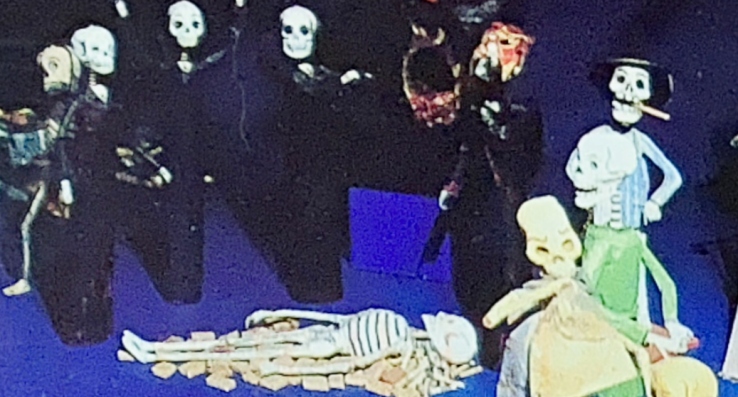
Have a weird Xmas (Blog about books acquired in Dec. 2023)

Maybe an hour ago, browsing in a used bookstore, I opened a worn and some might say dirty copy of Iain Banks’s 1985 novel Walking on Glass. The very first page of this old book was inscribed with the following:

Have a weird Xmas ’90

                 John

This copy of Iain Banks’s 1985 novel Walking on Glass—a 1990 Abacus trade paperback printed in London, the embossing on its cover yellowed by wear on its cover and back near its spine—this particular copy was addressed to no named person, its inscription signed by a name so anonymous we apply it to unidentified cadavers and prostitute clients.

I take myself to be the unidentified person being addressed by the identified generic John, wishing me weird wellness, a ghost of Xmas past.

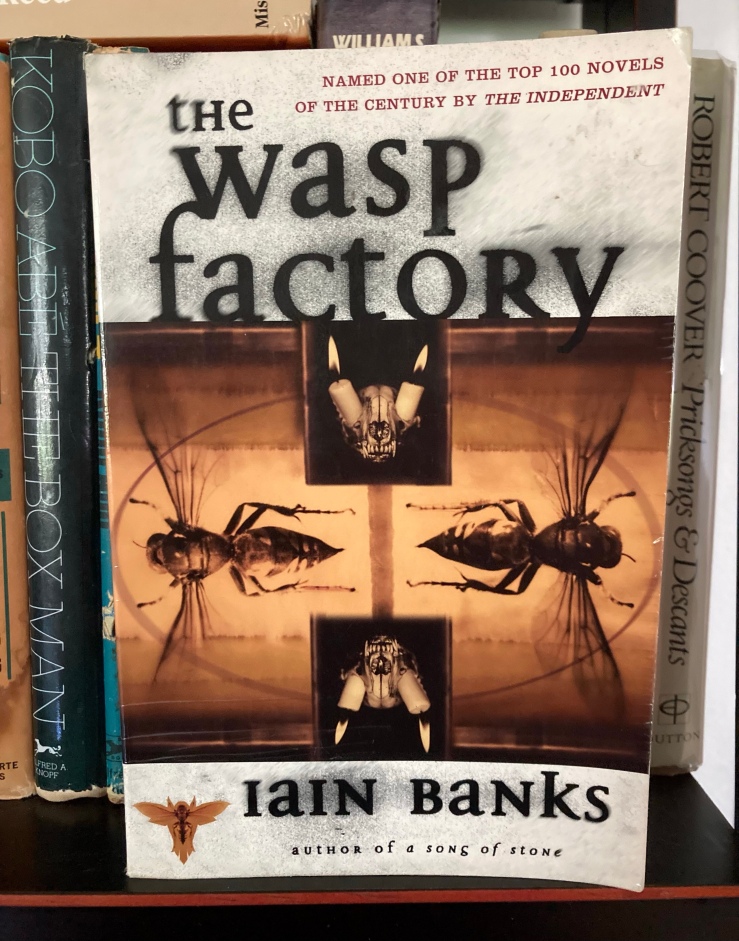
Earlier this year I made the tragic mistake of not pulling the trigger on first-edition hardbacks of Banks’s first two novels, The Wasp Factory and Walking on Glass. I hadn’t read Banks at that point, and my familiarity with his work came almost entirely of his proximity to the J.G. Ballard titles I routinely perused. I ended up reading and loving The Wasp Factory this summer (reviewed it here), and the blurb on the back of Walking on Glass promising further perversions intrigues me too, of course.

Today, I also came across a first-edition, first-U.S.-printing of Roberto Bolaño’s opus 2666It was marked at a third of the original cover price and has never been read. I could not leave it behind.

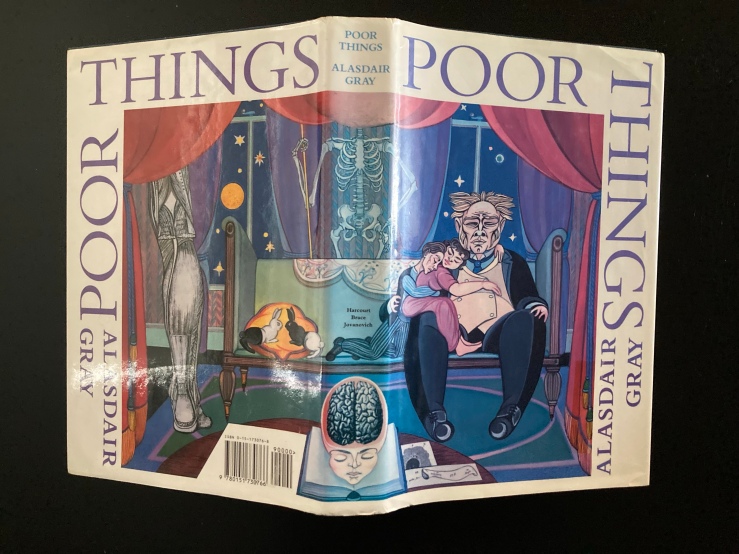
I actually traded some books in today, including my trade paperback of Alasdair Gray’s Poor Things. I had recently reread the novel in anticipation of Yorgos Lanthimos’ film adaptation, and, during that reread, oddly came across an inexpensive pristine first edition of the novel while browsing for something else. Maybe a week or two after finding that hardback of Poor Things, I found a hardback first edition of Gray’s 1990 novel Something Leather. Unlike Poor Things, which features lots of art and typographic adventures, Something Leather is pretty standard (apart from a few chapter heading illustrations)—but it does have a lovely cover under its cover:

Maybe a week after that, I was browsing with my son, who wanted a collection of Harlan Ellison short stories. I was shocked that we couldn’t find any—I had given away two mass market collections to some students maybe seven or eight years ago in a purge. Apparently a lot of it is out of print, but a “greatest hits” collection is coming out this spring. Anyway, I ended up finding hardback editions of Robert Coover’s Whatever Happened to Gloomy Gus of the Chicago Bears? Denis Johnson’s novel Fiskadaro. 

The Johnson is a British edition, Chatto & Windus, and while it’s hardly my favorite novel by him, I found its form too attractive to pass (and it was, like, cheaper than a beer in the same bookstore). I also picked up a book by Lewis Nordan, a slim collection of short stories called Welcome to the Arrow-Catcher Fair. I picked it up because I love those horrid lovely wonderful gross stylish Vintage Contemporaries editions, and then acquired it based on the blurb, which compared it to Flannery O’Connor, Ellen Gilchrist, and Harry Crews. Here it is next to my Vintage Contemporaries copy of Denis Johnson’ Fiskadaro:

I hope you have a weird Xmas. And I hope that John, wherever they are, has a weird Xmas too.

A review of Alasdair Gray’s novel Poor Things (and an anticipation of Yorgos Lanthimos’ film adaptation)

I. What I read

I read Alasdair Gray’s 1992 novel Poor Things. It was the second time I’d read the novel. I first read it close to ten years ago, after I read Gray’s superior but more flawed cult novel Lanark (1981).

II. What I remembered from that first reading

The basic contours of the plot; the postmodernist matryoshka-doll structure; the typography; the engravings; the art.

III. Why I reread it

Director Yorgos Lanthimos has adapted Poor Things into a film. The four films I have seen by him (Dogtooth, 2009; The Lobster, 2015; The Killing of a Sacred Deer, 2017; The Favourite, 2018) are formally daring, horrific, hallucinatory, and darkly funny. 

(The final two minutes of The Favourite are absolutely hypnotic.)

I had the good fortune to see all of these films cold, with no awareness of plot or structure, and I have extended this gift to myself again with Lanthimos’ adaptation of Gray’s novel: I have avoided watching any of the trailers for the film or reading any reviews or other bright clippings. I do know the identity of some of the actors involved, but do not know which characters they play. (I assume Emma Stone is Bella.)

Of course, in rereading the source novel, I have perhaps primed myself to a first viewing of Lanthimos’ Poor Things by setting Lanthimos’ vision against its literary and visual antecedent. This might be a way of saying I am not going into his film cold.

IV. About the plot of Alasdair Gray’s Poor Things

Poor Things riffs on Shelley’s Frankenstein. 

It is also a passionate defense for rationality, sexuality, feminism, and humanism. It is set primarily in the nineteenth century and in Glasgow, Scotland, but it is also set elsewhen and elsewhere.

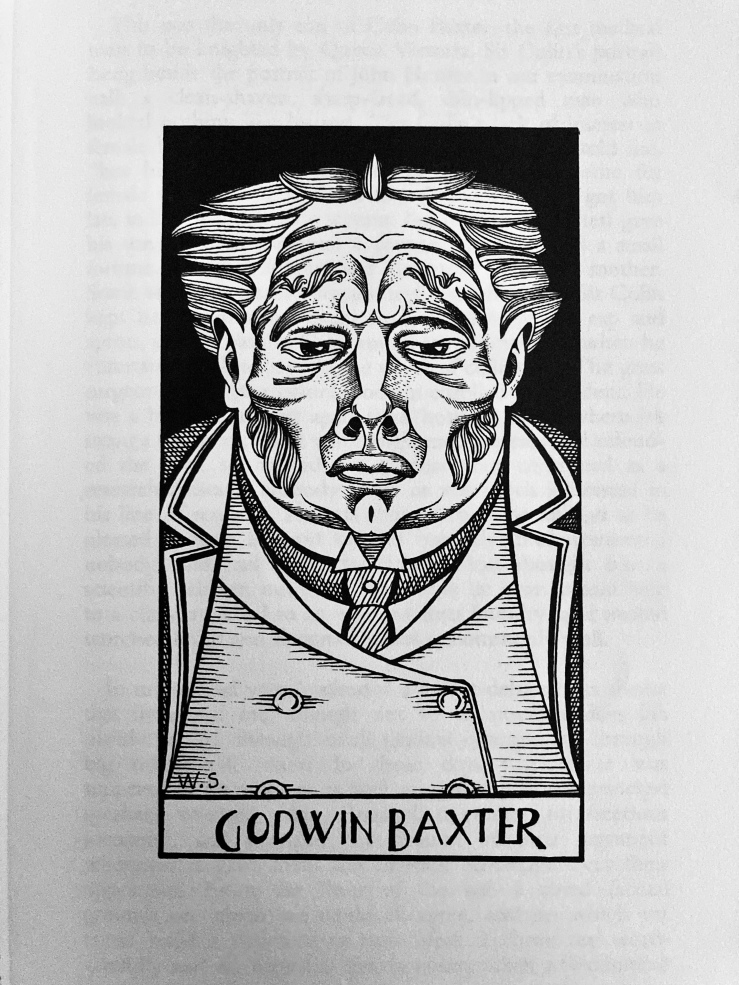
There are three primary characters: Archibald McCandless, Bella Caledonia, and Godwin Baxter. They are depicted rather allegorically on Gray’s wonderful cover for his novel, Archie and Bella cuddled up to God:

Godwin is not a mad scientist, but he does undertake some radical experiments.

Bella is the chiefest of those experiments. I will not spoil all the details. The narrative hints too that Godwin himself, surgeon son of a famous surgeon, might himself be an experimental creation.

Archibald McCandless, who narrates most of the novel, is of poorer stock than rich Godwin Baxter. A rural bastard with a chip on his shoulder, McCandless finds himself out of sync with his fellow medical students, rich boys all. But he finds a fellow to his liking in weirdo Godwin, through whom he meets Bella. He quickly falls deeply in love with the strange creature.

There are engagements, elopements, entanglements; there are dialectics, debates, debaucheries.

The rest of the plot of Poor Things should not be recounted in too much detail. It draws from Marys Shelley and Wollstonecraft; from Candide and Gray’s Anatomy, from 18th and 19th c. travelogues and Fabian Society tracts.

I should let Bella offer her own (which is to say Gray’s ironic metareflexive) dissection of the novel’s sources. In a letter that appends the narrative proper, she suggests that the “story positively stinks of all that was morbid in that most morbid of centuries, the nineteenth,” cribbing

…episodes and phrases to be found in Hogg’s Suicide’s Grave with additional ghouleries from the works of Mary Shelley and Edgar Allan Poe. What morbid Victorian fantasy has he NOT filched from? I find traces of The Coming Race, Dr. Jekyll and Mr. Hyde, Dracula, Trilby, Rider Haggard’s She, The Case-Book of Sherlock Holmes and, alas, Alice Through the Looking-Glass; a gloomier book than the sunlit Alice in Wonderland. He has even plagiarized work by two very dear friends: G. B. Shaw’s Pygmalion and the scientific romances of Herbert George Wells.

The “he” in the text above is Archibald McCandless (although it is also of course Alasdair Gray).

V. About the structure of Alasdair Gray’s Poor Things

The narrative structure of Gray’s Poor Things is indissoluble from the plot, images, and themes. I have used the word structure in the above; perhaps presentation of events would be better. Nevertheless.

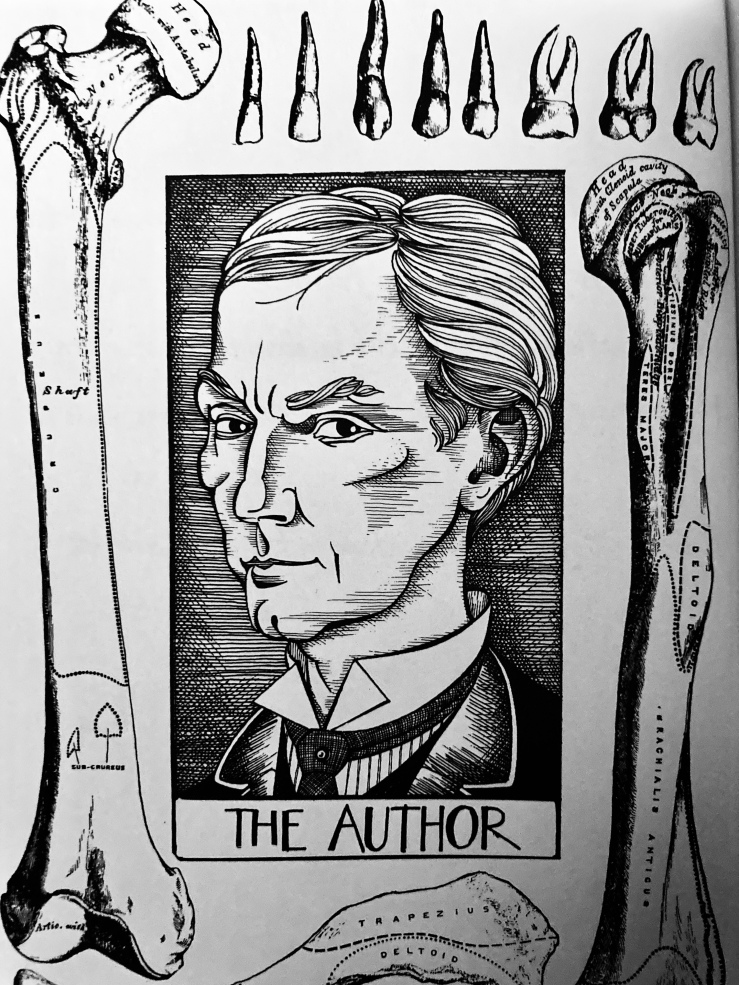
The bulk of the novel consists of a “lost” vanity-press memoir entitled Episodes from the Early Life of Archibald McCandless M.D., Scottish Public Health Officer. This narrative includes the ostensible etchings of one “William Strang” (the illustrations are of course by Gray himself).

Inside McCandless’ Episodes are nested other episodes, purportedly by other authors. First, there’s the letter from Duncan Wedderburn, once a lustful rake, now reduced to lunacy after his entanglement with Bella (his riff on Scotland and The Book of Revelations is a wonderful moment of true crankery).

Then, McCandless’s narrative gives way for quite some time to the purported letters of Bella herself, off adventuring away from Father God and Betrothed Archie. These letters are the philosophical backbone of Poor Things; the moral meat of its plot. McCandless then regains his Episodes; it ends with wonderful gothic violence.

But the novel Poor Things continues. We have another letter from Bella, now much advanced in age, herself a famous doctor, having taken up the family trade. Her silly husband Archie is dead and she’s destroyed all but a single copy of his memoir Episodes—the single copy we’ve just read. Her letter is addressed to the possible future heirs who have failed to materialize, and who thus have been spared the scandal of their antecedent’s apparent lunacy. Bella’s letter seeks to undo the gothic fantasies that preceded it, puncturing McCandless’s swollen fancies with surgical rationality while at the same time reasserting the essential feminist qualities of that precursor text. The effect is somewhat deflationary—but the novel is not yet complete!

Gray’s Poor Things is framed by two bookends, both attributed to “Alasdair Gray.”

The initial frame is “Introduction,” in which Gray explains how a friend found McCandless’s Episodes in a pile of documents that were set to be destroyed, read it, and passed it along to Gray. Gray then explains how he edited together the volume we are about to read (he “unfortunately” managed to lose the original volume in the process), cribbing it together along with Bella’s letter and some other visual materials—an assemblage, a lovely literary Frankenstein’s creature.

The final bookend is “Notes Critical and Historical.” In this section, Gray simultaneously bolsters and undermines all the narrative material that’s come before it. As one might expect from “historical” end notes, Gray (or “Gray”) lards this section with other narrative materials—anecdotes, citations, bibliographies, and interviews, among other apparent ephemera. And yet this conclusion is hardly ephemeral—indeed, the material Gray includes serves to again puncture the narratives that precede it.

Gray’s bookending gambit pays dividends in the last paragraph of the novel, by which I mean the last paragraph of “Notes Critical and Historical.” Again, I will not spoil the content here, but rather suggest that Gray has covered all his bets. The real fun in the novel is to immediately re-read the beginning: flip the frames around. Maybe fan the book about. Facts and fancies may fall out of it.

VI. An anticipation of Yorgos Lanthimos’ film adaptation of Poor Things

I have no strong emotional investment in the quality of a film adaptation of an Alasdair Gray novel. (I’m far more aesthetically invested in a possible video game adaptation of his cult classic Lanark.)

I don’t mean the previous unparantheticalized sentence to sound dismissive; to be very clear, I don’t think I’d object to any novel I loved being adapted to film or any other medium. The filmmaker might fuck up their own adaption but they could never truly affect the novel itself. At one point I think I’d have been aghast at someone’s attempt to adapt Gravity’s Rainbow or Blood Meridian; I’ve felt bad about film adaptations of Under the Volcano and Moby-Dick, no matter how grand their ambitions.

Now, I just don’t give a fuck. Go for it. Something interesting might happen, but you can’t hurt the text. At best, you’ll end up with a New Thing, which is what I expect and hope from Yorgos Lanthimos’ Poor Things. Who knows?

In rereading Gray’s Poor Things, I thought of what other filmmakers might do with the novel. Guillermo del Toro would fuss over its visuals too much at the expense of characterization. (Maybe Matteo Garrone could reign him in.) Jane Campion could likely channel its gothicism, its wit, its intellect. Peter Greenaway in his prime could have made a brilliant series of tableaux from Gray’s material. Gaspar Noé could explode a few pages of its essence over a few hours without ever getting to its core. Wes Anderson might have skillfully arranged its nested narratives, but perhaps too cleanly, too precisely even. Lars Von Trier might lean into the dirt. I suppose I could go on.

But really, while rereading Poor Things the thought that kept coming back to life was, Hey, how will Lanthimos adapt this to film?

VII. A possible answer to the above question

I hope he’s created his own beautiful monster.

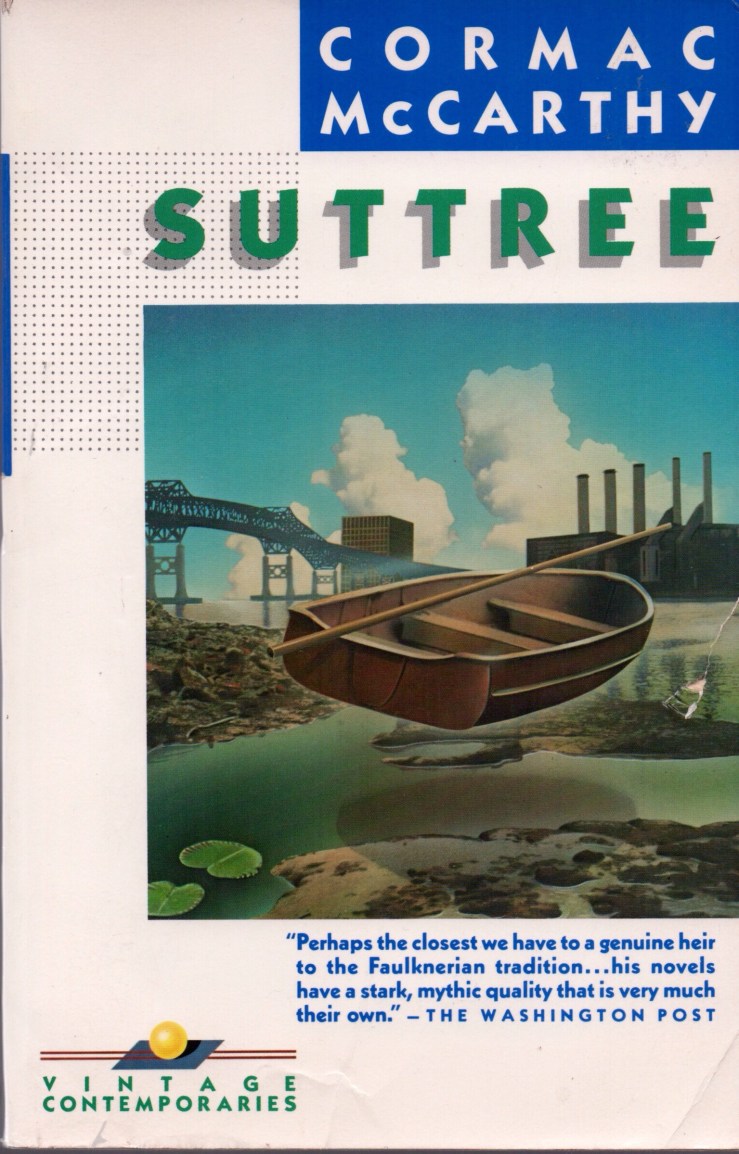
Questions for the quaking ovoid of lamplight | Passage from (and a little riff on) Cormac McCarthy’s novel Suttree

A clear night over south Knoxville. The lights of the bridge bobbed in the river among the small and darkly cobbled isomers of distant constellations. Tilting back in his chair he framed questions for the quaking ovoid of lamplight on the ceiling to pose to him: Supposing there be any soul to listen and you died tonight?

They’d listen to my death.

No final word?

Last words are only words.

You can tell me, paradigm of your own sinister genesis construed by a flame in a glass bell.

I’d say I was not unhappy.

You have nothing.

It may be the last shall be first.

Do you believe that?

No.

What do you believe?

I believe that the last and the first suffer equally. Pari passu.

Equally?

It is not alone in the dark of death that all souls are one soul.

Of what would you repent?

Nothing.

Nothing?

One thing. I spoke with bitterness about my life and I said that I would take my own part against the slander of oblivion and against the monstrous facelessness of it and that I would stand a stone in the very void where all would read my name. Of that vanity I recant all.

From Cormac McCarthy’s novel Suttree.

I first read Suttree around thirteen years ago. I’m not sure how many times I’ve waded into it since then. At least two more times in full, plus another two times on audiobook, via Richard Poe’s marvelous narration. I checked the audiobook out from my library again (via Hoopla, which has about everything Audible has, I reckon) a few weeks ago, and fell asleep to Buddy Suttree’s various McAnally misadventures, often not falling asleep as quickly as I planned to. The novel is incredibly rich and fertile, filled with pockets that seem to reverberate stronger from the past viewed through the strange glass of having read McCarthy’s final novel The Passenger late last year, a capstone novel, a novel of insane sobriety that answers to Suttree’s oversoul drunkenness. The Passenger is perhaps Suttree’s secret sequel. Poe’s Suttree narration dipped into my daytime hours—drives and chores, and then just listening and doing nothing else. I forgot so many things: How fucking funny the novel is (I knew this but forgot it, remembering all its bumbling and baffling tragedies); all the shenanigans Suttree and his boys get into (he, I suspect the deferred narrator of his own manic enterprises, always allows himself a measure of impartiality as a witness). I forgot how many of Suttree’s McAnally pals die. I forgot how sad the novel is. Anyway. I was finishing up some domestic chore—let’s call it squeezing the late fall lemons from the lemon tree into a concentrate to freeze, we’ve given all we can away, and they’ll spoil otherwise; or maybe I was finishing kneading a loaf of bread; or maybe something mundane as folding towels and rags hot from the dryer—anyway, I was finishing some or other chore when this passage floated through my ears, caught a bit of purchase, seemed worth sharing. Read Suttree!

A Review of Sonic Life, Thurston Moore’s Rock n’ Roll Fantasia

Thurston’s Rock n’ Roll Fantasy

Thurston Moore’s memoir Sonic Life kicks off in 1963 with his older brother Gene bringing home a 45 of the Kingsmen’s “Louie Louie,” blowing open five-year-old Moore’s mind to the sonic possibilities of raw guitar power.

Moore describes the primal garage hit as the introduction to “a new current of electricity,” one that rewrites the “soundworld” of his earlier suburban life. Our narrator chases that current, finding it in its purest form in The Stooges’ “I Wanna Be Your Dog,” a pre-punk anthem Moore’s band Sonic Youth would cover on their first full-length album, 1983’s Confusion Is Sex. Sonic Youth would also play “I Wanna Be Your Dog” live throughout their career and eventually perform it with Moore’s hero Iggy Pop.

Moore meets many of his heroes in his Sonic Life. It’s a goddamn rock n’ roll fantasy, albeit a fantasy filtered through the gritty reality of punk, No Wave, and smelly indie rock touring vans.

Sure, Moore meets some of the biggies, especially late in the memoir, as Sonic Youth reaches their sonic majority. He chats with Paul McCartney, professing a preference for McCartney’s brother Mike McGear’s stuff to the Beatles. Sonic Youth gets to back David Bowie on “I’m Afraid of Americans.” (Bowie later coos to Moore’s toddler daughter Coco). Moore tours and records with Yoko Ono.

But Moore’s eyes star starrier for the rough luminaries of the New York seventies scene he thrust himself into: Patti Smith, Joey Ramone, Richard Hell, Alan Vega, Tom Verlaine, Lenny Kaye, et al. He’s just as hot for contemporaries like the Minutemen, Black Flag, and Dinosaur Jr., and maybe even hotter for the bands that took Sonic Youth’s squeal to heart, like Pavement, Royal Trux, and My Bloody Valentine.

Sonic Life is larded with people, vibrations, art, life, a love of the weird. Sonic Youth were always as important as curators of the underground, channeling it to seekers of the strange, as they were as a musical act, and Sonic Life is the literary summation of that career.

Thurston’s Literary Fantasy

Any fan who followed Sonic Youth closely, especially in their nineties heyday, would attest that Thurston Moore was the band’s loquacious mouthpiece, a bit of tall charmed ADHD in verbal action, chatting up the world. Sonic Life is liquid, loquacious, loving. Literary protopunk hero Patti Smith populates the pages from the earliest chapters through the last.

Moore also works his decades-long sightings and meetings of William S. Burroughs into the book. Moore first spies Burroughs in 1977 in NYC at a Patti Smith show; decades later the band gets to hang with him a bit. (It’s unclear if Burroughs registers any of this.)

Kathy Acker’s spirit occasionally pops up; it’s clear she was a hero to Moore and his band, but she ghosts them at a planned joint performance in Rotterdam in 1985. The band reads passages of Blood and Guts in High School between songs, tearing out the pages and destroying the book.

Longtime Sonic Youth fans will anticipate Moore’s prose. Seemingly-oblique psychedelic expressions explode, artful phrases dash into each other, ultimately cushioned carefully into a comfortable syntactic register. The effect is not unlike much of Sonic Youth’s post-Sister output, which by turns twisted avant-garde experimentation into pop sugar and deconstructed classic rock riffs into punk scuzz.

Moore’s punchy prose is best summed up in the titles of his 71 chapters, most of them cribbed from song titles and lyrics (including his own): “Flaming Telepaths,” “Mere Animal in a Pre-Fact Clamour,” “Ecstatic Stigmatic,” “Secret Knowledge of Backroads,” “Latex Gold,” etc. The chapter titles are wonderful clues, sometimes direct, sometimes cryptic, always evocative. The prose generally hurtles along, with Moore’s verbal tricks wedged into easy, flowing configurations, but some of the tricks get tired. Particularly, Moore is particularly fond of “Particularly” as a linking expression. Too, we find the book peopled by characters who “could only laugh” at whatever absurdity life has conjured. An editor might have attended these repetitions, but I’m not sure if Moore’s best stuff ever came about via the hands of an editor. The book is generally well-written.

Experimental New York, Seventies and No Wave

Sonic Life begins in 1963, blasting the Kingsmen’s “Louie Louie,” and ends in 2009 with Moore naming Sonic Youth’s last album The Eternal. There are moments outside of this neat chronology though. Discussing his family, Moore goes back a few generations, if only for a paragraph or two. He touches briefly on the dissolution of both Sonic Youth and his marriage to Kim Gordon in 2011. That’s not what the book’s about. Sonic Life compresses events before 1977 and events after 1994. The book is almost 500 pages long; Steve Shelley, who joined the band in 1985 and who most fans think of as “the drummer of Sonic Youth,” shows up around page 300. This isn’t a tour diary or a tell-all.

Instead, much of Moore’s narrative focuses on New York in the scummy seventies and early eighties. Dirt, crime, and drone rock rules. Glenn Branca, Teenage Jesus and the Jerks, the last days of Sid Vicious. Difficulty making even the cheapest rents. No phones, No Wave, and his first stolen guitar. Moore documents an interstitial period in NYC history. He arrives after punk’s (non-)glory daze, too young to partake, too old to really fit in with the emerging wave of hardcore. Along with Kim Gordon and Lee Ranaldo, Moore shapes the noise and grime and angles and raw hope into something new–Sonic Youth.

Kim Gordon

Kim Gordon is a huge part of Thurston Moore’s life and a huge part of Sonic Life. She’s not exactly Moore’s muse, but he clearly looks up to her, as he, tall boy, looks up to so many of the people who people this memoir. Moore is frank in his description of Gordon as an artistic and musical partner, one whom he sometimes clearly grated on and at other times found himself astounded by.

In Moore’s telling, Gordon often felt outside of the band. Moore relates that when the band (working with Mike Watt under the name Ciccone Youth) were putting together the noises that eventually became The White(y) Album, Gordon felt herself out of sync with the band. She went to a mall and recorded a video karaoke cover of Robert Palmer’s “Addicted to Love,” an artistic gesture that confounded and impressed Moore and the rest of the band, lending ironic license to their Pop Art leanings.

Fans looking for anything gossipy in Moore’s memoir about his marriage and divorce from Gordon won’t find it. His focus is on Gordon as an artist and musician. Indeed, much of duo’s communication was rooted in the actual songs they wrote and played. In one of the book’s stronger passages, Moore details creating a punk poster that appropriated the image of a naked young Latina from a calendar he’d found. He scrawled some would-be feminist slogans over the image and hung it in their house. Gordon didn’t say anything at the time. However, when the band rehearsed their new song “Flower” (which would appear on 1985’s Bad Moon Rising), Gordon began singing Moore’s slogans as lyrics: “Support the power of women / Use the power of man.” But Moore then added her own words:

There’s a new girl in your lifeLong red wavy hairGreen, green lips and purple eyesSkinny hips and big round breastsHanging on your wall

Moore ends the chapter by noting that “the two of us never talked about it outright, only through our songwriting. It wouldn’t be the last time that music was the mode of dialogue in our relationship.” Throughout Sonic Life, he heaps praise on his ex-wife as an artist, intellect, musician, and mother, but she ultimately remains a cipher–like the other members of Sonic Youth.

Lee Ranaldo

Moore credits Ranaldo as the better musician and guitar player throughout his memoir, but for the most part he’s a blip in a book of nearly five hundred pages. Maybe that was Ranaldo’s choice—maybe he asked his musical partner of three decades if it was okay to share certain stories and Ranaldo said No.

Richard Edson

Richard Edson was the first drummer of Sonic Youth. Moore credits him with suggesting “the music would be far more effective if there was some semblance of an arrangement, guitars locking into a rhythm so changes could be audibly established.” Moore seems to receive this basic concept of songwriting as a revelation.

Edson went on to star in Stranger Than Paradise and Do the Right Thing, although most people would probably recognize him from a bit part as one of the garage guys in Ferris Bueller’s Day Off. He also had a bit part in Desperately Seeking Susan, a film featuring Madonna.

Madonna

Madonna wasn’t in Sonic Youth, but she floated in the same circles (and even briefly dated Swans frontman Michael Gira).

Moore brings up Madonna more than Lee Ranaldo or Steve Shelley.

Bob Bert

Moore spends a paragraph or two of Sonic Life implicitly apologizing to Bob Bert, whom Sonic Youth as a whole treated pretty shabbily. They fired and rehired him a few times. He gets more air time than Richard Edson or Steve Shelley (but not as much as Madonna).

Steve Shelley

Steve Shelley’s drumming made Sonic Youth Sonic Youth. He continues to play and record with Thurston Moore, so maybe the lack of words on Shelley in Sonic Life was by way of Shelley’s own request.

Our Band Could Be Your Sonic Life

Michael Azerrad’s 2001 book Our Band Could Be Your Life devotes a skeptical chapter to Sonic Youth. The editorial position of that history of indie bands in the eighties seems to posit that Sonic Youth were art rock prima donnas who eventually yoked a bevy of underground bands into major label harnesses. Azerrad’s book is really about real-life social networks and overlaps and DIY—Black Flag, SST, The Minutemen, Dischord, seven inches and tapes, and touring! touring! touring! Sonic Life doesn’t exactly duplicate Azzerad’s indie serial, but it does further authenticate it.

Range Life

Michael Azerrad’s 2001 book Our Band Could Be Your Life, at least in my memory, tends to dwell on touring: stinky vans, unpaid gigs, hard lodging. Moore doesn’t elide this aspect of the band’s identity, but neither does he dwell on it. Moore focuses on the energies on the stage, calling the band a “sonic democracy” — and really, here, I take back what I said above. They are not ciphers but sonics, musicians making the vibrations come alive. What else could we want?

Einstein A Go-Go

Thurston Moore includes the Einstein a Go-Go in a very short list of “clubs that welcomed the underground scene into their chambers, each with [their] own distinct environment.”

Einstein’s was an all-ages club that existed from 1985 to 1997 in Jacksonville Beach, FL. You could go there and dance to wild music for like a five buck cover, and you could see all kinds of cool bands play for maybe eight or ten bucks. I was there pretty much every Friday and Saturday night between ’95-’97 (and sometimes just hung out outside and walked the beach if I didn’t have the cover). Kids wept when it closed. I got to move, leave for college, words that now, as I type them, seem so cruel.

Sonic Youth played Einstein’s with fIREHOSE in the fall of 1986. This performance left a weird little dent in the city that could be felt a decade later by bands who had seen (or at least claimed they had seen) Thurston, Watt, Kim. There were always the older kids who had seen the band, or they had heard about it from older kids who had seen the band…this was called “a scene.”

The Faircloth family who ran Einstein’s were great people. Bands didn’t want to come to Florida; still don’t, really. The Faircloths made sure the bands were comfortable, had good lodging, good food (fried chicken!), leading to a pipeline of bands coming through — 10,000 Maniacs, Flaming Lips, They Might Be Giants, Alex Chilton, Ween, Soundgarden, Mudhoney, Meat Puppets, Dinosaur Jr., Primus, The Replacements, Jane’s Addiction, Nirvana…

By the time I was old enough to go to the all-ages club, the major indie acts that had passed through had graduated to Bigger Times. But I got to see so many great second-wave indie bands: Archers of Loaf, Polvo, Sebadoh, Thinking Fellers Union Local 282, Luna, the Swirlies, Superchunk, and so many, many more.

My stupid high school band got to play there a few times too. We were too loud and used weird tunings on the cheap guitars that we kept swapping between songs in lieu of actual songwriting.

Better than that, at Einstein’s I got to dance to the music I wanted to dance to through an incredibly loud speaker system, including Sonic Youth “hits” like “Teenage Riot,” “100%,” and “Bull in the Heather.” Some of that feeling of fucked up dancing reverberates still in Sonic Life.

Punk Breaks, Major $$$, Nirvana, Ecstatic Peace

Where does it all go? Well, you know. Punk breaks. Nirvana breaks. Sonic Youth signs to a major label, opens for Neil Young, and later makes enough money touring on Lollapalooza to build their Echo Canyon studio on Murray Street. They start their own label, SYR, releasing some of their more avant-garde projects. Opportunities expand. All of their equipment gets stolen. Moore and Gordon have a kid and move to the burbs. They still keep an apartment in NYC; Gordon is there the morning of the September 11, 2001 attacks on the Twin Towers. A plane engine crashes on Murray Street; thankfully, Sonic Youth producer and bassist Jim O’Rourke escapes, though not unharrowed. O’Rourke leaves the band and is replaced by Pavement’s Mark Ibold. Sonic Youth releases their last studio record, The Eternal, on indie Matador, having fulfilled their contract with Geffen. Moore begins an affair with Eva Prinz, an editor at Rizzoli. In 2011 he and Gordon divorce and Sonic Youth is kaput. Moore and Prinz marry and start a poetry imprint, Ecstatic Peace Library. He claims to have found his own ecstatic peace.

Radical Compression

As I mentioned above, Moore’s memoir focuses on the late seventies and the eighties. He condenses the band’s last twenty years (and the last ten of their sixteen studio albums) into about 100 pages, just a fifth of the book. And that’s probably for the better; Sonic Youth, while not exactly overexposed, were pretty well documented in print and film and web by the onset of the mid-nineties.

The radical compression is wonderfully effective at times, giving the book a clipped, propulsive rhythm and allowing Moore’s humor to shine through. A standout is Ch. 66, “Latex Gold,” the first chapter of the book’s final sixth section. It begins in 1996 with a Pacific Rim tour with the Beastie Boys and Foo Fighters. Moore and Gordon have enlisted Thurston’s sweet mother Eleanor to help out with Coco (and see a bit of the world). She gets hurt in the mosh pit, trying to take photographs, and ends up wheelchair-bound, but ex-Germs, ex-Nirvana Foo Fighter Pat Smear takes up her cause, making sure she doesn’t get left behind when everyone heads to a flea market in Jakarta. A page later, the band plays Late Night with Conan O’Brien; a few paragraphs later, Moore is remixing Yoko Ono, then playing guitar with Patti Smith. Then the band is on The Simpsons: “It was the single mainstream cultural event that we’d find ourselves identified with across the world.” A paragraph later, Moore is seated on a couch between Lou Reed and Jim Carroll watching a rough cut of The Basketball Diaries. Moore praises DiCaprio’s performance; Reed describes the film as “Fucking terrible” and leaves immediately. On the next page, Moore is driving an aging, overweight, and likely insane John Fahey around a series of gigs in the northeast. Fahey greets Moore at his motel room door one morning, fully nude, Fahey’s cracked CDs strewn across the floor. Moore tells Fahey he could be selling the CDs at their gigs. Fahey offers Moore to take as many CDs he wants. By the end of the ten-page chapter, Sonic Youth are backing up David Bowie at the Thin White Duke’s Madison Square Garden birthday bash.

End Hits

I really loved reading Sonic Life. It’s not a perfectly-written or balanced book, but it feels real. Moore forges a fascinating tone, at times deeply apologetic, particularly to the best friend of his teenage years, Harold Paris, whom he eventually alienates to the point of a break up in the mid eighties. The memoir is filled with conciliatory gestures and admissions of punk snottiness, whether it’s Moore apologizing for a nasty music review he wrote in his one semester of college, conceding that his brattiness to mentor Glenn Branca was likely misplaced, or expressing regret at getting in Dee Snider’s face to flip the bird at a Twisted Sister concert. Moore doesn’t try to spin his divorce from Kim Gordon; his recollection of his affair with Eva Prinz is brief, blunt, and frankly loving. Perhaps the most fascinating example of his zen reflection in the memoir is his take on the 1999 theft of all of Sonic Youth’s musical equipment while on tour in California. The band relied on racks of guitars in alternate tunings for their sound; the theft struck me as devastating at the time. Moore affords the episode just a few spare paragraphs, concluding that although he would miss his Fender Jazzmaster, he “embraced the liberation of losing things, being stripped of attachments” — a chance to “reignite” their musical mission. What did Moore feel at the time though? He doesn’t tell us, but the outlook he provides suggests wisdom and emotional maturity.

Mixtape

I made a mixtape based on the chapter titles and content of Sonic Life. I enjoyed listening to the music as I read Moore’s memoir, revisiting old gems and hearing cuts I haven’t heard in ages, along with a few tracks and artists new to me. And that’s what I think Moore and Sonic Youth always did best—expand a taste of the weird and the noisy, share the sonic love.


(This is not a review of) The Dragon Waiting, John M. Ford’s lost classic of fantastical history

So what’s this book you liked so much?

It’s called The Dragon Waiting. It’s a 1983 novel by a guy named John M. Ford. It’s this erudite historical fantasy, or maybe fantastical history, that—

Wait, it’s called The Dragon Waiting? It’s like about dragons and shit? Dungeons and dragons?

There are dungeons, or really towers—the whole medieval motif of hostage-taking is part of the novel—but no, no dragons. Or, there is a dragon at the very end of the novel, but it’s essentially a shared illusion manifested by the dreams of an approaching army. The dragon manifests as this illusory spectacle, a spectacle based on lack and imagination—it’s kinda Lacanian, really, because—

Okay, so, is it a fantasy novel or not? I mean are there wizards and monsters and shit?

There are wizards. But really, they operate more like, I dunno, spies or chemists or thieves. One of the four main protagonists is a Welsh wizard named Hywel Peredur, and he isn’t like, doing sorcery so much as he’s trying to shape events by aligning personalities, throwing out political and personal gambits, heroic scheming, and—

Like Gandalf.

Yeah, like Gandalf I guess. Or Merlyn. But really, the stuff in The Dragon Waiting is like, reality-based, by which I mean history-based, or at least historical-fantasy-based.

So there aren’t any orcs or trolls or elves or whatever and the dragon is just a shared illusion? 

There are monstrous people. Oh, there are also vampires, but they’re not all bad.

So it’s a vampire novel? A horror novel?

No, not a horror novel, although it has some gothic tinges, and definitely not a “vampire novel,” whatever that is—although one of the four protagonists is afflicted with vampirism. He’s a German engineer named Gregory von Bayern who specializes in artillery.

So he’s a vampire who makes guns and bombs?

Kind of, but that makes it sound silly.

And so he kills people?

Yeah, but not to feed on them, and not like, in general. He’s one of the heroes of the story, enlisted by Hywel to—

Hywel is the Gandalf?

Not a great analog but sure, Hywel is your Gandalf. And he kinda puts together this squad whose long-term goals are never really stated clearly, but they are essentially forming a Western resistance to the Byzantine Empire.

The Byzantine Empire?

Yeah. So, in the alternate reality of The Dragon Waiting, the Byzantine Empire is the great unified force in the East. And because of this, Christianity never emerges as a major religion, so instead there’s this plurality of all kinds of Gods worshipped—Egyptian, Greek, Roman, and son on. And the sort of background action of the novel is Byzantium encroaching into Europe, threatening Italy, which is a bunch of disunified city states, so even if the Medici are powerful, they still have their own internal opponents, that’s one of the major themes of the novel—political infighting. We see the political scheming thing most strongly in the novel’s dominant plot, which is Hywel’s gang’s attempt to get Richard the Duke of Gloucester on the English throne.

Richard the Duke of Gloucester—that was a real guy, right?

Lots of the characters in The Dragon Waiting are real guys from history, yes.

So what do I know Richard the Duke of Gloucester from?

He was Richard the III of England.

The hunchback guy? The winter of our discontent guy? The guy who killed his nephews?

That’s how Shakespeare depicted him in the play, yes. But Ford’s novel takes a different approach. He’s very human, and he has flaws, but he’s not a Machiavellian child-killing prick.

Okay, so all of this is taking place in like Byzantium and Italy and England and like, when? When is Richard III? 1600 something?

No, not Byzantium—that Empire is trying to spread west. No, the action takes place in Western Europe—Wales, Italy, France, Switzerland, England, and so on. And the dates would cover a few decades, but a lot of the prime action is happening at the end of the fifteenth century. Richard III was coronated in the summer of 1483, if that helps. But because Christianity never really takes off, the whole AD thing never happens, so those numbers don’t really show up in the book.

This sounds really complicated. Do I need to know a lot of European history, world history to understand what’s happening?

Oh, I think even if you knew a lot of the historical background very well you’d have a hard time understanding what’s happening.

Great. So why are you into this dragon book?

I love how it’s written; I love its themes, its layering, its construction. It’s a dense book that feels light; it’s serious and erudite but also psychologically drawn. Ford eschews exposition. In fact, at times he even sets the reader up to look the wrong way. And this fits with a lot of the themes and motifs and bits of the novels—illusionists, forgers, secret agents, disguises, spies, thieves, and so on. So it’s not just happening in the plot; it’s also happening at the rhetorical level. Like, for example, okay, so we get this kind of overture in the first three chapters, which establish three of our four protagonists: Hywel the Welsh wizard, Dimitrios Ducas, an exiled Greek mercenary, and Cynthia Ricci, an Italian doctor initially in the service of the Medici. And Ford’s camera sits close to their perspective, we get into their heads, get to know them a bit. And then all of a sudden we get to the book’s second section, and all of the characters are in disguise in this remote mountain inn, way up in the snow, using false names. And Ford never shows his hand, we just have to figure out what happens, who the characters really are, and how they relate to each other. And he sort of wedges this neat little murder mystery in there (in the snow in a hotel no less—reminded me of Crane’s “The Blue Hotel” or Tarantino’s The Hateful Eight). And Ford does this again and again, but in new ways—misdirection, disguise, illusion. I ended up having to read each chapter twice.

I bet the vampire did the murder!

Okay.

But so like there are vampires in this book, but that’s not, like, a thing?

The novel treats vampirism as a disease, not as a supernatural thing, and like many diseases, there is folklore and superstition that develops around the disease, some in common with our own concept of “vampirism.” The vampires in The Dragon Waiting are sensitive to light and they do have to consume blood, but they aren’t necessarily immortal, and to a large extent, they are shunned and feared. Although some of them become powerful.

And the vampire Gregory is good?

I guess. The motivations for the four main characters aren’t necessarily good or evil, per se, although the four of them are generally sympathetic to decency, humanity, and compassion over violence and raw power. But ultimately, they seem mostly motivated by the strange friendships they forge with each other.

That sounds corny.

It’s not.

Ok. So you like the writing, but what about the subject matter? I mean, I didn’t really think you were into historical fantasy fiction? Does a body have to know a lot of European history to get into this? I tried to ask you earlier and you deflected.

I think I answered just fine: No, not really. There’s a lot of English history in there, and a lot of it will be familiar (but strangely so) if you know Shakespeare’s plays on the Plantagenet kings—a cycle that ends with Richard III, obviously.

Obviously.

I think Ford knows his history really, really well, but part of his rhetorical technique is withholding certain clues, baiting and switching, reshuffling the deck, moving the cups quickly in a shell game…the story is really about shifting identities, shifting names, shifting allegiances, and so on. I suppose it might be easy to compare it to George R.R. Martin’s A Song of Ice and Fire books, but, like better written, smarter, and trimmed of all the fat.

Rude.

That’s not what I meant. It’s sort of like Gene Wolfe’s New Sun novels. Although I’d really compare The Dragon Waiting to something like Thomas Pynchon’s Against the Day or V.—those are historical fantasies too—or fantastical histories?—encyclopedic ones that frequently defer meaning and stun or bewitch the reader. There’s like a specter there in the prose, pushing out an illusion that the reader has to chase—

The reader has to chase the dragon?

Shush.

So you’re saying this dragon book is Pynchonian?

No, no. But many things I like in Pynchon—the paranoia, the showing of the parts while withholding the revelation of the whole, the dazzling encyclopediaism—I find that in The Dragon Waiting too. Ford’s style also reminds me a bit of Cormac McCarthy, who’s so good at simply showing actions while refusing to tell the reader what they mean—either to the characters or to the narrator or whomever. Things just happen and the reader has to sort it out.

But won’t I get confused?

I was confused but not frustrated. I was confused, but then I’d reread the chapter and realize I had been looking in the wrong direction or following the wrong thread. Again, rhetorical misdirection doubles the novel’s themes of political/magical misdirection.

But the history might get me all confused.

Okay, so, the names can cause confusion. Pretty much every character has multiple names or titles, and they all use aliases as well. And lots of the historical background characters, particularly the English ones, have the same names. Lots of Richards and Elizabeths and Edwards and Henrys in here. Ford provides a little overture of historical personages, and Wikipedia is always there. Oh, and there’s this really cool site called Draco Concordans which is a series of annotations on the novel.

Wait, I have to read annotations on a website to follow this book? Is this fucking Finnegans Wake or something?

No, and I only found the site after I finished the book. I might have liked to have used it when I reread each chapter though. But I would definitely recommend reading it the first time cold. I think the pleasure in the book is looking back to realize where you lost the thread, where you were misdirected. I’m sure I’ll consult the Concordans when I read The Dragon Waiting again.

So you’ll read it again?

Oh yeah, definitely. Loved it.

That sounds like a recommendation then.

It is. I highly recommend it.

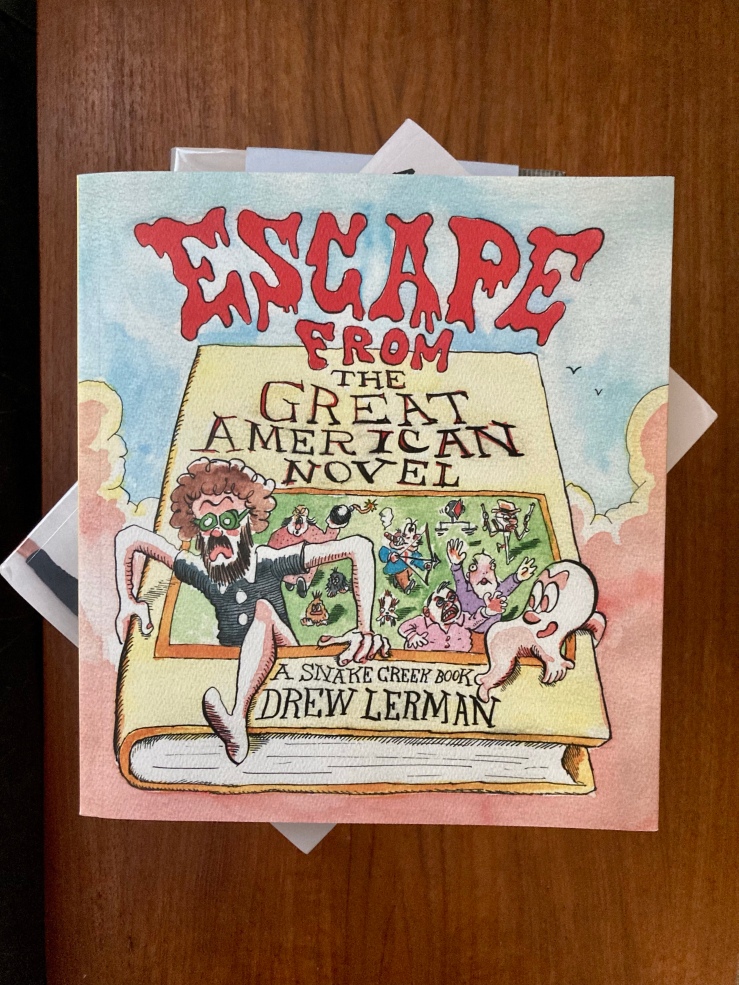
A review of Escape from the Great American Novel, Drew Lerman’s zany satire on art, nature, and capitalism

Drew Lerman’s comic strip Snake Creek takes us into the world of best pals Roy and Dav, weirdos among weirdos in Weirdest Florida. Their adventures and misadventures are both absurdly comic and zanily tragic, calling to mind George Herriman’s Krazy Kat strips and Samuel Beckett’s pessimism, Walt Kelly’s primeval Pogo and Robert Coover’s jivetalk, all rendered in kinetic black ink four-panel doses. I’ve been a big fan of the strip for a few years now, and Lerman’s latest collection Escape from the Great American Novel is his best work to date, a fun, messy, spirited send-up of the relationship between art, nature, and commerce.

Escape from the Great American Novel is a novel in just over 150 strips, spanning the end of August, 2019 through the beginning of August, 2021. If you reflect on those dates for a minute, you might recall that we squeezed in a lot of history there. Many of the (so-called) real-life tensions of that tumultuous time bubble up (and occasionally erupt) in the zany, myth-elastic world of Snake Creek.

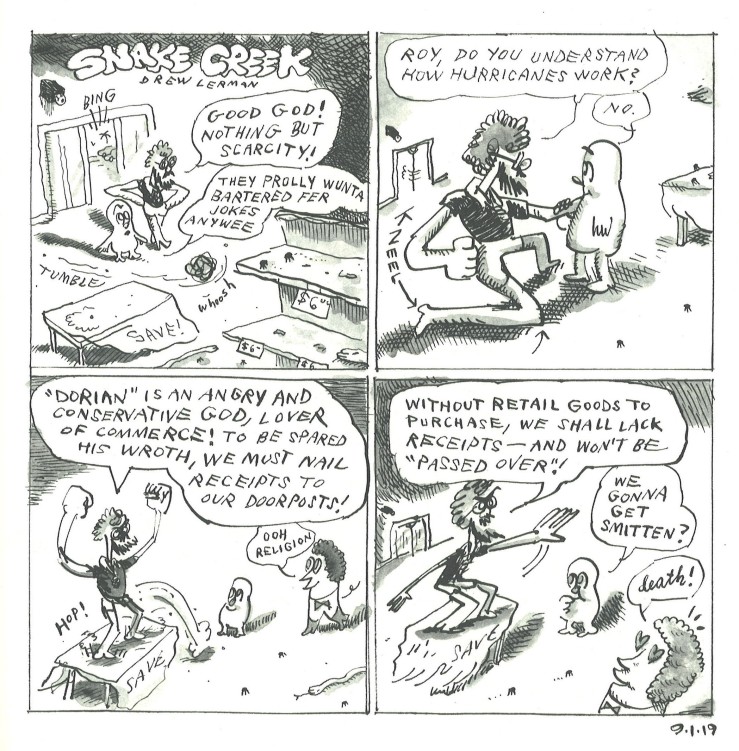
Things begin simply enough, with Dav seeking to reclaim his “status as a reader of books.” Our protagonist simply wants to dig in to fine literature, but news of approaching Hurricane Dorian blocks his book time. Lerman is a Miamian (a Floridian like myself), and although the world of Snake Creek reverberates with massive streaks of irreality, it is nevertheless also beholden to real-life forces of nature. Ever the slackers, Dav and Roy are ill-prepared for an impending Cat 5. Lerman lays out a comedic scene that might be familiar to anyone who’s tried to buy batteries and water and plywood at the last minute:

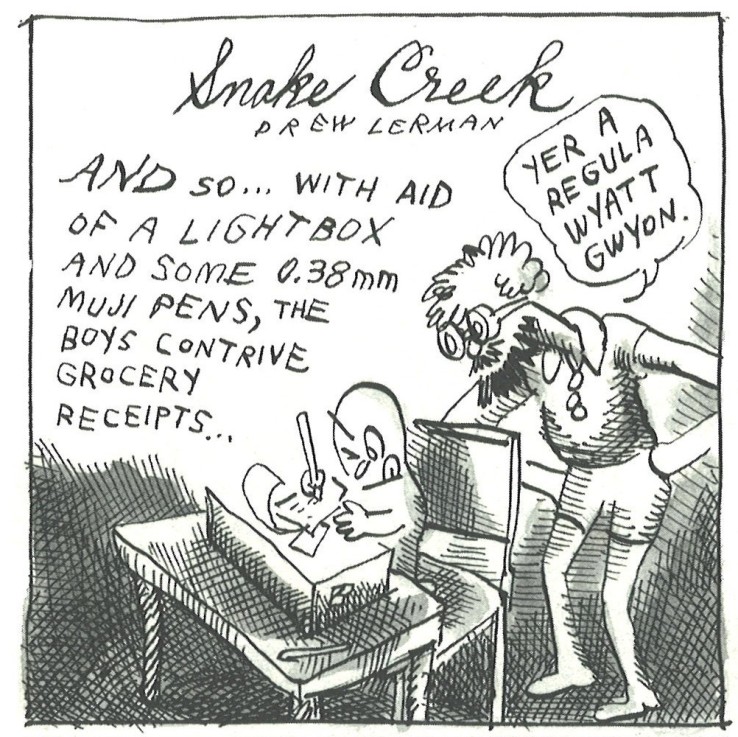
The early Dorian episodes of Escape usher in a critique of capitalism-as-religion, or capitalism-as-philosophy (as opposed to, say, the naked reality of exploitation both of people, animals, and natural resources). Short on capital or material, Dav and Roy concoct a plan to forge receipts, totems of capital that might ward off the angry Nature God Dorian. Lerman sneaks in a reference to the erstwhile hero of William Gaddis’s 1955 novel The Recognitions, the forger Wyatt Gwyon:

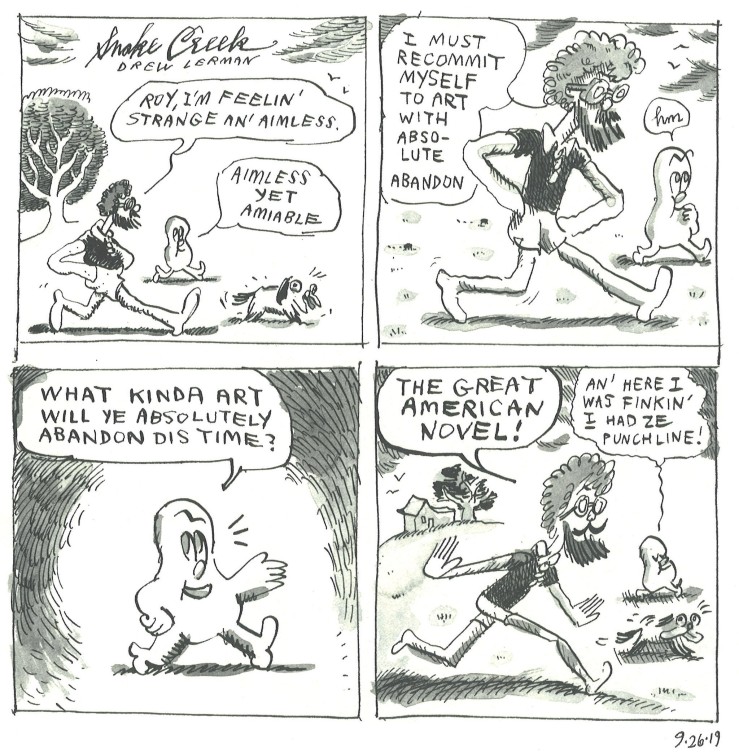
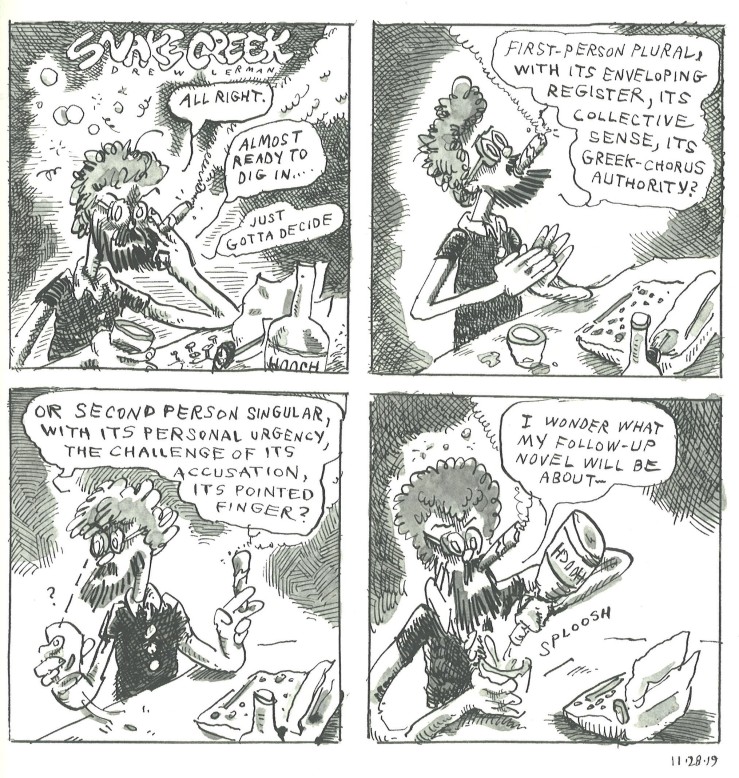
The storm passes, post-hurricane sobriety settles in, and Dav finds himself reflective: Just what is he doing with his life? And, maybe more to the point, what can he do to extend that life into immortality? His solution, immediately ridiculed by friend Roy, is to commit himself to writing The Great American Novel:

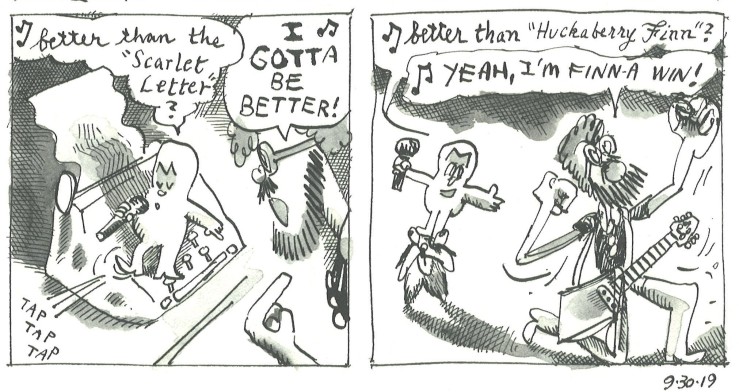
Dav’s quest takes a solipsistic turn. He plays the tortured artist, his ambition a block to his actual progress in writing The Great American Novel. Lerman satirizes the over-inflated but self-defeating ego of the artist who aspires to surpass all the great works came before him. While the pratfalls of a would-be tortured artist is not a particularly fresh subject matter, Lerman brings vitality to his depiction of Dav’s struggle against the anxiety of influence. If we enjoy mocking Dav, it’s because we understand and empathize with him. Who doesn’t want to contend with the greats?

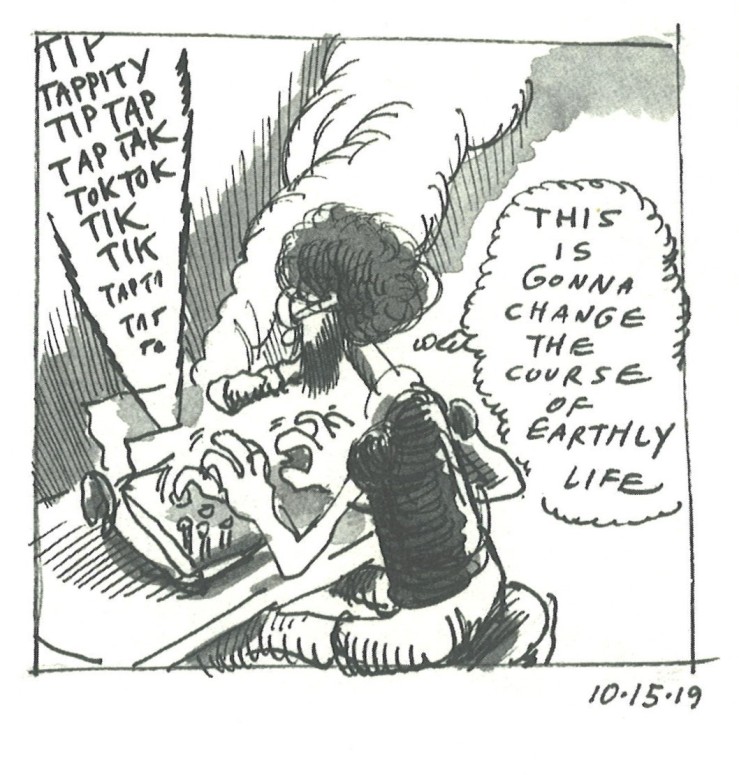
Dav’s quest also takes a turn away from his shenanigans with Roy. The pair’s riffing has always been the heart of Snake Creek, but Lerman keeps his partners apart for much of Escape. Dav’s dive into writing (or preparing to write, or preparing to prepare to write) distract him from Roy time. Initially, Dav chugs out reams of pages in the thrill of early enterprise. His ego swells, inflated by the grandeur of his illusions:

Only a few strips later, we find Dav’s illusions deflated. “S’all trash!” he declares over the mess of his nascent manuscript. Roy tries to help Dav. Snake Creek folk are all riled up over the plans of some “ollie garx” and the people are protesting. Roy rightfully recognizes potential inspiration here. He can bring his pal back to earth. “Sum sorter politicka thing” is happening, and that might be the inspirational grist Dav needs, right? But Dav rejects him: “I do not wish to know about anything that happened on this earth.” It might be hard to change the course of earthly life with that attitude. Instead of heeding Roy’s advice, Dav falls deeper into navel-gazing, imagining his future success, and generally doing anything except writing.

Dav’s dithering with the typewriter leaves Roy loose and “roving.” An amiable fellow, Roy soon takes up with two Russian oligarchs, Lev and Igor. This nefarious pair wishes to drill for oil in Snake Creek, destroying the weird paradise for profit. They plan to use charismatic, naïve Roy as their mouthpiece, a trusted liaison to the Creek community who can convince the locals on board to “drill baby drill.”

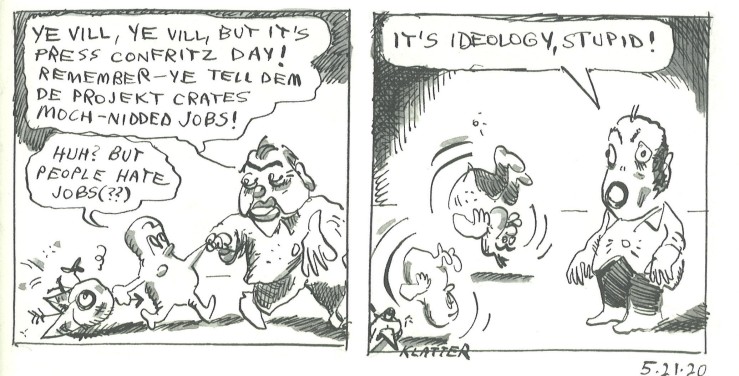
Lerman’s satire of these “ollie garx” and their relations with Roy is riddled with great gags. The oligarchs give Roy bald eagle eggs, which he proceeds to fry up to Dav’s dismay. They take him golfing and try to get him into Ayn Rand. They explain their anti-nature views—Mother Earth isn’t a caring mother but a devouring father who must, in oh-so Freudian terms, be eliminated. (Lerman, who always sneaks literary allusions into his strips, can’t resist referencing Faulkner’s As I Lay Dying during this exchange.) In one of my favorite exchanges in Escape, the oligarchs try to explain to Roy why his main talking point to convince the Snake Creek denizens to drill should be the promise of jobs:

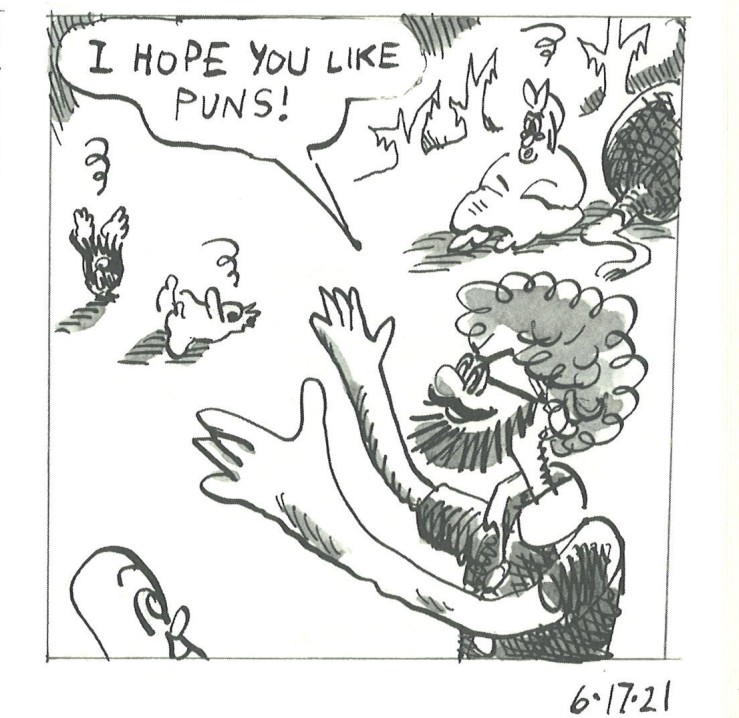
“But people hate jobs” — yes. And it is ideology, but you’re not stupid, reader, although the oligarchs might think you are. Their attempted seduction of sweet Roy plays out against Dav’s egotistical self-seduction into a fantasy of literary greatness in the twin threads of Escape from the Great American Novel. There are meditations on art, immortality, capitalism, and the role of our native environs. There are throwaway jokes on Harold Bloom and arguments over the better English translation of Camus’ L’Etranger. There are drones and fecal preoccupations and a nice ACAB reference; there are anarchist swamp folk and bombs! And there are puns. I hope you like puns.

The strips collected in Escape from the Great American Novel span two years that often felt in “real time” like an eternity. Many of us were separated from friends and family over these months. Lerman’s gambit, intentional or otherwise, is to keep his central characters separated, which adds real tension to a comic novel that otherwise might be a loose collection of funny riffs. As I stated before, Roy and Dav are the heart of Snake Creek, so when Lerman finally reunites them the moment is not just cathartic, it’s literarily metaphysical. For all its sardonic jags, ribald japes, and erudite allusions, Escape from the Great American Novel is in the end a sweet, even heartwarming read (Dav and Roy would find a way to mock this sentiment, I’m sure). I loved it. Highly recommended.

Escape from the Great American Novel is available in print from Radiator Comics.


Riff on rereading Riddley Walker, Russell Hoban’s post-apocalyptic coming-of-age novel

  1. I first read Russell Hoban’s 1980 post-apocalyptic quasi-religious coming-of-age novel Riddley Walker in maybe 1996 or 1997, when I was sixteen or seventeen, or possibly eighteen.
  2. That was the right age to read Riddley Walker for the first time, although I think anyone of any age, for the most part, could read Riddley Walker, if they want.
  3. This is not a review of Riddley Walker, but here is a nice summary from Benjamin DeMott’s 1981 NYT’s review:
  4. Set in a remote future and composed in an English nobody ever spoke or wrote, this short, swiftly paced tale juxtaposes preliterate fable and Beckettian wit, Boschian monstrosities and a hero with Huck Finn’s heart and charm, lighting by El Greco and jokes by Punch and Judy. It is a wrenchingly vivid report on the texture of life after Doomsday.

  5. The setting is near what was known – until 1997, when cataclysms wiped us out – as Canterbury, England. It is about 2,000 years after that disaster. The mostly dim lights of human life who survive are slaves to the obsessions of their invisible rulers. From generation to generation, they labor ceaselessly, under close surveillance, to disinter by hand the past that lies buried beneath tons of muck – mangled machines, mysteriously preserved bits of flesh, indecipherable fragments of writing. The rulers dream of uncovering the secret of secrets – the key to the power that enabled the giants of yesteryear to create a world in which boats sailed in the air and pictures moved on the wind.

  6. If the plot of Riddley Walker seems a trickle familiar it of course is. It’s been warmed up and reserved many times (and wholesale ripped off in the third Mad Max Max film). (It’s good eating.)
  7. But the novel still feels fresh (and grimy!) because of Hoban’s electrifying prose. Young Riddley’s narration is odd and alienating, even if, in, say, 2023, the novel’s premise seems worn.
  8. Back in the halcyon nineteennineties, when the world seemed generally less apocalpytic, a very good friend of mine loaned me his copy of Riddley Walker.
  9. I never gave it back.
  10. (Somehow, he still gives me books.)
  11. I too lost the first copy of Riddley Walker that I read. I loaned it to a student who never returned it, or Dune, or The Left Hand of Darkness, or a bunch of other sci-fi novels, god keep his soul.
  12. Riddley Walker was one of the first novels I wrote about on this silly website, way back in 2006. It wasn’t a review, it was about book theft.
  13. I had no plan to reread Riddley Walker, but here’s what happened—
  14. —I had finished reading Ian Banks’s odd coming-of-age novel The Wasp Factory
  15. —and I had and have been listening to the audiobook of T.H. White’s Arthur saga, a return perhaps inspirited by—
  16. —reading Jim Dodge’s alchemical-grail-quest-coming-of-age novel Stone Junction
  17. —and really, there were a lot of coming-of-age novels I seemed to get into this year:
  18. Trey Ellis’s postmodern polyglossic satire Platitudes—
  19. —Kathy Acker’s Great Expectations and Blood and Guts in High School—
  20. Henri Bosco’s The River and the Child
  21. Bernardo Zanonni’s picaresque My Stupid Intentions—
  22. and Cormac McCarthy’s coming-of-age novel The Crossing
  23. And so well and anyway, I was reading a novel in bed, my eyes working overtime, they’re older now, lenses over them but still there’s never enough light. I was reading this novel, it doesn’t matter what novel, but there was this little weird urge, germinating from the reading of the novels I mentioned above, asking me to Go pick up Riddley Walker again and check in.
  24. So I went and found my copy of Riddley Walker.
  25. It was not, obviously, the copy that I stole from my good friend that was later stolen from me.
  26. I’m not sure when I picked up this particular copy of Riddley Walker, but I’m thinking it was around 2008 or 2009.
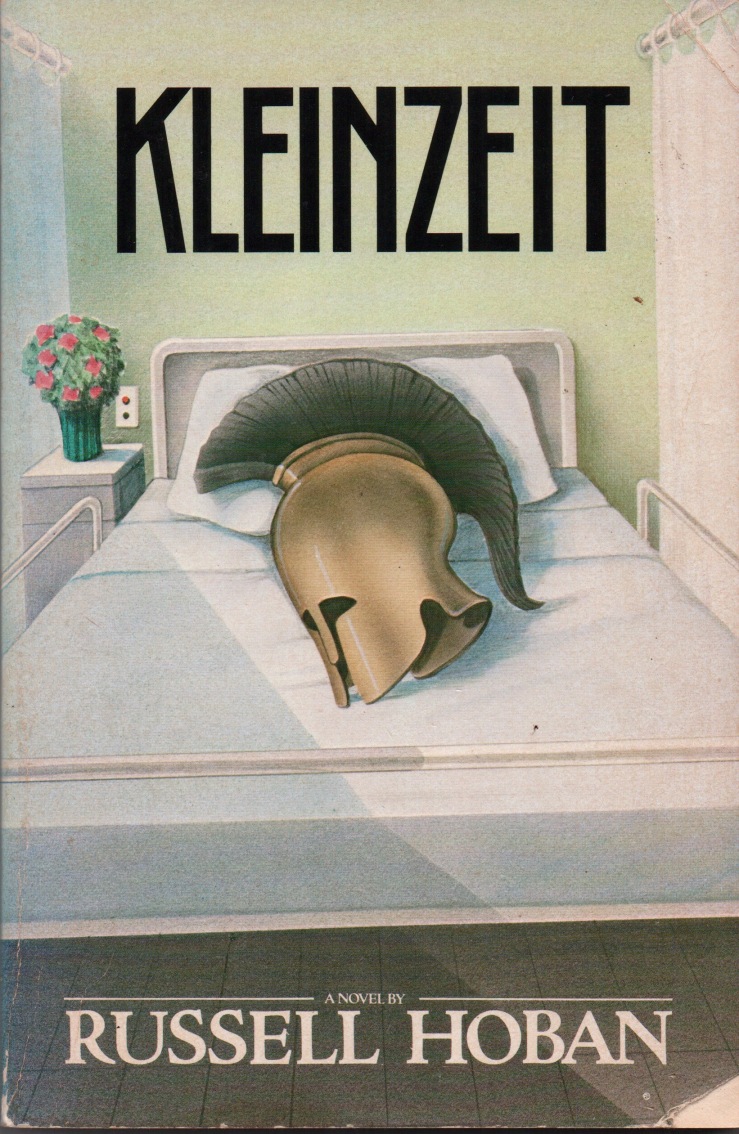
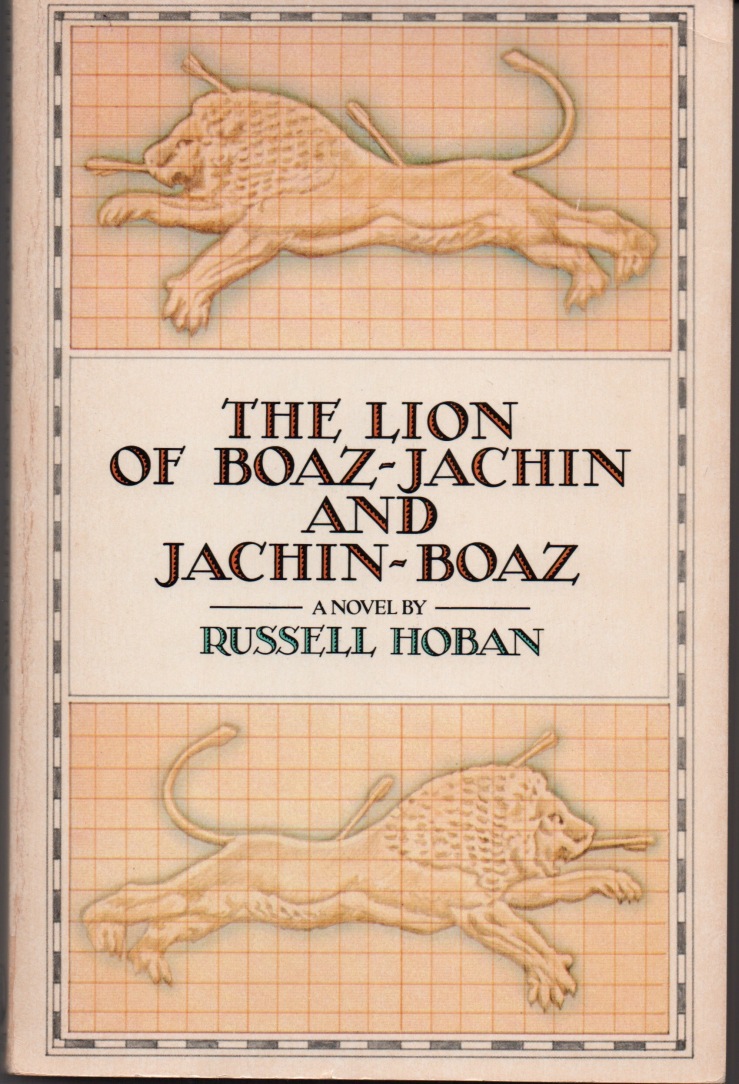
  27. I think that’s when I read the other Hoban novels that I’ve read: The Lion of Boaz-Jachin and Jachin-Boaz; Kleinzeit; Pilgermann.
  28. IMG_0010IMG_0012IMG_0013
  29. Of these three novels, Pilgermann is the best and most fucked up.
  30. (I like Kleinzeit, but it’s too indebted to Beckett.)
  31. Well so and anyway, I put down the novel I had been trying to read, and dug up Riddley Walker, put the thing under my poor old lensed eyes.
  32. Here are the first two paragraphs of Russell Hoban’s novel Riddley Walker:
  33. On my naming day when I come 12 I gone front spear and kilt a wyld boar he parbly ben the las wyld pig on the Bundel Downs any how there hadnt ben none for a long time befor him nor I aint looking to see none agen. He dint make the groun shake nor nothing like that when he come on to my spear he wernt all that big plus he lookit poorly. He done the reqwyrt he ternt and stood and clattert his teef and made his rush and there we wer then. Him on 1 end of the spear kicking his life out and me on the other end watching him dy. I said, ‘Your tern now my tern later.’ The other spears gone in then and he wer dead and the steam coming up off him in the rain and we all yelt, ‘Offert!’                                      The woal thing fealt jus that littl bit stupid. Us running that boar thru that las littl scrump of woodling with the forms all roun. Cows mooing sheap baaing cocks crowing and us foraging our las boar in a thin grey girzel on the day I come a man.

  34. I think this is probably the fifth time I’ve read Riddley Walker. I have a very distinct memory of using the novel as the basis for a project in a linguistics class in college. The project had something to do with graphemes and phonemes and was very harebrained, and I am lucky, as always, that the internet was an infant at the time. (I got a “B” on the project and recycled it my senior year in an English class, getting (earning?) an “A.”)
  35. The previous point is a way of protesting that, even as familiar as I was and perhaps am with Riddley Walker’s linguistic barrier, I still found rereading it physically exhausting.
  36. (I am older now, and all reading tires my body in ways I didn’t expect would be possible even five years ago.)
  37. I also find myself putting the book down to chase rabbits down internet holes that simply weren’t available to me the last times I read the book—
  38. —reading variations of the legend of St. Eustace or mapping Hoban’s Riddley Walker map to contemporary England—
  39. —or just getting hung up on particular phrases and images, letting them rattle around. (And now wishing I’d underlined them so as to share them here, which I didn’t, underline them that is.)
  40. Riddley himself is far more arrogant and decisive than I’d remembered; the angst here is more about a great becoming of a world to come than it is a becoming into the self of adulthood.
  41. (Whatever the fuck that last phrase means; sorry.)
  42. I find myself with new connections too—Aleksei German’s 2013 film adaptation of the Strugagtski’s novel Hard to Be a God comes readily to mind, as does Alfonso Cuarón’s 2006 film Children of Men.
  43. And David Mitchell’s novel Cloud Atlas, too (along with the Wachowskis’ film adaptation), which stole readily from Riddley Walker.
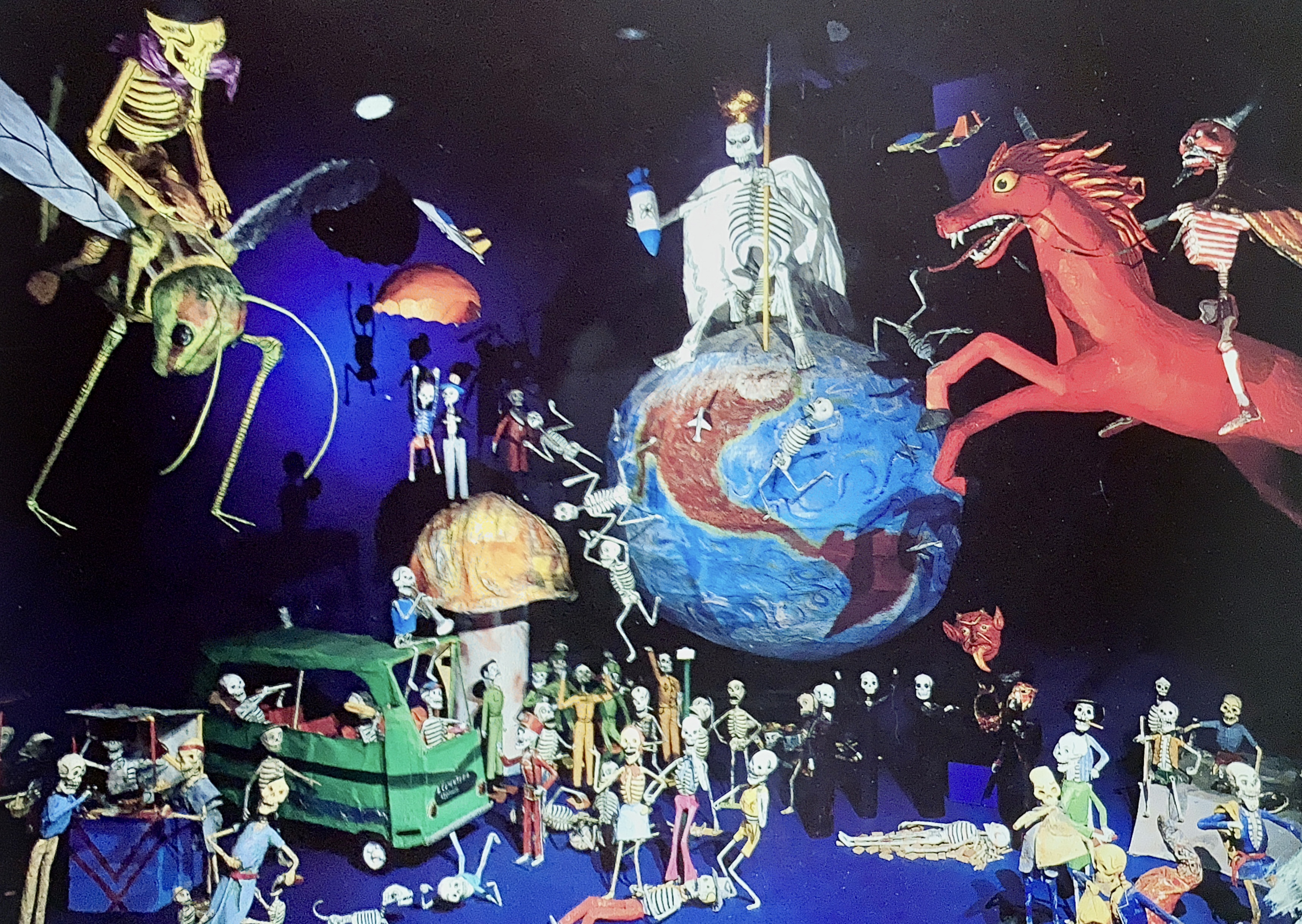
  44. The bookmark at the back of the copy of Riddley Walker I opened was a postcard from Mexico from Texas:
  45. The piece, according to the back of the postcard, is appropriately titled The Atomic Apocalypse—Will Death Die? The piece is a photograph of a painted papier mache menagerie, attirbuted to the Linares Family of Mexico City, 1989.
  46. Some old younger version of myself stuck it in the back of Riddley Walker as a joke.
  47. The postcard came from a man in Texas who won a contest to win a copy of the 25th-anniversary edition of Blood Meridian. 
  48. This man sent several postcards, and I scanned them and shared them on the site, but this particular postcard is not in that set of shared postcards.
  49. Why? Did the postcard not fit on the scanner? Was it sent later, as a polite Thank you? (I don’t think so; on the postcard’s b-side, the man who won the contest shared a quote from Blood Meridian describing the physical appearance of Judge Holden.)
  50. Let this postcard stand as aesthetic précis for Riddley Walker though, and let me be done. (I will find the other postcards over the years, or not.)

Iain Banks’s The Wasp Factory is an abject coming-of-age novel narrated by a teenage psychopath

Frank Cauldhame, the narrator of Iain Banks’s 1984 debut novel The Wasp Factory, is a teenage psychopath. Frank lives with his eccentric father on an island in rural Scotland. He is an unregistered person with “no birth certificate, no National Insurance number,” nothing to officially prove his existence. He enjoys this unofficial existence, patrolling his island, which he protects through various rituals.

One of these rituals is to construct and maintain “Sacrifice Poles,” and when we first meet Frank, he is “making the rounds” of these talismans: “One of the Poles held a rat head with two dragonflies, the other a seagull and two mice.” Frank has to keep plenty of dead animals on hand for his ritual defenses, and he kills them by slingshot, air-gun, explosives, and even an improvised flamethrower. (Readers sensitive to depictions of animal cruelty, or just cruelty in general, may wish to avoid The Wasp Factory.)

Another of Frank’s rituals consists of sacrificing a live wasp to the titular Wasp Factory (“beautiful and deadly and perfect,” in our narrator’s words). Frank has devised the Wasp Factory as a bizarre death trap built from “the face of the old clock which used to hang over the door of the Royal Bank of Scotland in Porteneil.” Once introduced to the Factory, the poor wasp can fall prey to one of a dozen different deaths, including the Boiling Pool, the Spider’s Parlour, the Acid Pit, or even “the rather jocularly named Gents (where the instrument of ending is [Frank’s] own urine, usually quite fresh).”

Frank’s urine becomes an important motif in The Wasp Factory. We learn fairly early that he is a “unique eunuch,” supposed victim of a dog bite accident that has left him forever unmanned (and deeply misogynistic). Our lad must piss sitting down, a shame he accepts with a hateful forbearance. Urine flows throughout the novel, an abject magical potion.

Indeed, Frank’s rituals frequently call for the most abject residues and excretions for the magic to work. Consider the Naming Ceremony he performs for a new weapon he’s purchased:

I smeared the metal, rubber and plastic of the new device with earwax, snot, blood, urine, belly-button fluff and toenail cheese, christened it by firing the empty sling at a wingless wasp crawling on the face of the Factory, and also fired it at my bared foot, raising a bruise.

Parts of me thought all this was nonsense, but they were in a tiny minority. The rest of me knew this sort of thing worked. It gave me power, it made me part of what I own and where I am. It makes me feel good.

Were it not for the animal cruelty, Frank’s rituals, no matter how abject, might be the stuff of antic children’s games–playing war, building dams, shooting pellets at cans, and so forth. But the ritualized animal murders are part and parcel of Frank’s most sadistic crimes. He is a serial killer.

Frank confesses his crimes early in The Wasp Factory, and the Scribner trade paperback edition uses his confession as copy on the back of the book to entice would-be readers, so I don’t think I’ll spoil much by sharing it:

Two years after I killed Blyth I murdered my young brother Paul, for quite different reasons than I’d disposed of Blyth, and then a year after that I did for my young cousin Esmerelda, more or less on a whim.

That’s my score to date. I haven’t killed anybody for years, and don’t intend to ever again.

It was just a stage I was going through.

The punchline there at the end is indicative of the dark humor that pervades The Wasp Factory. The edition I’m quoting includes blurbs from negative reviews as well, again highlighting Banks’s mordant glee with the monster he’s conjured. “Rubbish!” declares The Times of London; “There’s nothing to force you, having been warned, to read it; nor do I recommend it,” warns The Scotsman.

Elsewhere, Banks’s humor is earthier, as when Frank recounts some of the early days of his homeschooling at the hands of his ex-hippy chemist father:

For years I believed Pathos was one of the Three Musketeers, Fellatio was a character in Hamlet, Vitreous a town in China, and that the Irish peasants had to tread the peat to make Guinness.

There’s also a sweet streak to the book as well as Frank himself, who, despite his psychotic behavior, is a genuinely caring person at times. His relationship to his only friend, a dwarf named Jamie, is damn near tender; Frank perches Jamie on his shoulders so that the latter can better see the awful punk bands at the local pub.

Frank also cares deeply for his older brother Eric. In the first line of the novel, we learn that Eric has “escaped”; we soon learn he’s escaped from a psychiatric ward he’d been sent to after terrorizing the town folk. Eric’s insane crimes also involve animal cruelty: burning local dogs; force-feeding children worms.

The plot of The Wasp Factory is actually quite simple: What will happen when Eric comes home? Banks keeps the pot boiling through a series of phone calls Eric makes to Frank. We come to see that while Frank might be a psychopath, he is not insane in the way that his older brother is. (A late reveal in the novel that explains the cause of Eric’s insanity is one of the most disgusting pieces of prose I’ve ever read (I write this in admiration.)) In the meantime, Frank attempts to break into the office door that his father has always kept locked.

These twin plots—prodigal son coming home, daddy’s secret locked door—drive the action of The Wasp Factory (oh, and Frank’s basement is full of explosive cordite, too). The book’s real weight comes not from the plot, but from Frank’s narration. He’s a perceptive intelligence, and tuning into his voice is by turns mesmerizing and horrifying.

Not everyone will enjoy The Wasp Factory, as I’ve tried to make as clear as possible in this review. To borrow from The Scotsman, “There’s nothing to force you, having been warned, to read it.” And even admirers may find the twist ending a bit dated and the final moments of Frank’s deep reflection a bit rushed. But Banks does give the reader a conclusion, when it might have been so much easier to leave his characters (and readers) in a noncommittal fuzz of ambiguity. There’s a point of view here, even if it disturbs. The Wasp Factory is a truly fucked up coming-of-age novel, an abject anti-Huckleberry Finn whose narrator makes Holden Caulfield seem perfectly well adjusted. Not for everyone, but I loved it. Recommended.

Riff on Ursula K. Le Guin’s collection The Wind’s Twelve Quarters

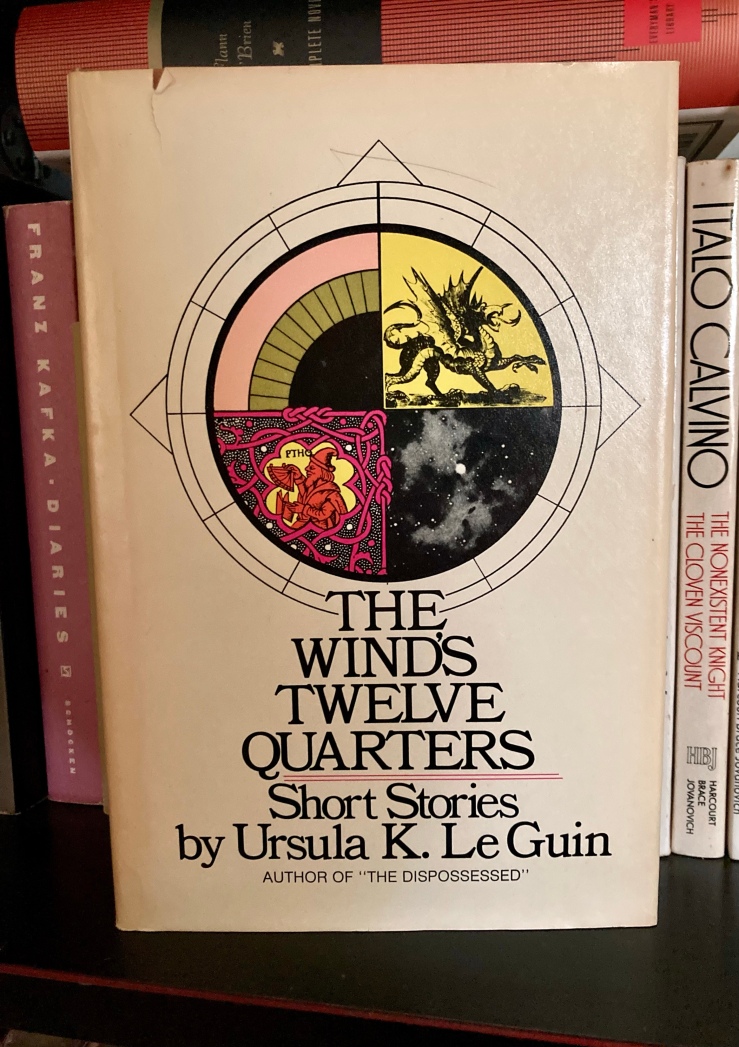
Ursula K. Le Guin’s 1975 volume The Wind’s Twelve Quarters collects seventeen short stories, offering, as the author puts it in her foreword, “a retrospective” of her career to date: “a roughly chronological survey of my short stories during the first ten years after I broke into print.” Le Guin adds that The Wind’s Twelve Quarters is “by no means a complete collection” of her short stories to date, and that the book does not include “fiction which doesn’t fit under the headings Fantasy or Science Fiction.” In addition to her foreword, Le Guin offers brief introductory notes to each of the seventeen tales.

For me, these introductions were often as interesting as the stories themselves. In her introduction to “Semley’s Necklace,” for example, Le Guin declares that the “candor and simplicity” of this early story exemplifies the “romanticism” characteristic of her early work — a mode that has “gradually become something harder, stronger, and more complex” as her career developed. In her introduction to “The Good Trip,” she tells us that her “only strong opinion about drugs (pot, hallucinogens, alcohol) is anti-prohibition and pro-education” but also admits that “people who expand their consciousness by living instead of by taking chemicals usually come back with much more interesting reports of where they’ve been.” In her intro to “Nine Lives,” which was originally published in Playboy in 1968, Le Guin laments that it appeared “under the only pen name I have ever used: U. K. Le Guin,” and that it is “surprising to me to realize how thoughtlessly I went along with them. It was the first (and is the only) time I met with anything I understood as sexual prejudice, prejudice against me as a woman writer, from any editor or publisher; and it seemed so silly, so grotesque, that I failed to see that it was also important.” In her introduction for “A Trip to the Head,” Le Guin describes a dark bout of writers block she experienced over a period of two years living in England. Giving herself permission to write “A Trip to the Head” released the block:

There is a kind of story which I would describe as a Bung Puller. The writer for one reason or another has been stuck, can’t work; and gets started again suddenly, with a pop, and a lot of beer comes leaping out of the keg and foaming all over the floor. This story was definitely a Bung Puller.

“A Trip to the Head” is one of the very few examples in the collection where the introductory material outweighs the tale it introduces. The story starts promisingly enough:

“Yes, this is Earth,” said the one beside him, “nor are you out of it. In Zambia men are rolling down hills inside barrels as training for space flight. Israel and Egypt have defoliated each other’s deserts. The Reader’s Digest has bought a controlling interest in the United States of America/General Mills combine. The population of the Earth is increasing by thirty billion every Thursday. Mrs Jacqueline Kennedy Onassis will marry Mao Tse-Tung on Saturday, in search of security; and Russia has contaminated Mars with bread mold.”

“Why then,” said he, “nothing has changed.”

—but then Le Guin makes good on that “nothing has changed” idea, even as, paradoxically, her story’s undefined protagonist transforms through a series of identities. “A Trip to the Head” is a postmodern experiment that doesn’t really succeed, unless, of course, you count that its creation unblocked our author.

And it’s a good thing Le Guin broke her block: some of her strongest work came after “A Trip to the Head,” including The Lathe of Heaven, The Dispossessed, and the first two Earthsea novels. Most of the stories in The Wind’s Twelve Quarters that came after “A Trip to the Head” are quite strong. 1971’s “Vaster Than Empires and More Slow,” part of Le Guin’s Hainish universe, tells the story of SPACE MADNESS! and a murderous empathic jungle. “The Ones Who Walk Away from Omelas” (1973) is a successful morality experiment (or “psychomyth,” to use Le Guin’s term). “Omelas” proposes a utopia where “millions [are] kept permanently happy on the one simple condition that a certain lost soul on the far-off edge of things should lead a life of lonely torment.” In her introduction, Le Guin attributes this riff on the scapegoat to William James’s essay “The Moral Philosopher and the Moral Life” (although she concedes that she first read the scenario in Dostoyevsky’s Brothers Karamazov). “Omelas” is a highlight of The Wind’s Twelve Quarters, as is 1974’s “The Day Before the Revolution,” which details a day in the life of the aged anarchist revolutionary Odo. “The Day Before the Revolution” serves as a kind of prologue to The Dispossessed, a move that appears elsewhere in the collection.

The opening story, “Semly’s Necklace,” is quite literally the prologue to Le Guin’s first novel Rocannon’s World (1966). “Winter’s King” (1969) was the spark that led to what many consider Le Guin’s finest novel The Left Hand of Darkness (published later the same year). 1964’s “The Word of Unbinding” and “The Rule of Names” preceded the Earthsea novels that Le Guin would begin in the late sixties. While these germinal tales are intriguing, its clear the Le Guin, ever the anthropologist, would like to do more than her limited canvas can hold. These tales are most notable as ancillary material to be situated in the worlds that Le Guin would go on to conjure in a much wider scope.

Ursula K. Le Guin portrait by Henk Pander.

Some of the best stories in the collection are self-contained, even as they point to Le Guin’s developing larger themes and goals as a writer. “The Masters” (1963) is a lovely dystopian riff on power, control, and knowledge (“The theme of this story is one I returned to later, with considerably better equipment,” Le Guin remarks in her intro, adding, “It has a good sentence in it, though: ‘He had been trying to measure the distance between the earth and God'” — that is a good sentence!) 1970’s “Things” imagines the paranoia of a promised apocalypse, with a brickmaker turned boatbuilder and a widowed weaver providing their own imaginative resistance to the coming onslaught. 1962’s “April in Paris” is a lovely oddity—a romantic time traveling tale with a sentimental happy ending:

The alchemist and the interstellar archaeologist went first, speaking French; the Gaulish slave and the professor from Indiana followed, speaking Latin, and holding hands. The narrow streets were crowded, bright with sunshine. Above them Notre Dame reared its two square towers against the sky. Beside them the Seine rippled softly. It was April in Paris, and on the banks of the river the chestnuts were in bloom

The Wind’s Twelve Quarters is not a great starting place for anyone interested in Le Guin’s worlds. Interested parties would do better to start with The DispossessedThe Lathe of Heaven, or The Left Hand of Darkness—but interested parties are probably aware of that. The book is better suited for folks like me—folks who tore through the Hainish cycle and the Earthsea books and collections, and still wanted a little moreThe Wind’s Twelve Quarters is ultimately most interesting as a document of a writer coming into the prime of her powers, and, as such, is indispensable for hardcore Le Guin fans.

Matt Bucher’s The Belan Deck is an unexpectedly moving argument for humanity and serious triviality

I stayed up later than I meant to the other night reading all of Matt Bucher’s new book The Belan Deck in one cover-to-cover go. On his website, Bucher describes The Belan Deck as “a little book…set mostly during a layover at SFO” that “centers around a person who maybe doesn’t really fit in at their AI tech job but still needs to produce one final PowerPoint deck.” This description approximates the plot, in the barest sense, but doesn’t touch on the spirit or form of The Belan Deck.

Let’s talk about the spirit and form of The Belan Deck. Bucher borrows the epigraphic, anecdotal, fractured, discontinuous style that David Markson practiced (perfected?) in his so-called Notecard Quartet (1996-2007: Reader’s Block, This Is Not A NovelVanishing Point, and The Last Novel). “An assemblage…nonlinear, discontinuous, collage-like,” wrote Markson, to which Bucher’s narrator replies, “Bricolage. DIY culture. Amateurism. Fandom. Blackout poems.”

Bucher’s bricolage picks up Markson’s style and spirit, but also moves it forward. Although Markson’s late quartet is arguably (I would say, by definition) formally postmodernist, the object of the Notecard Novels’ obsession is essentially Modernism. Bucher’s book is necessarily post-postmodern, taking as its objects the detritus and tools of postmodern communication: PowerPoint, Google Street View, Wikipedia, social media, artificial intelligence.

At the same time, Bucher continues Markson’s obsessions with artists and death, adding to the mortality lists that wormed through DM’s quartet. Bucher’s updates are odd though, in that they seem to, in their print form, contextualize anew coincidences that were so raw and immediate when they popped up on Twitter and other social media:

Nicanor Parra died the day after Ursula K. LeGuin died.

Larry McMurty and Beverly Cleary died the same day.

(In my memory, William H. Gass died the day before LeGuin, but this is not true. He died almost two months before LeGuin. But I recall teaching selections from both of their work in a literature class in the spring semester of 2018, and pointing out to my students that the empty spaces behind the dashes after their birth years might now be filled in. “An encyclopedia entry demands at least a birth or a death,” notes Bucher’s narrator.)

The encyclopedia, by which I mean Wikipedia, becomes a heroic motif in The Belan Deck. “Wikipedia is the number one result for over 50% of Google searches,” Bucher’s narrator points out, following it up with,

Wikipedia, made by humans, for free, is a better search engine than Google, the most expensive and sophisticated algorithm in the world.

Earlier in The Belan Deck, the narrator points to the “mindless pleasure of going down a deep Wikipedia rabbit hole,” a pleasure that an artificial intelligence, no matter how developed, could never feel. About three dozen pages later, Bucher’s narrator throws a slant rhyme to his previous note on the “mindless pleasures” of Wikipedia rabbit holes, pointing out that Thomas Pynchon had used Mindless Pleasures as a working title for Gravity’s Rainbow. That’s how this book operates: Disparate fragments of information are “Clues rather than trivia.”

The goal is to find the sublime in these connections; Bucher’s narrator repeatedly and succinctly argues that finding the beautiful, much less the sublime, is impossible for an artificial intelligence. The Belan Deck plays out as a discursive, looping, and unexpectedly moving argument for humanity, in all its serious triviality, against the backdrop of capital’s rapid encroachment into the human position in the arts.

“Capitalism is incompatible with being an artist, for most people,” avers our narrator. “Yet you participate!” might come the retort, and it’s true—not only does Bucher’s narrator work in a soulless medium, the deck (trying to inject some soul, some sublime, some humanity into it), he also works for the soulless Belan, a money guy who would love to replace artists with machines. (In what I think has to be a great intentional gag, Bucher’s narrator’s point of contact for Belan is a middleman named  Jimmy Chen. I just have to believe that the character’s a take on the Jimmy Chen who wrote and designed on HTMLGIANT for all those years.)

The narrator participates because there aren’t that many other options, as we all know. “Do you understand what I am saying? Does it also feel this way to you?” the narrator plaintively asks. I mean, for me, that’s a Yes, all the time. 

There’s much more in The Belan Deck than I can get to here—more on art, artists, baseball, airports—it’s voluminous for a “little book.” (“When we buy a book, we think we are buying time to read” is a line I underlined but could not otherwise work into this review, so I’ll include it here parenthetically. (A lot of this review has happened in parentheses.))

I’ll end with two bits of personal trivia, two coincidences.

First: The day The Belan Deck arrived in my mail, which is the day that I read The Belan Deck, some AI-cheerleading dork went viral on Twitter for posting a series of unasked-for renderings of “what the backgrounds of the most famous paintings in the world look like with AI.” He was roundly and rightly mocked for his endeavors, and I found the general antipathy heartening, but still a small cadre of people who know absolutely nothing about art congratulated his vapidity.

Second: Earlier that same day, I read a passage from Walter Tevis’s 1980 dystopian novel Mockingbird, and found its sentiment largely heartening as well. The hero of the novel, staring at a “dumb parody of humanity” declares it “nothing, nothing at all.” He continues, pointing out that the forces of capital “had given robots to the world with the lie that they would save us from labor or relieve us from drudgery so that we could grow and develop inwardly.” But underneath this false promise was a deep “contempt for the ordinary life of men and women,”  a deep hatred of human life itself. The sentiment I find heartening here is in the hero’s recognition and resistance to this contempt.

The Belan Deck isn’t a straightforward guidebook or manifesto or map, but it nevertheless, in its elliptical, poetic approach, offers a winding, thinking, feeling path of opposition to not only the machines themselves, but also the hollow men who would gladly replace artists and creators and thinkers with those machines. It’s also really fun to read. Great stuff.

This is not a review of Fernanda Melchor’s This Is Not Miami

  1. This is not a review of Fernanda Melchor’s collection This Is Not Miami.
  2. First published in 2013, This Is Not Miami is now available in English translation by Sophie Hughes.
  3. Hughes previously translated Melchor’s two novels, the recent shorty Paradais and the superb 2017 novel Hurricane Season.
  4. Melchor composed the twelve pieces collected in This Is Not Miami between 2002 and 2011.
  5. In her introduction to the collection, Melchor declares that the pieces in This Is Not Miami are not properly tales or stories or works of journalism, but rather relatos—reports “based on events that really happened.”
  6. Melchor crafts her relatos from eyewitness accounts.
  7. (There’s also some journalistic research in there.)
  8. Like Paradais and Hurricane Season, the relatos of This Is Not Miami all take place in Melchor’s native Veracruz.
  9. Like Paradais and Hurricane Season, the relatos of This Is Not Miami describe and explore violent crime.
  10. Some characters: narcos, corrupt cops, crackheads, corrupt judges, petty drug dealers, petty drug users, an infanticidal beauty queen, a child rapist, a ufologist, a lynch mob, starving stowaways, scared cadets, a demon-possessed teen, a healer, a priest, an older couple clinging to the floor of their apartment as bullets fly through the walls, etc.
  11. (And Melchor’s “I” of course.)
  12. (Oh, and there’s a brief appearance by Mel Gibson.)
  13. Most of Melchor’s relatos are short. There are two significantly longer pieces: “Queen, Slave, Woman” and “The House on El Estero.”
  14. “Queen, Slave, Woman” tells the story of Evangelina Tejera Bosada, queen of the 1983 Veracruz Carnival who killed her children and cut them into pieces.
  15. In the previous sentence, the phrase “tells the story” is imprecise. In “Queen” and in most of the relatos in the collection, Melchor is telling the story of the witnesses who are telling the story.
  16. “The House on El Estero,” the longest piece, is a haunted house/exorcism riff that ends up being a kind of love story, a story about falling in love with a storyteller.
  17. “The House on El Estero” began to to wear thin for me, its premise stretched farther than my interest.
  18. However, William T. Vollmann singled out “The House on El Estero” as a favorite in his New York Times review of This Is Not Miami, a review I read a few minutes before I decided not to write a review of This Is Not Miami.
  19. While I don’t think “El Estero” is one of the better pieces in the collection, I generally agree with Vollmann’s assessment of the book’s trajectory.
  20. Vollmann points out that “because the relatos are arranged mostly in order between 2002 and 2011, during which time the author was obviously working hard at her craft, the style rapidly improves, in Sophie Hughes’s translation, into something natural, careful and smooth.”
  21. And, I’d add, rough when necessary.
  22. I hate to say that I was disappointed in This Is Not MiamiI mean, I was, disappointed, but also deeply interested.
  23. The sketches here are not sketchy; they are ballast, the raw and vivid material that points to the Hurricane Season’s masterful hallucinatory language explosion.
  24. As such, This Is Not Miami reads like a minor work, but one nonetheless vital to its creator’s artistic maturation.
  25. For me, This Is Not Miami is most appreciable as an apprenticeship work that points toward the Bigger Thing to come.
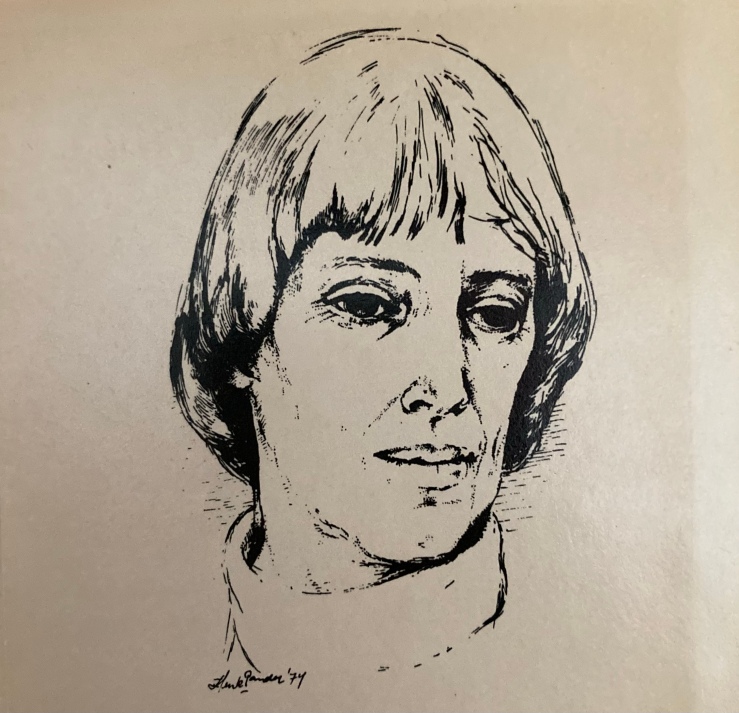
  26. And of course I want more.

A review of Trey Ellis’s polyglossic satire Platitudes

Trey Ellis’s 1988 debut novel Platitudes begins with a typical metatextual conceit: the novel-within-a-novel gambit. Our story starts with Earle, a nerdy, idealistic high school sophomore who lusts after True Love (and some sex if he can get it). After about a dozen pages though, the “author” shows his hand. Depressed divorced Dewayne Wellington is Earle’s creator, and he’s stuck in his novel-in-progress Platitudes. “I’m sorry. I don’t know what more to write,” Wellington declares, before soliciting help from his readers.

Wellington soon receives manuscript pages from bestselling author Isshee Ayam, who transplants his story from 1980s Manhattan to 1930s rural Georgia. When Wellington introduces worldly and gorgeous Dorothy as Earle’s romantic foil, Ayam’s rhetorical interventions take on a new intensity as the two authors duel to guide the spirit of the novel-in-progress.

The plot threads and styles intertwine, with Wellington’s experimental mode clashing with Ayam’s “Afro-baroque” style (as Ellis described it in a 1989 Los Angeles Times profile). A parodic pastiche of competing Black American artistic voices, Platitudes ultimately synthesizes polyglossic tones into a strangely endearing romantic comedy. Sharp but breezy, ironic and earnest, and utterly metatextual yet soaked in pathos, Ellis’s first novel seems to be an overlooked late-postmodernist gem.

Although Platitudes remains in print (via Northeastern University Press’s New England Library of Black Literature series), I have never seen it mentioned along with its contemporaries—books like David Foster Wallace’s 1989 collection Girl with Curious Hair or Bret Easton Ellis’s 1987 novel The Rules of Attraction. Instead, Ellis’s novel seems to be connected more often along with the works of Ishmael Reed, particularly his 1986 novel Reckless Eyeballing.

Reed’s novel concerns an experimental playwright who finds his career under attack from feminists. As Itabari Njeri pointed out in the LA Times profile mentioned above, many readers “assumed that Ayam is a thinly veiled Alice Walker and that Wellington is the novelist, poet and playwright, Ishmael Reed.” Ellis told Njeri that he hadn’t read Reckless Eyeballing until after he finished Platitudes. He also stated in the profile that he hadn’t read Walker’s The Color Purple. Before I read the Njeri profile I was almost certain that Ellis was parodying (lovingly though at times sharply) Reed and Walker.

Ayam’s “Afro-baroque” style is a particularly purple prose, telegraphed in the oh-so-unsubtle titles of her bestsellers: Chillun o’ de Lawd, Hog Jowl Junction, and My Big Ol’ Feets Gon’ Stomp Dat Evil Down. Here’s the first sentence of Ayam’s version of Platitudes:

Earle awakened to a day as new and as fresh as Mama’s hand-starched and sun-dried petticoat, a huge, plain garment as large and as fresh-smelling as the revival tents that bloomed every summer along Route 49 in Lowndes County, Georgia.

What an awesomely bad awesome sentence! The simple sentence is there: “Earle awakened,” but the adornment tacks on and on, a traffic jam of adjectives glommed onto a simile growing out of another simile, like a lichen that grows on a moss that grows on a rock.

Here’s Ayam’s next sentence:

Yes, from out of those wide Baptist thighs, thighs that shook with the centuries of injustice and degradation, thighs that twitched with the hope of generations yet unplanted, thighs that quivered with the friction of jubilant, bed-thumping, and funky-smelling lovemaking, emerged Earle.

“I’m speechless, Ms. Ayam,” responds Wellington by post after receiving her pages, and offers up as a return gift a list of Earle’s favorite things (to be sung to the tune Coltrane’s take on the Rodgers and Hammerstein song):

All kinds of tanks, Janey Rosebloom, Cream of Wheat, neighbors, Corinthians, toast-r-waffles, his own bean-fart vapors,

A tightly-tucked-in-bed,

Chef Boy-Ar-Dee

Schefflera, balsa wood, and Pay TeeVee.

Eff. Ay. Oh. Schwarz, lingerie straps, cowboy boots and hats.

Sunggle sacks, Chap Stick tubes, BeeBee guns, and films!

Sci-fi, cars, dance—Slurpees.

This list, printed in the console font that demarcates the many other lists, charts, menus, etc. that populate Platitudes then gives way to a brick list paragraph in whatever font Vintage Contemporaries are printed in. This second list might also comprise some of Wellington’s (and perhaps even Ellis’s?) favorite things, and includes “Jamaican accents, cleavage, efficiency, artificial cheese-food product” and

the way a pretty woman’s high heel dangles insecurely from the big toe of the crossed leg always near falling or—from a slight kick—flying spike-over-toe—an exotic Oriental weapon; but never doing either, just dangling, the toe of the shoe covering just enough to promise…

The back-and-forth of the two authors plays out as a personification of the tensions between two modes of Black literature that Ellis seeks to parody, synthesize, and ultimately transcend in Platitudes. While appreciative of the traditions and anti-traditions that came before him, he sought something new in his novel. A year later after the publication of Platitudes, Ellis published his essay “The New Black Aesthetic” in the journal Callaloo. Here, Ellis argued for a new kind of Black arts, evoking the concept of a ludic “cultural mulatto,” an artist free to borrow from both tradition and popular culture alike: “We no longer need to deny or suppress any part of our complicated and sometimes contradictory cultural baggage to please either white people or black,” Ellis declared in his essay.

Platitudes is not an essay—far from it—but it does enact the radical hybridization that Ellis put forth in his New Black Aesthetic manifesto. In his LA Times profile, Ellis declared Platitudes an “anti-novel,” adding that “It’s satirical and primarily about language performance, which has its own delights, as opposed to traditional narrative.”

And yet there is a traditional narrative here. Call it boy meets girl or coming of age or classical-in-the-Aristotelian-sense comedy or whatever you want, but Platitudes offers its reader a satisfying conclusion without selling out the ambiguities and ironies that course through its 180 or so pages.

In his back-cover blurb for Platitudes, Ishmael Reed wrote: “I was zapped by Trey Ellis’s humongous talent. His book, Platitudes, is delightfully rad.” Zapped and delightfully rad are perfect descriptors, and I feel like I’ve neglected to share enough of Ellis’s prose, which at times approximates linguistic channel surfing (at one point, quite literally). The book is both fun and funny, and while the book has not been neglected in academia (Christian Schmidt devotes a chapter to it in his study Postblack Aesthetics, for example), it deserves a wider readership from those who enjoy satirical postmodern novels. Highly recommended.

First riff: The Letters of William Gaddis, “Growing Up, 1930–1946”

The Letters of William Gaddis, ed. Steven Moore, NYRB, 2023

Chapter One: “Growing Up, 1930-1946”

Earliest letter:

To Edith Gaddis (mother), 9 Dec. 1930

Latest letter:

To Frances Henderson Diamond (early love interest), 13 March 1946

Synopsis, citations, and observations:

Most of the letters collected by Moore in this first section of Letters are addressed to Edith Gaddis, whom Moore appropriately describes as “the heroine of the first half of this book: his confidante, research assistant, financial benefactor, his everything.”

His everything clearly includes everything, but I would’ve thrown in the words earliest audience. The letters featured in this earliest chapter show only the barest germ of the writer into which Gaddis would evolve—but they do show a tenacious foundation for practice, one facilitated by a loving, motherly reader.

Here is the first letter in the volume:

Merricourt
Dec. 9, 1930

Dear Mother.

Our vacation is from Sat. Dec. 20. to January 4.
We are making scrapbooks and lots of things. We are learning about the Greek Gods.
I am making an airplane book.

With love
Billy

Little Billy is a few weeks shy of eight years old here, attending boarding school in Connecticut. He attended Merricourt from the time he was five—around the same time his mother Edith separated from his father, William T. Gaddis.

It’s clear why Moore would single out this particular letter for inclusion. The mechanical notion of “making” books, in particular books from scrap, recalls Jack Gibbs, hero of J R., who keeps scraps of newspapers and magazines in his pockets). Our boy was always a scissors-and-paste man.

The Letters gets through childhood and adolescence fairly quickly (a few scant pages) before we find 17-year old Bill sailing on the Caribbean on the SS Bacchus. There’s not much to the Caribbean adventure, but it does initiate an early theme of The Letters—young Bill goes on adventures, often getting in over his head, but also expanding his worldview. “A good part of the crew are colored but they’re okay too,” he writes to Mama Gaddis, a cringeworthy line, sure, but also one that underscores that Our Hero is a man of privilege.

A year later he’s at Harvard.

But not at Harvard for long!

This theme of attending and departing Harvard goes on a bit in the first part of Letters. (Gaddis never earned a degree). Young Bill fell ill his first semester (making him part of a famous fraternity of sick writers: Joyce, O’Connor, Kafka, Walser, Keats, Crane, Wharton, etc.),

What to do? Our Hero heads West, eventually landing in Arizona to recuperate.

Eastern Boy Gaddis’s Western Adventure is especially humorous against the backdrop of his literary oeuvre to come, particularly The Recognitions, which sardonically roasted poseurs (while simultaneously lifting up the efforts of counterfeiters who channel True Art). Our Boy decides to be a cowboy. In a letter to Mama Edith dated 17 Jan. 1942, he details his cowboy outfit:

I have gotten a pair of blue jeans ($1.39) and a flannel shirt (98¢) for this riding—expect to get another pair of jeans today—and later perhaps a pair of “frontier pants” and a gabardine shirt. No hat as yet as they do seem sort of “dudey”—but I can see that it too will become almost a necessity before too long.

The letter is part of an early genre that Gaddis hacked away at, if never perfecting: Mom, need money. 

It continues:

As for wanting anything else—well there are things down here that make me froth just to look at them!—belts such as I never dreamed of—rings—beautiful silver and leather work—but I figure I don’t need any of it now and will let it go until I’ve been around a bit more and seen more of these things that I’ve always known must exist somewhere!

We’ve all been twenty, all made questionable fashion choices, all wanted Beautiful Things We Could Not Afford. (Most of us have not had the misfortune to have our private letters published.)

Letters includes a photograph of Cowboy Bill, duded up in boots with horse. He did not give up the affect easily; in a later letter from the fall of 1942, when he’d returned to Harvard, he requested the following of Dear Mother:

Say when you get a chance could you start the following things on their way up here to make our room more habitable[:] the leopard skin on the lodge closet door—the spurs on the floor nearby—both of Smokey’s pictures—the small rug—both machetes and the little Mexican knife & sheath & chain to the right of the east hayloft windows (one machete is over hayloft door—the other on edge of balcony)—also any thing else you think might look intriguing on our wall—oh yes the steers’ horns—

Bill Gaddis spent much of the year bumming around the American West, getting to Los Angeles, Wyoming, and as far as east as St. Louis, where he meets a woman

hard of hearing—and her son Otto, who’s about 23—is sort of—simple. He went thru college—then started in at Harvard (!) and then cracked up it seems.

The first time I read The Recognitions, I found Otto a repugnant poseur of the worst stripe. Reading and rereading The Letters and Gaddis’s first novel, I find myself far more sympathetic.

The version of Young Gaddis we get from these early letters will resonate with anyone who’s held artistic ambitions. He’s callow, largely unread, generally ignorant of just how ignorant he is, charming, brave, and foolish. And while his reliance on his mama’s money transfers can occasionally irk, there’s a deep tenderness in his writing to her—for her. Again, almost every one of these letters are written to and for Edith.

William Thomas Gaddis Junior’s father and namesake hardly pops up in the discourse (at least in Moore’s edit), but a letter to Edith dated 26 Jan. 1942 is unusually detailed on the paternal topic:

And then as you say this slightly ironic setup—about my father. …As you said it has not been a great emotional problem for me, tho it does seem queer; you see I still feel a little like I must have when I said “I have no father; I never had a father!,” and since things have been as they have, I have never really missed one—honestly—and only now does it seem queer to me. All I know of fathers I have seen in other families, and in reading, and somehow thru the deep realization I have gained of their importance; of father-and-son relations; and families: not just petty little groups, but generations—a name and honour and all that goes with it—this feeling that I have gained from other channels without ever having missed its actual presence: somehow these are the only ties I feel I have with him.

Father-son relationships wrinkle queerly throughout Gaddis’s novel, always deferrals and deflections, whether Wyatt-Otto in The Recognitions or Bast-JR in J R or the King Lear tirade of Gaddis’s final letter to the world, Agapē Agape.

Gaddis returned to Harvard in the fall of 1942 (“devil to pay for eight months hence I guess”). He reads Nietzsche and Schopenhauer, or at least tells his mother he reads Nietzsche and Schopenhauer—but I believe him. Reading Nietzsche and Schopenhauer seems like a thing a young man might do. In a letter of December 1942, “so angry now am about to fly,” he complains of being recommended a history book that “turns out to be history of Communism and Socialism–Marxism–enough to make me actively ill.” A postscript lauds William Saroyan but worries that “G Stein is still a little beyond!” Our Lad has room to grow.

By the spring of 1943, Gaddis is working on the Harvard Lampoon. He would eventually become the President of the Lampoon (or, um, ‘Poon, as he writes his Mama). This project seems to entirely consume him, distracting him from his studies.

Gaddis was eventually kicked out of Harvard after an “incident” with the police (Our Boy was drunk and disorderly). The last few letters in the collection are bitter and a bit sad. Gaddis worked as a fact checker at The New Yorker for not-quite-a-year, with scant letters from this period appearing in Letters. There is a letter from a vacation to Montreal in the summer of 1945 that attests the following disillusionment:

Frankly the more I move along the more I find that every city is quite like the last one.

Not long after, Gaddis would start writing material that would wind up in The Recognitions.

NYRB 2023 updates to the Dalkey Archive’s 2013:

In addition to a smattering of letters to women who are not Edith Gaddis, NYRB’s new edition includes two new pictures–Gaddis’s Harvard 1944 yearbook picture and a professional head shot of Frances Henderson Diamond. There’s also this close-up of a photograph of children included in the Dalkey edition, clarifying which kid is Billy Gaddis.

Love Our Dude’s pipe!

Farce, then tragedy | A few thoughts on Osvaldo Soriano’s novel A Funny Dirty Little War

I had never heard of the Argentinian author Osvaldo Soriano, but I plucked his novel A Funny Dirty Little War from the bookstore shelf because of its title. The goofy, menacingly violent cover, featuring an illustration by Oscar Zarate, intrigued me, and the Italo Calvino blurb on the back sold me on the book before I’d even opened it.

Calvino’s blurb offers a succinct summary of the novel:

A Funny Dirty Little War tells the story of a political confrontation in a small village in Argentina. Obscure differences between Peronist supporters and leaders escalate in a crescendo of violence to the final massacre.

Those “obscure differences” first evince as absurd, petty eruptions between the various characters. “You’ve got infiltrators,” the novel opens, and from there accusations accumulate and intensify.

That first accuser is the Inspector, who tells Ignacio, the city’s Council Leader, to fire a mild mannered clerk for his Marxist sympathies. Ignacio refuses, and the early part of the novel casts his as the closest thing to the protagonist. To be clear though, Soriano’s journalistic style recalls Hemingway’s brevity. His camera rarely dips into the interior lives of his characters; most of the action is conveyed in short, punchy sentences and often-terse, often-humorous dialogue. As Calvino observes, the “characters, who with each chapter evolve from the comic and grotesque to the tragic, are observed by the author with a cool, dispassionate gaze.”

The initial grotesquerie lends the novel a farcical air at the outset. Ignacio quickly deputizes an ad hoc militia to square off against the Inspector and his goon squad, and the atmosphere is one of buffoonish amateurism, best encapsulated in the drunken agricultural pilot who takes to the sky to spray DDT on his adversaries. As the violence escalates, we get farther from any ideological differences. Both sides claim to be true Peronists, yet there’s no real politics here beyond grievances exploding into vengeance.

That vengeance and violence overtakes the farcical absurdity of the novel’s first half, sweeping into brusque tragedy. “[In} the end we are left with a feeling of bitter pity,” Calvino writes, and I agree. There is a punchline at the end of the novel, but that punchline isn’t the novel’s cumulative, explosive slaughter—an explosion, an abject corpse laid out on a toilet.

Nick Caistor’s translation telegraphs Soriano’s journalistic, clipped style. At times, I wished that the dialogue might be rougher. While the men do curse at each other, there’s a veneer of gentility that at times seems out of place (at times I found myself substituting words or phrases I thought one of Bolaño’s translators might have employed). A Funny Dirty Little War could be even dirtier.

I’m not sure if Caistor or an editor or even Soriano settled on the English title A Funny Dirty Little War, which, as I mentioned above, called for my attention. Soriano’s original title is No habrá más penas ni olvido: “Pain and longing shall be no more.” This original title (from a tango by Carlos Gardel and Alfredo Le Pera that expresses a longing to return to Argentina) suggests the deeper melancholy behind the narrative’s farcical, funny contours. The novel was first published in 1978, while Soriano was living in exile in Europe after the US-supported 1976 military coup in Argentina. He returned to Buenos Aires in 1984 after the junta’s collapse. Caistor’s English translation of No habrá más penas ni olvido published two years later.

A Funny Dirty Little War will in no way explain the Dirty War to those unfamiliar with its history. The causes and effects here unfold in the most basic way (all in a neat Aristotelian unity of action, place, and time). There is no introspection, no analysis—the violence just escalates. Absurd farce hurtles into absurd tragedy. Yet for all their outlandish, grotesque contours, Soriano’s characters are ultimately sympathetic. Or at least pathetic. In any case, this short novel will reward those who don’t mind their black humor extra bitter, with a heavy dose of violence.

A few sentences on every book I read or reread in 2022


☉ indicates a reread.

☆ indicates an outstanding read.

In some cases, I’ve self-plagiarized some descriptions and evaluations from my old tweets and blog posts.


Red Shift, Alan Garner ☆

Three plots, three eras, one place: Roman-conquered England, English Civil War, contemporary (early seventies) England. Great read, reminded me a bit of Hoban’s Riddley Walker.

Tyll, Daniel Kehlmann, trans. Ross Benjamin

Tyll Ulenspiegel teaches himself to walk the tightrope and becomes the greatest jester of his age, bearing witness to the horrors of the Thirty Years’ War. Very funny, slightly cruel.

The Silentiary, Antonio di Benedetto, trans. Esther Allen

In my review, I wrote that “The Silentiary is ultimately a sad, though never dour, read” that “does not wax elegaic for a romanticized, quieter past” or “call to make peace with cacophony.” The cacophony is modernity, and Di Benedetto’s sad hero does all he can to resist it. (He fails.)

Critics, Monsters, Fanatics, and Other Literary Essays, Cynthia Ozick

Moments of sharp criticism marred by “old-man-yells-at-cloud” vibes. The thematic undercurrent of the collection is the anxiety of loss of influence.

Fever Dream, Samanta Schweblin, trans. Megan McDowell

I wanted to like this novel a lot more than I did.

Cities of the Red Night, William S. Burroughs ☉☆

Burroughs’ final trilogy was a highlight of 2022 for me. I read the first book when I was far too young to understand it (not that I “understand” it now so much as feel it). The trilogy as a whole is an underrated postmodern classic, eclipsed by Burroughs’ cult of personality and weird sixties stuff. The strange beautiful ending of Cities collapses narrative into a performative verbal utopia. Has another book so accurately captured the all-at-onceness of dreams and nightmares?

I sneaked a whole thing into a blog about the rumors that Burroughs used a ghostwriter in his later years to clean up his final trilogy.

The Soft Machine, William S. Burroughs ☉☆

A reread, a kind of quick chaser while I tried to secure the next book in Burroughs’ last trilogy.

Sir Gawain and the Green Knight, trans. Simon Armitage

I listened to the audiobook (which included the original text) and really enjoyed it. I had intended to take it in before watching the film The Green Knight, but then I forgot to watch the film. (I still haven’t seen it.)

Moon Witch, Spider King, Marlon James

I wrote a few posts about James’s follow up to his outstanding 2020 novel Black Leopard, Red Wolf. In the last post I wrote on the novel, I concluded with “More thoughts to come” and then I never blogged about it again. After the dazzle of its predecessor, Moon Witch was a (big) disappointment—but I’ll read the next installment.

Fidelity, Grace Paley

I don’t usually just sit down and read a whole book of poetry, but that’s what happened here. Checked it out from the library and it really stuck with me—playful, sad, focused on the end of life.

Don’t Hide the Madness, William S. Burroughs and Allen Ginsberg

A series of conversations between Allen Ginsberg and William S. Burroughs. Burroughs is getting pretty close to the end of his life here, and Ginsberg seems to want to get him to further cement a cultural legacy through a late oral autobiography. Burroughs repeatedly derails these attempts though, which is hilarious. Burroughs talks about whatever comes to mind (often his guns). Loved it

Two Slatterns and a King, Edna St. Vincent Millay

A short play. I don’t really remember it.

The Hole, Hiroko Oyamada, trans. David Boyd

From my review: “The Hole is wonderfully dull at times, as it should be. It’s layered but brittle, with notes of a freshness just gone sour. It’s a quick, propulsive read—a thriller, even, perhaps—but its thrills culminate in sad ambiguity.”

The Very Last Interview, David Shields

The Last Interview: pretentious, solipsistic, shallow, bathetic, and very readable. Hated it!

Augustus, John Williams ☆

Loved it. Fantastic stuff. A good friend recommended it and I read it, even though the premise seemed worked to death already. Nevermind—good writing is good writing.

Going to Meet the Man, James Baldwin

Not really sure how I’d only read two of the stories here before this year. Good stuff.

Harrow, Joy Williams ☆

Williams takes the “post-apocalyptic” quite literally–Harrow is about post-revelation, an uncovering, a delayed judgment from an idiot savant. It’s one of those books you immediately start again and see that what appeared to be baggy riffing was knotting so tight you couldn’t recognize it the first time through — the appropriate style for a novel that dramatizes Nietzsche’s eternal return as a mediation of preapocalyptic consciousness in a post-apocalyptic world.

Telluria, Vladimir Sorokin ☆

One of the best contemporary novels I’ve read in a long time. Telluria is a polyglossic satirical epic pieced together in vital miniatures. Its fifty sections are simultaneously discrete and porous, richly dense but also loose and funny. It teems with life and language, exploding notions of stable storytelling into a carnival of wild voices. Read it!

The Adding Machine, William S. Burroughs

A quick, lucid read and another stop-gap before I got a copy of The Place of Dead Roads.

The Place of Dead Roads, William S. Burroughs ☆

The strongest and strangest of Burroughs’ final trilogy.

The Western Lands, William S. Burroughs ☆

The weakest entry in the final trilogy; still great stuff and more electric than any contemporary sci-fi schlock out there.

Rip It Up, Kou Machida, trans. Daniel Joseph

A strange little chaser for the Burroughs trilogy, this Japanese novel is equally alienating and self-indulgent stuff, conjuring a desperate, stuffy world punctured by punkrock linguistic resistance.

The Trees, Percival Everett

A novel about racist lynchings shouldn’t really be this funny. The world of The Trees is simultaneously cartoonish and brutally realistic, its comedic overtures exploding into the awful, visceral immediacy of a history of racial violence that is not actually a history at all, but a lived reality.

A Short History of Russia, Mark Galeotti

I read this (and really enjoyed it) as I reread Sorokin’s Telluria.

Binti, Nnedi Okorafor

An interesting concept marred by awful prose. I was not the intended audience.

Revenge of the Scapegoat, Caren Beilin

I can’t encapsulate this zany, cruel novel into a pithy sentence or two. Read my review if you want me to justify my sentiment that this is an excellent book.

The Deer, Dashiel Carrera 

Carrera’s debut novel is sometimes brilliant, often frustrating, gloomy, surreal, and terse.

2666, Roberto Bolaño, trans. Natasha Wimmer ☉☆

My fourth full trip through 2666 was an audiobook this time. I’ll go through it again.

The Living End, Stanley Elkin

A perfect comedic chaser to the weight of 2666. The Living End, like the other novels I’ve read by Elkin, is probably best understood as a series of vaudevillian riffs—but those riffs add up to a wonderful metaphysical complaint here. Great stuff.

Prison Pit, Johnny Ryan

Abject violence and every manner of cruel depravity. Problematic! Mean! Funny stuff!

The Lonely Boxer, Michael Anthony Perri

A terse, dark (and often funny) boxing story packed with punchy sentences.

Blue Lard, Vladimir Sorokin, trans. Max Lawton ☆

I think Lawton’s translation of Blue Lard is out next year from NYRB, and I’ll wait until then to write more about it. If you were to ask me what my favorite book of 2022 is, I’d probably say, “Vladimir Sorokin’s Telluria,” but the truth is my favorite book of 2022 is Vladimir Sorokin’s Blue Lard—but that isn’t out yet.

Checkout 19, Claire-Louise Bennett ☆

I generally detest what might be termed autofiction unless it is particularly excellent, interesting, perceptive, and well-written: which proves that genre labels really don’t mean that much. Checkou 19 is particularly excellent, interesting, perceptive, and well-written, and I will continue to read whatever Bennett publishes.

Paradais, Fernanda Melchor, trans. Sophie Hughes

While Paradais is not as rich and full (and really, just long) as Melchor’s novel Hurricane Season, it’s cut from the same abject cloth. Two kids working towards becoming full-time alcoholics in an upscale development somewhere in Mexico ruin their lives. It’s a grimy glowing postmodern gothic, part of the Nothing Good Happens genre of what I think of as the Nothing Good Happens genre, reminiscent of Handke’s Funny Games, Bolaño’s myth crimes, and Nicolas Winding Refn’s neon romance terrors. Good stuff.

Minor Detail, Adania Shibli, trans. Elisabeth Jaquette

A short book in two distinct halves, extrapolating individual trauma onto the trauma of the Palestinian people as a whole. Another one I wanted to like more than I did.

Dull Margaret, Jim Broadbent and Dix

Actor Jim Broadbent made a graphic novel with the artist Dix based on Bruegel’s painting Dulle Griet—and it’s really good!

Their Four Hearts, Vladimir Sorokin, trans. Max Lawton

Vladimir Sorokin’s novel Their Four Hearts made me physically ill several times. To be clear, the previous statement is a form of praise.

Blood Meridian, Cormac McCarthy ☉☆

I read it or audiobook it at least once a year. I found myself falling asleep to the audiobook every night, picking it up in random places.

A Shock, Keith Ridgway ☆

The rondel of stories in A Shock coalesce into a novel that captures the weird energy of consciousness butting up against concrete reality. Standout story “The Sweat” ends with a three page monologue that begins “Happiness is lovely to come across.” Probably one of the best passages I read all year.

The Setting Sun, Osamu Dazai, trans. Donald Keene

Another book I wanted to like more than I actually did.

Players, Don DeLillo

DeLillo’s early novel reads like a dress rehearsal for the midperiod stuff (particularly The Names, Libra, and Mao II). A novel of boredom, transience, games and their players.

Fireworks, Angela Carter

If the pieces here are not as refined and unified as the anti-fairy tales that comprise Carter’s more-celebrated collection The Bloody Chamber, they are all the more fascinating as studies in sadomasochism, alienation, and the emerging of a new literary consciousness.

Tripticks, Ann Quin ☆

Quin’s fourth and final novel (in print again for the first time in two decades, thanks to And Other Stories) is a radical satire of America. It’s a road novel and an anti-road novel, elegant and messy, sexy and ugly, cruel and generous. The narrative plays out in a cartoonish, slapdash sequences of chases across the American West—the narrator is either chasing one of his ex-wives and her new lover, or is being chased by them. Flashbacks interject without transition or any other warning, treating us to grotesque cavalcade of characters, including the ex-wife’s father and mother (the father is a particularly wonderful satire of the American self-made noveau riche blowhard) and a sex cult leader. Quin also slices in lists that start somewhat orderly and then explode into hyperbole and/or bathos. The germ of Tripticks was first published in the J.G. Ballard and Martin Bax’s seminal journal Ambit as part of a contest. The gimmick was to write a story Under the Influence of Drugs. Quin won with her story, composed under the influence of the contraceptive pill.

My Phantoms, Gwendoline Riley

An unhappy novel about an unhappy family. Saw way too much of myself in this one.

Cardinal Numbers, Hob Broun ☆

I feel as if Cardinal Numbers were written specifically for me. Hob Broun’s shorts (not stories, not tales) are like an intersection of Barry Hannah and David Berman—funny, devastating, enigmatic, thoughtful. Cardinal Numbers is the best collection of short stories that no one has ever heard of.

The Spy Who Came in from the Cold, John le Carre ☆

Fun fun fun fun fun sad fun fun fun fun dark fun fun fun fun fun fun fun fun fun fun fun fun fun fun fun fun fun fun fun fun fun fun fun fun fun fun fun fun fun fun fun fun dark fun fun fun fun fun bit weird fun fun fun fun fun fun more fun fun fun fun

The Passenger, Cormac McCarthy ☆

I riffed a lot on McCarthy’s baggy opus and read exactly one review of it (Joy Williams’), but I was still attuned to enough chatter to get the impression that many people did not like The Passenger. My take is something like: The Passenger is McCarthy’s messy, sad, joyful synthesis of McCarthy’s oeuvre. If Suttree is his attempt to synthesize the American literature before it into something new (which it is), McCarthy’s last (?) big novel does the same—but for McCarthy’s books. I tried to get at that idea in some of my riffs on the book. But I’ll understand too if folks wanted Something Else from The Passenger. I loved it.

All the Pretty Horses, Cormac McCarthy ☉☆

I read it again for the first time in years as a kind of comedown from The Passenger as I waited for Stella Maris to drop. I’ll read the other Border Trilogy books next year.

First Love, Gwendoline Riley

A slim, spare, precise study of passive-aggressive cruelty, sublimated dreams, and lowered expectations. Pervading the novel is a general sense that one would prefer not to get stuck in a corner with any of these characters at a party, let alone end up living with one. I think Gwendoline Riley is a good writer but I don’t think I’ll read anymore Riley novels.

Hello America, J.G. Ballard

You’d think a novel where President Manson wants to make America great Again would feel more prescient, but Ballard’s so in love here with the sparkle and pop of Pop Art America that he fails to attend to the dirt, grease, and grime that make the machine run. A fun novel, but its contemporary currency is squashed not so much by historical reality as the weight of Ballard’s oeuvre before it.

Cinema Speculation, Quentin Tarantino

A messy book about a messy decade of filmmaking. Tarantino names a bajillion films in Cinema Speculation and makes me want to watch almost all of them. Some of his recommendations fall short of his praise (Joe) while others exceed it (Hi, Mom! and Rolling Thunder). This book almost reads like an elegy to moviegoing as a communal experience that will never come back.

Monsters, Barry Windsor-Smith ☆

When I was a kid, Barry Windsor-Smith’s Weapon X was a revelation to me, one which (perhaps ironically, as it was a Marvel comic book featuring mainstream comics’ most popular character) led me away from Marvel and DC comics into alternative stuff. When I saw Monsters on the shelf of my college library, I immediately checked it out, a little bit confused that I simply had never heard of something so big and beautiful. When I started the novel, I was a bit worried that it was simply a retooling of the Weapon X material (itself a retooling of Shelley’s Frankenstein)—but that isn’t the case. Sweeping, dense, sad, and occasionally unexpectedly funny, Monsters is Windsor-Smith’s masterpiece, a word I don’t use lightly.

Stella Maris, Cormac McCarthy

Above, I claimed that The Passenger is McCarthy’s self-synthesis of his own oeuvre. Stella Maris is the incestuous sibling of that novel, one that has to be read intertextually against it/with it—a call to read these last (?) works with/against the McCarthy novels that preceded them.

Dr. No, Percival Everett

While I was reading Stella Maris a second time, I started Everett’s Dr. No on audiobook. This was at the suggestion of Hoopla, the service my library uses. I knew that Dr. No was Everett’s new novel, and that was about it. I didn’t know that it was about a mathematician who studies nothing. It would be hard to overstate the overlap between Dr. No and Stella Maris (hell, the female protagonist in Everett’s novel is a topologist!), but they couldn’t be more tonally different. One of my favorite gags in Dr. No is the naming of characters—Everett gives characters names like “Stephanie Meyer,” “George Bush,” and “Otis Redding.” And while this initially seems like a (perhaps-lazy) postmodern joke, it ends up paying dividends in the novel’s central themes of nothing butting up against the prospect of naming nothing.

At the Doors and Other Stories, Boris Pilnyak, trans. Emily Laskin, Isaac Zisman, Louis Lozowick, Sofia Himmel, John Cournos

A lovely little book by a Russian author I’d never heard of. The title story “At the Doors” reminds me very much of “Mondaugen’s Story” in Pynchon’s V.—a strange mix of terror, grime, and zaniness that resists neat coherence. Good stuff!

What else? | Last scattered thoughts on Cormac McCarthy’s novel The Passenger

What else?

The Passenger, Cormac McCarthy

Versions of the phrase What else repeat throughout The Passenger, sometimes at the beginning of a sentence but more often than not as a two-word statement or question. It’s a verbal tic not unlike the plentiful instances of They rode on to be found in Blood Meridian, and like that phrase, it serves as a linguistic placeholder that both moves the action of the novel and also advances one of its central philosophical themes.

What else? here is plaintive, existential, but also human, relatable.


The novel Blood Meridian (1985) establishes Cormac McCarthy as unchallenged king of literary mule carnage. No fewer than fifty-nine specific mules die in the book, plus dozens more that are alluded to in groups and bunches. Mules are shot, roasted, drowned, knifed, and slain by thirst; but the largest number, 50 out of a conducta of 122 mules carrying quicksilver for mining, plummet from a single cliff during an ambush, performing an almost choreographic display of motion and color, “the animals dropping silently as martyrs, turning sedately in the empty air and exploding on the rocks below in startling bursts of blood and silver as the flasks broke open and the mercury loomed wobbling in the air in great sheets and lobes and small trembling satellites. . . . Half a hundred mules had been ridden off the escarpment.”

The Dead Mule Rides Again,” Jerry Leath Mills


A small mule danced in a flowered field. He stopped to watch it. It rose on its hind legs like a satyr and sawed its head about. It whinnied and hauled at its rope and kicked and it stopped and stood splayfooted and stared at Western and then went hopping and howling. It had browsed through a nest of wasps but Western didnt know how to help it and he went on.

The Passenger, Cormac McCarthy

This minor scene in the last pages of The Passenger seems like another previously-rare self-referential move on McCarthy’s part. Our “unchallenged king of literary mule carnage” sets up what appears, at first, a bucolic, even corny image—a mule dancing in a field of flowers. The pastoral, frolicking image comes undone under scrutiny—the mule is not at play but under duress. But the duress is not the result of a moral malice. It’s simply natural. Western cannot assuage the mule’s pain, he can only observe it, which he does so with a stoic measure of sympathy.

Detail from Don Quixote, Sancho Panza and the Dead Mule, Honore Daumier, 1867

He said that the souls of horses mirror the souls of men more closely than men suppose and that horses also love war. Men say they only learn this but he said that no creature can learn that which his heart has no shape to hold.

All the Pretty Horses, Cormac McCarthy


The other dream was this. There was a riderless horse standing at a gate at dawn. Some other country, some other time. The news that the horse brings is a day’s ride old, no more. The horse’s dreams were once of mares and grass and water. The sun. But those dreams are no more. His is a world of blood and slaughter and the screams of men and animals all of which he has little understanding of. The horse stands at the gate with his head bowed while the day breaks. He wears a cloak of knitted steel dark with blood and he stands with one forefoot tilted upon the stones. No one comes. The news does not arrive.

The Passenger, Cormac McCarthy

The above passage was probably the saddest moment in The Passenger for me. The speaker is the ghost of Long John Sheddan, present in the consciousness of Bobby Western. It is the horse’s dream inside of Sheddan’s dream (inside of Western’s dream (McCarthy’s dream)) that I find so sad—an Edenic vision flooded with the reality of blood and violence, by the mechanics of war. The horse stalks the stones of the earth, awaiting a revelation that does not come to pass. No one comes. The news does not arrive.


I always thought when I got older that God would sort of come into my life in some way. He didn’t. I don’t blame him. If I was him I’d have the same opinion about me that he does.

No Country for Old Men, Cormac McCarthy


I waited to hear from God and I never did.

The Passenger, Cormac McCarthy


Like most writers committed to pessimism, McCarthy is never very far from theodicy. Relentless pain, relentlessly displayed, has a way of provoking metaphysical complaint. . . .

But [in Blood Meridian] McCarthy stifles the question of theodicy before it can really speak. His myth of eternal violence—his vision of men “invested with a purpose whose origins were antecedent to them”—asserts, in effect, that rebellion is pointless because this is how it will always be. Instead of suffering, there is represented violence; instead of struggle, death; instead of lament, blood.

Red Planet”, James Wood

Critic James Wood was unkind in his estimation of Blood Meridian. He demanded a theodicy from McCarthy—never McCarthy’s intention—and then failed to attend to any evidence in the novel that would indicate the possibility of resistance to unrepentant Darwinian malice, to an illiterate taste for mindless violence.


I don’t know if Wood has written on the latest, not last, but close-to-last, novel from McCarthy. The only review I’ve read was a short tweet from a contemporary Irish writer whose latest novel I very-much admired. He did not think The Passenger was good. I believe he wrote that it was, in fact, very bad. I really loved The Passenger, and when I finally get this last little riff out of my system, I might even read some reviews.


In the dawn there is a man progressing over the plain by means of holes which he is making in the ground. He uses an implement with two handles and he chucks it into the hole and he enkindles the stone in the hole with his steel hole by hole striking the fire out of the rock which God has put there. On the plain behind him are the wanderers in search of bones and those who do not search and they move haltingly in the light like mechanisms whose movements are monitored with escapement and pallet so that they appear restrained by a prudence or reflectiveness which has no inner reality and they cross in their progress one by one that track of holes that runs to the rim of the visible ground and which seems less the pursuit of some continuance than the verification of a principle, a validation of a sequence and causality as if each round and perfect hole owed its existence to the one before it there on that prairie upon which are the bones and the gatherers of bones and those who do not gather. He strikes fire in the hole and draws out his steel. Then they all move on again.

Blood Meridian, Cormac McCarthy


In the end, she had said, there will be nothing that cannot be simulated. And this will be the final abridgment of privilege. This is the world to come. Not some other. The only alternate is the surprise in those antic shapes burned into the concrete.
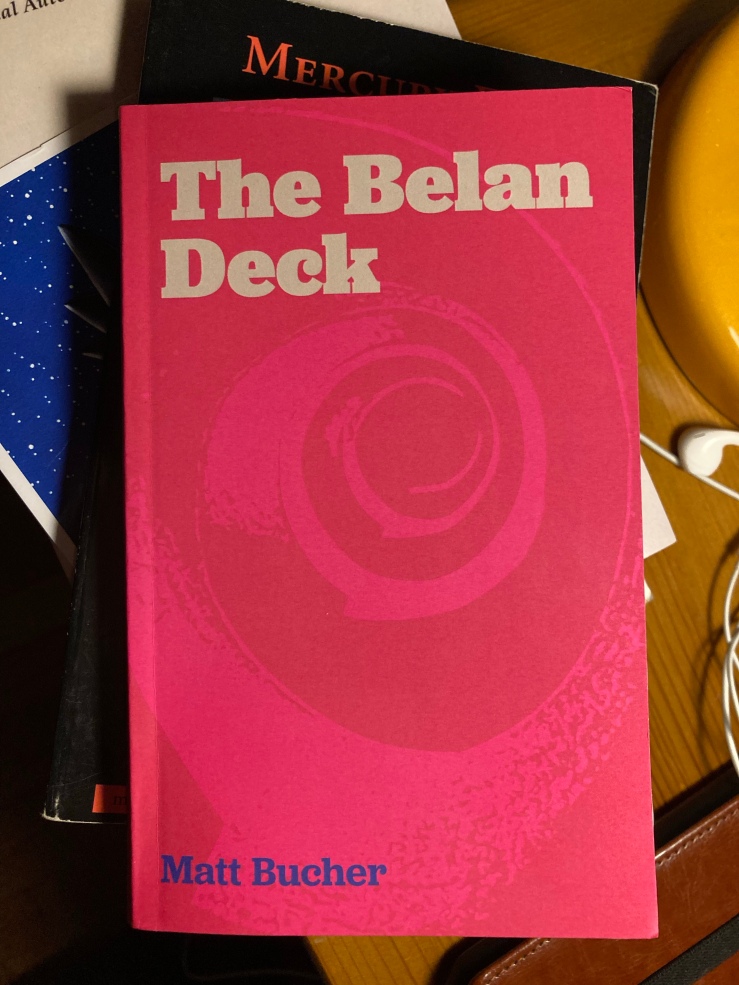
The Passenger, Cormac McCarthy

The final moments of The Passenger, particularly Alicia Western’s words (via Bobby’s memory) seem to echo the gnostic dream that is the epilogue of Blood Meridian. Her apocalyptic final line (again, via Bobby’s consciousness) evokes the consequences of the atomic bomb, a new original sin of creation: “My father’s latterday petroglyphs and the people upon the road naked and howling.”

Alicia chooses to erase herself from the world, while Bobby stays in it, lives. The final moments of The Passenger point to a sliver of metaphysical hope:

He knew on the day of his death he would see her face and he could hope to carry that beauty with him into the darkness with him, the last pagan on earth, singing softly on his pallet in an unknown tongue.


You have to carry the fire.

The Road, Cormac McCarthy.


White Meridian | More scattered thoughts on Cormac McCarthy’s novel The Passenger

He’d bought a small ruled notebook at the stationer’s in Ibiza. Cheap pulp paper that would soon yellow and crumble. He took it out and wrote in it with his pencil. Vor mir keine Zeit, nach mir wird keine Sein.

The Passenger, Cormac McCarthy

In the second paragraph of the last chapter of Cormac McCarthy’s new novel The Passenger, protagonist Bobby Western, now living on a Spanish island near Ibiza, writes in German a sentence in a cheap notebook. The sentence translates to something like, Before me there will be no time, after me there will be none.


Vor mir war keine Zeit, nach mir wird keine seyn,
Mit mir gebiert sie sich, mit mir geht sie auch ein.

Sexcenta Monodisticha Sapientum, III, II, Daniel von Czepko (1655)

Western’s line appears to be cribbed from an epigram by the early seventeenth-century German poet, Daniel von Czepko. Czepko’s epigram translates to something like, Before me there was no time, after me there will be none / With me she gives birth, with me she dies.


I deny, in a high number of instances, the existence of succession. I deny, in a high number of instances, contemporaneity as well.

“A New Refutation of Time,” Jorge Luis Borges, translated by James E. Irby

Did McCarthy find Czepko’s in Borges’ essay “A New Translation in Time,” where I found it when I first searched the German phrase?


All language is of a successive nature: it does not lend itself to reasoning on eternal, intemporal matters.

“A New Refutation of Time,” Jorge Luis Borges, translated by James E. Irby


I feel like I’ve jumped into the deep end here too quickly for this riff, what with the seventeenth-century German poet and the wonky Borges essay that feels like a gimmicky (and perhaps ironic) championing of idealism in service towards forging an aesthetics of time. Let me put in a simpler substitution for Western’s (McCarthy’s (Borges’ (Czepko’s))) epigram, a favorite line from another life-and-deather with oceanic motifs:
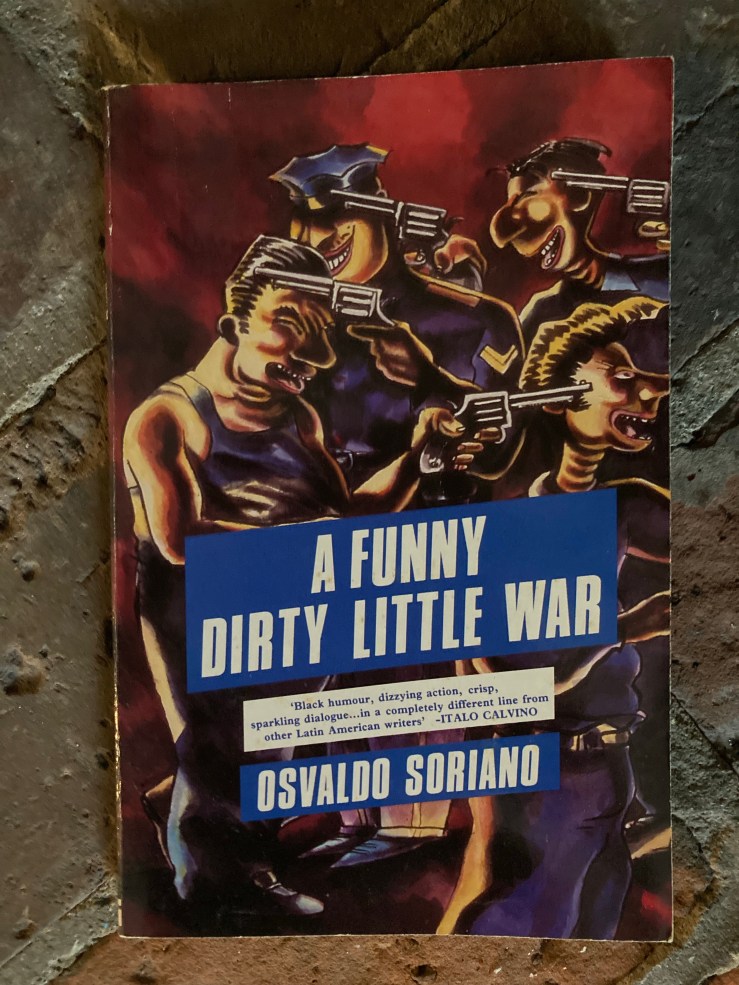
Perhaps an individual must consider his own death to be the final phenomenon of nature.

“The Open Boat,” Stephen Crane


Start again: This is a scattered mess. I finished The Passenger yesterday, punched in the face by the final chapter, where McCarthy condenses characters and tropes and symbols and allegories into a slim 19 pages that points to both infinity and death. The Passenger is possibly McCarthy’s baggiest novel, messier than Suttree, and eschewing even a glimmer of the precision of Blood Meridian. Like No Country for Old MenThe Passenger is bound in genre fiction tropes—crime novels, detective novels, 1970s paranoia novels, Westerns, and so on. Like No Country, The Passenger purposefully derails reader expectations for what the genre plot should do. The refusal to go forward with the initial promised plot (Who is the missing passenger, escaped or removed from the sunken plane?) reinforces the tense ambiguity in the core of McCarthy’s worldview. The apparent abandoning of a tight plot might alienate some readers, but I suspect most fans of the trajectory of McCarthy’s work would have been disappointed if he’d stuck to a story that Makes Sense and Follows a Clear Trajectory and Ultimately Resolves. I would have been furious if the end of The Passenger gave up some kind of easy answer.

For only Gossamer, my Gown –
My Tippet – only Tulle –
“Because I could not stop for Death” (poem 479), Emily Dickinson

In her white gown carrying the barnlantern out through the trees. Holding the hem of her gown, her slender form candled in the sheeting. The shadows of the trees, then just the dark. The cold in the stone amphitheatre and the slow turning of the stars overhead.

The Passenger, Cormac McCarthy


Last time I wrote about The Passenger, I wrote about its dominant incest motif. I suggested that the dummy Crandall was the dreamchild of incestuous Western union. I had not yet gotten to the episode where Bobby, on the lam in Idaho, dreams of an incestuous stillborn child, one with only the rudiments of a brain. Bobby queries the dream doctor of his dreamchild: “Does it have a soul?” Bobby’s True Love, his sister Alicia, is the barest slip of a ghost in the final chapter of The Passenger (in contrast to the ghost of Long John Sheddan, who gets a full last dialogue with Bobby), but she shows up again here—theatrical, ghostly, an echo of the speaker of Emily Dickinson’s “Because I could not stop for Death.” I hope we get more from Alicia Western in Stella Maris.


His father. Who had created out of the absolute dust of the earth an evil sun by whose light men saw like some hideous adumbration of their own ends through cloth and flesh the bones in one another’s bodies.

The Passenger, Cormac McCarthy


Père Western, coauthor of the atom bomb (“evil sun”/evil son, evil Adam) is a background wraith in The Passneger (although more present than Ma Western—but I’m sure the lack of mothers in McCarthy’s oeuvre has been commented on at length, perhaps in academic papers. Dude doesn’t include mothers, and mother figures, if they appear, are tangential, marginalized). Wait, where was I? Père Western, haunting the background of The Passenger, takes a bit more of the stage (just a bit) in the final chapter of The Passenger. His Big Crime seems to soak diver Bobby, even if Bobby can’t directly address it.


It was a lone tree burning on the desert. A herladic tree that the passing storm had left afire. The solitary pilgrim drawn up before it had traveled far to be here and he knelt in the hot sand and held his numbed hands out while all about in that circle attended companies of lesser auxiliaries routed forth into the inordinate day, small owls that crouched silently and stood from foot to foot and tarantulas and solpugas and vinegarroons and the vicious mygale spiders and beaded lizards with mouths black as a chowdog’s, deadly to man, and the little desert basilisks that jet blood from their eyes and the small sandvipers like seemly gods, silent and the same, in Jedda, in Babylon. A constellation of ignited eyes that edged the ring of light all bound in a precarious truce before the torch whose brightness had set back the stars in their sockets.

Blood Meridian, Cormac McCarthy


His father spoke little to them of Trinity. Mostly he’d read it in the literature. Lying face down in the bunker. Their voices low in the darkness. Two. One. Zero. Then the sudden whited meridian. Out there the rocks dissolving into a slag that pooled over the melting sands of the desert. Small creatures crouched aghast in the sudden and unholy day and then were no more. What appeared to be some vast violetcolored creature rising up out of the earth where it had thought to sleep its deathless sleep and wait its hour of hours.

The Passenger, Cormac McCarthy.


More than a decade ago, I suggested on this site that the moral core of McCarthy’s best novel Blood Meridian is a sequence wherein a host of creatures coalesce into a “constellation of ignited eyes…in a precarious truce” to observe a burning tree in the desert. Witness and attendant, his own eyes presumably ignited, is the kid, the hero of Blood Meridian. The sequence rebukes the pronouncements of Judge Holden, satanic anchor of that novel, pointing towards coexistence and peace.

The whited meridian sequence in The Passenger, evoking the first ever detonation of a nuclear weapon, reverses McCarthy’s previous passage—blanches it, makes a ghost of it, turns its blood white. Whites it.


(I have a few more thoughts scribbled on a cheap yellow legal pad but the hour grows late and a big storm looms—so, more thoughts to come (including a kind of peace with mules?)