Blog about Gordon Lish’s claim that he was infatuated with Wallace Steven’s wife, or at least her profile, on the dime, on the half dollar, from the time he was five or six or seven years old

dnei093vsaafypf

This afternoon I was reading, or really, I now know, rereading Gordon Lish’s 1996 interview with Rob Trucks, and while reading (rereading) this interview, I experienced terrible déjà vu, the kind of déjà vu that upsets one like a bad itch tucked away and wriggling in an unscratchable little alcove in the back of one’s mind. Only of course now I know that I wasn’t necessarily experiencing what can rightfully be called déjà vu; rather, I was simply failing to fully remember having read something several years prior—in this case, Gordon Lish’s 1996 interview with Rob Trucks.

Early bits of the interview set me tingling. Stuff about Julia Kristeva’s Powers of Horror. Stuff about DeLillo. Lots of Lish’s anxiety about Blood Meridian.  But my (non)déjà vu exploded when Lish shared the following story while discussing his (anxiety of) influences:

I read Wallace Stevens a lot, since you asked about influence. I read Stevens’s letters a lot. I’m eager to find all sorts of connections between Stevens’s life and my own, right down to, and I’ll put this to you, my extraordinary discovery not long ago that the face on the coin, on the half dollar coin, and on the dime that I gazed at so often as a child in honor o my idea of an American woman, since I come from an immigrant family, what a great American woman looked like, the one that you would have to bed in lieu of all other women you could not bed, turns out to have been modeled for a sculptor who was a landlord in Chelsea. he was, in fact, Stevens’s landlord when he and Elsie Kachel, his wife, were living in Chelsea, and the design on the coin was modeled by Stevens’s wife, so that it’s fair to make the claim that I was infatuated with Steven’s wife, or at least her profile, from the time I was five or six or seven years old. You looked at the dime, you looked at the half dollar, and you saw Stevens’s wife, amazingly.

When I read this amazingly amazing anecdote the déjà vu had passed pulsating—it was humming, whirring in the background, trying to attach to something, eventually coming up with, “David Markson? Is this something you read in a David Markson novel?” Instead of trying to search through Markson’s work (where I’m sure, or now not really sure, but rather somewhat sure, I read the anecdote of Wallace Stevens getting into a fistfight with a much younger Ernest Hemingway off the coast of Key West) for this Elsie Kachel Stevens reference, I simply did a basic internet search to get some more background on Lish’s claim that the poet Wallace Stevens’s wife served as the profile model on at least two coins of U.S. currency. The story more or less checks out (with a lot of passive voice).

Here is a photograph of the dime in question, which was designed by Adolph Weinman and minted in 1916:


800px-1943d_mercury_dime_obverse

And here is a photograph of Elsie Kachel Stevens:

elsie-stevens-by-bridge-in-elizabeth-park

And here is a photograph of the bust that Adolph Weinman made of Elsie Kachel Stevens:

elsie-stevens

Anyway. I went back to the interview, still tingling a little, but also a bit preoccupied—I needed to prepare our dinner of tacos, kids needed to get to piano lessons, the dog need walking, etc. And as I hurtled through the interview, I got to a moment when Lish tells his interlocutor, “I use my dick, mainly, to write the first time, and I’m using my brains to do the revisions. I mean, not my brain. I’m using rather practiced sequences of motions that have to do chiefly with mind or chiefly with know-how. I’m trying to stick it into the page the first time out.” And then, a few paragraphs later, this nugget:

Q: So Self-Imitation is still a dick book?

A: It’s a dick book. All my books are dick books.

And then I laughed out loud and then I remembered that I had not only read this interview, but I had even written about it years ago on this idiot blog of mine. And so my itch was scratched.

I read—by which I mean reread—Gordon Lish’s 1996 interview with Rob Trucks in Conversations with Gordon Lish (edited by David Winters and Jason Lucarelli), a collection chocked full of tingly bits and fat juicy morsels and etc.


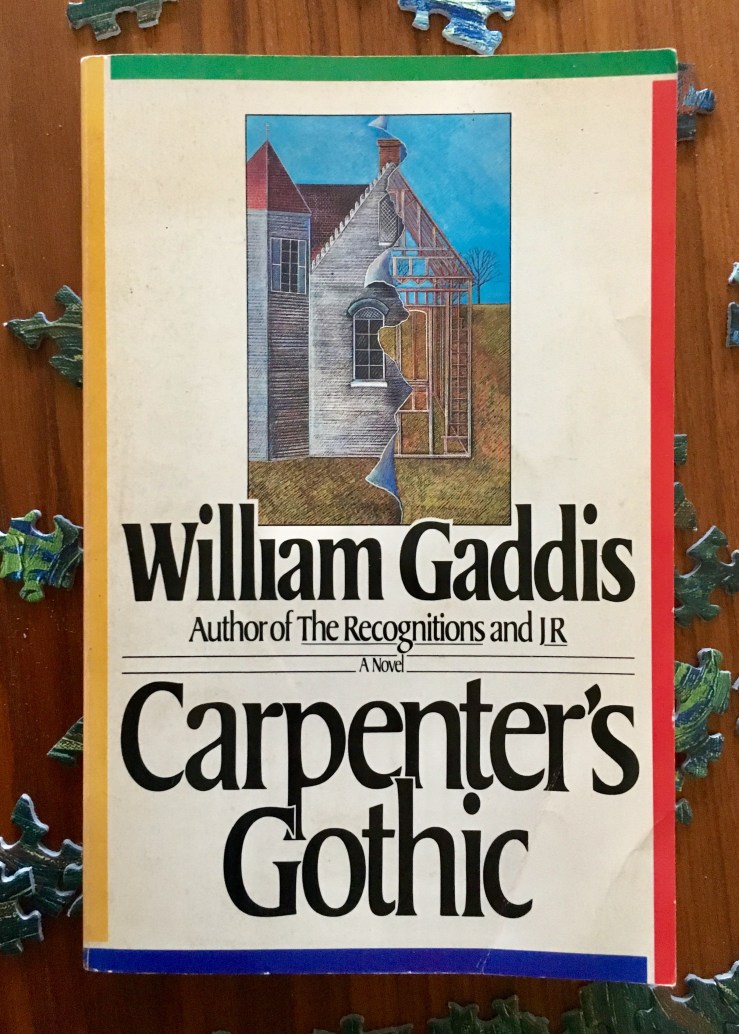
Blog about the first 96 pages of William Gaddis’s novel Carpenter’s Gothic

img_1155

I have blazed through the first three (unnumbered) chapters of William Gaddis’s third novel Carpenter’s Gothic (1985) this weekend, consuming the prose with an urgency I did not expect. After all, Gaddis is (at least according to Jonathan Franzen) “Mr. Difficult,” right?

But Carpenter’s Gothic is not especially difficult, or does not feel that way to me, anyway—although I’m sure I find it so readable in large part because I’ve read Gaddis’s second novel  J R twice already, and Carpenter’s Gothic is written in the same style as J R. The first time I read J R did find its style tremendously challenging. Gaddis strips almost all exposition and scene-setting in J R. The novel’s 726 pages are comprised primarily in dialogue, often unattributed, leaving the reader to play director, producer, and cinematographer. Reading it a second time was, in a way, like reading it for the first time, revealing one of the best and arguably most important American novels of the second-half of the twentieth century.

In any case, reading J R has taught me how to read Carpenter’s Gothic, which is told in the same style. Carpenter’s Gothic is a smaller novel though, both literally (around 250 pages) and figuratively. While J R sports a large cast, sprawling and interlinked plots, divergent tones, and a wide array of themes, Carpenter’s Gothic is restrained to a few talking characters, whom Gaddis keeps confined to an isolated house somewhere in New England. (It is from this house’s architectural design that the novel gets its title).

The central character is Elizabeth Booth, 33, an heiress locked out of her inheritance. Elizabeth is married to an awful abusive man named Paul, a racist Vietnam Veteran who embodies almost every characteristic of what we now think of as toxic masculinity. Elizabeth is recovering from an as-yet-unspecified accident, and spends most of her time confined to her rented house, fielding phone calls. Some of these phone calls are from folks related to her husband’s latest scheme with a televangelist. Other calls are from her friend Edith who has run off to sunny Jamaica—a prospect of escape that entices Elizabeth. Even more calls come for the mysterious owner of the house, McCandless, who eventually shows up in the third chapter.

McCandless’s visit sparks something in Elizabeth. She gets to glance into his locked study, crammed with papers and books and even a piano, and she takes him for a writer, but he claims he’s a geologist. His short visit inspires Elizabeth to dig up the draft of a book, or something like a book, she’s been working on, and add a few notes. The romantic impulse is eventually punctured by her husband’s return.

Carpenter’s Gothic’s relentless interiority and inherent bitterness can give the novel a claustrophobic feeling, and reading it often reminds me of the scenes in J R that are set in the ramshackle 96th Street apartment shared by Bast and Gibbs. And yet its interiority always branches outward, evoking an exotic and pulsating world that Elizabeth might love to experience. There’s Montego Bay, there’s Orson Welles in Jane Eyre, there’s the nomadic Masai of central east Africa. Etc. But Elizabeth’s experiences are mediated by newspapers, magazine articles, phone calls, and old movies on television. It’s quite sad and frustrating.

Elizabeth thus far fits neatly into American literature’s motif of the confined woman: Walt Whitman’s 29th bather, Kate Chopin’s Mrs. Mallard, William Carlos Williams’ young housewife, Charlotte Perkins Gilman’s distressed and nervous heroine. There are many, many more, of course.  I’m not quite half way through Carpenter’s Gothic–no spoilers from you please, readers!—and curious what Gaddis will do with his heroine. Will there be an escape? Freedom? A happy ending?

So many 19th and 20th century American writers seemed unsure of what to do with their heroines, even after they had freed them (Kate Chopin’s Edna Pontellier is a particularly easy go-to example, but again: there are more). Carpenter’s Gothic seems set on a tragic track, but Gaddis has a way of making his readers recognize the farcical contours in tragedy.

I haven’t given a taste of Gaddis’s prose yet. I will share, as a closing, the novel’s opening two-sentence paragraph, which I think is simply marvelous, and which I had to read at least three times before I could turn to the novel’s second page. Here it is:

The bird, a pigeon was it? or a dove (she’d found there were doves here) flew through the air, its colour lost in what light remained. It might have been the wad of rag she’d taken it for at first glance, flung at the smallest of the boys out there wiping mud from his cheeks where it hit him, catching it up by a wing to fling it back where one of them now with a broken branch for a bat hit it high over a bough caught and flung back and hit again into a swirl of leaves, into a puddle from rain the night before, a kind of battered shuttlecock moulting in a flurry at each blow, hit into the yellow dead end sign on the corner opposite the house where they’d end up that time of day.

Blog about Evan Dara’s two-act play Provisional Biography of Mose Eakins

Screenshot 2018-10-06 at 1.38.52 PM

Evan Dara’s latest work is a two-act play called Provisional Biography of Mose Eakins. Set “c. 2015” on a stage “As bare as you can stand it,” Dara’s play follows Mose Eakins, “35-ish and spry,” as he becomes afflicted with a condition that “has come to be known as imparlence.”

Mose’s imparlence erodes his ability to communicate with others. He loses his job, his home, and eventually his girlfriend Zina, from whom he initially hides his condition. Though his life deteriorates, Mose eventually lands a job as the maitre d’ of an overpriced French restaurant. Here, his sympathies extend to the overworked kitchen staff, and he takes a stand against the unjust working conditions, trying to make meaning through his actions, even as his words fail to communicate.

Dara keeps Provisional Biography spare but active, using a device he calls “the swirl” as a kind of Greek Chorus to keep the play shuttling along, even as the narrative threatens to fall apart. And because Mose is our viewpoint character, and because Mose is afflicted with “imparlence,” the narrative of Provisional Biography is under constant threat of its own linguistic erasure. As the swirl helpfully informs the audience, “people with imparlence lose the capacity to infuse their words with intelligible significance.”

Provisional Biography’s opening lines are an especially baffling affront to “intelligible significance.” When we meet Mose, he’s already imparlent, although he does not know it yet. Consider the play’s opening lines:

MOSE: Tell me something, Jeff. Those numbers convincing to you?

(to someone else)

Bring me the swordfish. Not blackened. You got that? Not blackened. Go.

(to someone else, jauntily)

Well, you know what they say…

(to someone else)

Nice, Zina – the chart is really good. Zina, your students will love it!

(to someone else, laughing)

Tell him that and he’s totally going to have a kitten!

The first few pages of the play continue in this line, Mose’s utterances disconnected from any context that might anchor their meaning. A swirl member eventually appears on stage to push the narrative into more traditional territory:

SWIRL MEMBER 1: Hear it here! Mose Eakins (born June 10, 1978) is an American
field-risk analyst working for Concord Oil. Specializing in mid-level hard-soil
extractions, he won the Kamden Prize for his research into adjacent fauna protection and occasionally lectures in his field.

As Mose’s imparlence worsens, the tension between Mose and the world he cannot communicate with increases, erupting in moments both tragic and comic (and farcical and tragicomic). The swirl is often there to assuage him (and the audience), armed with a humorous (and occasionally ironic) quiver of quotes from the likes of Melanie Klein, William H. Gass, Jean Jacques Rousseau, St. Augustine, and television personality Doctor Oz.

The swirl advises our poor hero, suggesting treatments and support groups—and also offering up punchlines when there’s no real hope in sight:

SWIRL MEMBER: There is no known cure. Imparlence is untreatable—

MOSE: But the doctor – the doctor recommended medicine!

(Mose pulls out the paper given by Doctor Mazlane, shows it to the swirl.)

He told me to take this and come see him again! It’s a prescription…

(reads the paper)

…a prescription…to pay him five hundred and twenty dollars… And I thought bleeding patients went out in the nineteenth century.

SWIRL MEMBER: There’s been a strong return to traditional medicine.

(Other jokes don’t land so neatly—in a segment mocking TV drug commercials, a swirl member offers up an absolute groaner with the phrase “irregular vowel movements.” Who knows though? Maybe the joke plays well on the stage).

With all of its humor, Provisional Biography is ultimately a sad, even tragic story, and nowhere is it sadder than in Mose’s revelation that he can communicate to other humans through one medium: economic exchange. He takes to desperately buying Tic Tacs from street vendors simply to communicate intelligibly, and eventually resorts to buying phrases from a fellow homeless person.

And yet these purchased utterances are not true linguistic exchanges—they do not mean outside of their inherent economic content. Mose Eakins despairs:

MOSE: So – so that’s it? That’s it for me? I can only just flapgaggle by myself for the
rest of my days – flapgaggle and hope?

SWIRL MEMBER: Perhaps inevitable. According to Robert Nozick of Harvard, imparlence is just the latest expression of the ownership society.

SWIRL MEMBER: Meaning has been privatized. It’s been made part of the private
sphere.

SWIRL MEMBER: Significance is no longer a publicly-owned utility, a service
provided by a command and control center.

SWIRL MEMBER: This will vastly increase our linguistic productivity—

SWIRL MEMBER: —liberate our potential as creators of meaning—

SWIRL MEMBER: —freeing us from the restrictions and inefficiencies of the nanny
dictionary!

MOSE: But…

The swirl here satirizes the newspeak of late capitalism, imagining language—a thing that makes us inherently human—as yet another commodity to be consumed and sold back to us by a dehumanizing system that seems to operate on its own inscrutable logic. While there’s humor in the little scene, it’s also quite painful.

The idea that late capitalism reduces linguistic exchange to only an economic (and thus inauthentic) exchange is repeated again in a far more painful scene later in the play. Mose pleads for “Something real…A real response – something that speaks from the heart!” from the homeless man he has been buying phrases from, to which the man simply puts out his hand for a coin. “Is that the only thing left?” cries Mose. The swirl is there to offer an out to this existentialist despair: “Salvation–only through action! Guided by further philosophical slivers proffered by the swirl, Mose converts his despair into radical action by the end of the play. The conclusion is fittingly moving and movingly strange.

Provisional Biography of Mose Eakins, in showing a human communication dissolve, follows Dara’s 2013 novel Flee, which shows a town dissolve. Flee is an oblique but devastating address to the 2008 economic collapse in America, and Provisional Biography is a fitting follow-up, continuing Dara’s critique of the human position in the late-capitalist landscape.

Significantly, Dara’s critique of the relationship between language and commerce extends to accessing his play, which can be downloaded for free at his publisher Aurora’s website.  You simply have to give them your email address. Under the “Download” button and above the PayPal button is the following message:

“If you please, reciprocation accepted only after reading. Thank you.”

And what would “reciprocation” mean, in the end? Write your own two-act play about the relationship between language and commerce in the early 21st century and send it to Evan Dara?

I PayPal’d Aurora $11.11.

Blog about a list of films included in Antoine Volodine’s short story “The Theory of Image According to Maria Three-Thirteen”

img_1148

Antoine Volodine’s short story “The Theory of Image According to Maria Three-Thirteen” is collected in Writers, a book available in English translation by Katina Rogers from Dalkey Archive Press.

Writers is one of the best books I’ve read in the past few years: unsettling, bizarre, satirical, and savage, its stories focus on writers who are more than writers: they are would-be revolutionaries and assassins, revolting humans revolting against the forces of late capitalism.

Writers (which I wrote about here) functions a bit like a discontinuous novel that spins its own web of self-references to produce a small large gray electric universe—the Volodineverse, I guess—which we can also see in post-exotic “novels” like Minor Angels and Post-Exoticism in Ten Lessons, Lesson Eleven. 

Volodine’s post-exotic project refers obliquely to the ways in which the late 20th century damns the emerging 21st century. And yet the trick of it all is that the stories and sketches and vignettes seem ultimately to refer only to themselves, or to each other—the world-building is from the interior. This native interiority is mirrored by the fact that many of his writer-heroes are prisoners communicating from their cells, often to interrogators, but just as often to an unresponsive void.

“The Theory of Image According to Maria Three-Thirteen” takes place in such a void, a kind of limbo into which the (anti-)hero Maria Three-Thirteen speaks herself into existence. It’s an utterly abject existence; Maria Three-Thirteen crouches naked like “a madwoman stopped before the unknown, before strangers and nothingness, and her mouth and her orifices unsealed after death…all that remains for her is to speak.” She speaks to a semi-human tribunal, a horrorshow, creatures “without self-knowledge.” After several paragraphs of floating abject abstraction, Maria eventually illustrates her thesis—an evocation of speech without language, speech in a deaf natural voice–to this audience.

Her illustration is a list of scenes from 20th-century films.

I found this moment of the story initially baffling—it seemed, upon first reading, an utter surrender to exterior referentiality on Volodine’s part, a move inconsistent with the general interiority of Writers. Even though the filmmakers alluded to made and make oblique, slow, often silent, often challenging (and always beautiful) films, films aesthetically similar to Volodine’s own project, I found Volodine’s gesture too on-the-nose: Of course he’s beholden to Bergman, Tarkovsky, Bela Tarr!

Rereading the story, and rereading it in the context of having read more of Volodine’s work, I take this gesture as the author’s recognition of his aesthetic progenitors. Volodine here signals that the late 20th-century narrative that most informs his work is cinema—a very specific kind of cinema—and not per se literature.

This reading might be a misreading on my part though. Maybe Volodine simply might have wanted to make a list of some of his favorite scenes from some of his favorite films, and maybe Volodine might have wanted to insert that list into a story. And it’s a great list. I mean, I like the list. I like it enough to include it below. I have embedded the scenes alluded to where possible, and in a few places made what I take to be worthy substitutions.

Here is Volodine; here is Volodine’s Maria Three-Thirteen, speaking the loud deaf voice—

And now, she begins again, to illustrate, I will cite a few images without words or almost without words, several images that make their deaf voice heard. You know them, you have certainly attended cinema showings during which they’ve been projected before you. These are not immobile images, but they are fundamentally silent, and they make their deaf voice heard very strongly.

The chess match with death in The Seventh Seal by Ingmar Bergman, with, in the background, a procession of silhouettes that undertake the arduous a scent of a hill.

The man on all fours who barks in the mud facing a dog in Damnation by Bela Tarr.

The baby that cries in a sordid and windowless apartment in Eraserhead by David Lynch.

The bare facade of an abandoned apartment building, with Nosferatu’s head in a window, in Nosferatu by Friedrich Murnau.

The boat that moves away from across an empty sea, overflowing with cadavers, at the end of Shame by Ingmar Bergman.

The desert landscape, half hidden by a curtain that the wind lifts in Ashes of Time by Wong Kar Wai.

The early morning travel by handcar, with the regular sound of wheels, in Stalker by Andrei Tarkovsky.

The old man with cancer who sings on a swing in Ikiru by Akira Kurosawa.

The blind dwarfs with their enormous motorcycle glasses who hit each other with canes in Even Dwarfs Started Small by Werner Herzog.

The train station where three bandits wait at the beginning of Once Upon a Time in the West by Sergio Leone.

The flares above the river in Ivan’s Childhood by Andrei Tarkovsky.

The prairie traveled over by a gust of wind in The Mirror by Andrei Tarkovsky.

She is quiet for a moment.

There are many others she thinks. They all speak. They all speak without language, with a deaf voice, with a natural and deaf voice.


Blog about George Eliot’s Silas Marner, a novel of not knowing

img_1146

I have just now finished George Eliot’s novel Silas Marner, which I enjoyed. The novel is set in England at the beginning of the nineteenth century, and its plot goes something like this:

As a young man, Silas Marner, a weaver, is a member of a nonconformist church with Calvinist tendencies. Falsely accused of theft, he is excommunicated from his church. Divided from the only community he knows, he loses faith in humanity and religion, leaves his “native place” Lantern Yard in Northern England, and moves to Raveloe, a village in the Midlands.

(Lantern Yard and Raveloe are both Eliot’s inventions, like Middlemarch in Middlemarch. And while Silas Marner is much shorter than Middlemarch, the world Eliot conjures in Raveloe is nevertheless similarly rich and full and detailed, a real fake place, a spot in the Eliotverse).

Silas’s technological prowess at the loom finds him plenty of customers in Raveloe, and while he amasses a wealth in gold coins, testifying to his weaving’s popularity, he nevertheless remains isolated from the community. For a decade and a half he hoards his gold coins, counting them late into the night alone at home, and cementing his reputation as an eccentric with the Raveloe folk. He’s always the Stranger.

In the meantime, Raveloe’s wealthiest family, the Casses, continue their lives as obnoxious rich assholes. The elder son Godfrey harbors a shameful secret, the younger son Dunstan is an alcoholic ne’er-do-well, and Papa Cass—excuse me, Squire Cass—is a pompous prick. There’s a ruined horse, an opium-addicted wife, a Christmas Party ruined by a visit from big-A Anxiety. Etc.

Through a series of skillful plot-moves, Eliot meshes the Cass story line with Marner’s story weaving the two together around the novel’s central conceit: Silas Marner’s hoard of gold is stolen. Soon after, he finds a baby girl, whose golden curls he takes as a kind of symbolic exchange for his golden coins. The girl saves his life in the sense that she saves his soul. Eliot gives us this moving exchange between adopted father and daughter near the end of the novel:

“But I know now, father,” said Eppie. “If it hadn’t been for you, they’d have taken me to the workhouse, and there’d have been nobody to love me.”

“Eh, my precious child, the blessing was mine. If you hadn’t been sent to save me, I should ha’ gone to the grave in my misery. The money was taken away from me in time; and you see it’s been kept—kept till it was wanted for you. It’s wonderful—our life is wonderful.”

There is nothing like a character declaring something like “It’s wonderful–our life is wonderful” to signal an impending moment of the unwonderful, of course, and Godfrey Cass barges into the life of Silas Marner on queue. Old secrets come to light, etc.

But there is a happy ending, a classically comic ending, with a wedding and a garden and laughter and everything.

I do not think my plot summary spoils too much, or at least I very much hope it spoils nothing. I went into Silas Marner not knowing anything about the plot, and, after writing my little summary, I can see how the novel might be misinterpreted as a tad, uh, sentimental. And it does earn its emotional ending, that’s true. But, as in Middlemarch, it’s really the way that Eliot captures emotion—psychology, intention, bewilderment—-that so compels me.

Silas Marner is a novel about conscience and consciousness, anxiety and isolation, strangers and community. It is a novel about knowing, but it is also very much a novel about not knowing. The novel’s strange hero Silas Marner is a weaver, a symbolic doubling for an author, sure, but Silas Marner is a novel that points to its own loose threads.

This theme of not knowing is most evident in the final paragraphs of the novel’s final numbered chapter. There is a chapter titled “Conclusion” after the final numbered chapter, and this chapter “Conclusion” gives us the classical comedic ending of a wedding in a garden and, you know, happily ever after. This “Conclusion” gives the text a sense of resolution that the novel’s final numbered chapter withholds. I find Eliot’s evocation of not knowing in the final numbered chapter a far more persuasive indicator of the emerging modernism I read in her novels.

In this final numbered chapter (Chapter XXI), Silas takes his daughter Eppie to the North, to Lantern Yard. He wants to show his daughter his “native place,” but he also wants to confront Mr. Patson the minister of the church that excommunicated him. He wants to demonstrate his innocence to the minister. He wants this member of his old community to know himself the way he knows himself; he wants to know that the minister knows what he himself knows.

Silas and Eppie are aghast at Lantern Yard though—the place looks awful and smells bad; none of it is as Silas had known it. It is a new place, an industrialized place. Even the church where he had worshiped is gone, replaced by a factory. And his detective work does not pay off:

But neither from the brush-maker, who had come to Shoe Lane only ten years ago, when the factory was already built, nor from any other source within his reach, could Silas learn anything of the old Lantern Yard friends, or of Mr. Paston the minister.

When Silas returns to Raveloe, he confides in his friend Dolly Winthrop, who serves as kind of leveling conscience in the novel, telling her:

The old home’s gone; I’ve no home but this now. I shall never know whether they got at the truth o’ the robbery, nor whether Mr. Paston could ha’ given me any light about the drawing o’ the lots. It’s dark to me, Mrs. Winthrop, that is; I doubt it’ll be dark to the last.

Silas has reconciled himself to the darkness of not knowing; there’s no teleological neatness in this conclusion. Teleological neatness is reserved for “Conclusion” —for the wedding, the garden, the laughter. And it’s in those human moments, moments that serve to counter his early years of isolation, that Silas finds “light enough to trusten” the human race he once rejected. Silas weaves the dark loose ends of his old life into something new and bright, and in this way, preserves his soul.

Blog about not seeing Darren Aronofsky’s seventh film Mother! in the theater

120171105173333

I did not see Darren Aronofsky’s seventh feature film Mother! in the theater.

***

I saw director Darren Aronofsky’s first feature film Pi at the Reitz Union theater at the University of Florida in the fall semester of my sophomore year of college. In my four years attending the University of Florida, I always made a point to go watch the free films the Union’s theater screened. I saw The Big Lebowski and Fear and Loathing in Las Vegas there. I saw Christopher Nolan’s film Memento there, and Harmony Korine’s follow-up to Gummo, the unfortunate Julien Donkey-Boy (Chloe Sevigny ice-skating to Oval’s skittering soundtrack left a permanent mark on my memory). I saw Austin Powers: The Spy Who Shagged Me there. I saw a hypnotist there, also. (It was all free, in the sense that no money was required). And, like I said, I saw director Darren Aronofsky’s first feature film Pi there.

***

I saw Pi with my girlfriend and her roommate and her roommate’s boyfriend, who I was starting to be friends with. We—by which I mean my girlfriend and I—loved it; roommate and roommate’s boyfriend hated it. We found this out minutes after leaving the theater. I might have argued for it, using terms like claustrophobia and paranoia and German expressionism; I am the kind of asshole who might have brought up, like, The Cabinet of Dr. Caligari at this point of my life. The roommate’s boyfriend—who turned out to be and remains to this day one of the greatest friends I’ve ever made—pointed out that the film was silly–self-important, muddled, vague. He may or may not have used the word histrionic.

(He could be entirely right. I’ve never rewatched Pi).

***

(I’ve never rewatched any film directed by Darren Aronofsky).

***

The same roommate’s boyfriend, at this point broken up with the roommate (also no longer the roommate) would have been present at the small-screen screening of Requiem for a Dream held in The House Where We Always Drank Excessively some time in the fall of 2000. We–the ten or maybe twelve of us—did not Drink Excessively during the film, leaving bottles and bongs and etc. largely untouched after the first half hour, our horror slowly growing. This was No Fun. We didn’t talk after, slinking off in the humid Gainesville night. We tacitly agreed not to see each other for at least a week or two.

***

Aronofsky’s film The Fountain arrived in the mail on DVD via the mail-DVD service Netflix some time at my house in 2007. The film had a certain mystique to it—it was a boondoggle, an interesting failure, a trial balloon that popped. I recall liking it quite a bit, as I told my wife after she woke up after having fallen asleep thirty minutes into the film.

***

(I might have actually watched The Fountain a few times).

***

My daughter was an infant when The Wrestler was in theaters. I watched it too via a mail-ordered DVD from Netflix, and thought it was Pretty Good, but no My Cousin Vinny or By the Time the Devil Knows You’re Dead. (Marisa Tomei Forever).

***

My son was an infant when Black Swan was in theaters. So again: Netflix DVD, no big screen. My wife liked this one—we both laughed and laughed. At some point, maybe, one of us, getting up to pee or pour another glass of wine or check that a child was tidily asleep—well, I guess we took to it as a kind of histrionic comedy, a comedy-horror. This could be an entirely wrong take, but I don’t know. (I’ve never rewatched any film directed by Darren Aronofsky).

***

By the time I watched Aronofsky’s sixth film Noah, I had essentially given up on him: I found his films a remarkable mix of camp, melodrama, and repulsion—hard to read, searingly original, visually compelling areas I couldn’t wait to leave. I reviewed Noah on this blog, writing,

Aronofksy is an auteur, and like most auteurs, I’m sure rewatching his films would enrich an understanding of the themes and problems he’s trying to address. However, I find his films repulsive, by which I mean the opposite of compelling. I have never wanted to exit a fictional world as much as I wanted to escape Requiem for a Dream. I found The Wrestler depressing and empty. I’m afraid if I watch Black Swan again it will turn out that Aronofsky was actually not attempting to make a comedy about psychosis, but was rather actually serious about his melodrama’s tragic scope.

***

When Mother! (or mother!, as it is sometimes stylized) came out last year I was intrigued, first by the film’s marvelous posters (by James Jean), and then by the advance word on it. Mother! sounded Rosemary’s Baby, but also something like Salo or Irreversible or even Ichi the Killer—something scary and a bit psychotic and divisive and depraved. Something that some folks would certainly hate. But two kids and a job and etc. make a movie hard to grab on the go, and we wanted to see PT Anderson’s Phantom Thread, of course, which is what I think we ended up seeing instead of Mother! Maybe a week or two later at a party, a friend immediately asked me if I had seen Mother! yet. She wanted to talk about it very much. She told me to go see it.

***

Mother!: I should have gone to the theater to see Mother!

***

We watched Mother! via a streaming service in a very dark room on the largest TV we have ever owned, and I’m sure that this is not even close to what it was like to see the film in the theater. It was great. Great! I should have gone to see Mother! in the theater.

***

This blog began with the bestest of best intentions. I was going to write a proper review of Mother!, or not a review so much as a riff, or not so much a riff, really, but rather an appreciation, a take on the feeling of watching Mother!—but when I started writing I realized that I had these other thousand words to write first. And now that I’ve written them, I hate to just delete them—and anyway, it’s only blog. But I mostly see that I’d like to  watch Mother! again before I write about it again.

w3jbjps3wbmz


Blog about October reading (and blogging) goals

On 1 April 2018 I set the silly goal of blogging about something every day of the month. I actually wound up meeting the goal, and it was fun (if sometimes exhausting). The April “Blog about” thing allowed me to just write in a way that was freeing. I have a tendency to let riffs and reviews languish, to leave my half-assed remarks on whatever I’m reading left unremarked, etc.

Anyway. Lately I’ve been Not Writing–in part because I’ve been extraordinarily busy with work and family, but also because it’s incredibly hot in Florida. (If this does not make sense to you, don’t worry. Look—sometimes it’s just too hot). So well anyway—I’m going to use 1 October 2018 as an occasion to declare my good intent to blog about something—books, film, art—every day or nearly every day. I’m not sure how it will go.

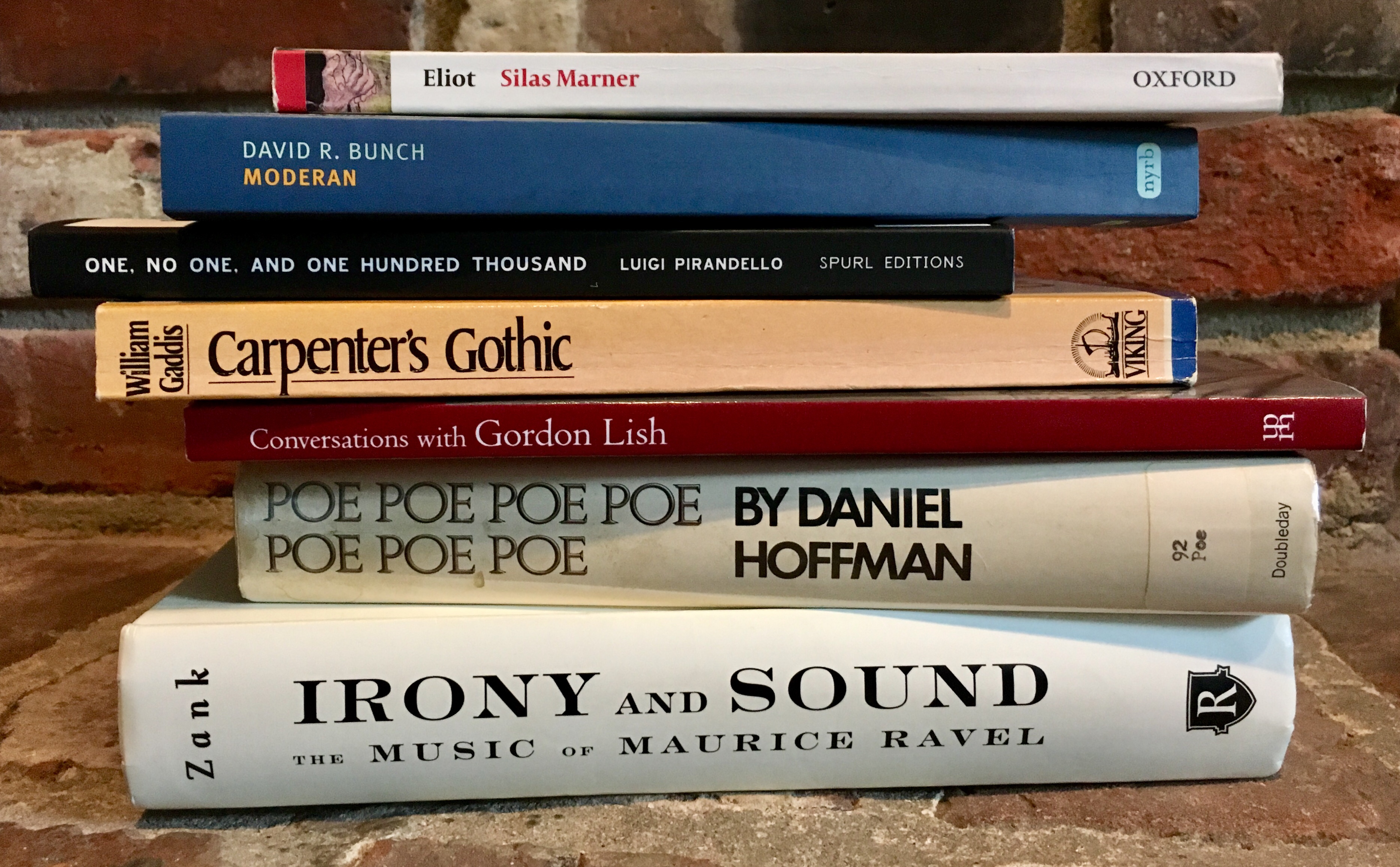
For now, some October reading goals, in no way prioritized:

Finish George Eliot’s Silas Marner.

This probably should have been the first Eliot novel I read—it’s more approachable (and let’s be honest, much, much shorter) than Middlemarch. Eliot’s major skill, it seems to me, is in evoking consciousness-in-action—that’s the impression I got after finishing Middlemarch, anyway. Like MiddlemarchSilas Marner is also a thoroughly convincing evocation of place. And, in its treatment of anxiety, it also seems to me an easy pre-Modern Modern novel.

Make a bigger dent in David R. Bunch’s Moderan.

Bunch’s Moderan stories connect into a strange novel told in a thoroughly singular voice. “Thoroughly singular voice” is a total cliché, but it’s true here: Bunch’s New Metal Man Stronghold 10 paints his plastic-coated post-apocalyptic world as if it were a perfect paradise. The language, the voice, is its own idiom—barking, visceral, phallic—perfectly suited to conjure a postnuked dystopian world. The great trick of it all is that the narrator Stronghold 10 views this dystopia as a utopia, resulting in a layer of ironic distance between author and speaker that creates a bizarre comic tension that’s ripe for misreading. The voice’s singularity though means that’s a very particular flavor; one doesn’t always want Stronghold 10 booming in one’s ear. I hope to do a few posts on Moderan this month, but if your interest is piqued, check out Rob Latham’s thorough review at the Los Angeles Review of Books.

Check out Luigi Pirandello’s One, No One, and One Hundred Thousand.

A review copy from Spurl Editions of William Weaver’s translation of Pirandello’s final novel arrived late last week but I haven’t made much time to check it out.

Finally read Carpenter’s Gothic by William Gaddis.

It will happen.

Do a few posts on Conversations with Gordon Lish (ed. by David Winters and Jason Lucarelli).

I tried not to gobble most of these Lish interviews up too quickly—the experience of reading them is something closer to reading an essay or a transcript of a performance than a staid interview.

Read more of Poe Poe Poe Poe Poe Poe Poe.

I unexpectedly dipped into Daniel Hoffman’s biography-criticism-memoir Poe x 7 this weekend, after randomly flicking to a page where Hoffman comments on Poe commenting on Hawthorne (all on allegory already aye?). The book is so strange and intriguing.

Return a book to a friend.

I asked a colleague, a musicologist, what he thought of Ravel’s Bolero and he loaned me Stephen Zank’s Irony and Sound: The Music of Maurice Ravel, and then narrowed his eyes a bit and clarified that the book should be returned. (Hardback U of P books ain’t cheap, people). A lot of it is way over my head, but Zank’s analysis often turns to literature—Baudelaire shows up as much in the index as Debussy—so there’s that.

Try not to gobble up all of Paul Kirchner’s forthcoming collection Hieronymus & Bosch.

You might have read some of Biblioklept favorite Paul Kirchner’s comic strips Hieronymus & Bosch at Adult Swim Comics. This Fall, French publisher Tanibis Editions will release a 100-page collection of Kirchner’s comic riff on life in hell. The digital advance they sent me looks great—I’ve tried to restrain myself from eating it all up at once.

unnamed (1)

Blog every day, even about nothing.

Notes on Vulture’s “Premature Attempt at the 21st Century Canon”

Last year, Vulture put together a list of “100 Great Works of Dystopian Fiction,” and I wrote about it on my blog. The list was good fun, and there are a handful of novels on it I’m still keeping an eye out for (feel free to send me a copy of David Ohle’s Motorman, people).

Today, Vulture published another list of 100 books, this one ambitiously but cautiously titled, “A Premature Attempt at the 21st Century Canon.” The list begins with a nearly-900 word prefatory essay called “Why Now?” that isn’t bad but is perhaps unnecessary; the sentence, “We thought it might be fun to speculate (very prematurely) on what a canon of the 21st century might look like right now” is fine enough. I mean, look: List-making is fun. Putting together a syllabus or anthology or “canon” is fun. It generates conversation and maybe pisses folks off. And Vulture racked up a range of ringers to make their list—I have a lot of respect for many of the critics and writers who contributed here.

But ultimately, I think we all know that this canon is not a canon; it cannot be a canon because a canon evolves over time, and then evolves (or devolves or implodes or mutates or pick your verb) more. We don’t know what the most important books of the past eighteen years are yet, and most of us won’t be alive to know what they turn out to be. We would be better suited, really, to naming the canonical novels of 1900-1918 I suppose. But again, I think we all know that. Lists are fun. I take Vulture’s list to be a lovely set of reading recommendations from a set of smart folks.

I’ve already prefaced too much. I will go through the list, fairly quickly, in the order that Vulture prepared it, making comments or making none, occasionally recommending an alternative. I will write quickly without much reflection and I will undoubtedly forget a ton of books.

The Last Samurai, by Helen DeWitt (September 20, 2000)

For a few years now, almost every single reader whose taste I greatly admire has recommended DeWitt’s debut novel to me. I’ll admit that I didn’t care for her novel Lightning Rods at all, which seemed like the premise for a Ballard story stretched too thin over 200 or so pages. I am close to giving up on her short story collection Some Trick. I may be entirely misreading her. However, I admire the critic Christian Lorentzen, who helmed Vulture’s essay on The Last Samurai, and the fact that it came in number one on the list means that I’ll almost certainly give it a shot.

The Corrections, by Jonathan Franzen (September 1, 2001)

I recall chuckling at the part where the one son was drunk and doing some business with the lawn clippers. I suspect there’s some nostalgia at work with this one. Should I recommend a different book so early? Sure: Open City, by Teju Cole  (February 8, 2011) is somehow absent.

Never Let Me Go, by Kazuo Ishiguro (March 3, 2005) 

I can’t quibble. Reminds me that I want to read The Unconsoled

How Should a Person Be?, by Sheila Heti (September 25, 2010) 

Autofiction! Maybe I should read it. In the meantime, may I recommend Writers, by Antoine Volodine (August 5th, 2016)?

The Neapolitan Novels, by Elena Ferrante (2011-2015)

Are these autofiction, too? I love these books. I would read a fifth one. And a sixth one. Etc.

The Argonauts, by Maggie Nelson (May 5, 2015)

I downloaded the audiobook of this this summer but kept stalling, which is weird because it’s pretty short (Nelson reads it herself, too). Give it another shot.

2666, by Roberto Bolaño (November 11, 2008) 

What can I say? There are seven review of 2666 posted on Biblioklept. I would’ve picked this as number one. Ten years after a hype cycle that could’ve withered a lesser book, 2666 seems as prescient as ever—not only in its content, but in its form—or really the welding of content and form, into one big dark dark big labyrinth-poem.

The Sellout, by Paul Beatty (March 3, 2015) 

Another reminder that I don’t read enough contemporary fiction.

The Outline Trilogy (OutlineTransit, and Kudos), by Rachel Cusk (2014–2018) 

Somehow Against the Day, by Thomas Pynchon (November 21, 2006) is not on this list, a fact that has nothing whatsoever to do with Cusk’s books, which I have not read.

Atonement, by Ian McEwan (September 2001) 

I found it a slog and an utter bore. Europe Central, by William T. Vollmann (2005) is somehow not on Vulture’s list.

The Year of Magical Thinking, by Joan Didion (September 1, 2005) 

I remember reading it when it came out but I really don’t remember anything other than the premise.  A Mercy, by Toni Morrison (November 11, 2008) is not on Vulture’s list

Leaving the Atocha Station, by Ben Lerner (August 23, 2011)

I hated 10:04 (Lerner’s follow up to Atocha Station) so much that I doubt I will ever read another book by the man. I loved loved loved Flee, by Evan Dara (2013) though.

The Flamethrowers, by Rachel Kushner (April 2, 2013) 

Luc Sante is recommending The Flamethrowers, so maybe I should finally make time to read it.

Erasure, by Percival Everett (August 1, 2001)

Haven’t read any Everett; is this a good starting place?

Middlesex, by Jeffrey Eugenides(September 4, 2002)

A thoroughly passable entertainment that has no business on a list. Did you know that Jimmy Corrigan, the Smartest Kid on Earth, by Chris Ware (2000) was published in the last 18 years also?

Platform, by Michel Houellebecq (September 5, 2002) 

Houellebecq writes fascinating stuff, and his follow up The Possibility of an Island (2005) would fit in here too.

Do Everything in the Dark, by Gary Indiana (June 1, 2003)

Lorentzen’s write up of this one made me add it to a little note I keep on my iPhone of books to look out for.

The Known World, by Edward P. Jones (August 14, 2003)

Haven’t heard of it.

The Plot Against America, by Philip Roth (September 30, 2004)

I tried with Roth, I really did, and it just didn’t stick, none of it, just not for me. Point Omega, by Don DeLillo (February 2, 2010), is, in my estimation, one of the better novels of the post-9/11 zeitgeist (and really underrated as a DeLillo novel).

The Line of Beauty, by Alan Hollinghurst (October 1, 2004)

A really fantastic book that’s not on this list is Asterios Polyp, by David Mazzucchelli (July 7, 2009).

Veronica, by Mary Gaitskill (October 11, 2005)

I’ve enjoyed some of her short stories a lot.

The Road, by Cormac McCarthy (September 26, 2006)

It’s good. No Country for Old Men (2005) is probably better, but not as zeitgeisty.

Ooga-Booga, by Frederick Seidel (November 14, 2006)

Ooga-Booga is a fantastic name for a book.

The Brief Wondrous Life of Oscar Wao, by Junot Díaz (September 6, 2007)

I recalled enjoying it fine, but it’s hardly canonical stuff, is it?

Wolf Hall, by Hilary Mantel (April 30, 2009)

I loved Bring Up the Bodies (May 8, 2012) very much too.

The Possessed, by Elif Batuman (February 16, 2010)

Always meant to read this and then never followed through.

The Particular Sadness of Lemon Cake, by Aimee Bender (June 1, 2010)

Mr. Fox, by Helen Oyeyemi (June 1, 2011)

Lives Other Than My Own, by Emmanuel Carrère (September 13, 2011)

Zone One, by Colson Whitehead (October 6, 2011) 

Gone Girl, by Gillian Flynn (May 24, 2012)

NW, by Zadie Smith (August 27, 2012)

White Girls, by Hilton Als (January 1, 2013)

Mr. Fox looks good—but is it fantastic? I read Zone One but I guess it didn’t make a huge impression on me, because I don’t recall much besides the premise. White Teeth didn’t persuade me to read another of Smith’s books, but many smart people say they are good so.

My Struggle: A Man in Love, by Karl Ove Knausgaard (May 13, 2013)

Where are my Never Knuasgaards?

The Goldfinch, by Donna Tartt (September 23, 2013)

Is this any good?

Dept. of Speculation, by Jenny Offill (January 28, 2014)

All My Puny Sorrows, by Miriam Toews (April 11, 2014)

Citizen: An American Lyric, by Claudia Rankine (October 7, 2014)

consent not to be a single being, by Fred Moten (2017–2018)

I’ve been copying and pasting the titles, authors, and dates from Vulture’s sites, and each time I have to remove their Amazon links.

The Amazing Adventures of Kavalier & Clay, by Michael Chabon (September 19, 2000)

I will never understand the acclaim for this one. Never.

Also: Hey: If this Vulture list came out in, say, 2008, how many Jonathan Lethem books would be on it? How many Dave Eggers books?

The Amber Spyglass, by Philip Pullman(October 10, 2000)

Great stuff.

True History of the Kelly Gang, by Peter Carey (January 9, 2001)

I’m beginning to get tired of this post and I wished that I hadn’t started and I apologize to you, reader. Gerald Murnane seems like a writer to put on a list.

The Beauty of the Husband: A Fictional Essay in 29 Tangos, by Anne Carson (February 6, 2001)

I don’t know this one! Autobiography of Red came out in 1998 so it can’t go on the list, and thus proves lists are only foolish fun.

The Last Report on the Miracles at Little No Horse, by Louise Erdrich (April 3, 2001)

This list is a huge reminder to me that I don’t read enough women. I try, but I think I don’t try hard enough.

Austerlitz, by W.G. Sebald (October 2, 2001)

A challenging book, and not the best starting place for Sebald, but also very rewarding. (Start with The Rings of Saturn (1995)).

Fingersmith, by Sarah Waters (February 4, 2002)

The Time of Our Singing, by Richard Powers (October 3, 2002)

The Book of Salt, by Monique Truong (April 7, 2003)

Mortals, by Norman Rush (May 27, 2003)

Home Land, by Sam Lipsyte (February 16, 2004)

I recall liking Home Land a lot, but canonical it ain’t. I tried with Richard Powers but it did not take.

Oblivion, by David Foster Wallace (June 8, 2004)

I’m tempted to write a whole mini-essay here in the middle of this damn thing about how Wallace’s literary stock seems to have fallen, at least to a broader audience, over the last few years. He seems like a target for handwringers to wring their hands over—and he (and, more importantly, his work) doesn’t even seem like the target—it’s his reputation and his fans that seem like the target. Anyway. I mean:

“Good Old Neon” is in Oblivion, and it belongs on the list.

Honored Guest, by Joy Williams (October 5, 2004)

Suite Française, by Irène Némirovsky (October 31, 2004)

The Sluts, by Dennis Cooper (January 13, 2005)

Voices From Chernobyl, by Svetlana Alexievich (June 28, 2005)

Magic for Beginners, by Kelly Link (July 1, 2005)

The Afterlife, by Donald Antrim (May 30, 2006)

Winter’s Bone, by Daniel Woodrell (August 7, 2006)

Wizard of the Crow, by Ngũgĩ wa Thiong’o (August 8, 2006)

American Genius, A Comedy, by Lynne Tillman (September 25, 2006)

Eat the Document, by Dana Spiotta (November 28, 2006)

Many casual readers may not know that Herman Melville’s Moby-Dick (1851) was both a commercial and a critical flop—it essentially ended his writing career. The book found its audience among the modernist critics, writers, and readers of the 1920s though, and by the 1940s was generally esteemed as a canonical classic.

The Harry Potter novels, by J.K. Rowling (1997–2007) 

Oh.

Sleeping It Off in Rapid City, by August Kleinzahler (April 1, 2008)

The White Tiger, by Aravind Adiga (April 22, 2008)

The Lazarus Project, by Aleksandar Hemon (May 1, 2008)

Home, by Marilynne Robinson (September 2, 2008)

Fine Just the Way It Is, by Annie Proulx (September 9, 2008)

Scenes From a Provincial Life: Boyhood, Youth, and Summertime, by J.M. Coetzee (1997–2009)

Notes From No Man’s Land, by Eula Biss (February 3, 2009)

Spreadeagle, by Kevin Killian (March 1, 2010)

There are 100 books on this list and somehow The Last Novel, by David Markson (2007) is not one of them.

Super Sad True Love Story, by Gary Shteyngart (July 27, 2010)

I genuinely hate this novel.

Seven Years, by Peter Stamm (March 22, 2011)

The Sense of an Ending, by Julian Barnes (August 4, 2011)

1Q84, by Haruki Murakami (October 25, 2011)

The Gentrification of the Mind, by Sarah Schulman (January 7, 2012)

Billy Lynn’s Long Halftime Walk, by Ben Fountain (May 1, 2012)

Capital, by John Lanchester (June 11, 2012)

I’ve finally given in and admitted to myself that Haruki Murakami is Not For Me.

The MaddAddam Trilogy (Oryx and CrakeThe Year of the Flood, and MaddAddam), by Margaret Atwood (2003-2013)

MaddAddam wasn’t especially good but Atwood’s first two are pretty good zeitgeisty affairs (and fun quick reads).

A Constellation of Vital Phenomena, by Anthony Marra (May 7, 2013)

Taipei, by Tao Lin (June 4, 2013)

Men We Reaped, by Jesmyn Ward (September 17, 2013)

Family Life, by Akhil Sharma (April 7, 2014)

How to Be Both, by Ali Smith (August 28, 2014)

A Brief History of Seven Killings, by Marlon James (October 2, 2014)

I’ll admit I’ve stopped reading even the blurbs at this point.

Preparation for the Next Life, by Atticus Lish (November 11, 2014)

A tremendous novel. The sort of thing that if you described the plot to me I’d, like, wave my hand as if to say, “Pass” — but, no, it’s so, so, so very good.

The Sympathizer, by Viet Thanh Nguyen (April 7, 2015)

The Light of the World, by Elizabeth Alexander (April 21, 2015)

The Broken Earth trilogy, by N.K. Jemisin (2015-2017)

What Belongs to You, by Garth Greenwell (January 19, 2016)

Collected Essays & Memoirs (Library of America edition), by Albert Murray (October 18, 2016)

The Needle’s Eye, by Fanny Howe (November 1, 2016)

Ghachar Ghochar, by Vivek Shanbhag (February 7, 2017)

The Hate U Give, by Angie Thomas (February 28, 2017)

All Grown Up, by Jami Attenberg (March 7, 2017)

The Best We Could Do: An Illustrated Memoir, by Thi Bui (March 7, 2017)

Tell Me How it Ends, by Valeria Luiselli (March 13, 2017)

Priestdaddy, by Patricia Lockwood (May 2, 2017)

Red Clocks, by Leni Zumas (January 16, 2018)

Asymmetry, by Lisa Halliday (February 6, 2018)

The Largesse of the Sea Maiden, by Denis Johnson (January 16, 2018)

Johnson’s novel isn’t last on the list—Halliday’s is—(and I don’t think “last” is anything but chronology for the authors near the end of the list)—but I’ve read it and I love it (and it’s another write up from Lorentzen)—but it’s not a canonical work. It’s great, and it somehow manages to match Johnson’s best early stuff, but again—not canonical. Although of course I could be wrong.

What I think is this:

For a while, we’ll see the canon, or The Canon if you prefer—and just as significantly, the idea of a literary canon–increasingly atomized, interrogated, personalized, and deconstructed (and perhaps neglected, at least from an academic standpoint). It doesn’t matter. The work of today’s literary darlings may be the foamy flotsam and jetsam of tomorrow. But of course you’ll be dead—I mean I’ll be dead—what I’m saying is we’ll be dead, so it doesn’t matter. We could pretend to be, like, Stewards of the Canon or something—hope for a cultural continuity (or discontinuity) that preserves (or disrupts) Certain Literary Values (Ours!)—or maybe just accept that reading is a bit of pleasure, a bit of fun, and that we antecede those who will decide, a hundred years from now, what the 21st-century canon really is.


Blog about Denis Johnson’s story “Strangler Bob”

Screenshot 2018-07-25 at 5.28.36 PM
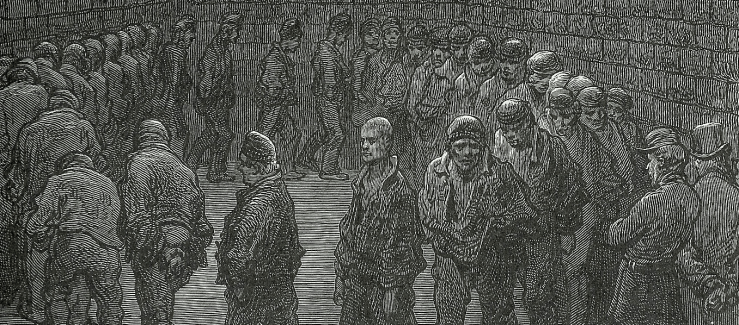
Detail from Newgate Exercise Yard by Gustave Dore, 1872

Denis Johnson’s story “Strangler Bob” is the third selection in The Largesse of the Sea Maiden. At about 20 pages, it’s also the shortest piece in the collection (the other four stories run between 40 and 50 pages). While still a bit longer than the stories in Johnson’s seminal collection Jesus’ Son, “Strangler Bob” nevertheless seems to pulse from that same vein, its narrator Dink another iteration of Jesus’ Son’s Fuckhead. Indeed, “Strangler Bob” feels a bit like an old sketch that’s been reworked by Johnson into something that fits thematically into Largesse.

Here’s the opening paragraph of “Strangler Bob” in full, which gives us the basic premise and setting (and you can’t beat those two opening sentences):

You hop into a car, race off in no particular direction, and blam, hit a power pole. Then it’s off to jail. I remember a monstrous tangle of arms and legs and fists, with me at the bottom gouging at eyes and doing my utmost to mangle throats, but I arrived at the facility without a scratch or a bruise. I must have been easy to subdue. The following Monday I pled guilty to disturbing the peace and malicious mischief, reduced from felony vehicular theft and resisting arrest because—well, because all this occurs on another planet, the planet of Thanksgiving, 1967. I was eighteen and hadn’t been in too much trouble. I was sentenced to forty-one days.

Those forty-one days take us from Thanksgiving to the New Year, with the story’s spiritual climax occurring on Christmas Eve.

Before we get to that climax Johnson builds an unexpectedly rich world in the county lockup, populating it with young toughs who can’t yet see how bad the paths they’ve chosen will be. The men of Johnson’s jail aren’t simply down on their luck or somehow morally misunderstood. They are jovial young fuck-ups who plan to continue fucking up their lives the minute they get out.

A lot of the stage-setting and background characterization in “Strangler Bob” reads like picaresque sketches that Johnson had lying about unused from decades ago. Much of the early part of the story is dedicated to “the blond sociopathic giant Jocko,” a sort of prince of the jail who saves a crazy kid from being murdered by the other inmates. Such scenes give the story a ballast of baroque energy and even an unexpectedly-comic realism, but they don’t fully fit into the main theme of the story, which is hunger.

On his first day in the jail the narrator Dink is warned not to oversleep or he will have his breakfast stolen. Hardheaded, he sleeps in anyway, but learns from his mistake:

After that I had no trouble rousing myself for the first meal, because other than the arrival of food we had nothing in our lives to look forward to, and the hunger we felt in that place was more ferocious than any infant’s. Corn flakes for breakfast. Lunch: baloney on white. For dinner, one of the canned creations of Chef Boyardee, or, on lucky days, Dinty Moore. The most wonderful meals I’ve ever tasted.

Hunger in “Strangler Bob” is an expression of the deep boredom the prisoners feel, and mealtimes become the only way these men measure the passing of time. The hunger in “Strangler Bob” is not just a desire for food, but rather something to fill up the void, the space, the empty feeling. In this world, romantic adventure is ironized into confined torpor:

Dundun, BD and I formed a congress and became the Three Musketeers—no hijinks or swashbuckling, just hour upon hour of pointless conversation, misshapen cigarettes, and lethargy.

Dundun and BD are perhaps unlikely friends for Dink—

Dundun was short and muscled, I was short and puny, and BD was the tallest man in the jail, with a thick body that tapered up toward freakishly narrow shoulders.

—but their fellowship holds together because they had “long hair and chased after any kind of intoxicating substance.” Thanks to BD they get their mitts on some LSD:

BD told us he had a little brother, still in high school, who sold psychedelic drugs to his classmates. This brother came to visit BD and left him a hotrod magazine, one page of which he’d soaked in what he told BD was psilocybin, but was likelier just, BD figured, LSD plus some sort of large-animal veterinary tranquilizer. In any case: BD was most generous. He tore the page from the magazine, divided it into thirds, and shared one third with me and one with Donald Dundun, offering us this shredded contraband as a surprise on Christmas Eve.

The ink from the newsprint turns their tongues black. Narrator Dink seems to think that the LSD was not evenly distributed on the page though—BD trips the hardest, seeing snow falling indoors, but Dink seems to think he’s mostly unaffected, while Dundun denies any effect at all. However, consider this exchange between Dink and Dundun, which suggests that they might be tripping harder than they think:

“I’m feeling all the way back to my roots. To the caves. To the apes.” He turned his head and looked at us. His face was dark, but his eyeballs gave out sparks. He seemed to be positioned at the portal, bathed in prehistoric memories. He was summoning the ancient trees—their foliage was growing out of the walls of our prison, writhing and shrugging, hemming us in.

A sloppy and unnecessary Freudian analysis of the three kids parcels them out easily as id (Dundun the apeman), super ego (BD the strange moralist), and ego, our narrator who rejects any kind of spirituality in a world where “Asian babies fried in napalm.”

Dink’s cellmate, the eponymous Strangler Bob, poses a challenge to the narrator’s easy nihilism though. Even though Dink believes that he’s not affected by the LSD, his encounter with Bob on Christmas Eve reads like a bad trip:

The only effect I felt seemed to coalesce around the presence of Strangler Bob, who laughed again—“Hah!”—and, when he had our attention, said, “It was nice, you know, it being just the two of us, me and the missus. We charcoaled a couple T-bone steaks and drank a bottle of imported Beaujolais red wine, and then I sort of killed her a little bit.”

To demonstrate, he wrapped his fingers around his own neck while we Musketeers studied him like something we’d come on in a magic forest.

Dundun then exclaims that Strangler Bob is “the man who ate his wife” — but Bob admonishes that his cannibalism was greatly exaggerated:

Strangler Bob said, “That was a false exaggeration. I did not eat my wife. What happened was, she kept a few chickens, and I ate one of those. I wrung my wife’s neck, then I wrung a chicken’s neck for my dinner, and then I boiled and ate the chicken.”

The hunger in Strangler Bob is perverse and abject; his crime is of a moral magnitude far more intense than the malicious hijinks the youthful Musketeers have perpetrated–it’s taboo, a challenge to all moral order. He’s also an oracle of strange dooms:

He said, “I have a message for you from God. Sooner or later, you’ll all three end up doing murder.” His finger materialized in front of him, pointing at each of us in turn—“Murderer. Murderer. Murderer”

We learn in the final melancholy paragraphs of the story that Bob’s prophecy comes true, more or less. In those paragraphs too there is a moment of grace, albeit a grace hard purchased. Of the latter part of his life, the Dink tells us:

I was constantly drunk, treated myself as a garbage can for pharmaceuticals, and within a few years lost everything and became a wino on the street, drifting from city to city, sleeping in missions, eating at giveaway programs.

It’s worth noting that if Dink were 18 in the fall of 1967, he would likely have been born in 1949, the year that Denis Johnson was born. The narrators of two other stories in Largesse are also born in or around 1949, and it’s my belief that all of the narrators are essentially the same age, and all are pseudoautofictional iterations of Johnson.

In “Strangler Bob,” Dink is an iteration that fails to thrive, that can’t survive addiction and recovery and enter into a new life. He does not heed Bob’s warning, and at the end of the story he laments that he is a poisoned person who has poisoned others:

When I die myself, B.D. and Dundun, the angels of the God I sneered at, will come to tally up my victims and tell me how many people I killed with my blood.

These final lines push the narrator into a place of bare remorse and regret, as he reflects back on his time in the jail, which he describes in retrospect as “some kind of intersection for souls.” Dink now sees that he’s failed to acknowledge the messengers that might have sent him on a better path. Angels come in strange forms.

Very early Christmas morning on the planet of 1967, after “the festival of horrors” that constituted the LSD trip, Strangler Bob gives one last message, a strange delivered in Dink’s grandmother’s voice:

I studied him surreptitiously over the edge of the bunk, and soon I could see alien features forming on the face below me, Martian mouth, Andromedan eyes, staring back at me with evil curiosity. It made me feel weightless and dizzy when the mouth spoke to me with the voice of my grandmother: “Right now,” Strangler Bob said, “you don’t get it. You’re too young.” My grandmother’s voice, the same aggrieved tone, the same sorrow and resignation.

“You’re too young” — wisdom is purchased through folly, pain, terrible mistakes, crimes and sins. The narrator’s grandmother ventriloquizes Strangler Bob, but she doesn’t have a moral message, just tired pain.

The voice here is Denis Johnson’s voice too, inhabiting a mad oracle, warning some version of himself that exists today.


You can read “Stranger Bob” online here.

I wrote about the title story in The Largesse of the Sea Maiden here.

I wrote about the second story, “The Starlight on Idaho” here.


Blog about Denis Johnson’s story “The Starlight on Idaho”

“The Starlight on Idaho” is the second of five stories in Denis Johnson’s collection The Largesse of the Sea Maiden. Apart from the collection’s title story (which I wrote about here), “The Starlight on Idaho” is the only piece in Largesse to have been previously published (in a different form in a 2007 issue Playboy). You can read the story online in full here, and watch/hear Johnson read excerpts from it in this video:

My impression after reading Largesse the first time was that “Starlight” was a good story, but also perhaps the weakest in the collection. Reading it again this afternoon, I see its inclusion in Largesse as vital. “Starlight” engages with the book’s overall themes of repentance, regret, and forgiveness—as well as the act of writing itself—more overtly than the other four stories in Largesse. In a sense, the story bridges Johnson’s earlier work (like Angels and Jesus’ Son) more directly to the late (and more complex) narratives in Largesse, like “Doppelgänger, Poltergeist” and “Triumph Over the Grave.”

The title of the story refers not to the literal starlight on the literal state of Idaho (where Johnson lived for some years), but rather to the “Starlight Addiction Recovery Center on Idaho Avenue, in its glory days better known as the Starlight Motel.” The story’s narrator is Cass—Mark Cassandra—and he is in this California rehab “because the last four years have really kicked [his] ass.” Cass summarizes those four years a few times in “Starlight,” including this charming list:

Just to sketch out the last four years – broke, lost, detox, homeless in Texas, shot in the ribs by a thirty-eight, mooching off the charity of Dad in Ukiah, detox again, run over (I think, I’m pretty sure, I can’t remember) shot again, detox right now one more time again.

Our hero has hit rock bottom and now writes to family members, friends, the devil, and other folks. As he puts it, Cass is “writing letters to each one of you lucky winners who has a hook in my heart.” The epistolary form allows Johnson to explore issues of regret and religion through the lens of a defiant but wrecked soul, who at one point tells his reader that “I’m not about to get on my knees.”

Cass’s detox is a metaphorical descent into hell. He writes to Pope John Paul; he writes to Satan. At one point in the middle of a letter to his brother, he sneaks in a letter to God:

Excuse me, I have to burn this page and write a letter to God while it’s on fire. Question is, God, where are you?  What the fuck on earth do you think you’re doing, man?  We are in HELL down here, HELL down here, HELL. You know?  Where’s Superman?

“The Starlight on Idaho” ultimately reads like one long letter to God. We learn much about Cass’s family (fractured, foul, awful), but Cass never uses them as an excuse for his behavior. He knows that his alcoholism and drug abuse “was a button [he] could push to destroy the known world.” Letter writing is part of restoring Cass to the world again. He has to find a way to tell his story.

Similarly, listening to other people’s stories is part of Cass’s recovery. Key scenes in “Starlight” feature Cass attending to other people’s tales and empathizing with them. “Starlight” climaxes not with Cass’s own story, but with the story of a man named Howard, a former undercover narc who has royally fucked up his own life. “My story is the amazing truth,” Howard declares, and that story ends with God squeezing Howard’s soul, intensely, always. This squeezing brings Howard closer to God.

Cass tells Howard’s story to his brother “John the Strangest Of All us Cassandras” in the final letter in “Starlight.” In the letter previous—addressed to Satan—Cass signs off as “Mark Cassandra, a more or less Christian.” In the final letter to John, Cass signs off “Your Brother In Christ, Cass.” Is the conversion complete and true? I think so. Johnson loves his characters and often drives them to a place of salvation.

For some readers, this insistence on redemption—and here a specifically Christian redemption—might be a bit too much, even a bit too on the nose. Cass certainly has a Jesus Christ complex. In the depths of detox, he despairs:

Why do I think I might be Jesus Christ and I’m supposed to come here and suffer, really suffer, suffer past your most excruciating fantasies of torment and why do I think everybody’s looking at me because they know this about me?

Johnson lets it drop more than once that our narrator is about to turn 33, as if to underline the point. However, he’s a disciple, not a messiah. He’s Mark Cassandra; his brother’s names are Luke and John. Those guys wrote a few letters, right? And then of course there’s that pagan last name, Cassandra. Is Mark a prophet? And will his prophecies be ignored? Who are they for? Who reads his words? Well, us of course.

“The Starlight on Idaho” may end on a note of religious redemption, but a subtler motif lies under the narrative’s surface. Johnson’s work has never struck me as overtly metafictional, but “Starlight” is clearly about writing itself, and foregrounds writing as vital to Cass’s recovery. Cass and the other “inmates” of the Starlight Addiction Recovery Center are like participants in a writer’s workshop, only one with much higher stakes. These recovering addicts are making their fractured lives cohere through narrative power. The trick of “The Starlight on Idaho” is to withhold the product—the life narrative—and give us instead the process, the pieces, the fragments themselves. Mark Cassandra’s letters may not be addressed to us, but of course we are his readers and his witnesses.

Blog about Denis Johnson’s story “The Largesse of the Sea Maiden”

img_0381

I finished reading Denis Johnson’s posthumous collection of short stories The Largesse of the Sea Maiden a few weeks ago. I felt a bit stunned by the time I got to the fourth story in the collection, “Triumph Over the Grave,” which ends with these words: “It’s plain to you that at the time I wrote this, I’m not dead. But maybe by the time you read it.”

Denis Johnson died just over a year ago, of course, a fact that haunts any reading of Sea Maiden (at least for fans, and I am a fan). The collection was released just half a year after his death, and I managed to avoid reading any reviews of it. I held out on picking it up for reasons I don’t really know how to explain, but I when I finally read it, I consumed it in a greedy rush.

Anyway, since I finished the book I’ve tried a few times to put together a “review,” but each time I get some words down I find myself sprawling out all over the place, rereading bits of the stories, picking out new motifs, new questions, new parallels between Johnson’s life and the lives of his narrators. Very short review: The Largesse of the Sea Maiden is one of Johnson’s best books, a perfect gift to his readers—his own tragicomic obituary in fictional form. It’s a book about death and writing and art and commerce and regret and salvation, and each time I go back to it I find more in there than I saw the first time–more order, more threads, more design. So instead of a full long review, I’ll offer instead a series of blogs about each of the five stories in the collection. (Perhaps this form is simply an excuse to reread The Largesse of the Sea Maiden).

The first story is the title track, “The Largesse of the Sea Maiden.” First published in The New Yorker back in 2014, this long short story (it runs to not-quite 40 pages) introduces the major themes and tones of the entire collection. “Largesse” is told by a first-person narrator in ten titled vignettes. Some of the titles, like “Widow,” “Orphan,” “Farewell,” and “Memorial,” directly name the themes of both the story and the book.

The narrator of “The Largesse of the Sea Maiden” is a writer—but not a writer of literature or fiction—of art—but of commercials. Although “Largesse” shows him somewhat comfortable in his life in San Diego with his third wife, the narrator nevertheless is melancholy, even dour at times. In the beginning of the vignette “Ad Man,” he declares:

This morning I was assailed by such sadness at the velocity of life—the distance I’ve traveled from my own youth, the persistence of the old regrets, the new regrets, the ability of failure to freshen itself in novel forms—that I almost crashed the car.

(Is there a subtle nod there to one of Johnson’s most well-known stories, “Car-Crash While Hitchhiking”? I think so. If not, I find a thread).

“Ad Man” initiates the major plot trajectory of “Largesse”: Our narrator has won an award for an advertisement he wrote and directed decades ago, and he will have to return to New York City to be given the award at a special dinner. Floating through the vignettes is the ad man’s anxiety about his own legacy of work against the backdrop of the finer arts. We learn in “Accomplices” that he cares enough about the arts to object that his host has hung a Mardsen Hartley oil landscape above a lit fireplace—but he doesn’t prevent the man from burning the painting—his “property”—in a moment where Johnson subtly critiques the relationship between art and commerce. The narrator turns the burning of the painting into a new art though—storytelling.

The narrator later tells us that “looking at art for an hour or so always changes the way I see things afterward,” and “Largesse” is riddled with encounters with art and artists, like the outsider painter Tony Fido, whom the narrator meets at a gallery. The artist offers, unprompted, a scathing critique of a Edward Hopper’s painting Gas:

“You’re a painter yourself.”

“A better painter than this guy,” he said of Edward Hopper.

“Well, whose work would you say is any good?”

“The only painter I admire is God. He’s my biggest influence.”

That attribution — “he said of Edward Hopper” — is a lovely example of Johnson’s sharply-controlled wit.

Tony Fido plays a major minor role in “Largesse.” Fido tells the narrator the story of his encounter with a widow—one of several widows in both “Largesse” and Largesse, and his own suicide—Fido’s—becomes a strange moment for the narrator to realize how little he actually knows about his friend. And of course, all of these plot points give Johnson a chance to riff on the themes of death, loss and regret.

“Largesse” is loaded with thoughts on regret and forgiveness. Talking with a friend, the narrator muses that “we wandered into a discussion of the difference between repentance and regret. You repent the things you’ve done, and regret the chances you let get away.” The vignette “Farewell” stages a chance for the narrator to repent his past sins; his ex-wife, dying of cancer, calls him up to (possibly) forgive him:

In the middle of this I began wondering, most uncomfortably, in fact with a dizzy, sweating anxiety, if I’d made a mistake—if this wasn’t my first wife Ginny, no, but rather my second wife, Jennifer, often called Jenny. Because of the weakness of her voice and my own humming shock at the news, also the situation around her as she tried to speak to me on this very important occasion—folks coming and going, and the sounds of a respirator, I supposed—now, fifteen minutes into this call, I couldn’t remember if she’d actually said her name when I picked up the phone and I suddenly didn’t know which set of crimes I was regretting, wasn’t sure if this dying farewell clobbering me to my knees in true repentance beside the kitchen table was Virginia’s, or Jennifer’s.

I’ve quoted at such length because the moment is an example of Johnson’s tragicomic genius—a sick punchline that disconnects crime from punishment and punishment from forgiveness. The narrator ends up making the connections himself in the end: “after all, both sets of crimes had been the same.” And yet Johnson keeps pushing his character past reconciliation into a midnight walk to clear his conscience:

I wonder if you’re like me, if you collect and squirrel away in your soul certain odd moments when the Mystery winks at you, when you walk in your bathrobe and tasseled loafers, for instance, well out of your neighborhood and among a lot of closed shops, and you approach your very faint reflection in a window with words above it. The sign said “Sky and Celery.”

Closer, it read “Ski and Cyclery.”

“Farewell” ends on this note of a winking Mystery—on the profound insight that we are always susceptible to misreading the signs in front of us.

“The Largesse of the Sea Maiden” is very much a story about trying to put together a cohesive narrative from the strands and fragments around us. Indeed, its very form points to this—the fractured vignettes have to be pieced together by the reader. Johnson fractures not just form but tone. The deadpan, tragicomic, pathos-laden humor that’s run throughout Johnson’s oeuvre dominates in “Largesse,” yes, but there are strange eruptions of sentimental fantasy, particularly in “Mermaid,” a vignette that reads like the narrator’s own imaginative construction, and not the (often banal) reality that most of the narrative is grounded in. After receiving his award in New York, the narrator makes his way to a bar, and here conjures a scene like something from a film noir:

I couldn’t see the musician at all. In front of the piano a big tenor saxophone rested upright on a stand. With no one around to play it, it seemed like just another of the personalities here: the invisible pianist, the disenchanted old bartender, the big glamorous blonde, the shipwrecked, solitary saxophone…And the man who’d walked here through the snow…And as soon as the name of the song popped into my head I thought I heard a voice say, “Her name is Maria Elena.” The scene had a moonlit, black-and-white quality. Ten feet away at her table the blond woman waited, her shoulders back, her face raised. She lifted one hand and beckoned me with her fingers. She was weeping. The lines of her tears sparkled on her cheeks. “I am a prisoner here,” she said. I took the chair across from her and watched her cry. I sat upright, one hand on the table’s surface and the other around my drink. I felt the ecstasy of a dancer, but I kept still.”

The ecstasy here—internalized and “still”—is the ecstasy of storytelling, imagination, art. This is the gift of the mermaid, the largesse of the sea maiden. The minor moment is the real award for our ad man hero, who finds no real transcendence in commercial writing.

I’ve been using “the narrator” in this riff, but our hero has a name, which he reveals to us in the final vignette, “Whit.” It’s here that he describes the ad he’s (not exactly) famous for, an “animated 30-second spot [where] you see a brown bear chasing a gray rabbit.” The chase ends when the rabbit gives the bear a dollar bill.” Narrator Whit explains that this ad for a bank “referred, really, to nothing at all, and yet it was actually very moving.” He goes on:

I think it pointed to orderly financial exchange as the basis of harmony. Money tames the beast. Money is peace. Money is civilization. The end of the story is money.

And yet our ad man, despite his commercial interpretation of his own writing, recognizes too that this work “was better than cryptic—mysterious, untranslatable.” The word “untranslatable” is one of several clues that link the final section of “Largesse” to the final section of Walt Whitman’s long poem, Song of Myself. Whitman’s narrator (“Walt Whitman, a kosmos”) claims that he is, like the spotted hawk who swoops to disturb his reverie, “untranslatable.” Bequeathing himself to us—a gift for our good graces—he reminds us that “You will hardly know who I am,” a line that Johnson echoes in the beginning of “Whit”: “My name would mean nothing to you, but there’s a very good chance you’re familiar with my work.” And then of course, there’s the big tell—Johnson’s narrator is Bill Whitman, a pun that works on several levels. Walt Whitman’s language has seeped into the language of advertising—in a way it is the genesis of a new commercial American idiom—and here Johnson slyly pushes it back into the realm of art.

Just as the conclusion of Song of Myself builds to a self-penned elegy for its self-subject, “The Largesse of the Sea Maiden” reads like Johnson’s elegy for an alter-ego. We learn in the final paragraphs that Bill Whitman is “just shy of sixty-three” — roughly the same age as Johnson would’ve been when the story was published. (We learn that the narrator of “Doppelgänger, Poltergeist,” the final story in The Largesse of the Sea Maiden, is also the same age as Johnson. That narrator was born on “July 20, 1949.” Johnson’s birthday was July 1, 1949).

Narrator Whit reflects on his life in the story’s melancholy penultimate paragraph:

I note that I’ve lived longer in the past, now, than I can expect to live in the future. I have more to remember than I have to look forward to. Memory fades, not much of the past stays, and I wouldn’t mind forgetting a lot more of it.

However, there’s still a restlessness to his spirit, a questing desire to answer the final lines of Song of Myself, perhaps, where Whitman writes:

Failing to fetch me at first keep encouraged,
Missing me one place search another,
I stop somewhere waiting for you

The last paragraph of “The Largesse of the Sea Maiden” is Johnson’s narrator’s implicit response to these lines, and as I cannot improve upon his prose, they will be my last lines as well:

Once in a while, I lie there as the television runs, and I read something wild and ancient from one of several collections of folktales I own. Apples that summon sea maidens, eggs that fulfill any wish, and pears that make people grow long noses that fall off again. Then sometimes I get up and don my robe and go out into our quiet neighborhood looking for a magic thread, a magic sword, a magic horse.

Blog about reading Middlemarch (and wishing I was rereading Middlemarch)

Screenshot 2018-06-12 at 8.35.14 PM
Detail of a portrait of Mary Ann Evans (George Eliot) at age 30 by François d’Albert Durade (1804–1886)

There should be a word in some language (perhaps not yet invented—word or language) to describe the feeling of Having pushed far enough into a very long novel (a novel that one has cracked into more than once) to the point that one now feels one can finally finish it.

I have felt this specific feeling a number of times in my life after finally sinking into long novels like Moby-DickGravity’s Rainbow, and Infinite Jest. There’s a sort of relief mixed into this (as-yet-unnamed?) feeling, a letting go even, where the reader (me, I mean) surrenders to the novel’s form and content. Finally freed from the idea of reading the novel, I am able to read the novel.

There are 86 numbered chapters in George Eliot’s 1872 novel Middlemarch (not counting a “Prelude” and a “Finale”). I have just finished Chapter XXXV—not exactly a half-way point, but far enough in to finally feel like the story and the style are sticking with me. I’ve been reading a public domain copy on my iPad, after having abandoned my 1977 Norton Critical Edition—the Norton’s print is too cramped (and maybe my eyes are starting to go as I approach 40). Also, the Norton annotations are useful but too intrusive for a first read. I found myself utterly distracted by the Norton footnotes after about 50 pages; switching to a footnote-free version has alleviated a lot of the anxiety I initially felt about trying to fully comprehend Eliot’s novel in its own historical context. Dispensing with the footnotes allowed me to finally sink into Middlemarch and appreciate its wonderful evocation of consciousness-in-action.

So far, my favorite character in Middlemarch is Dorothea Brooke. In part my allegiance to her is simply a matter of the fact that she initially appears to be the novel’s central character—until Eliot swerves into new narratives near the end of Book I (Book I of VIII, by the way). But beyond traditional formal sympathies, it’s the way that Eliot harnesses Dorothea’s consciousness that I find so appealing. Eliot gives us in Dorothea an incredibly intelligent yet palpably naive young woman who feels the world around her a smidge too intensely. Dorothea is brilliant but a bit blind, and so far Middlemarch most interests me in the way that Eliot evokes this heroine’s life as a series of intellectual, emotional, and aesthetic revelations. We see Dorothea seeing—and then, most remarkably, we see Dorothea seeing what she could not previously see.

There are other intriguing characters too, like Dr. Tertius Lydgate, the wastrel Fred Vincy, and the would-be-Romantic Will Ladislaw (who has like, totally smoked opium, just so you know). I’m particularly fond of Dorothea’s goofy uncle Arthur Brooke.

I won’t bother summarizing the plot thus far of the novel, which is really a bunch of plate spinning, but rather offer this sentence from the novel itself:

Scenes which make vital changes in our neighbors’ lot are but the background of our own, yet, like a particular aspect of the fields and trees, they become associated for us with the epochs of our own history, and make a part of that unity which lies in the selection of our keenest consciousness.

There’s also another self-summarizing passage a few chapters before this one, worth citing here:

Your pier-glass or extensive surface of polished steel made to be rubbed by a housemaid, will be minutely and multitudinously scratched in all directions; but place now against it a lighted candle as a centre of illumination, and lo! the scratches will seem to arrange themselves in a fine series of concentric circles round that little sun. It is demonstrable that the scratches are going everywhere impartially and it is only your candle which produces the flattering illusion of a concentric arrangement, its light falling with an exclusive optical selection. These things are a parable. The scratches are events, and the candle is the egoism of any person now absent…

Each of us is a reader reading other lives as scratches on a mirror or trees in the distance, and in our reading we incorporate them into our own consciousness, our own narrative. Middlemarch is very good at evoking this social reality.

I started this blog post by trying to describe a very specific feeling for which I don’t have a word—namely, and again: Having pushed far enough into a very long novel to the point that one now feels one can finally finish it. I suspect that this is a not-uncommon feeling. I’m not so sure though of how common the other feeling I have while reading Middlemarch is. I keep feeling (feeling, not thinking): I wish that I was rereading Middlemarch and not reading Middlemarch. If I were rereading Middlemarch I could make much more sense of those mirror scratches and those trees in the distance; if I were rereading Middlemarch, I could feel the feeling of reading Middlemarch more. There is an obvious answer to this desire, of course. I can finish reading Middlemarch. Then I can reread Middlemarch. 

Reviews, riffs, anti-reviews, and interviews of Jan 2018-May 2018 (and an unrelated fruit bat)

DP167067

These are links to some of the longer pieces I’ve written so far this year. The painting of the great Indian fruit bat (c. 1777-1782) is attributed to Bhawani Das or one of his followers.

The Last Jedi and the anxiety of influence

A review of Paul Thomas Anderson’s film Phantom Thread

A review of Paul Kirchner’s underground comix collection Awaiting the Collapse (at The Comics Journal)

A review of The Paris Review’s overproduced podcast

A review of Stanisław Ignacy Witkiewicz’s collection Narcotics

A few paragraphs on beginning Iris Murdoch’s novel The Bell

On a compelling Stephen Crane character

A review of Iris Murdoch’s novel The Bell

On a particular Gordon Lish sentence

On rereading Nathaniel Hawthorne’s The Blithedale Romance

Screenshot 2018-05-31 at 3.59.41 PM

On Goya’s painting The Straw Man

On Don DeLillo’s novel The Names

On the radical postmodernism of Ursula K. Le Guin’s short story “Schrödinger’s Cat” 

Polygamy as a metaphor in Nathaniel Hawthorne’s The Blithedale Romance

On Nathaniel Hawthorne’s “silvery veil” — and David Foster Wallace’s Madame Psychosis

An analysis of William Carlos Williams’s ekphrastic poem “The Wedding Dance in the Open Air”

A close reading of Lydia Davis’s very short story “Happiest Moment”

On a passage from Gerald Murnane’s short story “Stream System”

Something on a scene from Nathaniel Hawthorne’s The Blithedale Romance

Screenshot 2018-05-31 at 3.59.29 PM

On John Berryman’s Dream Song 265

On making a literary cocktail, the sherry cobbler

On Robert Coover’s short story “The Brother”

On Claire-Louise Bennett’s short story “Stir-Fry”

On Balthus’s portraits of young girls reading 

On the postmodern comedy-horror axis of Martin Scorsese’s The King of Comedy

An interview with the editors of Egress, a new literary magazine devoted to innovative writing

A completely subjective and thoroughly unnecessary ranking of Thomas Pynchon’s novels

Screenshot 2018-05-31 at 3.58.43 PM

Antoine Volodine’s Writers blows me away

A review of Dave Cooper’s queasy abject comic Mudbite (at The Comics Journal)

On Michael Radford’s film adaptation of 1984

Is The Running Man a good film?

On William Friedkin’s paranoid, claustrophobic horror flick Bug

Mary and the Witch’s Flower, a love letter to Studio Ghibli from director Hiromasa Yonebayashi

On Hayao Miyazaki’s film Porco Rosso

A review of Zora Neale Hurston’s Barracoon

A review of Lady Macbeth

Screenshot 2018-05-31 at 3.59.03 PM

Blog about the first half of Antoine Volodine’s Writers

img_9711

Antoine Volodine’s collection of loosely-connected stories Writers (2010; English translation by Katina Rogers, Dalkey Archive, 2014) is 108 pages. I have read the first four of the seven stories here—the first 54 pages. This is the first book by Volodine that I have read. Antoine Volodine is in fact a pseudonym, I know, but I don’t know much else about the writer. I’ve been meaning to read him for a few years, after some good folks suggested I do so, but I’ve never come across any of his books in the wild until this weekend. After I finish Writers I will read more about Volodine, but for now I am enjoying (?) how and what this book teaches me about the bigger project Volodine seems to be working towards.

That bigger project evinces in the first story in the collection, “Mathias Olbane,” which centers on the titular character, a writer who tries to hypnotize himself into a suicide attempt. Poor Mathias goes to prison for twenty-six years — “He had assassinated assassins.” Like most of the figures in Writers (so far anyway—you see by the title of this post that I am reporting from half way through, yes?) — like most of the figures in Writers, Mathias is a revolutionary spirit, resisting capitalist power and conformist order through radical violence. Before prison, Mathias wrote two books. The first, An Autumn at the Boyols’ “consisted of eight short texts, inspired by fantasy or the bizarre, composed in a lusterless but impeccable style. Let’s say that it was a collection that maintained a certain kinship with post-exoticism…” The description of the book approximates a description of Writers itself; notably, Volodine identifies his own genre as post-exoticism. Autumn at the Boyols’ doesn’t sell at all, and its sequel, Splendor of the Skiff (which “recounted a police investigation, several episodes of a global revolution, and traumatizing incursions into dream worlds”) somehow fares even worse. Mathias begins a new kind of writing in prison:

…after twenty-six years in captivity, he had forged approximately a hundred thousand words, divided as follows:

  • sixty thousand first and last names of victims of unhappineess
  • twenty thousand names of imaginary plants, mushrooms, and herbs
  • ten thousand names of places, rivers, and localities
  • and ten thousand various words that do not belong to any language, but have a certain phonetic logic that makes them sound familiar

I love the mix of tones here: Mathias Olbane’s grand work is useless and strange and sad and ultimately unknowable, and Volodine conveys this with both sinister humor and dark pathos. Once released from prison, our hero immediately becomes afflicted with a rare and incurable and painful disease. Hence, the suicide urge. But let’s move on.

The second tale in Writers, “Speech to the Nomads and the Dead,” offers another iteration of post-exotic writing, both in form and content. The story plays out like a weird nightmare. Linda Woo, isolated and going mad in a prison cell, conjures up an audience of burn victims, an obese dead man, Mongolian nomads, and several crows. She delivers a “lesson” to her auditors (a “lesson,” we learn, is one of post-exoticism’s several genres). The lesson is about the post-exotic writers themselves. She names a few of these post-exotic writers (Volodine is addicted to names, especially strange names), and delivers an invective against the modern powers that the post-exotic writers write against:

Post-exoticism’s writers…have in their memory, without exception, the wars and the ethnic and social exterminations that were carried out from one end of the 20th century to the other, they forget none and pardon none, they also keep permanently in mind the savageries and the inequalities that are exacerbated among men…

The above excerpt is a small taste of Woo’s bitter rant, which goes on for long sentence after long sentence (Volodine is addicted to long sentences). Like Mathias Olbane, Linda Woo writes in the face of futility, creating the “post-exotic word,” a word that creates an “absurd magic” that allows the post-exotic writers to “speak the world.”

Linda Woo’s name appears in the next story in Writers, “Begin-ing,” if only in passing. This story belongs to an unnamed writer, yet another prisoner. Wheelchair-bound, he is interrogated and tortured by two insane inmates who have taken over their prison, having killed their captors. The pair, Greta and Bruno Khatchatourian, are thoroughly horrific, spouting abject insanities that evoke Hieronymus Boschs’s hell. They are terrifying, and I had a nightmare the night that I read “Begin-ing.” It’s never quite clear if Greta and Bruno Khatchatourian are themselves post-exotic writers gone mad or just violent lunatics on the brink of total breakdown. In any case, Volodine affords them dialogue that veers close to a kind of horror-poetry. “We can also spew out the apocalypse,” Greta defiantly sneers. They torture the poor writer. Why?

They would like it, in the end, if he came around to their side, whether by admitting that he’s been, for a thousand years, a clandestine leader of dark forces, or by tracing for them a strategy that could lead them to final victory. … They would like above all for him to help them to drive the dark forces out from the asylum, to prepare a list of spies, they want him to rid the world of the last nurses, of Martians, of colonialists, and of capitalists in general.

The poor writer these lunatics torture turns inward to his own formative memories of first writings, of begin-ing, when he created his own worlds/words in ungrammatical misspelled scrawlings, filling notebook after notebook. Volodine unspools these memories in sentences that carry on for pages, mostly centering on the writer’s strange childhood in an abject classroom where he engages in depravities that evoke Pasolini’s Salò. And yet these memories are the writer’s comfort—or at least resistance—to the lunatics’ violence. Volodine’s prose in “Begin-ing” conjures Goya’s various lunatics, witches, demons, and dogs. It’s all very upsetting stuff.

Courtyard with Lunatics, 1794 by Francisco Goya (1746-1828)

After the depravity of “Begin-ings,” the caustic comedy of the next story “Acknowledgements” is a welcome palate cleanser. In this story’s twelve pages (I wish there were more!) Volodine simultaneously ridicules and exults the “Acknowledgements” page that often appends a novel, elevating the commonplace gesture to its own mock-heroic genre. The story begins with the the hero-writer thanking “Marta and Boris Bielouguine, who plucked me from the swamp that I had unhappily fallen into along with the bag containing my manuscript.” The “swamp” here is not a metaphor, but a literal bog the writer nearly drowned in. And the manuscript? A Meeting at the Boyols’, a title that recalls poor Mathias Olbane’s first book  An Autumn at the Boyols’. Each paragraph of “Acknowledgments” is its own vignette, a miniature adventure in the form of a thank-you note to certain parties. Most of the vignettes end in sex or death, or an escape from one of the two. “Grad Litrif and his companion Lioudmila” as well as “the head of the Marbachvili archives” (oh the names in this story!) are thanked for allowing the writer

…to access the notebooks of Vulcain Marbachvili, from which I was able, for my story Long Ago to Bed Early, to copy several sentences before the earthquake struck that engulfed the archives. My thanks to these three people, and apologies to the archivist, as I was sadly unable to locate either her name or her body in the rubble.

“Acknowledgments” is littered with such bodies—sometimes victims of disasters and plagues, and elsewhere the bodies of the married or boyfriended women the writer copulates with before escaping into some new strange circumstances (he often thanks the husbands and the boyfriends, and in one inspired moment, thanks a gardener “who one day had the presence of mind to detain Bernardo Balsamian in the orchard while Grigoria and I showered and got dressed again”). He thanks a couple who shows him their collection of 88 stuffed guinea pigs; he thanks “the leader of the Muslim Bang cell” who, during his “incarceration in Yogyakarta…forbid the prisoners on the floor from sodomizing” him; he thanks the “Happy Days” theater troupe who “had the courage” to perform his play Djann’s Awakening three times “before a rigorously empty room.” Most of the acknowledgments connect the writer’s thank-you to a specific book he’s written. I’m tempted to list them all (oh the names!), but just a few—Tomorrow the OttersEve of PandemicJournal of PandemoniumGoodbye CloudsGoodbye RomeoMlatelpopec in ParadiseMacbeth in ParadiseHell in Paradise…Without exaggeration: “Acknowledgements” is one of the funniest stories I’ve ever read.

With its evocations of mad and obscure writers, Volodine’s books strongly reminds me of Roberto Bolaño’s work. And yet reading it is not like reading an attempt to copy another writer—which Volodine is in no way doing—but rather like reading a writer who has filtered much of the same material of the 20th century through himself, and has come to some of the same tonal and thematic viewpoints—Volodine’s labyrinth is dark and weird and sinister and abject, but also slightly zany and terribly funny. More to come.


Blog about Blog about 3

  1. There are 30 days in April. On 1 April 2018—Easter Sunday and/or April Fool’s Day—I declared on my cursed blog that I would write something on the blog every day this month. I failed to write every day on the blog in the month of April; specifically, I did not post stuff on April 13, April 20, or April 24.
  2. (Not a reason for not posting on any of these dates but fun: April 13 was a Friday the 13th; April 20 is 4/20; April 24 is my cousin’s birthday).
  3. On the 1 April Blog about post I specifically hunted down the Fool card in the Rider-Waite tarot deck that I keep out for fun. I always thought tarot was foolish silliness, even if I found some of the aesthetics attractive, before a third or maybe fourth rereading of Gravity’s Rainbow prompted my buying a deck for research purposes. The deck figures heavily in Pynchon’s novel, providing a mystical and indeterminate contrast to the novel’s motif of mathematical precision. At some point I start flipping a card every day—not as some kind of superstitious soothsaying totem, but rather for fun. I don’t know. I scattered some of those cards into these posts when I photographed books; every card was a card I flipped that day, aside from The Fool.
  4. This morning I flipped the Two of Wands, a card I like. I like most of the Wands suit (and generally dislike the Swords suit; the Cups are my thing though). It’s in the pic above, which is a lazy attempt at an organizing principle for this post, which is not The Last Blog about post, but the last one for April 2018. (Tomorrow is May 2018).
  5. I mean what I mean is, Trying to blog every day was rewarding but also exhausting. I was surprised at some of what I wrote, even a little tiny small bit happy with some of it, and I still have a slim deck of ideas on deck. I think I’ll try to do one or two of these a week, and at least do one on Sundays.
  6. So I said above (by said I mean wrote) that I used a picture as an organizing principle for this disorganized post. The pic is of a loose stack of books that I’ve read or am reading or intend to read or have maybe halfway sorta given up on. It’s a pile that needs organizing. So, from top to bottom:
  7. I reread Hawthorne’s The Blithedale Romance this month and loved it. I almost started a reread of The House of Seven Gables after reading it—and typing this out now, I realize that that’s what I’d like to read soon, actually. One of the favorite posts I did in this Blog about series was on making a cocktail Hawthorne’s narrator drinks in the novel.
  8. I picked up Players after reading DeLillo’s The Names, which I wrote about early in these Blog about posts. It’s been hanging out unattended for a few weeks and I’m sure I’ll get to it in 38 months.
  9. I said I’d finally read Middlemarch this year, but I find myself unwilling to commit after two or three chapters and am irritated with myself in my constantly transferring it from room to room without reading it or shelving it. Maybe I’m only interested in it because it is monstrous. (I love big fat monsters; make me read Middlemarch).
  10.  I wrote one of these Blog about posts about Gerald Murnane’s story “Stream System.” I have another thing sketched out for his story “Stone Quarry” which is like this wonderfully satirical take on metafiction. I’m mostly enjoying reading this book slowly. I hate the drive to read too fast.
  11. I read The Passion According to G.H. by Clarice Lispector maybe five or six years ago and I pulled it out the other day because I think I’d like to reread it, because that’s what I like—rereading—I mean, I’ d prefer to reread Middlemarch without all the hard labor of, like, reading it first. But then I realized I’d never actually finished it. So I need to read it so I can reread it.
  12. I got the Hob Broun in the mail today and I’m going to quit writing this stupid fucking blog and go read it now.
  13. I’ll do another one of these tomorrow if I feel like it, but not if I don’t feel like it, and if I don’t not feel like it, maybe.

Blog about Three Books

Between the first Sunday of September 2015 and the first Sunday of September 2016 I ran a series of posts—every Sunday that year—I called “Three Books.” I would scan the covers of the books, and I generally tried to find books with interesting design elements to them; I would also try to find a thread between the books (but not always). The posts allowed me to write about the design and aesthetics of covers, as well as other elements of the books (y’know, like, what was actually between the covers). The posts also gave me a regular goal on a Sunday. After a year, I moved on to another series of Sunday posts I called Sunday Comics; before the Three Books thing, I posted pics of my bookshelves on Sundays and wrote about that; and before that, I posted images of death masks on Sundays. A themed post of some kind every Sunday seemed to give this accursed blog a sense of direction, however false. I don’t remember how or why I quit posting Sunday comics, but searching the tag shows me I stopped at the end of June in 2017. This whole paragraph seems like a long and rambling preamble to saying something like, Maybe I should do these Blog about posts on Sundays? Huh? What do you think?

But the title said “Three Books”…so—Three Books, chosen somewhat at random:

img_9605

Captain Maximus by Barry Hannah. First edition hardback by Knopf, 1985. Cover design by Fred Marcellino.

Great cover, right? Fred Marcellino popped up a few times in the Three Books series.

Last summer I visited Alias East Books East in Los Angeles, where, along with sometime-Biblioklept contributor Ryan Chang, I fondly fondled a signed first edition of Barry Hannah’s novel RayI couldn’t bring myself to pay sixty dollars for it, but one night, after a few drinks, broke down and bid on eBay for a signed Hannah—Captain Maximus. I wound up paying six dollars more than what Knopf wanted to charge folks for an unsigned edition back in ’85. This particular copy clearly has never been read. I ended up picking up the Penguin Contemporary Classics paperback version of Captain Maximus (for three dollars of used bookstore credit) and reading that instead. The signed Hannah’s spine is still pristine, and I realize that I am something awful.

The book is purple.

img_9604

The Heart of a Dog by Mikhail Bulgakov. English translation by Michael Kenny. First edition hardback, Harcourt, Brace, & World, 1968. Design by Applebaum & Curtis Inc.

The last fifty pages or so are warped from water damage, but I couldn’t pass up this oh-so-purple, oh-so-sixties Bulgakov. I ended up liking it a lot more than I liked The Master and Margarita.

The book is purple-pink.

img_9607

The World within the Word by William H. Gass. Trade paperback by Basic Books. Cover design by Rick Pracher.

Just a wonderful collection of essays. His essay on Stein is required reading, and “Carrots, Noses, Snow, Rose, Roses” is perfect metafiction posing as criticism. Lovely stuff.

The book is pink.


Blog about Martin Scorsese’s film The King of Comedy

Screenshot 2018-04-27 at 7.41.03 PM

I watched Martin Scorsese’s 1982 film The King of Comedy last weekend and then added it to a list of examples for a much bigger Thing I’ve been working on for a few years (and hence will never likely finish, unlike these Blog about posts). The much bigger Thing is about the relationship between Comedy and Horror—not purely the formal characteristics that belong to specific genres of literature, film, and art, but rather the relationship between the emotions themselves (with special attention to how literature, film, and art evoke that relationship).

The short thesis for this bigger Thing is that I think that comedy relies strongly on horror, and that the best provocations of horror are tempered in humor. There is a long list of examples in support of this thesis, including Goya and Bolaño and Larry David and Don Quixote and Candide  and Thomas Bernhard and Surrealism and Get Out and etc. —-but that’s all for said bigger Thing, and the title of this post seems to promise Something (not a big Thing) on Martin Scorsese’s 1983 film The King of Comedy, which I recently rewatched.

I first saw The King of Comedy in the spring of 1998. I was a freshman at the University of Florida and had quickly discovered their library of films on VHS, which I would imbibe over my four years there. I started with stuff I was already a bit familiar with though. Like every other stupid eighteen-year old, I thought Taxi Driver was A Work of Genius (without fully understanding it), and I’d seen Goodfellas and Casino approximately one thousand times by this point. I started UF’s collection of Scorsese tapes with the neo-neorealism of Raging Bull, a brutal and hence thoroughly comprehensible character study, an ugly film shot in gorgeous black and white. The King of Comedy was next.

The internet in 1998 was not the internet of 2018. What I mean is that we generally learned about films through books and journals and magazines, or really other films, or really, really by word of mouth. I don’t think I had any word of mouth on The King of Comedy—what I mean is that I think I thought the film was a comedy. Which it is. Sort of. I mean, it’s funny—-very funny sometimes. But it’s also very cruel, and often scary and off putting, and generally queasy.

The King of Comedy stars Robert De Niro as Rupert Pupkin. That ridiculous name is on one hand a running joke, but on the other hand a vein of horror that pulsates throughout the film—an aberrant twitching oddity, a sort of literal curse, both on poor Rupert (who bears that name) and on every person who encounters him. Rupert is a would-be comedian who dreams (literally and often from his mother’s basement) of stardom. He dreams that he’ll achieve this stardom through a spotlight gig on The Jerry Langford Show, a Carson-style late night show hosted by Jerry Langford, played by a wonderfully fed-up Jerry Lewis.

Rupert is an autograph hound, an obsessive type of fan who makes Jerry’s life a literal terror.  Rupert’s foil is Masha, a trust-fund baby played by Sandra Bernhard. Masha stalks Jerry with extreme competitive anxiety; her stalking is a lifestyle elevated to art. When Masha goes too far early in the film and hijacks Jerry’s limo, Rupert sees an opening—he saves the day, ousting Masha, but then he invades the limo (proving himself stalker supreme over Masha).  In the limo ride, Rupert asks Jerry for help in advancing his career, and Jerry gives generous if general advice, which amounts to Put the work in and pay your dues. Rupert complains that he simply doesn’t have time to invest in doing the real hard grinding work, and basically demands that Jerry give him a shortcut.

In showing a deranged would-be artist who feels he’s entitled to bypass the years of work involved in honing a skill, Scorsese anticipates our current zeitgeist. Rupert Pupkin desires fame, adoration, and applause, but he is far less interested in producing an art that would earn these accolades. The King of Comedy slowly shows us that Pupkin is mentally ill, and that his disease is radically exacerbated by a culture of mass media.

The King of Comedy’s most sarcastic bite is that Rupert is eventually rewarded for his deranged behavior. He and Masha kidnap Jerry as part of a plan to get Rupert an opening set of The Jerry Langford Show. The plan succeeds, and Rupert executes it so that he not only gets to land his dream gig, he also gets to watch himself do it in front of The Girl He Liked in High School:

Rupert’s audacious gambit is part and parcel of a postmodern mass media era that makes only the slightest distinction between fame and infamy. Rupert is famous for doing something famous—and something horrific, kidnapping a beloved TV host. It’s his one bit of work, but it’s enough to land him a book deal, celebrity, and money (and a fairly short prison sentence).

Parts of Rupert’s monologue are funny, but other parts read like the memoir of a damaged soul trying to recover from an abusive childhood. And maybe these parts mix. Again, horror underwrites comedy.

This horror repeats in Scorsese’s framing of Rupert’s routine. There’s a dream-like quality to the monologue, with its television tube frame. This is not the first time we’ve seen this framing in King of Comedy—we get similar TV fantasies via Rupert’s deranged mind—but this time the plot asks us to think of it as “real,” even as Scorsese’s aesthetics suggest that the ending of the film may all be in Pupkin’s warped mind, the unseen clapping audience just another delusion of grandeur.

The same gesture is present at the end of Taxi Driver, which is essentially the twin of The King of Comedy. Travis Bickle—another ridiculous name, another loser—improbably ends up the hero of the narrative. But the conclusion of Taxi Driver has always struck me as the internal fantasy of its reactionary (anti-)hero. Likewise, The King of Comedy concludes in yet another fantasy in Rupert Pupkin’s addled consciousness.

With its metatextual contours and its insinuations of reality-as-mediated-by-mass-media, The King of Comedy is perhaps Scorsese’s most formally postmodern film (although his smaller follow-up After Hours might be his most thematically postmodern). It’s no wonder that the film didn’t land with audiences in 1983. Beyond its postmodern rhythms, The King of Comedy is essentially repulsive—nothing good happens; there is no clear hero; the world it depicts is devoid of any meaning not centered in relation to fame. Its satire is so black no light escapes. In comparison, Scorsese’s later films like Goodfellas and The Wolf of Wall Street are laugh riots.

The genius of The King of Comedy is something best felt. The film disrupts genre conventions (and audience expectations), pushing a comedy into a horror. Or maybe The King of Comedy is a horror film with comedic overtones. Or, really—I mean, what I really want to say here is:

The King of Comedy isn’t a horror film or a comedy film—like many of Scorsese’s best films, it’s a character study—realistic and engrossing and grotesque in its utter realism. Time has caught up with it. If Rupert Pupkin seemed an extreme example of the kind of derangement and alienation that could be aggravated by a mass media culture in the early 1980s, by today’s standards he’s perhaps charming. And that’s horrifying.