Poe Poe Poe Poe Poe Poe Poe (Book acquired, 21 Sept. 2018)

img_1111

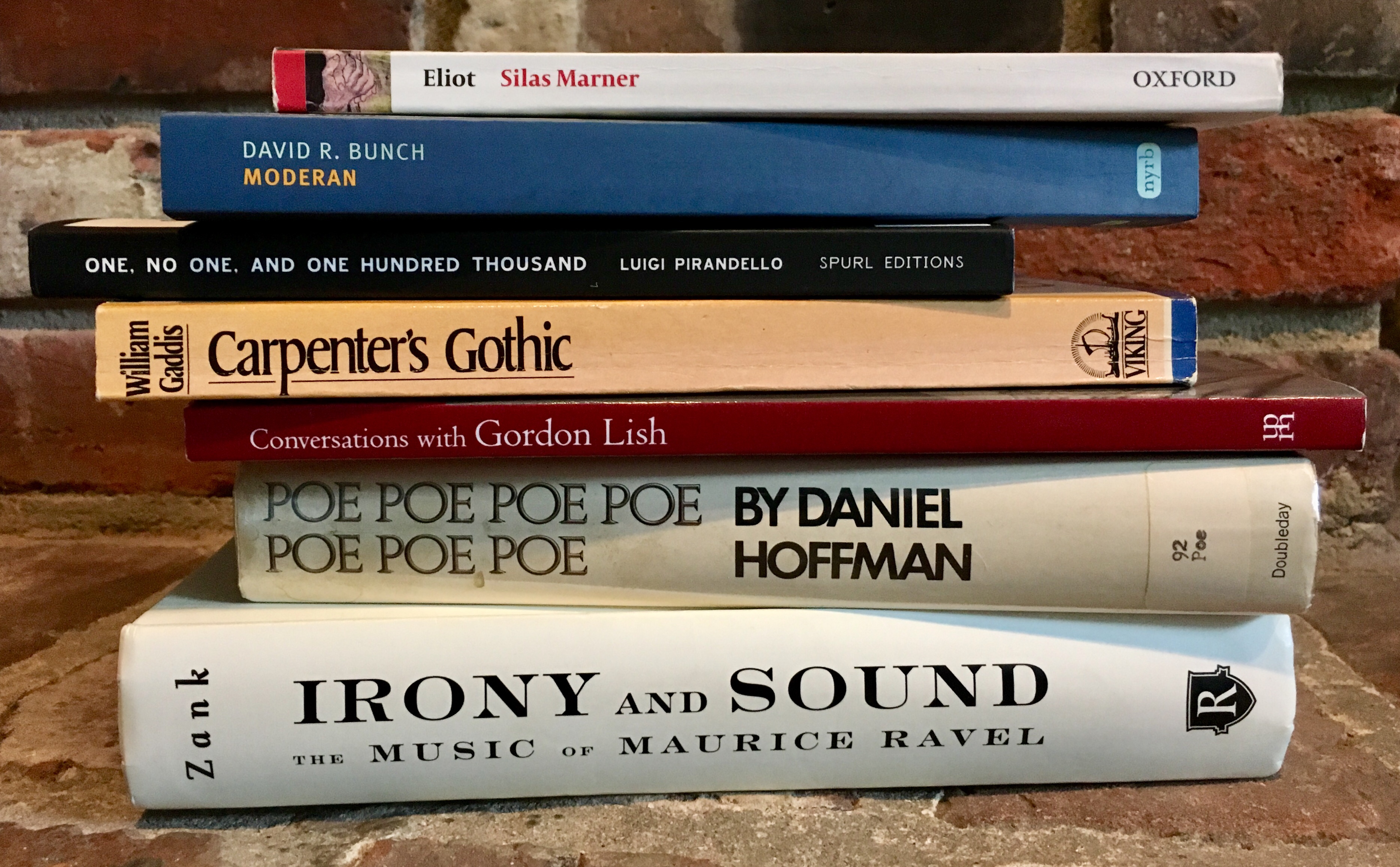
After flirting with the thing after first spying it a few weeks ago, I finally broke down and picked up Daniel Hoffman’s 1972 biography Poe Poe Poe Poe Poe Poe Poe. It is too weird not to be mine. Here is a good review of the book.

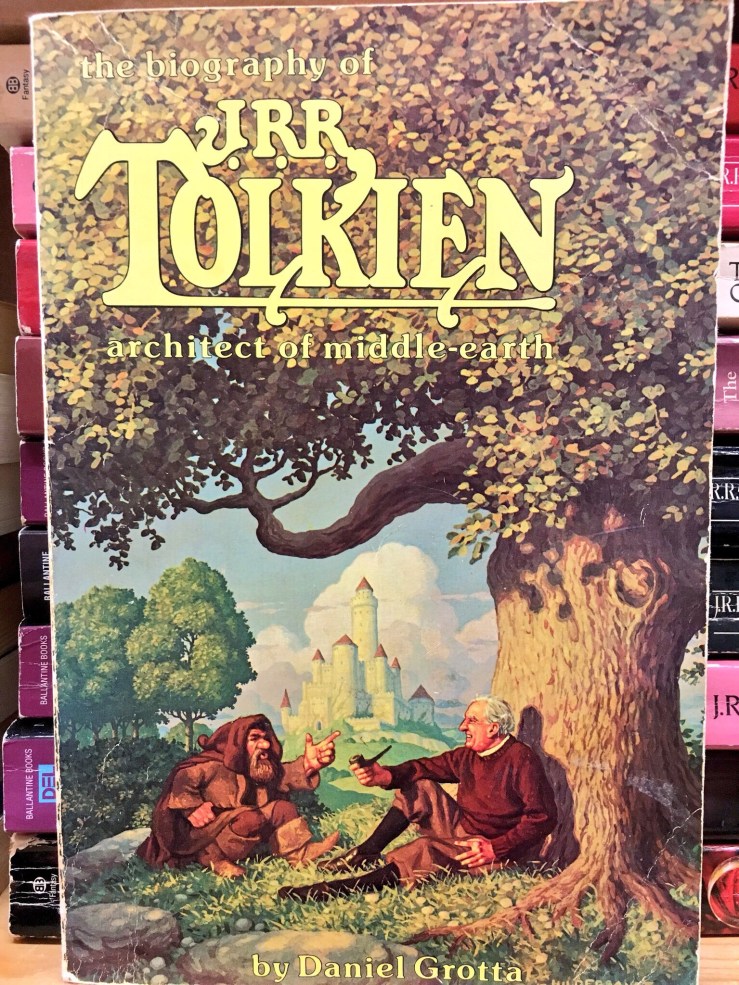
I spied but did not pick up this biography of JRR Tolkien, but its cover is utterly charming.

img_1101

A review of Anders Nilsen’s comic Tongues

screenshot-2018-08-31-at-4-30-04-pm

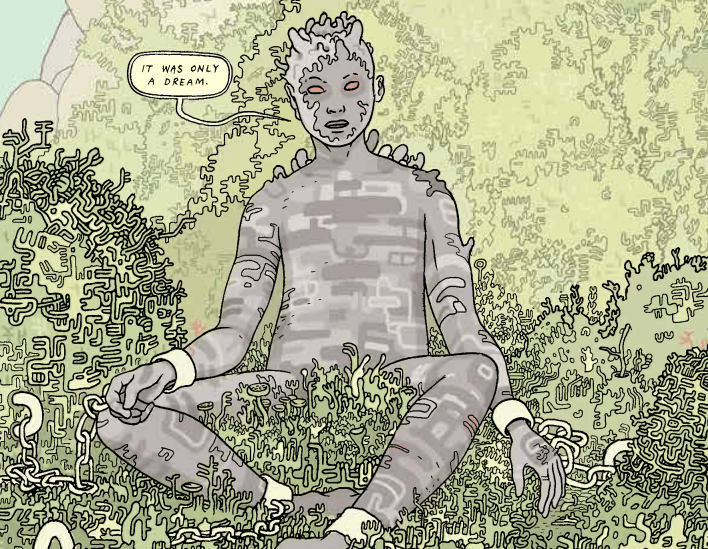
Check out my review (at The Comics Journal) of Anders Nilsen’s new comic Tongues. First paragraph:

There’s a lot going on in the first two issues of Anders Nilsen’s new graphic novel-in-progress Tongues. A black eagle plays chess with Prometheus before tearing out the chained god’s liver. A young American ambles aimlessly through a Central Asian desert, a teddy bear strapped to his back. Stealing away from his lover’s tower window, a youth morphs into a black swan and flies into the desert, where he consumes the tongue and throat of a murder victim sprawled in the sand. A little girl chats in Swahili about her assassination plans with a black chicken. (There are lots of black birds in Tongues). There’s also some literal monkey business. It’s all really beautiful stuff.

Read the full review at The Comics Journal.

screenshot-2018-08-31-at-4-34-20-pm

Notes on Vulture’s “Premature Attempt at the 21st Century Canon”

Last year, Vulture put together a list of “100 Great Works of Dystopian Fiction,” and I wrote about it on my blog. The list was good fun, and there are a handful of novels on it I’m still keeping an eye out for (feel free to send me a copy of David Ohle’s Motorman, people).

Today, Vulture published another list of 100 books, this one ambitiously but cautiously titled, “A Premature Attempt at the 21st Century Canon.” The list begins with a nearly-900 word prefatory essay called “Why Now?” that isn’t bad but is perhaps unnecessary; the sentence, “We thought it might be fun to speculate (very prematurely) on what a canon of the 21st century might look like right now” is fine enough. I mean, look: List-making is fun. Putting together a syllabus or anthology or “canon” is fun. It generates conversation and maybe pisses folks off. And Vulture racked up a range of ringers to make their list—I have a lot of respect for many of the critics and writers who contributed here.

But ultimately, I think we all know that this canon is not a canon; it cannot be a canon because a canon evolves over time, and then evolves (or devolves or implodes or mutates or pick your verb) more. We don’t know what the most important books of the past eighteen years are yet, and most of us won’t be alive to know what they turn out to be. We would be better suited, really, to naming the canonical novels of 1900-1918 I suppose. But again, I think we all know that. Lists are fun. I take Vulture’s list to be a lovely set of reading recommendations from a set of smart folks.

I’ve already prefaced too much. I will go through the list, fairly quickly, in the order that Vulture prepared it, making comments or making none, occasionally recommending an alternative. I will write quickly without much reflection and I will undoubtedly forget a ton of books.

The Last Samurai, by Helen DeWitt (September 20, 2000)

For a few years now, almost every single reader whose taste I greatly admire has recommended DeWitt’s debut novel to me. I’ll admit that I didn’t care for her novel Lightning Rods at all, which seemed like the premise for a Ballard story stretched too thin over 200 or so pages. I am close to giving up on her short story collection Some Trick. I may be entirely misreading her. However, I admire the critic Christian Lorentzen, who helmed Vulture’s essay on The Last Samurai, and the fact that it came in number one on the list means that I’ll almost certainly give it a shot.

The Corrections, by Jonathan Franzen (September 1, 2001)

I recall chuckling at the part where the one son was drunk and doing some business with the lawn clippers. I suspect there’s some nostalgia at work with this one. Should I recommend a different book so early? Sure: Open City, by Teju Cole  (February 8, 2011) is somehow absent.

Never Let Me Go, by Kazuo Ishiguro (March 3, 2005) 

I can’t quibble. Reminds me that I want to read The Unconsoled

How Should a Person Be?, by Sheila Heti (September 25, 2010) 

Autofiction! Maybe I should read it. In the meantime, may I recommend Writers, by Antoine Volodine (August 5th, 2016)?

The Neapolitan Novels, by Elena Ferrante (2011-2015)

Are these autofiction, too? I love these books. I would read a fifth one. And a sixth one. Etc.

The Argonauts, by Maggie Nelson (May 5, 2015)

I downloaded the audiobook of this this summer but kept stalling, which is weird because it’s pretty short (Nelson reads it herself, too). Give it another shot.

2666, by Roberto Bolaño (November 11, 2008) 

What can I say? There are seven review of 2666 posted on Biblioklept. I would’ve picked this as number one. Ten years after a hype cycle that could’ve withered a lesser book, 2666 seems as prescient as ever—not only in its content, but in its form—or really the welding of content and form, into one big dark dark big labyrinth-poem.

The Sellout, by Paul Beatty (March 3, 2015) 

Another reminder that I don’t read enough contemporary fiction.

The Outline Trilogy (OutlineTransit, and Kudos), by Rachel Cusk (2014–2018) 

Somehow Against the Day, by Thomas Pynchon (November 21, 2006) is not on this list, a fact that has nothing whatsoever to do with Cusk’s books, which I have not read.

Atonement, by Ian McEwan (September 2001) 

I found it a slog and an utter bore. Europe Central, by William T. Vollmann (2005) is somehow not on Vulture’s list.

The Year of Magical Thinking, by Joan Didion (September 1, 2005) 

I remember reading it when it came out but I really don’t remember anything other than the premise.  A Mercy, by Toni Morrison (November 11, 2008) is not on Vulture’s list

Leaving the Atocha Station, by Ben Lerner (August 23, 2011)

I hated 10:04 (Lerner’s follow up to Atocha Station) so much that I doubt I will ever read another book by the man. I loved loved loved Flee, by Evan Dara (2013) though.

The Flamethrowers, by Rachel Kushner (April 2, 2013) 

Luc Sante is recommending The Flamethrowers, so maybe I should finally make time to read it.

Erasure, by Percival Everett (August 1, 2001)

Haven’t read any Everett; is this a good starting place?

Middlesex, by Jeffrey Eugenides(September 4, 2002)

A thoroughly passable entertainment that has no business on a list. Did you know that Jimmy Corrigan, the Smartest Kid on Earth, by Chris Ware (2000) was published in the last 18 years also?

Platform, by Michel Houellebecq (September 5, 2002) 

Houellebecq writes fascinating stuff, and his follow up The Possibility of an Island (2005) would fit in here too.

Do Everything in the Dark, by Gary Indiana (June 1, 2003)

Lorentzen’s write up of this one made me add it to a little note I keep on my iPhone of books to look out for.

The Known World, by Edward P. Jones (August 14, 2003)

Haven’t heard of it.

The Plot Against America, by Philip Roth (September 30, 2004)

I tried with Roth, I really did, and it just didn’t stick, none of it, just not for me. Point Omega, by Don DeLillo (February 2, 2010), is, in my estimation, one of the better novels of the post-9/11 zeitgeist (and really underrated as a DeLillo novel).

The Line of Beauty, by Alan Hollinghurst (October 1, 2004)

A really fantastic book that’s not on this list is Asterios Polyp, by David Mazzucchelli (July 7, 2009).

Veronica, by Mary Gaitskill (October 11, 2005)

I’ve enjoyed some of her short stories a lot.

The Road, by Cormac McCarthy (September 26, 2006)

It’s good. No Country for Old Men (2005) is probably better, but not as zeitgeisty.

Ooga-Booga, by Frederick Seidel (November 14, 2006)

Ooga-Booga is a fantastic name for a book.

The Brief Wondrous Life of Oscar Wao, by Junot Díaz (September 6, 2007)

I recalled enjoying it fine, but it’s hardly canonical stuff, is it?

Wolf Hall, by Hilary Mantel (April 30, 2009)

I loved Bring Up the Bodies (May 8, 2012) very much too.

The Possessed, by Elif Batuman (February 16, 2010)

Always meant to read this and then never followed through.

The Particular Sadness of Lemon Cake, by Aimee Bender (June 1, 2010)

Mr. Fox, by Helen Oyeyemi (June 1, 2011)

Lives Other Than My Own, by Emmanuel Carrère (September 13, 2011)

Zone One, by Colson Whitehead (October 6, 2011) 

Gone Girl, by Gillian Flynn (May 24, 2012)

NW, by Zadie Smith (August 27, 2012)

White Girls, by Hilton Als (January 1, 2013)

Mr. Fox looks good—but is it fantastic? I read Zone One but I guess it didn’t make a huge impression on me, because I don’t recall much besides the premise. White Teeth didn’t persuade me to read another of Smith’s books, but many smart people say they are good so.

My Struggle: A Man in Love, by Karl Ove Knausgaard (May 13, 2013)

Where are my Never Knuasgaards?

The Goldfinch, by Donna Tartt (September 23, 2013)

Is this any good?

Dept. of Speculation, by Jenny Offill (January 28, 2014)

All My Puny Sorrows, by Miriam Toews (April 11, 2014)

Citizen: An American Lyric, by Claudia Rankine (October 7, 2014)

consent not to be a single being, by Fred Moten (2017–2018)

I’ve been copying and pasting the titles, authors, and dates from Vulture’s sites, and each time I have to remove their Amazon links.

The Amazing Adventures of Kavalier & Clay, by Michael Chabon (September 19, 2000)

I will never understand the acclaim for this one. Never.

Also: Hey: If this Vulture list came out in, say, 2008, how many Jonathan Lethem books would be on it? How many Dave Eggers books?

The Amber Spyglass, by Philip Pullman(October 10, 2000)

Great stuff.

True History of the Kelly Gang, by Peter Carey (January 9, 2001)

I’m beginning to get tired of this post and I wished that I hadn’t started and I apologize to you, reader. Gerald Murnane seems like a writer to put on a list.

The Beauty of the Husband: A Fictional Essay in 29 Tangos, by Anne Carson (February 6, 2001)

I don’t know this one! Autobiography of Red came out in 1998 so it can’t go on the list, and thus proves lists are only foolish fun.

The Last Report on the Miracles at Little No Horse, by Louise Erdrich (April 3, 2001)

This list is a huge reminder to me that I don’t read enough women. I try, but I think I don’t try hard enough.

Austerlitz, by W.G. Sebald (October 2, 2001)

A challenging book, and not the best starting place for Sebald, but also very rewarding. (Start with The Rings of Saturn (1995)).

Fingersmith, by Sarah Waters (February 4, 2002)

The Time of Our Singing, by Richard Powers (October 3, 2002)

The Book of Salt, by Monique Truong (April 7, 2003)

Mortals, by Norman Rush (May 27, 2003)

Home Land, by Sam Lipsyte (February 16, 2004)

I recall liking Home Land a lot, but canonical it ain’t. I tried with Richard Powers but it did not take.

Oblivion, by David Foster Wallace (June 8, 2004)

I’m tempted to write a whole mini-essay here in the middle of this damn thing about how Wallace’s literary stock seems to have fallen, at least to a broader audience, over the last few years. He seems like a target for handwringers to wring their hands over—and he (and, more importantly, his work) doesn’t even seem like the target—it’s his reputation and his fans that seem like the target. Anyway. I mean:

“Good Old Neon” is in Oblivion, and it belongs on the list.

Honored Guest, by Joy Williams (October 5, 2004)

Suite Française, by Irène Némirovsky (October 31, 2004)

The Sluts, by Dennis Cooper (January 13, 2005)

Voices From Chernobyl, by Svetlana Alexievich (June 28, 2005)

Magic for Beginners, by Kelly Link (July 1, 2005)

The Afterlife, by Donald Antrim (May 30, 2006)

Winter’s Bone, by Daniel Woodrell (August 7, 2006)

Wizard of the Crow, by Ngũgĩ wa Thiong’o (August 8, 2006)

American Genius, A Comedy, by Lynne Tillman (September 25, 2006)

Eat the Document, by Dana Spiotta (November 28, 2006)

Many casual readers may not know that Herman Melville’s Moby-Dick (1851) was both a commercial and a critical flop—it essentially ended his writing career. The book found its audience among the modernist critics, writers, and readers of the 1920s though, and by the 1940s was generally esteemed as a canonical classic.

The Harry Potter novels, by J.K. Rowling (1997–2007) 

Oh.

Sleeping It Off in Rapid City, by August Kleinzahler (April 1, 2008)

The White Tiger, by Aravind Adiga (April 22, 2008)

The Lazarus Project, by Aleksandar Hemon (May 1, 2008)

Home, by Marilynne Robinson (September 2, 2008)

Fine Just the Way It Is, by Annie Proulx (September 9, 2008)

Scenes From a Provincial Life: Boyhood, Youth, and Summertime, by J.M. Coetzee (1997–2009)

Notes From No Man’s Land, by Eula Biss (February 3, 2009)

Spreadeagle, by Kevin Killian (March 1, 2010)

There are 100 books on this list and somehow The Last Novel, by David Markson (2007) is not one of them.

Super Sad True Love Story, by Gary Shteyngart (July 27, 2010)

I genuinely hate this novel.

Seven Years, by Peter Stamm (March 22, 2011)

The Sense of an Ending, by Julian Barnes (August 4, 2011)

1Q84, by Haruki Murakami (October 25, 2011)

The Gentrification of the Mind, by Sarah Schulman (January 7, 2012)

Billy Lynn’s Long Halftime Walk, by Ben Fountain (May 1, 2012)

Capital, by John Lanchester (June 11, 2012)

I’ve finally given in and admitted to myself that Haruki Murakami is Not For Me.

The MaddAddam Trilogy (Oryx and CrakeThe Year of the Flood, and MaddAddam), by Margaret Atwood (2003-2013)

MaddAddam wasn’t especially good but Atwood’s first two are pretty good zeitgeisty affairs (and fun quick reads).

A Constellation of Vital Phenomena, by Anthony Marra (May 7, 2013)

Taipei, by Tao Lin (June 4, 2013)

Men We Reaped, by Jesmyn Ward (September 17, 2013)

Family Life, by Akhil Sharma (April 7, 2014)

How to Be Both, by Ali Smith (August 28, 2014)

A Brief History of Seven Killings, by Marlon James (October 2, 2014)

I’ll admit I’ve stopped reading even the blurbs at this point.

Preparation for the Next Life, by Atticus Lish (November 11, 2014)

A tremendous novel. The sort of thing that if you described the plot to me I’d, like, wave my hand as if to say, “Pass” — but, no, it’s so, so, so very good.

The Sympathizer, by Viet Thanh Nguyen (April 7, 2015)

The Light of the World, by Elizabeth Alexander (April 21, 2015)

The Broken Earth trilogy, by N.K. Jemisin (2015-2017)

What Belongs to You, by Garth Greenwell (January 19, 2016)

Collected Essays & Memoirs (Library of America edition), by Albert Murray (October 18, 2016)

The Needle’s Eye, by Fanny Howe (November 1, 2016)

Ghachar Ghochar, by Vivek Shanbhag (February 7, 2017)

The Hate U Give, by Angie Thomas (February 28, 2017)

All Grown Up, by Jami Attenberg (March 7, 2017)

The Best We Could Do: An Illustrated Memoir, by Thi Bui (March 7, 2017)

Tell Me How it Ends, by Valeria Luiselli (March 13, 2017)

Priestdaddy, by Patricia Lockwood (May 2, 2017)

Red Clocks, by Leni Zumas (January 16, 2018)

Asymmetry, by Lisa Halliday (February 6, 2018)

The Largesse of the Sea Maiden, by Denis Johnson (January 16, 2018)

Johnson’s novel isn’t last on the list—Halliday’s is—(and I don’t think “last” is anything but chronology for the authors near the end of the list)—but I’ve read it and I love it (and it’s another write up from Lorentzen)—but it’s not a canonical work. It’s great, and it somehow manages to match Johnson’s best early stuff, but again—not canonical. Although of course I could be wrong.

What I think is this:

For a while, we’ll see the canon, or The Canon if you prefer—and just as significantly, the idea of a literary canon–increasingly atomized, interrogated, personalized, and deconstructed (and perhaps neglected, at least from an academic standpoint). It doesn’t matter. The work of today’s literary darlings may be the foamy flotsam and jetsam of tomorrow. But of course you’ll be dead—I mean I’ll be dead—what I’m saying is we’ll be dead, so it doesn’t matter. We could pretend to be, like, Stewards of the Canon or something—hope for a cultural continuity (or discontinuity) that preserves (or disrupts) Certain Literary Values (Ours!)—or maybe just accept that reading is a bit of pleasure, a bit of fun, and that we antecede those who will decide, a hundred years from now, what the 21st-century canon really is.


David R. Bunch’s Moderan (Book acquired, 13 Sept. 2018)

img_1036

I’ve enjoyed dipping into the first few stories in NYRB’s collection of David R. Bunch’s Moderan stories over the past few days. Bunch’s weird world has meshed nicely with the Strugatsky’s The Snail on the Slope, which I finished today. More to come on Moderan, but here’s NRYB’s blurb for now:

Welcome to Moderan, world of the future. Here perpetual war is waged by furious masters fighting from Strongholds well stocked with “arsenals of fear” and everyone is enamored with hate. The devastated earth is coated by vast sheets of gray plastic, while humans vie to replace more and more of their own “soft parts” with steel. What need is there for nature when trees and flowers can be pushed up through holes in the plastic? Who requires human companionship when new-metal mistresses are waiting? But even a Stronghold master can doubt the catechism of Moderan. Wanderers, poets, and his own children pay visits, proving that another world is possible.

“As if Whitman and Nietzsche had collaborated,” wrote Brian Aldiss of David R. Bunch’s work. Originally published in science-fiction magazines in the 1960s and ’70s, these mordant stories, though passionately sought by collectors, have been unavailable in a single volume for close to half a century. Like Anthony Burgess in A Clockwork Orange, Bunch coined a mind-bending new vocabulary. He sought not to divert readers from the horror of modernity but to make us face it squarely.

This volume includes eleven previously uncollected Moderan stories.

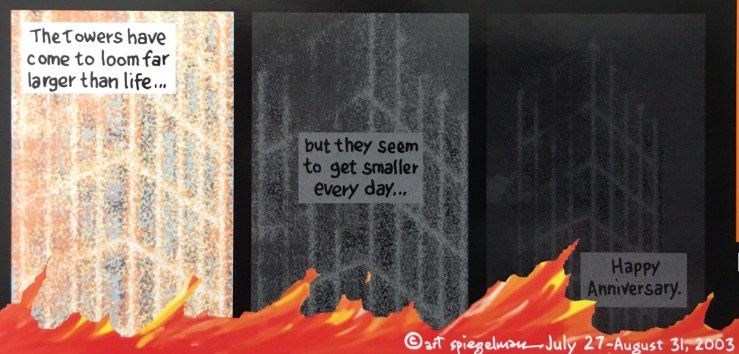
Anniversary (Art Spiegelman)

img_1026

From In the Shadow of No Towers by Art Spiegelman.


About the time the Spy and the Fanny sailed | Nathaniel Hawthorne’s journal entry for September 10th, 1852

September 10th.–Here is another beautiful morning, with the sun dimpling in the early sunshine. Four sail-boats are in sight, motionless on the sea, with the whiteness of their sails reflected in it. The heat-haze sleeps along the shore, though not so as quite to hide it, and there is the promise of another very warm day. As yet, however, the air is cool and refreshing. Around the island, there is the little ruffle of a breeze; but where the sail-boats are, a mile or more off, the sea is perfectly calm. The crickets sing, and I hear the chirping of birds besides.

At the base of the light-house yesterday, we saw the wings and feathers of a decayed little bird, and Mr. Thaxter said they often flew against the lantern with such force as to kill themselves, and that large quantities of them might be picked up. How came these little birds out of their nests at night? Why should they meet destruction from the radiance that proves the salvation of other beings?

Mr. Thaxter had once a man living with him who had seen “Old Bab,” the ghost. He met him between the hotel and the sea, and describes him as dressed in a sort of frock, and with a very dreadful countenance.

Two or three years ago, the crew of a wrecked vessel, a brigantine, wrecked near Boon Island, landed on Hog Island of a winter night, and found shelter in the hotel. It was from the eastward. There were six or seven men, with the mate and captain. It was midnight when they got ashore. The common sailors, as soon as they were physically comfortable, seemed to beperfectly at ease. The captain walked the floor, bemoaning himself for a silver watch which he had lost; the mate, being the only married man, talked about his Eunice. They all told their dreams of the preceding night, and saw in them prognostics of the misfortune.

There is now a breeze, the blue ruffle of which seems to reach almost across to the mainland, yet with streaks of calm; and, in one place, the glassy surface of a lake of calmness, amidst the surrounding commotion.

The wind, in the early morning, was from the west, and the aspect of the sky seemed to promise a warm and sunny day. But all at once, soon after breakfast, the wind shifted round to the eastward; and great volumes of fog, almost as dense as cannon-smoke, came sweeping from the eastern ocean, through the valley, and past the house. It soon covered the whole sea, and the whole island, beyond a verge of a few hundred yards. The chilliness was not so great as accompanies a change of wind on the mainland. We had been watching a large ship that was slowly making her way between us and the land towards Portsmouth. This was now hidden. The breeze is still very moderate; but the boat, moored near the shore, rides with a considerable motion, as if the sea were getting up.

Mr. Laighton says that the artist who adorned Trinity Church, in New York, with sculpture wanted some real wings from which to imitate the wings of cherubim. Mr. Thaxter carried him the wings of the white owl that winters here at the Shoals, together with those of some other bird; and the artist gave his cherubim the wings of an owl.

This morning there have been two boat-loads ofvisitors from Rye. They merely made a flying call, and took to their boats again,–a disagreeable and impertinent kind of people.

The Spy arrived before dinner, with several passengers. After dinner, came the Fanny, bringing, among other freight, a large basket of delicious pears to me, together with a note from Mr. B. B. Titcomb. He is certainly a man of excellent taste and admirable behavior. I sent a plateful of pears to the room of each guest now in the hotel, kept a dozen for myself, and gave the balance to Mr. Laighton.

The two Portsmouth young ladies returned in the Spy. I had grown accustomed to their presence, and rather liked them; one of them being gay and rather noisy, and the other quiet and gentle. As to new-comers, I feel rather a distaste to them; and so, I find, does Mr. Laighton,–a rather singular sentiment for a hotel-keeper to entertain towards his guests. However, he treats them very hospitably when once within his doors.

The sky is overcast, and, about the time the Spy and the Fanny sailed, there were a few drops of rain. The wind, at that time, was strong enough to raise white-caps to the eastward of the island, and there was good hope of a storm. Now, however, the wind has subsided, and the weather-seers know not what to forebode.

From Nathaniel Hawthorne’s journal entry for September 10th, 1852. From Passages from the American Note-Books.

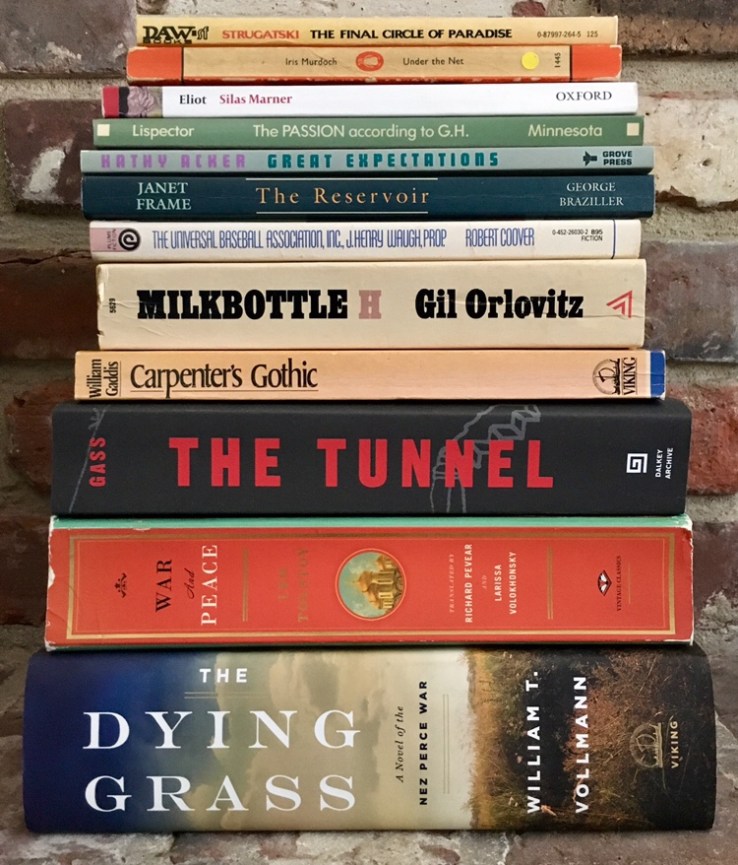
Biblioklept turns twelve today, so here are twelve books I’ll try to read some time in the next twelve years

Biblioklept is twelve today.

Here are twelve books that I’ve never read before that I’ll try to read some time in the next twelve years.

img_1014

From top to bottom, with no real hierarchy other than the physical heft involved in composing the photograph above—

The Final Circle of Paradise by Arkady and Boris Strugatsky (trans. by Leonid Renen)

I snatched up this Daw mass market paperback of this Strugatsky brothers novel a few years ago; they aren’t as easy to find as you might think (although Chicago Review Press is slowly reissuing new translations).

Chance I’ll get to it soon: High. I’ve been on a Strugatsky kick the last two years and this is one that I physically own, so.

The Net by Iris Murdoch

I picked up a slim Penguin edition of The Net when I couldn’t find The Bell (not realizing that the “Iris Murdoch” section extended in my used bookshop and that there were plenty of copies of The Bell). I loved The Bell, and want to read more Murdoch. Folks told me not to do The Net next, but I own it. So maybe let’s call it a placeholder.

Chance I’ll get to it soon: The chance that I get to another Murdoch novel sometime later this year is very high.

Silas Marner by George Eliot

I finally read Middlemarch in 2018. I loved it but good lord it was longSilas Marner is much shorter.

Chance I’ll get to it soon: Very high. It’s on deck after I finish up a few of the shorter novels and short story collections I’m reading now.

The Passion According to G.H. by Clarice Lispector (trans. by Ronald W. Sousa)

Like seemingly every book blogger, I went through a Lispector jag in the early part of this decade, gobbling up The Hour of the Star and Near to the Wild Heart. I had thought that I’d read The Passion According to G.H., but when I pulled it out earlier this year to look for something in it, I realized I hadn’t finished it—I probably hadn’t even gotten a third of the way through, if the idle bookmark (a charming doodle by my daughter) is any indication. Furthermore, the selection I was looking for, a passage on abjection, wasn’t even in Passion—it was in Wild Heart.

Chance I’ll get to it soon: Not extraordinarily high, but it’s unshelved, loose in the wilds now.

Great Expectations by Kathy Acker

I picked this one up a few weeks ago, and started in on it a bit—it’s short and has this kind of dark wild surreal icky sexy beach read vibe to it.

Chance I’ll get to it soon: I should’ve taken it camping with me next week. It’s the kind of book I want to read in a specific place that’s not, like, my couch or whatever. What I’m saying is that I’ll read this on the beach or in a tent or like, maybe you invite me down to stay at your place for a weekend but your house is so full of other guests, but, Guess what? There’s a wonderful little bedroom on your catamaran, which is docked gently right here. So after a night of good wine and good conversation, I’ll sneak off to the catamaran and read Kathy Acker before falling into wavy slumbers.

The Reservoir by Janet Frame 

I read the first few of the stories in The Reservoir a few years ago and loved them but then got absorbed in something else. I was looking for a story by her to use in class, and I pulled this collection out, but it wasn’t in there. I think it’s in The New Yorker though.

Chance I’ll get to it soon: Again–I pulled it out of rotation, so who knows? I’m in the midst of another short story collection (which is frankly turning into a hate read at this point), so maybe a few of these Frames will be an antidote to the Very Clever Author Whose Work I Keep Wincing At.

The Universal Baseball Association, Inc., J. Henry Waugh, Prop. by Robert Coover

When I picked up The Universal Baseball Association, I knew that I wasn’t going to read it anytime soon, but I also knew that I’d regret not having picked up a copy for three bucks when I had the chance. I was finishing up Going for a Beer, Coover’s recent collection of greatest hits, and was frankly exhausted with the man (the stories in A Night at the Movies can, uh, be repetitive).

Chance I’ll get to it soon: Not very high. I downloaded a copy of his novel The Origin of the Brunists one night on a lark and I don’t know if I’ll get to it any time soon either.

Milkbottle H by Gil Orlovitz

A somewhat rare cult novel with no real visible cult, Olrovitz’s Milkbottle H has been described as “the Ulysses of Philadelphia.” I found it a few weeks ago in the miscellaneous O section of my local used bookstore for three bucks. The book is long and seems to employ a mix of modernist techniques that makes it, uh, confusing at first.

Chance I’ll get to it soon: Not high. Right now it’s more like a thing I want to do, but it looks like a project that will require its own special time.

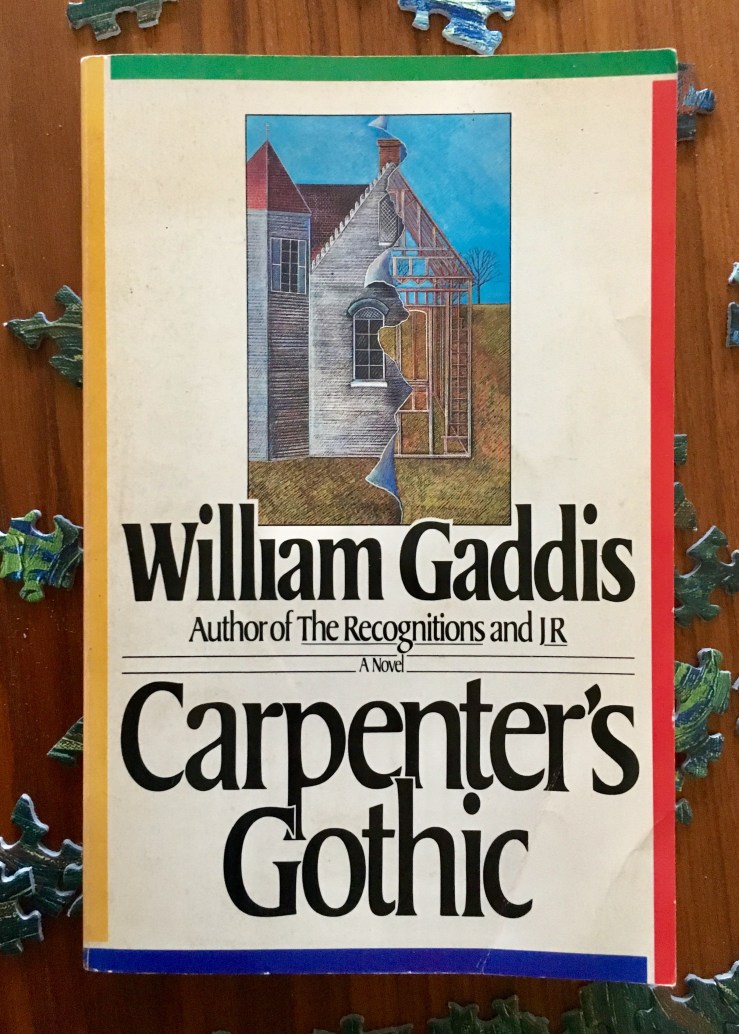
Carpenter’s Gothic by William Gaddis

I hate that I still haven’t gotten past page 30 of Carpenter’s Gothic. I gave it a second shot a few years ago and then wound up rereading J R instead.

Chance I’ll get to it soon: Should I prioritize this one after Silas Marner? I’m sure some new novel/review copy will get in the way, mucking things up…but should I commit to Carpenter’s Gothic? (I recently wrote about wanting to reread The Recognitions, so…).

The Tunnel by William H. Gass

I made a Serious Attempt earlier this year and stalled out.

Chance I’ll get to it soon: I will make a Serious Attempt earlier next year (and likely stall out).

War and Peace by Leo Tolstoy

War and Peace is one of those big books that I can’t believe I haven’t read. Earlier this year I said I’d give it a shot and then I never did (I tried The Tunnel and then settled into Middlemarch).

Chance I’ll get to it soon: Can anyone suggest a good audiobook version?

The Dying Grass by William H. Vollmann

The Dying Grass is almost 1,400 pages. I tried reading the ebook when it came out but the page breaks were weird (Vollmann has a Whitmanesque style on the page). I downloaded the audiobook which is 54 hours long, but I kept losing the thread. I picked up a used copy of the hardback for six bucks and it’s a goddamn monster.

Chance I’ll get to it soon: Try holding your breath.


Blog about the first paragraph of Arkady and Boris Strugatsky’s surreal novel The Snail on the Slope

I have been listening to Arkady and Boris Strugatsky’s 1972 novel The Snail on the Slope on audiobook over the last two weeks.

This new English translation is by Olena Bormashenko, who also translated Roadside Picnic and Hard to Be a God. (I listened to Roadside Picnic last year—this fantastic audiobook is read by Robert Forster—and read Bormashenko’s translation of Hard to Be a God after watching Aleksei German’s 2013 film adaptation. All are excellent). Chris Andrew Ciulla narrates the new audiobook of The Snail on the Slope and he does a very good job. 

Like I said, I’ve been listening to this new translation of The Snail on the Slope for a few weeks. I should be done (the book is only 9.5 hours), but I’ve listened to most of the chapters twice, and restarted the book once, because The Snail on the Slope is fucking bonkers. The novel is a wild trip, full of bizarre transformations, failed plans, jungle swamps,  marching ants, deadlings, mushrooms, foolish bureaucrats, and broken calculators—it’s abject, savage, funny, and just so fucking weird, a bizarre beast tumbling around on its own radical logic. I have about 3 hours left, but I don’t think I’ll muster a review—or a summary, I mean. Or anyway—

I mean, here’s my review: I love itI love its strange mucky weirdness, its refusal to clearly delineate the contact points of its allegorical satire, its sheer absurdity, its utter alterity. But a summary seems too much to ask so—

Here is publisher Chicago Review Press’s blurb—

The Snail on the Slope is a neglected masterpiece by Russian science fiction greats Arkady and Boris Strugatsky, who thought of it as their “most complete and important work.” now, in a stunning translation, this tour de force is ready to be introduced to a new generation of American readers. The novel takes place in two worlds. One is the Administration, an institution run by a surreal, Kafkaesque bureaucracy whose aim is to govern the forest below. The other is the Forest, a place of fear, weird creatures, primitive but garrulous people, and violence. Peretz, who works at the Administration, wants to visit the Forest. Candide crashed in the Forest years ago and wants to return to the Administration. Their journeys are surprising and bizarre, and readers are left to puzzle out the mysteries of these foreign environments. Brilliant, enigmatic, and revelatory, The Snail on the Slope is one of the greatest literary works to come out of Soviet Russia.

Here is the cover + blurb of Bantam’s 1980 edition of The Snail on the Slope (translated by Alan Meyers). Bob Larkin’s cover is more interesting to me than the “respectable” cover that Chicago Review Press put together so—

thsnlnthsl1980

This edition was apparently recalled, distribution was halted, and existing copies were destroyed.

The German cover (credited to Ute Osterwalder and Hans Ulrich Osterwalder) is also pretty cool—

dschnckmhn1978

But I promised in this blog’s headline to riff on the first paragraph, which isn’t that long, but in some ways reveals the sheer oddity of The Snail on the Slope. So here is that paragraph:

From this height, the forest looked like dappled, fluffy foam; like a gigantic, world-encompassing porous sponge; like an animal that had once lain hidden in wait, then had dozed off, becoming overgrown with coarse moss. Like a shapeless mass, hiding a face no one had ever seen.

The viewer at this height is one of the novel’s two heroes, Peretz, who dangles his feet over the forest that calls to him. I could go on about Peretz’s attraction to the unknowable forest, but let’s look instead at the similes the Strugatskys (and their translator Bormashenko) deploy here:

The forest is like

  1. foam
  2. a sponge
  3. a dozing, bemossed animal
  4. an indefinite mass with an unseen face

The utter alterity of the forest is announced at the novel’s outset. This shifting series of similes shows that the central space of The Snail on the Slope cannot have a fixed definition—it cannot even have a stable referent of similitude. Rather, the forest is ever-shifting, from the playful guise of a space of “fluffy foam” to the sinister aspect of a “shapeless mass” that hides an unknown (and unknowable) visage. The Strugatskys shuttle us from simile to simile, foregrounding one of the novel’s central themes—language has a limited purchase of reality. Peretz, a surrogate for the reader, cannot settle on a simile, which only entices him more: What is this place? What would it mean to know this place—in language? Significantly, Peretz is a linguist, but he—and the reader–have no training to properly comprehend what enfolds when The Snail on the Slope takes us into the forest. And this is the fucked up joy of the novel—one weird transformation morphs into another, similes unwinding in a stretch toward an ultimate referent that refuses to arrive on time.

A gathering impossible / General merriment (From Pynchon’s Against the Day)

A DAY OR TWO LATER, Lew went up to Carefree Court. The hour was advanced, the light failing, the air heated by the Santa Ana wind. Palm trees rattled briskly, and the rats in their nests up there hung on for dear life. Lew approached through a twilit courtyard lined with tileroofed bungalows, stucco archways, and the green of shrubbery deepening as the light went. He could hear sounds of glassware and conversation.

From the swimming pool came sounds of liquid recreation—feminine squeals, deep singlereed utterances from high and low divingboards. The festivities here this evening were not limited to any one bungalow. Lew chose the nearest, went through the formality of ringing the doorbell, but after waiting a while just walked in, and nobody noticed.

It was a gathering impossible at first to read, even for an old L.A. hand like Lew—society ladies in flapper-rejected outfits from Hamburger’s basement, real flappers in extras’ costumes—Hebrew headdresses, belly-dancing outfits, bare feet and sandals—in from shooting some biblical extravaganza, sugar daddies tattered and unshaven as street beggars, freeloaders in bespoke suits and sunglasses though the sun had set, Negroes and Filipinos, Mexicans and hillbillies, faces Lew recognized from mug shots, faces that might also have recognized him from tickets long cold he didn’t want to be reminded of, and here they were eating enchiladas and hot dogs, drinking orange juice and tequila, smoking cork-tip cigarettes, screaming in each others’ faces, displaying scars and tattoos, recalling aloud felonies imagined or planned but seldom committed, cursing Republicans, cursing police federal state and local, cursing the larger corporate trusts, and Lew slowly began to get a handle, for weren’t these just the folks that once long ago he’d spent his life chasing, them and their cousins city and country? through brush and up creek-beds and down frozen slaughterhouse alleyways caked with the fat and blood of generations of cattle, worn out his shoes pair after pair until finally seeing the great point, and recognizing in the same instant the ongoing crime that had been his own life—and for achieving this self-clarity, at that time and place a mortal sin, got himself just as unambiguously dynamited.

He gradually understood that what everybody here had in common was having survived some cataclysm none of them spoke about directly—a bombing, a massacre perhaps at the behest of the U.S. government. . . .

“No it wasn’t Haymarket.”

“It wasn’t Ludlow. It wasn’t the Palmer raids.”

“It was and it wasn’t.” General merriment.

—Thomas Pynchon’s novel Against the Day. Happy Labor Day.


“Prometheus” — Franz Kafka


Camus, Eliot, and Kuper’s Kafka (Books acquired, 31 Aug. 2018)

img_0894

I went to my favorite used bookshop on Friday afternoon to browse, order another Gerald Murnane novel, and pick up a copy of George Eliot’s Silas Marner.

I spied a late fifties mass market copy of Albert Camus’ novel Exile and the Kingdom from Vintage Books. I fell in love with the cover (by George Giusti) and ended up picking it up, although I’ll admit I haven’t read a Camus novel since college (it was The Plague if memory serves).

Browsing copies of Silas Marner, I found this monstrosity:

img_0892

I don’t even know where to start with this cover. I mean, even the colors seem to clash. It doesn’t really come across in the photo, but this hardback has a cheap greasy feel to it. I initially assumed that it was some kind of TV or film tie in, but as far as I can tell…no. Horrifying. I ended up going with the Oxford edition with Ferdinand Hodler’s painting Unemployed on the cover.

When I got home, the mail had come. It included a copy of Peter Kuper’s Kafkaesque, which collects 14 of Kuper’s illustrated Kafka translations. Publisher Norton’s blurb:

Award-winning graphic novelist Peter Kuper presents a mesmerizing interpretation of fourteen iconic Kafka short stories.

Long fascinated with the work of Franz Kafka, Peter Kuper began illustrating his stories in 1988. Initially drawn to the master’s dark humor, Kuper adapted the stories over the years to plumb their deeper truths. Kuper’s style deliberately evokes Lynd Ward and Frans Masereel, contemporaries of Kafka whose wordless novels captured much of the same claustrophobia and mania as Kafka’s tales. Working from new translations of the classic texts, Kuper has reimagined these iconic stories for the twenty-first century, using setting and perspective to comment on contemporary issues like civil rights and homelessness.

Longtime lovers of Kafka will appreciate Kuper’s innovative interpretations, while Kafka novices will discover a haunting introduction to some of the great writer’s most beguiling stories, including “A Hunger Artist,” “In The Penal Colony,” and “The Burrow.” Kafkaesque stands somewhere between adaptation and wholly original creation, going beyond a simple illustration of Kafka’s words to become a stunning work of art.

It was September now (Cormac McCarthy’s Suttree)

It was September now, a season of rains. The gray sky above the city washed with darker scud like ink curling in a squid’s wake. The blacks can see the boy’s fire at night and glimpses of his veering silhouette slotted in the high nave, outsized among the arches. All night a ruby glow suffuses the underbridge from his garish chancel lamps. The city’s bridges all betrolled now what with old ventriloquists and young melonfanciers. The smoke from their fires issues up unseen among the soot and dust of the city’s right commerce.

Sometimes in the evening Suttree would bring beers and they’d sit there under the viaduct and drink them. Harrogate with questions of city life.

You ever get so drunk you kissed a nigger?

Suttree looked at him. Harrogate with one eye narrowed on him to tell the truth. I’ve been a whole lot drunker than that, he said.

Worst thing I ever done was to burn down old lady Arwood’s house.”

“You burned down an old lady’s house?

Like to of burnt her down in it. I was put up to it. I wasnt but ten year old.

Not old enough to know what you were doing.

Yeah.–Hell no that’s a lie. I knowed it and done it anyways.

Did it burn completely down?

Plumb to the ground. Left the chimbley standin was all. It burnt for a long time fore she come out.

Did you not know she was in there?

I disremember. I dont know what I was thinkin. She come out and run to the well and drawed a bucket of water and thowed it at the side of the house and then just walked on off towards the road. I never got such a whippin in my life. The old man like to of killed me.

Your daddy?

Yeah. He was alive then. My sister told them deputies when they come out to the house, they come out there to tell her I was in the hospital over them watermelons, she told em I didnt have no daddy was how come I got in trouble. But shit fire I was mean when I did have one. It didnt make no difference.

Were you sorry about it? The old lady’s house I mean.

Sorry I got caught.

Suttree nodded and tilted his beer. It occurred to him that other than the melon caper he’d never heard the city rat tell anything but naked truth.

A vignette from Cormac McCarthy’s Suttree—a transition scene perhaps, but one that draws Suttree and Harrogate closer, even as it underlines their differences.

In my review of Suttree a few years back, I argued that the novel is a grand synthesis of American literature, brimming with literary allusions. I singled out Faulkner’s “A Rose for Emily” as the basis for a later scene with Harrogate, so I can’t help but think of Faulkner’s “Barn Burning” here.

A review of Olga Tokarczuk’s novel Flights

Olga Tokarczuk’s Flights,

being a book of diversions, of anything but the straight and narrow; a book bound by water, in that it is fluid, unfixed, and preoccupied with the very stuff, and the whales within; an interminable book, in which numerous stories never finish (for what is an ending but a wall to be destroyed or circumnavigated by time and other stories), but also a terminal book, in that it is “situated at the extremity of something” (New Oxford American Dictionary), like a book set on the eve of an important day, the day we leave, the day we make our move, the day we attack; and speaking of extremities, it is a book obsessed with fingers and toes and the blood vessels within, and all of the body’s parts, muscles in particular, and their preservation, long after the soul has left the body, submerged in anything from booze to Kaiserling III and held in a jar, transported across the world via horse and buggy or Russian galleon, to be placed on full display before students, kings, curious onlookers, and a grieving daughter, whose letters challenge the dubious practice of plastination; a book in which letters cross paths with lists, travelogues, tall tales, myths, ruminations on plastic bags and sanitary pads, dark matter and swastikas, stories that traverse the ruins of Athens, a boiler room in Moscow, the olive groves of Croatia, not to mention places without names, impossible to find on a map, without coordinates, all of it jumping from past to present and back again, if linear time is to be believed; a book of wandering women, who disappear and reappear on their own accord, slipping into the divine rhythms of circular time; a book about the temptation to make meaning out of any assortment of objects; a book made of 116 sections in all, which is the number of years the Hundred Years’ War actually lasted, and is the prefix for several European telephone helplines such as 116000, the hotline for missing children, or 116123, the emotional support helpline, according to Wikipedia, a site which may be, says Tokarczuk, “mankind’s most honest cognitive project,” except that it cannot index “its inverse, its inner lining, everything we don’t know”; a book populated by characters who either do not know, can’t figure it out, are lost, are trying to figure out what happened in that span of time that slipped their grasp, or those who know it all, who know the map like the back of their hand, or so they think; a book that anticipates the sovereignty of airports, those modern portals that make us time travelers, where you and I might collide, and if we do, will we talk to each other, tell our stories, move beyond the Three Travel Questions (where are you from, where are you coming from, where are you going) and into our ideas, those dangerous, viscous things, or will we simply utter apologies and head to our gates; a book that floods, that breaks at the seams and spills out into the world, so that fact and fiction get scrambled and mix in the deluge, becoming indistinguishable; a book with no answers, only arrows pointing in other directions, toward books yet to be written, histories to be retold, cities at the ends of the earth, or to the person nearest you; a book oriented, most importantly, toward other pilgrims…

…is masterfully translated from the Polish by Jennifer Croft, available from your English publisher of choice, and a magnificent read, one that travelled with me across Poland, Ireland, and the UK, and has convinced me, once and for all, that it is a crime never to read Moby-Dick.

(Image above, a map of Novaya Zemlya, via. Read an excerpt over at Asymptotein their January 2016 issue.)

“Quite an original” (From Herman Melville’s novel The Confidence-Man)

“Quite an original:” A phrase, we fancy, rather oftener used by the young, or the unlearned, or the untraveled, than by the old, or the well-read, or the man who has made the grand tour. Certainly, the sense of originality exists at its highest in an infant, and probably at its lowest in him who has completed the circle of the sciences.

As for original characters in fiction, a grateful reader will, on meeting with one, keep the anniversary of that day. True, we sometimes hear of an author who, at one creation, produces some two or three score such characters; it may be possible. But they can hardly be original in the sense that Hamlet is, or Don Quixote, or Milton’s Satan. That is to say, they are not, in a thorough sense, original at all. They are novel, or singular, or striking, or captivating, or all four at once.

More likely, they are what are called odd characters; but for that, are no more original, than what is called an odd genius, in his way, is. But, if original, whence came they? Or where did the novelist pick them up?

Where does any novelist pick up any character? For the most part, in town, to be sure. Every great town is a kind of man-show, where the novelist goes for his stock, just as the agriculturist goes to the cattle-show for his. But in the one fair, new species of quadrupeds are hardly more rare, than in the other are new species of characters—that is, original ones. Their rarity may still the more appear from this, that, while characters, merely singular, imply but singular forms so to speak, original ones, truly so, imply original instincts.

In short, a due conception of what is to be held for this sort of personage in fiction would make him almost as much of a prodigy there, as in real history is a new law-giver, a revolutionizing philosopher, or the founder of a new religion.

In nearly all the original characters, loosely accounted such in works of invention, there is discernible something prevailingly local, or of the age; which circumstance, of itself, would seem to invalidate the claim, judged by the principles here suggested.

Furthermore, if we consider, what is popularly held to entitle characters in fiction to being deemed original, is but something personal—confined to itself. The character sheds not its characteristic on its surroundings, whereas, the original character, essentially such, is like a revolving Drummond light, raying away from itself all round it—everything is lit by it, everything starts up to it (mark how it is with Hamlet), so that, in certain minds, there follows upon the adequate conception of such a character, an effect, in its way, akin to that which in Genesis attends upon the beginning of things.

For much the same reason that there is but one planet to one orbit, so can there be but one such original character to one work of invention. Two would conflict to chaos. In this view, to say that there are more than one to a book, is good presumption there is none at all. But for new, singular, striking, odd, eccentric, and all sorts of entertaining and instructive characters, a good fiction may be full of them. To produce such characters, an author, beside other things, must have seen much, and seen through much: to produce but one original character, he must have had much luck.

There would seem but one point in common between this sort of phenomenon in fiction and all other sorts: it cannot be born in the author’s imagination—it being as true in literature as in zoology, that all life is from the egg.

From Herman Melville’s novel The Confidence-Man.

Disparage the press? (From Herman Melville’s novel The Confidence-Man)

“Anything in praise of the press I shall be happy to hear,” rejoined the cosmopolitan, “the more so,” he gravely proceeded, “as of late I have observed in some quarters a disposition to disparage the press.”

“Disparage the press?”

“Even so; some gloomy souls affirming that it is proving with that great invention as with brandy or eau-de-vie, which, upon its first discovery, was believed by the doctors to be, as its French name implies, a panacea—a notion which experience, it may be thought, has not fully verified.”

“You surprise me, Frank. Are there really those who so decry the press? Tell me more. Their reasons.”

“Reasons they have none, but affirmations they have many; among other things affirming that, while under dynastic despotisms, the press is to the people little but an improvisatore, under popular ones it is too apt to be their Jack Cade. In fine, these sour sages regard the press in the light of a Colt’s revolver, pledged to no cause but his in whose chance hands it may be; deeming the one invention an improvement upon the pen, much akin to what the other is upon the pistol; involving, along with the multiplication of the barrel, no consecration of the aim. The term ‘freedom of the press’ they consider on a par with freedom of Colt’s revolver. Hence, for truth and the right, they hold, to indulge hopes from the one is little more sensible than for Kossuth and Mazzini to indulge hopes from the other. Heart-breaking views enough, you think; but their refutation is in every true reformer’s contempt. Is it not so?”

“Without doubt. But go on, go on. I like to hear you,” flatteringly brimming up his glass for him.

“For one,” continued the cosmopolitan, grandly swelling his chest, “I hold the press to be neither the people’s improvisatore, nor Jack Cade; neither their paid fool, nor conceited drudge. I think interest never prevails with it over duty. The press still speaks for truth though impaled, in the teeth of lies though intrenched. Disdaining for it the poor name of cheap diffuser of news, I claim for it the independent apostleship of Advancer of Knowledge:—the iron Paul! Paul, I say; for not only does the press advance knowledge, but righteousness. In the press, as in the sun, resides, my dear Charlie, a dedicated principle of beneficent force and light. For the Satanic press, by its coappearance with the apostolic, it is no more an aspersion to that, than to the true sun is the coappearance of the mock one. For all the baleful-looking parhelion, god Apollo dispenses the day. In a word, Charlie, what the sovereign of England is titularly, I hold the press to be actually—Defender of the Faith!—defender of the faith in the final triumph of truth over error, metaphysics over superstition, theory over falsehood, machinery over nature, and the good man over the bad. Such are my views, which, if stated at some length, you, Charlie, must pardon, for it is a theme upon which I cannot speak with cold brevity…”

From Chapter 24 of Herman Melville’s novel The Confidence-Man.

Some sentences on some books I’ve read or have been reading

img_0857

I finished Gerald Murnane’s 1982 novel The Plains last week. The Plains is quite short—it’s a novella really—and is divided into three parts. I read Part I in two sittings, gulping down the first-person narrator’s description of an Australia that exists in some alternate universe, where aristocratic plainsmen of Inner Australia keep grand houses populated by every kind of artisan. The novel’s first 70 pages or so move at a brisk pace, brimming with hints of a mythology that Murnane’s narrator keeps always just outside the frame. I read Parts II and III (much shorter than Part I) at a much slower pace. Murnane’s prose condenses here, his sentences tangling out into thick knots of consciousness. I’m still not sure what to make of the novel’s conclusion.

I’m absolutely crawling through Mario Benedetti’s The Truce (in English translation by Harry Morales). Subtitled The Diary of Martín Santomé, this Uruguayan novel is told in lucid prose. Santomé’s journal entries track his day to day life as a man with three children—the youngest approaching adulthood—who was widowed early in life. He’s just now started up a love affair with a younger colleague (an affair that he doesn’t want to call an affair and an affair which I think is like hey a very bad idea, Martin!). It reminds me a bit of John Williams’ novel Stoner. I’ve been reading one or two of the diary entries a day, usually in the morning before I leave for work. It’s a different way to read a book (at least for me anyway).

Herman Melville’s The Confidence-Man is my big re-read right now. I’m having a lot more fun with it the second time. I think the first time taught me how to read it. I’m moving pretty slowly but that’s fine.

I read most of Antoine Volodine’s Post-Exoticism in 10 Lessons, Lesson 11 in two sittings. I want to write a proper review of the novel, or novella, really, or really it’s something besides a novel or novella—anyway, I want to write a proper review on the thing, but I need to go back and finish his novel Minor Angels, which I started earlier in the summer but lost track of (I think I was trying to plow through the end of Eliot’s Middlemarch at the time).

I’ve read the first and third (but not the second) stories in Helen DeWitt’s new collection Some Trick and…I don’t know. There’s a part of me that doesn’t trust my reaction so far. I know that what she’s doing here would’ve flipped any wig I was wearing ten or twelve years ago, but I find myself not particularly persuaded to keep going. I skipped to the third story because it had a bunch of footnotes, a la DF Wallace and that intrigued me. It’s a bit clever, yes?

I’ve only read two of the stories in Tadao Tsuge’s collection of “alternative manga” (mostly from the sixties and seventies) Slum Wolf (in English translation by Ryan Holmberg), but there’s definitely a different flavor here—rough, weird, and a bit chilling. I hope to post a review of Slum Wolf at The Comics Journal next month.

Not pictured above because I read it on an iPad: The first two chapters of Anders Nilsen’s graphic novel Tongues, which is a loose retelling of the story of Prometheus and a few other myths (maybe). There’s a lot going on it. The art is gorgeous—a bit reminiscent of Geof Darrow, but more not as sprawly. Again, I hope to do a review at TCJ soon on these.

img_0635

Also not pictured because also an e-book: Provisional Biography of Mose Eakins, a two-act play by Evan Dara. You can download the play here without paying upfront: The site instead gives this somewhat cryptic message on payment: “If you please, reciprocation accepted only after reading. Thank you.” The message actually makes sense after you’ve read the play, which is very much about paying for language—literally utterances as commodities. Mose Eakins is “imparlent” — he cannot communicate with those around him. The play is often funny, but also very sad, and it’s impossible not to read it as an allegory for the limitations of real communication in the age of late capitalism. I read it all at once last night. Speaking of which, I need to reciprocate now.


What fictional character would Italo Calvino like to be?

Mercutio. Among his virtues, I admire above all his lightness in a world of brutality, his dreaming imagination – as the poet of Queen Mab – and at the same time his wisdom, as the voice of reason amid the fanatical hatreds of Capulets and Montagues. He sticks to the old code of chivalry at the price of his life, perhaps just the sake of style, and yet he is a modern man, skeptical and ironic – a Don Quixote who knows very well what dreams are and what reality is, and he lives both with open eyes.

From The New York Times 1985 obituary of Italo Calvino. The obituary is here citing an interview Calvino did with The New York Times Book Review in late 1984.