Some pics I took of Flannery O’Connor’s childhood home

img_5525

I enjoyed my visit to Flannery O’Connor’s childhood home in Savannah, Georgia. We visited the day before her birthday.

The house is located at 207 East Charlton Street, facing Lafayette Square, with a prominent view of the Cathedral of St. John the Baptist, where young Mary Flannery attended mass.

Here’s the house:

img_5551 Continue reading “Some pics I took of Flannery O’Connor’s childhood home”

“The Man of Adamant,” an apologue by Nathaniel Hawthorne

“The Man of Adamant”

An Apologue

by Nathaniel Hawthorne


IN the old times of religious gloom and intolerance lived Richard Digby, the gloomiest and most intolerant of a stern brotherhood. His plan of salvation was so narrow, that, like a plank in a tempestuous sea, it could avail no sinner but himself, who bestrode it triumphantly, and hurled anathemas against the wretches whom he saw struggling with the billows of eternal death. In his view of the matter, it was a most abominable crime–as, indeed, it is a great folly–for men to trust to their own strength, or even to grapple to any other fragment of the wreck, save this narrow plank, which, moreover, he took special care to keep out of their reach. In other words, as his creed was like no man’s else, and being well pleased that Providence had entrusted him, alone of mortals with the treasure of a true faith, Richard Digby determined to seclude himself to the sole and constant enjoyment of his happy fortune.

“And verily,” thought he, “I deem it a chief condition of Heaven’s mercy to myself, that I hold no communion with those abominable myriads which it hath cast off to perish. Peradventure, were I to tarry longer in the tents of Kedar, the gracious boon would be revoked, and I also be swallowed up in the deluge of wrath, or consumed in the storm of fire and brimstone, or involved in whatever new kind of ruin is ordained for the horrible perversity of this generation.”

So Richard Digby took an axe, to hew space enough for a tabernacle in the wilderness, and some few other necessaries, especially a sword and gun, to smite and slay any intruder upon his hallowed seclusion; and plunged into the dreariest depths of the forest. On its verge, however, he paused a moment, to shake off the dust of his feet against the village where he had dwelt, and to invoke a curse on the meetinghouse, which he regarded as a temple of heathen idolatry. He felt a curiosity, also, to see whether the fire and brimstone would not rush down from Heaven at once, now that the one righteous man had provided for his own safety. But, as the sunshine continued to fall peacefully on the cottages and fields, and the husbandmen labored and children played, and as there were many tokens of present happiness, and nothing ominous of a speedy judgment, he turned away, somewhat disappointed. The further he went, however, and the lonelier he felt himself, and the thicker the trees stood along his path, and the darker the shadow overhead, so much the more did Richard Digby exult. He talked to himself, as he strode onward; he read his Bible to himself, as he sat beneath the trees; and, as the gloom of the forest hid the blessed sky, I had almost added, that, at morning, noon, and eventide, he prayed to himself. So congenial was this mode of life to his disposition, that he often laughed to himself, but was displeased when an echo tossed him back the long, loud roar. Continue reading ““The Man of Adamant,” an apologue by Nathaniel Hawthorne”

The Inhumanity Museum


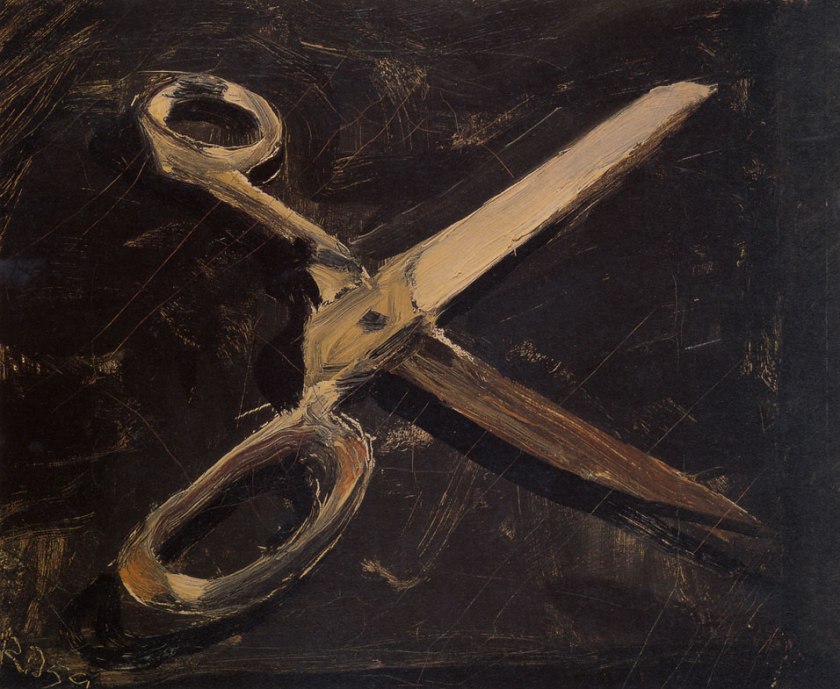
Scissors, Richard Diebenkorn

Near the end of the first cycle-section of Doris Lessing’s novel The Golden Notebook, protagonist Anna Wulf abandons the pretense of personal narrative in favor of pastiche, collage, clipping. Our heroine cuts and pastes material directly from the newspapers she’s been reading into her blue notebook:

[At this point the diary stopped, as a personal document. It continued in the form of newspaper cuttings, carefully pasted in and dated.]

March, 50

The modeller calls this the ‘H-Bomb Style’, explaining that the ‘H’ is for peroxide of hydrogen, used for colouring. The hair is dressed to rise in waves as from a bomb-burst, at the nape of the neck. Daily Telegraph.

July 13th, 50

There were cheers in Congress today when Mr Lloyd Bentsen, Democrat, urged that President Truman should tell the North Koreans to withdraw within a week or their towns would be atom-bombed. Express.

July 29th, 50

Britain’s decision to spend £100 million more on Defence means, as Mr Attlee has made clear, that hoped-for improvements in living standards and social services must be postponed. New Statesman.

Aug. 3, 50

America is to go right ahead with the H Bomb, expected to be hundreds of times more powerful than the atom bombs. Express.

The passages continue for pages in the same vein until:

30th March 2nd H-BOMB EXPLODED. Express.

This section of The Golden Notebook fits neatly into what I’ve come to think of as the Inhumanity Museum. The writer clips from the newspaper and passes those fragments to the author, who tosses them to the speaker, the narrator, a character, perhaps—and asks: What to do with these? Can you believe this? Are there even words for this? 

Which is the appeal to the writer, I think, of clippings that belong to the Inhumanity Museum: That the journalist telegraphs (plainly, simply, succinctly) what the novelist may deem ineffable.

I’ve appropriated the term the Inhumanity Museum from William H. Gass’s novel Middle C:

The gothic house he and his mother shared had several attic rooms, and Joseph Skizzen had decided to devote one of them to the books and clippings that composed his other hobby: the Inhumanity Museum. He had painstakingly lettered a large white card with that name and fastened it to the door. It did not embarrass him to do this, since only he was ever audience to the announcement. Sometimes he changed the placard to an announcement that called it the Apocalypse Museum instead. The stairs to the third floor were too many and too steep for his mother now. Daily, he would escape his sentence in order to enter yesterday’s clippings into the scrapbooks that constituted the continuing record:

Friday June 18, 1999

Sri Lanka. Municipal workers dug up more bones from a site believed to contain the bodies of hundreds of Tamils murdered by the military. Poklek, Jugoslavia. 62 Kosovars are packed into a room into which a grenade is tossed. Pristina, Jugoslavia. It is now estimated that 10,000 people were killed in the Serbian ethnic-cleansing pogram..

There is more

Tomato and Knife, Richard Diebenkorn

I’m still not sure exactly how the Inhumanity Museum fits into Middle C’s tale of fraud and music. Maybe it’s just Gass’s excuse to unload some of the material he’s been clipping for years. (Maybe I need to reread Middle C).

Here is Gass, in a 2009 interview, discussing William Gaddis (the emphasis is mine): 

We were very close, even though we spent most of our time apart. I really had the warmest… We had great times. We both had the same views: Mankind, augh hsdgahahga!!!!. And he would read the paper and make clippings out of it. He was always saying, “Did you read…!?” We would both exalt in our gloom.

“Mankind [unintelligible]!” Ha! He would read the paper and make clippings out of it, like Pivner père in Gaddis’s novel The Recognitions, who builds his own Inhumanity Museum:

…he picked up his newspaper. The Sunday edition, still in the rack beside him, required fifty acres of timber for its “magic transformation of nature into progress, benefits of modern strides in transportation, communication, and freedom of the press: public information. (True, as he got into the paper, the average page was made up of a half-column of news, and four-and-one-half columns of advertising.) A train wreck in India, 27 killed, he read; a bus gone down a ravine in Chile, 1 American and 11 natives; avalanche in Switzerland, death toll mounts . . . This evening edition required only a few acres of natural grandeur to accomplish its mission (for it carried less advertising). Mr. Pivner read carefully. Kills father with meat-ax. Sentenced for slaying of three. Christ died of asphyxiation, doctor believes. Woman dead two days, invalid daughter unable to summon help. Nothing escaped Mr. Pivner’s eye, nor penetrated to his mind; nothing evaded his attention, as nothing reached his heart. The headless corpse. Love kills penguin. Pig got rheumatism. Nagged Bible reader slays wife. “Man makes own death chair, 25,000 volts. “Ashamed of world,” kills self. Fearful of missing anything, he read on, filled with this anticipation which was half terror, of coming upon something which would touch him, not simply touch him but lift him and carry him away.Every instant of this sense of waiting which he had known all of his life, this waiting for something to happen (uncertain quite what, and the Second Advent intruded) he brought to his newspaper reading, spellbound and ravenous. 

There is more.

This section of The Recognitions reminds me of Félix Fénéon’s faits divers, microtragedies composed in 1906 for the newspaper Le Matin:.

“If my candidate loses, I will kill myself,” M. Bellavoine, of Fresquienne, Seine-Inferieure, had declared. He killed himself.

A thunderstorm interrupted the celebration in Orléans in honor of Joan of Arc and the 477th anniversary of the defeat of the English.

In the course of a heated political discussion in Propriano, Corsica, two men were killed and two wounded.

In Bone, the courts and the bar have reestablished contact with the prison, now that the typhus outbreak there has been curbed.

Clash in the street between the municipal powers of Vendres, Herault, and the party of the opposition. Two constables were injured.

Despondent owing to the bankruptcy of one of his debtors, M. Arturo Ferretti, merchant of Bizerte, killed himself with a hunting rifle.

Etc.

Scissors and Lemon, Richard Diebenkorn

Fénéon’s faits divers owe their survival to scissors and paste: His mistress cut each column from the paper and collected them in an album. A century later, NYRB published Novels in Three Lines, their own album of Fénéon’s faits divers.

Recently, the writer Teju Cole has followed Fénéon’s example, composing his own series of small fatesCole began his small fates while working on his “new book, a non-fictional narrative of Lagos.” Cole’s small fates had their origin in the crime and metro sections of the Nigerian newspapers that he read daily. Attracted to the “life in the raw” presented here, Cole revised the news articles into a synthesis of Fénéon’s style with his own. He felt that these stories were “too brief, too odd, and certainly too sensational” for his new book, and yet he was compelled to tell them anyway. Even if he couldn’t fit them into his new book, they were nevertheless part of his storytelling project.

Fénéon was elevating a preexisting form of newspaper reporting, artfully injecting humor and subtle observation into the structure of his faits divers, unlike Lessing, Gaddis, or Gass, who used clippings to inject reality—and the real human inhumanity of reality—into their fictional texts. 

Perhaps Fénéon was motivated by the same spirit as those later authors. Perhaps like Pivner the Elder in Gaddis’s The Recognitions “the newspaper served him, externalizing in the agony of others the terrors and temptations inadmissible in himself.” There’s something defensive about the humor in Fénéon’s faits divers, a human reaction to horror we misname inhuman.

Is there another way to react? In her short story “Greenleaf,” Flannery O’Connor converts the Inhumanity Museum into a strange, private shrine. Mrs. Greenleaf (whom the protagonist Mrs. May regards with utter contempt) buries her clippings and prays over them:

Instead of making a garden or washing their clothes, her preoccupation was what she called “prayer healing.” Every day she cut all the morbid stories out of the newspaper—the accounts of women who had been raped and criminals who had escaped and children who had been burned and of train wrecks and plane crashes and the divorces of movie stars. She took these to the woods and dug a hole and buried them and then she fell on the ground over them and mumbled and groaned for an hour or so, moving her huge arms back and forth under her and out again and finally just lying down flat and, Mrs. May suspected, going to sleep in the dirt.

The opening lines suggest an ironic displacement. Mrs. May, a thoroughly worldly figure, devoid of spirituality, thinks that Mrs. Greenleaf should be “making a garden or washing,” activities we might associate with a kind of spiritual activity—Eden-building or purifying (for Mrs. May these would be quotidian chores). Mrs. Greenleaf’s prayer healing is of course explicitly spiritual, but its spirituality directly responds to the awful lurid everyday morbidity of the news. 

O’Connor doesn’t use the same (in)direct cut and paste technique as some of the other writers I’ve mentioned here, but her fiction is full of newspaper and magazine readers. I think now of Bailey, the ill-fated father in “A Good Man Is Hard to Find,” whom we meet “bent over the orange sports section of the Journal.” There’s something lurid about the orangeness, a bright distraction. (In O’Connor’s universe The Holy Bible is the book everyone evades contemplating). And it’s in that same paper that the Misfit is introduced, the serial killer who brings the characters from distraction back to reality.

For O’Connor, the stakes couldn’t be higher—she was concerned for the immortal soul:

…in my own stories I have found that violence is strangely capable of returning my characters to reality and preparing them to accept their moment of grace.  Their heads are so hard that almost nothing else will do the work.  This idea, that reality is something to which we must be returned at considered cost, is one which is seldom understood by the casual reader, but it is one which is implicit in the Christian view of the world.

While O’Connor was deeply invested in her own “Christian view of the world,” I think she offers a description, if not a definition, of how the Inhumanity Museum can function in literary texts. It’s the violent shock of the real that the author wishes to evoke. The utter banality of how that reality is communicated through mass texts serves to bring the shock into sharper relief.

Is the goal then to unlearn the dulled reading habits that Gaddis showcases in Pivner?: “Nothing escaped Mr. Pivner’s eye, nor penetrated to his mind; nothing evaded his attention, as nothing reached his heart.” Yet to be so fully absorbed into the pain and ugliness and stupidity of the world would surely result in crushing madness, or “chaos,” as Anna Wulf of The Golden Notebook claims. And perhaps that’s why the Inhumanity Museum is such an important location. A museum has an exit.

[Ed. note–Biblioklept originally published this post in August, 2014].

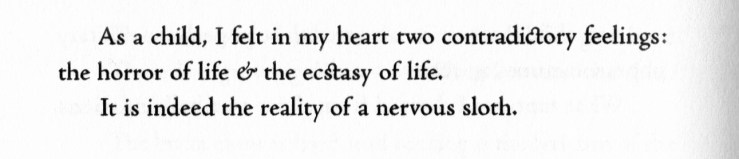
Indeed the reality of a nervous sloth (Baudelaire)

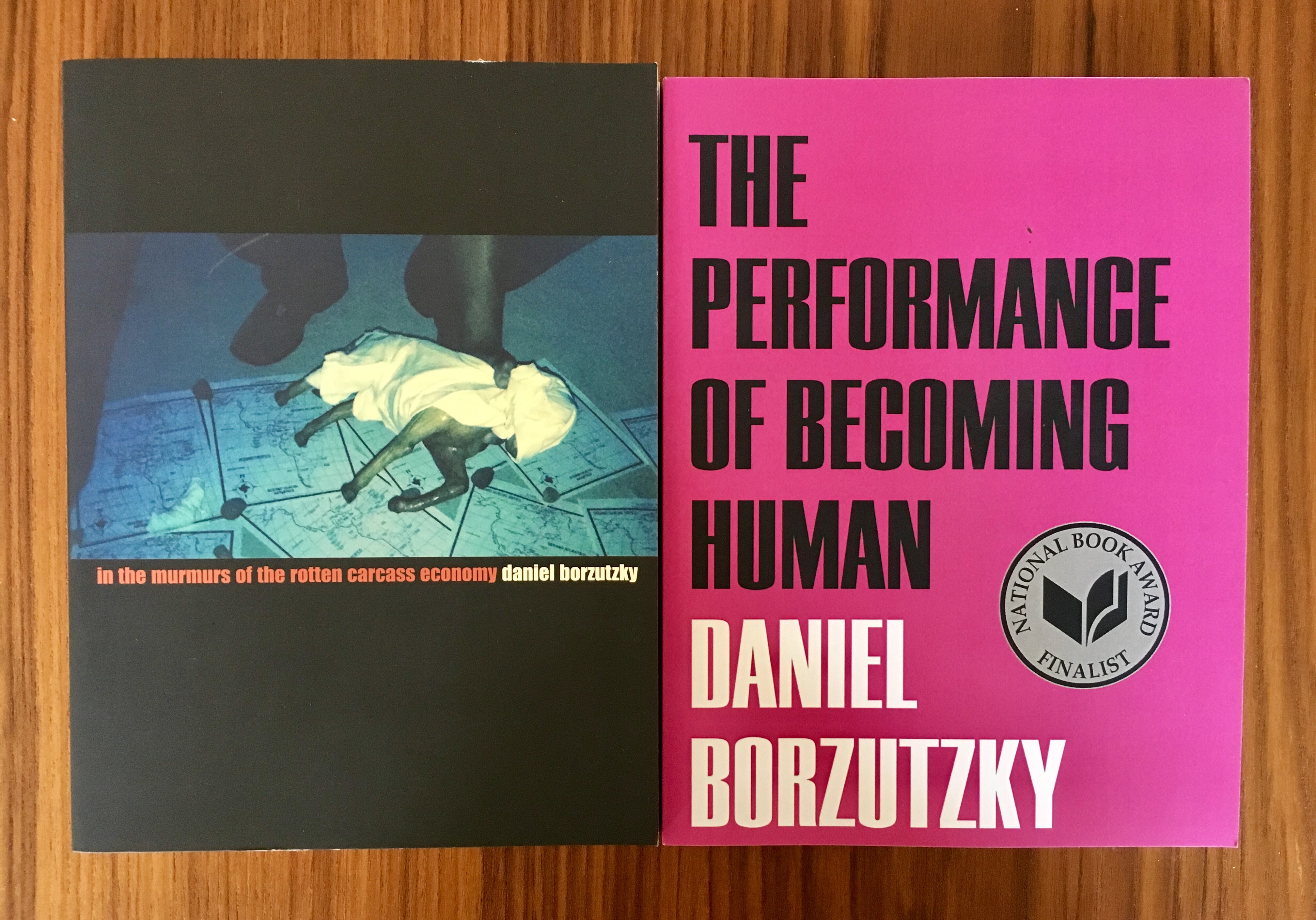
Daniel Borzutzky poems (Books acquired, 9 March 2017)

Big thanks to BLCKDGRD for sending me two books of poetry by Daniel Borzutzky. I’d never read Borzutzky before, but I dig it so far. These poems are abject—stuff about what it means to have a body, to have some horror at having a body, etc.

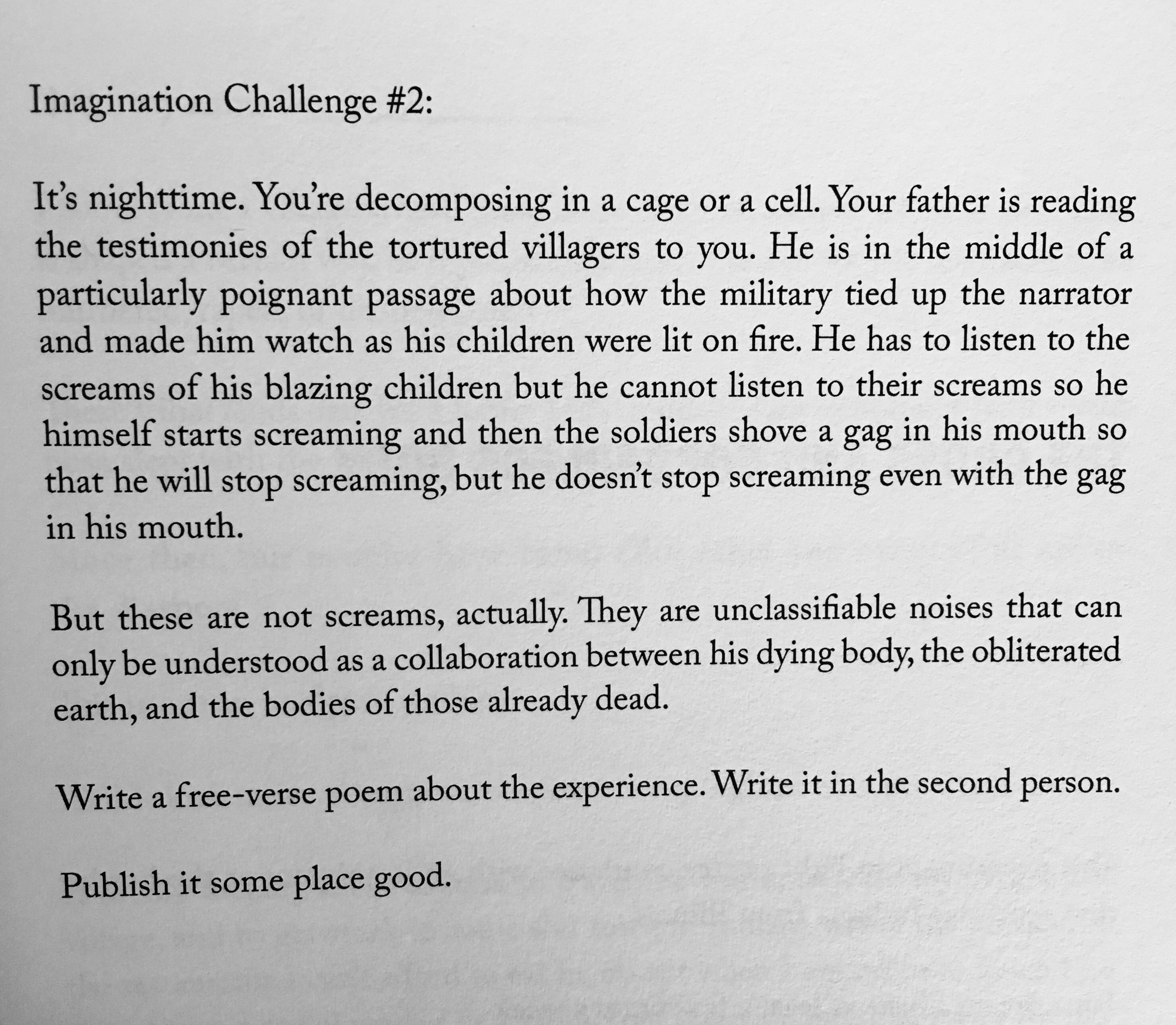
A bit from “The Blazing Cities of Your Rotten Carcass Mouth,” collected in The Performance of Becoming Human:

The Never-Ending Torture of Unrest | Georg Büchner’s Lenz Reviewed

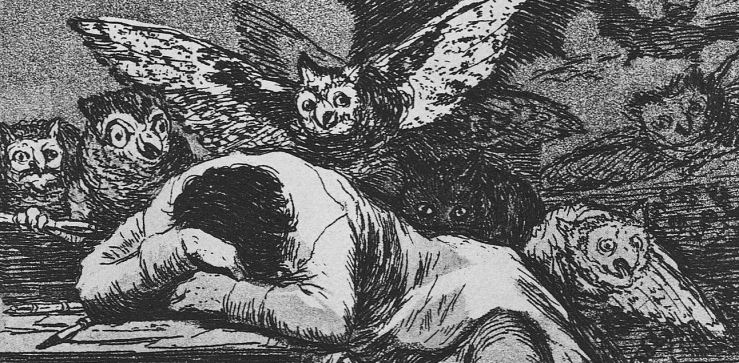
sleep of reason

Composed in 1836, Georg Büchner’s novella-fragment Lenz still seems ahead of its time. While Lenz’s themes of madness, art, and ennui can be found throughout literature, Büchner’s strange, wonderful prose and documentary aims bypass the constraints of his era.

Let me share some of that prose. Here is the opening paragraph of Lenz:

The 20th, Lenz walked through the mountains. Snow on the peaks and upper slopes, gray rock down into the valleys, swatches of green, boulders, firs. It was sopping cold, the water trickled down the rocks and leapt across the path. The fir boughs sagged in the damp air. Gray clouds drifted across the sky, but everything so stifling, and then the fog floated up and crept heavy and damp through the bushes, so sluggish, so clumsy. He walked onward, caring little one way or another, to him the path mattered not, now up , now down. He felt no fatigue, except sometimes it annoyed him that he could not walk on his head. At first he felt a tightening in his chest when the rocks skittered away, the gray woods below him shook, and the fog now engulfed the shapes, now half-revealed their powerful limbs; things were building up inside him, he was searching for something, as if for lost dreams, but was finding nothing. Everything seemed so small, so near, so wet, he would have liked to set the earth down behind an oven, he could not grasp why it took so much time to clamber down a slope, to reach a distant point; he was convinced he could cover it all with a pair of strides.

Büchner sets us on Lenz’s shoulder, moving us through the estranging countryside without any exposition that might lend us bearings. The environment impinges protagonist and reader alike, heavy, damp, stifling. Büchner’s syntax shuffles along, comma splices tripping us into Lenz’s manic consciousness, his mind-swings doubled in the path that is “now up, now down.” We feel the “tightening” in Lenz’s chest as the “rocks skittered away,” as the “woods below him shook” — the natural world seems to envelop him, cloak him, suffocate him. It’s an animist terrain, and Büchner divines those spirits again in the text. The claustrophobia Lenz experiences then swings to another extreme, as our hero, his consciousness inflated, feels “he could cover [the earth] with a pair of strides.

And that baffling line: “He felt no fatigue, except sometimes it annoyed him that he could not walk on his head.” Well.

The end notes to the Archipelago edition I read (translated by Richard Sieburth) offer Arnold Zweig’s suggestion that “this sentence marks the beginning of modern European prose,” as well as Paul Celan’s observation that “whoever walks on his head has heaven beneath him as an abyss.”

Celan’s description is apt, and Büchner’s story repeatedly invokes the abyss to evoke its hero’s precarious psyche. Poor Lenz, somnambulist bather, screamer, dreamer, often feels “within himself something . . . stirring and swarming toward an abyss toward which he was being swept by an inexorable force.” Lenz is the story of a young artist falling into despair and madness.

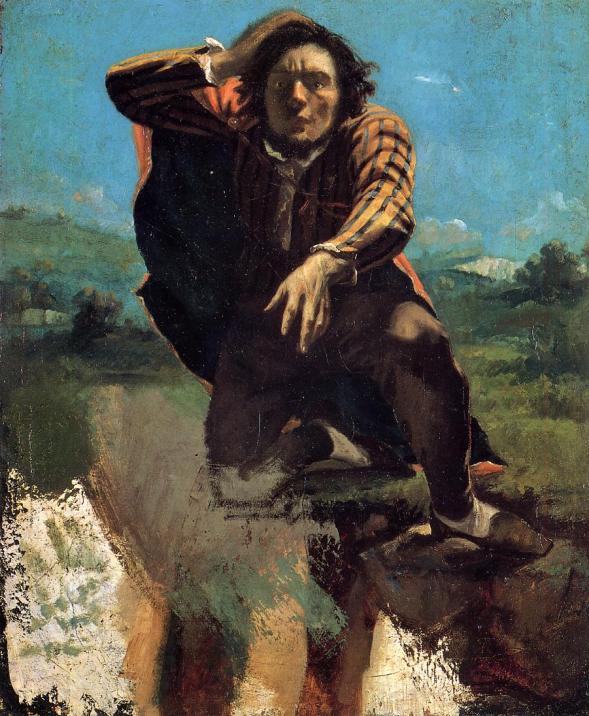
The Man Made Mad by Fear, Gustave Courbet

But perhaps I should offer a more lucid summary. I’ll do that in the next paragraph, but first: Let me just recommend you skip that paragraph. Really. What I perhaps loved most about Lenz was piecing together the plot through the often elliptical or opaque experiences we get via Büchner’s haunting free indirect style. The evocation of a consciousness in turmoil is probably best maintained when we read through the same confusion that Lenz experiences. I read the novella cold based on blurbs from William H. Gass and Harold Bloom and I’m glad I did.

Here is the summary paragraph you should skip: Jakob Lenz, a writer of the Sturm and Drang movement (and friend and rival to Goethe), has recently suffered a terrible episode of schizophrenia and “an accident” (likely a suicide attempt). He’s sent to pastor-physician J.F. Oberlin, who attends to him in the Alsatian countryside in the first few weeks of 1778. During this time Lenz obsesses over a young local girl who dies (he attempts to resurrect her), takes long walks in the countryside, cries manically, offers his own aesthetic theory, prays, takes loud late-night bath in the local fountain, receives a distressing letter, and, eventually, likely—although it’s never made entirely explicit—attempts suicide again and is thusly shipped away.

Büchner bases his story on sections of Oberlin’s diary, reproduced in the Archipelago edition. In straightforward prose, these entries fill in the expository gaps that Büchner has so elegantly removed and replaced with the wonder and dread of Lenz’s imagination. The diary’s lucid entries attest to the power of Büchner’s speculative fiction, to his own art and imagination, which so bracingly take us into a clouded mind.

In Sieburth’s afterword (which also offers a concise chronology of Lenz’s troubled life), our translator points out that “Like De Quincey’s “The Last Days of Immanuel Kant” or Chateaubriand’s Life of Rancé, Büchner’s Lenz is an experiment in speculative biography, part fact, part fabrication—an early nineteenth-century example of the modern genre of docufiction.” Obviously, any number of postmodern novels have explored or used historical figures—Public Burning, Ragtime, and Mason & Dixon are all easy go-to examples. But Lenz is more personal than these postmodern fictions, more an exploration of consciousness, and although we are treated to Lenz’s ideas about literature, art, and religion, we access this very much through his own skull and soul. He’s not just a placeholder or mouthpiece for Büchner.

Lenz strikes me as something closer to the docufiction of W.G. Sebald. Perhaps it’s all the ambulating; maybe it’s the melancholy; could be the philosophical tone. And, while I’m lazily, assbackwardly comparing Büchner’s book to writers who came much later: Thomas Bernhard. Maybe it’s the flights of rant that Lenz occasionally hits, or the madness, or the depictions of nature, or hell, maybe it’s those long, long passages. The comma splices.

Chronologically closer is the work of Edgar Allan Poe, whose depictions of manic bipolar depression resonate strongly with Lenz—not to mention the abysses, the torment, the spirits, the doppelgängers. Why not share another sample here to illustrate this claim? Okay:

The incidents during the night reached a horrific pitch. Only with the greatest effort did he fall asleep, having tried at length to fill the terrible void. Then he fell into a dreadful state between sleeping and waking; he bumped into something ghastly, hideous, madness took hold of him, he sat up, screaming violently, bathed in sweat, and only gradually found himself again. He had to begin with the simplest things in order to come back to himself. In fact he was not the one doing this but rather a powerful instinct for self preservation, it was as if he were double, the one half attempting to save the other, calling out to itself; he told stories, he recited poems out loud, wracked with anxiety, until he came to his sense.

Here, Lenz suspends his neurotic horror through storytelling and art—but it’s just that, only a suspension. Büchner doesn’t blithely, naïvely suggest that art has the power to permanently comfort those in despair; rather, Lenz repeatedly suggests that art, that storytelling is a symptom of despair.

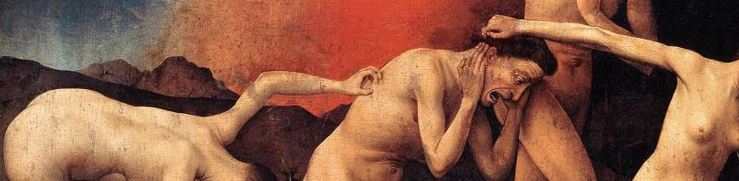
The Last Judgment (detail), Rogier van der Weyden

What drives despair? Lenz—Lenz—Büchner (?)—suggests repeatedly that it’s Langeweile—boredom. Sieburth renders the German Langeweile as boredom, a choice I like, even though he might have been tempted to reach for its existentialist chain-smoking cousin ennui. When Lenz won’t get out of bed one day, Oberlin heads to his room to rouse him:

Oberlin had to repeat his questions at length before getting an answer: Yes, Reverend, you see, boredom! Boredom! O, sheer boredom, what more can I say, I have already drawn all the figures on the wall. Oberlin said to him he should turn to God; he laughed and said: if I were as lucky as you to have discovered such an agreeable pastime, yes, one could indeed wile away one’s time that way. Tedium the root of it all. Most people pray only out of boredom; others fall in love out of boredom, still others are virtuous or depraved, but I am nothing, nothing at all, I cannot even kill myself: too boring . . .

Lenz fits in neatly into the literature of boredom, a deep root that predates Dostoevsky, Camus, and Bellow, as well as contemporary novels like Lee Rourke’s The Canal and David Foster Wallace’s The Pale King.


Ultimately, the boredom Lenz circles around is deeply painful:

The half-hearted attempts at suicide he kept on making were not entirely serious, it was less the desire to die, death for him held no promise of peace or hope, than the attempt, at moments of excruciating anxiety or dull apathy bordering on non-existence bordering on non-existence, to snap back into himself through physical pain. But his happiest moments were when his mind seemed to gallop away on some madcap idea. This at least provided some relief and the wild look in his eye was less horrible than the anxious thirsting for deliverance, the never-ending torture of unrest!

The “never-ending torture of unrest” is the burden of existence we all carry, sloppily fumble, negotiate with an awkward grip and bent back. Büchner’s analysis fascinates in its refusal to lighten this burden or ponderously dwell on its existential weight. Instead, Lenz is a character study that the reader can’t quite get out of—we’re too inside the frame to see the full contours; precariously perched on Lenz’s shoulder, we have to jostle along with him, look through his wild eyes, gallop along with him on the energy of his madcap idea. The gallop is sad and beautiful and rewarding. Very highly recommended.

[Ed. note—Biblioklept originally published this review in June of 2013]. 

A list of “Irish heroes and heroines of antiquity” from James Joyce’s Ulysses

One of my favorite passages in Ulysses (it’s from the “Cyclops” chapter, episode 12)—

He wore a long unsleeved garment of recently flayed oxhide reaching to the knees in a loose kilt and this was bound about his middle by a girdle of plaited straw and rushes. Beneath this he wore trews of deerskin, roughly stitched with gut. His nether extremities were encased in high Balbriggan buskins dyed in lichen purple, the feet being shod with brogues of salted cowhide laced with the windpipe of the same beast. From his girdle hung a row of seastones which dangled at every movement of his portentous frame and on these were graven with rude yet striking art the tribal images of many Irish heroes and heroines of antiquity, Cuchulin, Conn of hundred battles, Niall of nine hostages, Brian of Kincora, the Ardri Malachi, Art MacMurragh, Shane O’Neill, Father John Murphy, Owen Roe, Patrick Sarsfield, Red Hugh O’Donnell, Red Jim MacDermott, Soggarth Eoghan O’Growney, Michael Dwyer, Francy Higgins, Henry Joy M’Cracken, Goliath, Horace Wheatley, Thomas Conneff, Peg Woffington, the Village Blacksmith, Captain Moonlight, Captain Boycott, Dante Alighieri, Christopher Columbus, S. Fursa, S. Brendan, Marshal Mac-Mahon, Charlemagne, Theobald Wolfe Tone, the Mother of the Maccabees, the Last of the Mohicans, the Rose of Castille, the Man for Galway, The Man that Broke the Bank at Monte Carlo, The Man in the Gap, The Woman Who Didn’t, Benjamin Franklin, Napoleon Bonaparte, John L. Sullivan, Cleopatra, Savourneen Deelish, Julius Caesar, Paracelsus, sir Thomas Lipton, William Tell, Michelangelo, Hayes, Muhammad, the Bride of Lammermoor, Peter the Hermit, Peter the Packer, Dark Rosaleen, Patrick W. Shakespeare, Brian Confucius, Murtagh Gutenberg, Patricio Velasquez, Captain Nemo, Tristan and Isolde, the first Prince of Wales, Thomas Cook and Son, the Bold Soldier Boy, Arrah na Pogue, Dick Turpin, Ludwig Beethoven, the Colleen Bawn, Waddler Healy, Angus the Culdee, Dolly Mount, Sidney Parade, Ben Howth, Valentine Greatrakes, Adam and Eve, Arthur Wellesley, Boss Croker, Herodotus, Jack the Giantkiller, Gautama Buddha, Lady Godiva, The Lily of Killarney, Balor of the Evil Eye, the Queen of Sheba, Acky Nagle, Joe Nagle, Alessandro Volta, Jeremiah O’Donovan Rossa, Don Philip O’Sullivan Beare. A couched spear of acuminated granite rested by him while at his feet reposed a savage animal of the canine tribe whose stertorous gasps announced that he was sunk in uneasy slumber, a supposition confirmed by hoarse growls and spasmodic movements which his master repressed from time to time by tranquillising blows of a mighty cudgel rudely fashioned out of paleolithic stone.

Flann O’Brien’s Novel The Third Policeman Is a Surreal Comic Masterpiece

3911167477981.560ac19fa0b67
Illustration for Flann O’Brien’s The Third Policeman by Nancy Martinez

Here’s the short review: Flann O’Brien’s The Third Policeman is a dark, comic masterpiece—witty, bizarre, and buzzing with surreal transformations that push the limits of language. I am ashamed that I came so late to its cult (how the novel escaped my formative teens and twenties escapes me), but also thankful that I trusted the readers of this blog who kindly suggested I read it.

I’m also thankful that I knew pretty much nothing about the book going in; I’m thankful that I skipped over Denis Donoghue’s introduction (which has the gall to spoil the novel’s end); I’m thankful that I resisted looking up information on de Selby, a philosopher I had never heard the name of before The Third Policeman. I read the novel in an ideal state, a kind of Platonic purity of appropriate bewilderment, at turns gaping and guffawing at O’Brien’s sublime impositions on plot, imagery, thought, language.

To be plain, I think that you should read the book too, gentlest reader, and if you are fortunate enough to possess innocence of its strange virtues, all the better. The less you know about The Third Policeman, the more enjoyable your first time will be. But if such conditions are too much to ask, here are a few fragments of plot:

We have an unnamed narrator, a one-legged orphan and would-be de Selby scholar (don’t ask) who enters into a nefarious plot with a man named Divney. Okay, they plan and execute a murder for treasure. Shades of Crime and Punishment creep into the novel by way of Poe’s nervous narrators; the plot even anticipates in some ways The Stranger, though not as moody and far funnier and honestly just way better. (I’m riffing on books here because, again, it seems to me a disservice to the interested reader to overshare the plot of The Third Policeman).

Let’s just say there’s a two-dimensional house. Let’s just say there’s an absurd picaresque quest to recover a missing black box. Let’s just say there are two policemen (okay, there are three), alternately terrifying, edifying, assuaging, bewildering. Let’s just say there’s an army of one-legged men. Let’s just say there’s a soul. Let’s call him “Joe.”

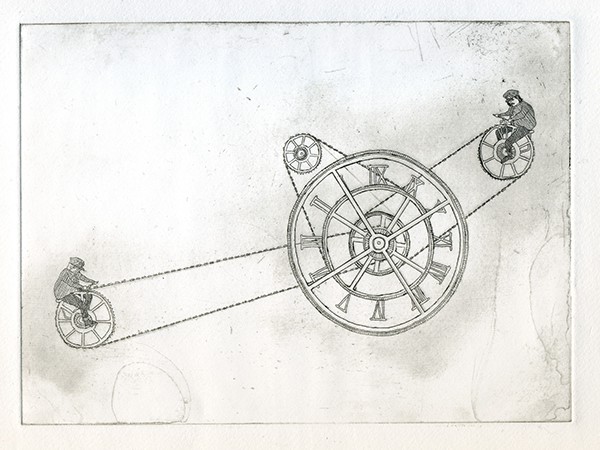
Let’s just say there are bicycles. Lots and lots of bicycles.

And the wisdom (?!) of de Selby, of course, “the savant,” who, via our unnamed narrator’s erudite footnotes (including the notes of de Selby’s esteemed commentators, of course) offers up opinions and maxims on matters of natural science and philosophy alike. Here’s a taste of de Selby, from the epigraph:

Human existence being an hallucination containing in itself the secondary hallucinations of day and night (the latter an insanitary condition of the atmosphere due to accretions of black air) it ill becomes any man of sense to be concerned at the illusory approach of the supreme hallucination known as death.

It’s also a good taste of the bizarre thrust of The Third Policeman; the first five words might work as a dandy summary, or at least summary enough.

But maybe I should share some of O’Brien’s language (and not just some philosopher that if you’re being honest you’ll admit you’ve never heard of before, although it seems like maybe you ought to have heard of him, hmmm?).

Just the first paragraph, gentle soul. It was enough to hook this fish:

Not everybody knows how I killed old Phillip Mathers, smashing his jaw in with my spade; but first it is better to speak of my friendship with John Divney because it was he who first knocked old Mathers down by giving him a great blow in the neck with a special bicycle-pump which he manufactured himself out of a hollow iron bar. Divney was a strong civil man but he was lazy and idle-minded. He was personally responsible for the whole idea in the first place. It was he who told me to bring my spade. He was the one who gave the orders on the occasion and also the explanations when they were called for.

And: two more excerpts that you can read, funny-stuff, context-free.

Okay. Hopefully I’ve convinced you a) to read The Third Policeman and b) to quit reading this review (let’s be honest, this isn’t so much a review as it is a riff, a recommendation, and it’s going to get even ramblier in a moment). You can get The Third Policeman from The Dalkey Archive, so you know it’s good, but oh-my-God-guess-what-can-you-believe-it? The Dalkey Archive is actually named after one of O’Brien’s novels, The Dalkey Archive.

So, yes, very highly recommended, read it, etc.

The rest of this riff I devote to puzzling out (without resolution) some of the marvels and conundrums of The Third Policeman; if you haven’t read the book, I suggest skipping all that follows.

I imagine that there’s a ton of criticism out there that might try to explain or elucidate the meaning of The Third Policeman, and while I’d love to hear or read some opinions on the book, I think it ultimately defies heavily symbolic readings. I suppose we might argue that the bicycle motif points toward the slow mechanization of humanity in the post-industrial landscape (or some such nonsense), or we might try to find some codex for the plot of the novel in the work of the fictional philosopher de Selby (and his critics), or we might try to plumb the novel’s mystical and religious underpinnings. It seems to me though that the absurd, nightmarish fever-joy of The Third Policeman lies in its precise indeterminacy. Here’s an example, at some length, of our narrator’s marvelous powers to describe what cannot be described:

This cabinet had an opening resembling a chute and another large opening resembling a black hole about a yard below the chute. He pressed two red articles like typewriter keys and turned a large knob away from him. At once there was a rumbling noise as if thousands of full biscuit-boxes were falling down a stairs. I felt that these falling things would come out of the chute at any moment. And so they did, appearing for a few seconds in the air and then disappearing down the black hole below. But what can I say about them? In colour they were not white or black and certainly bore no intermediate colour; they were far from dark and anything but bright. But strange to say it was not their unprecedented hue that took most of my attention. They had another quality that made me watch them wild-eyed, dry-throated and with no breathing. I can make no attempt to describe this quality. It took me hours of thought long afterwards to realize why these articles were astonishing. They lacked an essential property of all known objects. I cannot call it shape or configuration since shapelessness is not what I refer to at all. I can only say that these objects, not one of which resembled the other, were of no known dimensions. They were not square or rectangular or circular or simply irregularly shaped nor could it be said that their endless variety was due to dimensional dissimilarities. Simply their appearance, if even that word is not inadmissible, was not understood by the eye and was in any event indescribable. That is enough to say.

O’Brien’s unnamed narrator repeatedly runs up against the problem of the ineffable, of the inability of language to center meaning.

The policemen—Sergeant Pluck and Policeman MacCruiskeen—are handier at navigating the absurd pratfalls of language. When the Sergeant asks the narrator if he’d like “a velvet-coloured colour,” we see the tautological, self-referential scope to description, and hence the underlying trouble of approaching pure communication. Much of the humor of The Third Policeman comes from such language. The Sergeant tells of an angry mob that “held a private meeting that was attended by every member of the general public except the man in question,” and we see the mutability of oppositions like “private/public” played to absurd comic effect.

When the policemen describe machines that break sensation into opposing and contradictory parts, we get here an anticipation of deconstruction, of the idea that difference and instability governs sensation and meaning. There is no purity:

‘We have a machine down there,’ the Sergeant continued, ‘that splits up any smell into its sub – and inter-smells the way you can split up a beam of light with a glass instrument. It is very interesting and edifying, you would not believe the dirty smells that are inside the perfume of a lovely lily-of-the mountain.’

‘And there is a machine for tastes,’ MacCruiskeen put in, ‘the taste of a fried chop, although you might not think it, is forty per cent the taste of…’ He grimaced and spat and looked delicately reticent.

The policemen’s analytic machinery correlates strongly with the narrator’s interest in philosophy and science. Through de Selby and his various critics, O’Brien simultaneously mocks and reveres the atomizing pursuits of knowledge. Delivered mostly in footnotes that would give David Foster Wallace a run for his money, the absurd philosophy of de Selby underpins the physical and metaphysical conundrums of The Third Policeman (this is, after all, the story of a man traversing a world where the laws of physics do not adhere). Here’s an early footnote:

. . . de Selby . . . suggests (Garcia, p. 12) that night, far from being caused by the commonly accepted theory of planetary movements, was due to accumulations of ‘black air’ produced by certain volcanic activities of which he does not treat in detail. See also p. 79 and 945, Country Album. Le Fournier’s comment (in Homme ou Dieu) is interesting. ‘On ne saura jamais jusqu’à quel point de Selby fut cause de la Grande Guerre, mais, sans aucun doute, ses théories excentriques – spécialement celle que nuit n’est pas un phénomène de nature, mais dans l’atmosphère un état malsain amené par un industrialisme cupide et sans pitié – auraient l’effet de produire un trouble profond dans les masses.’

This is wonderful mockery of academicese, a ridiculous idea presented with some commentary in French. At this point in the novel, I started to doubt the existence of de Selby; as the narrator’s notations of de Selby’s ideas grew increasingly bizarre, I soon realized the joke O’Brien had played on me.

And yet these jokes do not deflate the essential metaphysical seriousness of The Third Policeman: This is a novel about punishment, about crime, about damnation; this is a novel about not knowing but trying to know and describe what can’t be known or described.

This not knowing extends strongly to the reader of The Third Policeman. I was never sure if the narrator was dreaming or hallucinating or wandering through a strange afterlife—and in a way, it didn’t matter. There’s no allegorical match-up or metaphysical scorecard from which to parse The Third Policeman’s final meaning because there is no final meaning. Here’s O’Brien—or really Brian O’Nolan, I suppose; O’Brien was a pseudonym—summarizing the novel in a 1940 letter to William Saroyan:

I’ve just finished another book. The only thing good about it is the plot and I’ve been wondering whether I could make a crazy…play out of it. When you get to the end of this book you realize that my hero or main character (he’s a heel and a killer) has been dead throughout the book and that all the queer ghastly things which have been happening to him are happening in a sort of hell which he earned for the killing. Towards the end of the book (before you know he’s dead) he manages to get back to his own house where he used to live with another man who helped in the original murder. Although he’s been away three days, this other fellow is twenty years older and dies of fright when he sees the other lad standing in the door.

Then the two of them walk back along the road to the hell place and start thro’ all the same terrible adventures again, the first fellow being surprised and frightened at everything just as he was the first time and as if he’d never been through it before. It is made clear that this sort of thing goes on for ever – and there you are. It is supposed to be very funny but I don’t know about that either…I think the idea of a man being dead all the time is pretty new. When you are writing about the world of the dead – and the damned – where none of the rules and laws (not even the law of gravity) holds good, there is any amount of scope for back-chat and funny cracks.

Happily, as I mentioned earlier, I skipped the introduction and thus missed this letter, which I think deflates the novel in some ways, including the authorial spoiler. Also, O’Brien’s just plain wrong when he contends that the “only good thing about it is the plot” — there’s also the language, the ideas, the rhythm, the structure . . .

But 1940 was not ready for such a strange novel, and The Third Policeman wasn’t published until 1967, a year after its author’s death. By 1967 Thomas Pynchon had published V. and The Crying of Lot 49, John Barth has published The Sot-Weed Factor and Giles Goat-Boy, Don DeLillo had quit advertising to start writing novels, Donald Barthelme had published Snow-White, Kurt Vonnegut had gained a large audience—in short, the world of letters had caught up to O’Brien (or O’Nolan, if you prefer). Here was a post-modern novel delivered while Modernism was still in full swing.

But literary labels are no fun. You know what’s fun? The Third Policeman is fun. And unnerving. And energetic. And surreal. And really, really great. Very highly recommended.

[Ed. note—Biblioklept originally published a version of this review in May of 2012].

THE DIARY OF A CORONER would be a work likely to meet with large popular acceptance | Nathaniel Hawthorne’s journal entry for March 16th, 1854

March 16th.–Yesterday, at the coroner’s court, attending the inquest on a black sailor who died on board an English vessel, after her arrival at this port. The court-room is capable of accommodating perhaps fifty people, dingy, with a pyramidal skylight above, and a single window on one side, opening into a gloomy back court. A private room, also lighted with a pyramidal skylight, is behind the court-room, into which I was asked, and found the coroner, a gray-headed, grave, intelligent, broad, red-faced man, with an air of some authority, well mannered and dignified, but not exactly a gentleman,–dressed in a blue coat, with a black cravat, showing a shirt-collar above it. Considering how many and what a variety of cases of the ugliest death are constantly coming before him, he was much more cheerful than could be expected, and had a kind of formality and orderliness which I suppose balances the exceptionalities with which he has to deal. In the private room with him was likewise the surgeon, who professionally attends the court. We chatted about suicide and such matters,–the surgeon, the coroner, and I,–until the English case was ready, when we adjourned to the court-room, and the coroner began the examination. The English captain was a rude, uncouth Down-Easter, about thirty years old, and sat on a bench, doubled and bent into an indescribable attitude, out of which he occasionally straightened himself, all the time toying with a ruler, or some such article. The case was one of no interest; the man had been frost-bitten, and died from natural causes, so that no censure was deserved or passed upon the captain. The jury, who had been examining the body, were at first inclined to think that the man had not been frostbitten, but that his feet had been immersed in boiling water; but, on explanation by the surgeon, readily yielded their opinion, and gave the verdict which the coroner put into their mouths, exculpating the captain from all blame. In fact, it is utterly impossible that a jury of chance individuals should not be entirely governed by the judgment of so experienced and weighty a man as the coroner. In the court-room were two or three police officers in uniform, and some other officials, a very few idle spectators, and a few witnesses waiting to be examined. And while the case was going forward, a poor-looking woman came in, and I heard her, in an undertone, telling an attendant of a death that had just occurred. The attendant received the communication in a very quiet and matter-of-course way, said that it should be attended to, and the woman retired.

THE DIARY OF A CORONER would be a work likely to meet with large popular acceptance. A dark passageway, only a few yards in extent, leads from the liveliest street in Liverpool to this coroner’s courtroom, where all the discussion is about murder and suicide. It seems, that, after a verdict of suicide the corpse can only be buried at midnight, without religious rites.

“His lines are cast in pleasant places,”–applied to a successful angler.

A woman’s chastity consists, like an onion, of a series of coats. You may strip off the outer ones without doing much mischief, perhaps none at all; but you keep taking off one after another, in expectation of coming to the inner nucleus, including the whole value of the matter. It proves, however, that there is no such nucleus, and that chastity is diffused through the whole series of coats, is lessened with the removal of each, and vanishes with the final one which you supposed would introduce you to the hidden pearl.

From Nathaniel Hawthorne’s journal entry for March 16th, 1854. Collected in Passages from the English Note-Books.

There is also an imperial head of Julius Cæsar | Nathaniel Hawthorne’s journal entry for March 15th, 1858

March 15th.–A week ago we went to the Vatican, to the halls of sculpture. They commence by a very long narrow gallery, the first part of which is devoted principally to inscriptions, inserted into or fastened upon the walls–on the right hand, pagan, on the left, Christian. All along the gallery of inscriptions there are sarcophagi, vases, torsos, capitals of columns, cippi, and various bas-reliefs of fine workmanship–cornices, and specimens of everything picked up and dug up about Rome. The second part of the gallery contains busts, and figures of heroes, gods, goddesses, emperors, philosophers, poets, children, and women. Here is the colossal head of Minerva, with the strange black eyes and black lashes, while the rest is snowy marble–the grand, colossal, sitting figure of Tiberius, with the civic crown. He seems to have been carved out for a god, though he became unworthy even of the name of man. Here also is the newly-discovered and only true Cicero. The Cicero that has hitherto been called the orator, is now supposed to be his brother, who was a soldier. It is only a year ago that this was found. It is very satisfactory–a refined, intellectual, penetrating head, with a mouth of wonderful beauty. Its authenticity is proved by its exact resemblance to a medal in the Vatican, inscribed with his name, and which the long-accepted Cicero does not at all resemble. It is delightful really to have seen Cicero. Here, too, is the celebrated young Augustus, of a delicate, poetic, musing beauty, with a lovely mouth and a perplexed brow. The trouble on his brow seems a prophetic shadow of his anxiety, at the close of his life, to know “whether he had played his part well.”

There is also an imperial head of Julius Cæsar, as Pontifex Maximus, with a folded drapery, and another fine Cæsar, not veiled. These are both far superior to the head in the Hall of the Emperors, at the Capitol, though still like that. A baby Nero was very interesting. It is not a pretty child, but it is not evil in its expression. I was disappointed in Scipio Africanus. I expected him to be very noble. It is an earnest, strong head, and full of care, and in nero antico. Praxiteles’ charming Faun is here also,–a happy smile embodied. There is an astonishing grace in the figure, and a cheerfulness, like a sunny afternoon. I became acquainted with this ever-enchanting creation in the Capitol. He stands in an attitude of easy rest, making multitudes of curves. Sunshine on rippling water is like the gleam on his face and form. The dolce far niente was never so exquisitely expressed. He is perfect bonhommie, idealized with a thousand fine amenities. It is one of those master-pieces of antiquity, in which “the marble flows like a wave.”

About half-way in the long gallery, the Braccio Nuovo leads off to the left,–a gallery with mosaic floor, and marble columns and arched niches, in which full-length statues stand–and half-columns of red, oriental granite, surmounted with busts: If it were not for what they contain, the halls of the Vatican would be visited for their own intrinsic splendor and state. But who minds the setting of diamonds? In the Braccio Nuovo is the Minerva Medica, which alone is worthy of a pilgrimage to Rome. I had never heard of this “statue in America, and first saw a cast of it, a very fine cast of it, in the Crystal Palace last autumn, pointed out to us by Mr. Silsbee, who greatly estimated it. Even then, in the disguise, and through the obstruction of plaster, it seemed to me the most majestic expression of profound and pensive” thought I had ever imagined. The plaster was as much as I could comprehend at first, and I am glad I saw it first; and now to see the marble is a privilege, for which I trust I am sufficiently thankful. There is a grand sorrow in the countenance and air, but it is the sorrow of an immortal–the pensiveness of profound insight–not a human emotion. The drapery is in fine folds, and falls round the feet in solemn flow. The expression is entirely introspective. The features are of perfect beauty, of a very high order of beauty–with no prettiness. She is the sister of the Apollo Belvedere. He is all immortal action, while Minerva is immortal Thought, and both heroic.

From Nathaniel Hawthorne’s journal entry for March 15th, 1858. Collected in the “Roman Notebook” of Notes in England and Italy.

Beware

beware

Italo Calvino: “There are two wrong ways of thinking of a possible political use for literature”

In a word, what I think is that there are two wrong ways of thinking of a possible political use for literature. The first is to claim that literature should voice a truth already possessed by politics; that is, to believe that the sum of political values is the primary thing, to which literature must simply adapt itself. This opinion implies a notion of literature as ornamental and superfluous, but it also implies a notion of politics as fixed and self-confident: an idea that would be catastrophic. I think that such a pedagogical function for politics could only be imagined at the level of bad literature and bad politics.

The other mistaken way is to see literature as an assortment of eternal human sentiments, as the truth of the human language that politics tends to overlook, and that therefore has to be called to mind from time to time. This concept apparently leaves more room for literature, but in practice it assigns it the task of confirming what is already known, or maybe of provoking in a naïve and rudimentary way, by means of the youthful pleasures of freshness and spontaneity. Behind this way of thinking is the notion of a set of established values that literature is responsible for preserving, the classical and immobile idea of literature as the depository of a given truth. If it agrees to take on this role, literature confines itself to a function of consolation, preservation, and regression – a function that I believe does more harm than good.

From Italo Calvino’s essay “Right and Wrong Uses of Political Uses of Literature.” Translation by Patrick Creagh. Collected in The Uses of Literature.

Roberto Bolaño’s Recipe for Brussels Sprouts with Lemon

In Roberto Bolaño’s sprawling opus 2666 (specifically, in “The Part About Fate”), founding member of the Black Panthers/cookbook author Barry Seaman offers the following recipe during a lecture at a Detroit church–

The name of the recipe is: Brussels Sprouts with Lemon. Take note, please. Four servings calls for: two pounds of brussels sprouts, juice and zest of one lemon, one onion, one sprig of parsley, three tablespoons of butter, black pepper, and salt. You make it like so. One: Clean sprouts well and remove outer leaves. Finely chop onion and parsley. Two: In a pot of salted boiling water, cook sprouts for twenty minutes, or until tender. Then drain well and set aside. Three: Melt butter in frying pan and lightly sauté onion, add zest and juice of lemon and salt and pepper to taste. Four: Add brussels sprouts, toss with sauce, reheat for a few minutes, sprinkle with parsley, and serve with lemon wedges on the side. So good you’ll be licking your fingers, said Seaman. No cholesterol, good for the liver, good for the blood pressure, very healthy.

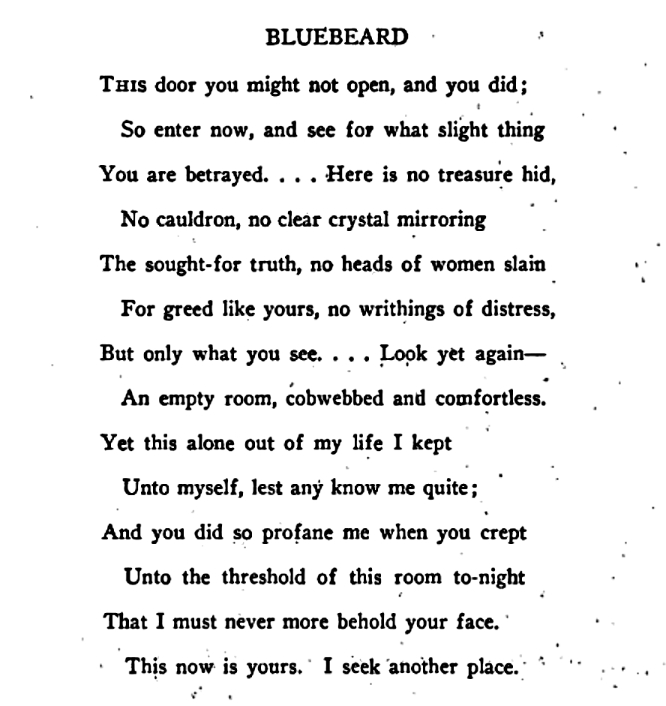
“Bluebeard” — Edna St. Vincent Millay

bluebeard

Jane Bowles’ novel Two Serious Ladies confounds with sinister humor and dark delight

Two Women, Gwen John

Here’s a short review of Jane Bowles’ only novel, Two Serious Ladies: The book is amazing, a confounding, energetic picaresque suffused with sinister humor and dark delight. I read it knowing nothing about the plot on the recommendation of Ben Marcus, who described it as “so insane, so beautiful, and in some sense, unknowable to me. On the surface, it’s not really about much, but the arrangement of words does something chemical to me.” My recommendation is to dispense with the rest of my review and read Bowles’ novel.

“Unknowable” is a fair description, and Two Serious Ladies was met with bewilderment when it was first published in 1943, as Negar Azimi points out in the comprehensive essay “The Madness of Queen Jane”:

Edith Walton, writing in the Times Book Review, called the book senseless and silly: “To attempt to unravel the plot of ‘Two Serious Ladies’ would be to risk, I am sure, one’s own sanity.” Another reviewer said, simply, “The book is about nothing.” Jane’s family, in the meantime, found it unseemly in its stark depiction of lesbianism. Its characters, who have goals and motivations that are hard to grasp, were difficult to relate to. Yet another critic wrote, “The only shocking thing about this novel is that it ever managed to find its way to print.” Jane was only twenty-four.

The notion that “The book is about nothing,” is corrected by Marcus’s qualifier about its “surface”: Two Serious Ladies moves through the phenomenological world that its characters experience, but it does not mediate the concrete contours of that world in a way that its characters can name for the reader. When the characters, those two serious ladies, do stumble into language that might name, pin down, or otherwise fix their experience, fix their consciousness into a stable relation with the world, Bowles spins the wheel again, flings her characters into new scenarios. Moments of epiphany are transitory and hard-purchased. A (perhaps) illustrating passage, offered without context:

Mrs. Copperfield started to tremble after the girl had closed the door behind her. She trembled so violently that she shook the bed. She was suffering as much as she had ever suffered because she was going to do what she wanted to do. But it would not make her happy. She did not have the courage to stop from doing what she wanted to do. She knew that it would not make her happy, because only the dreams of crazy people come true. She thought that she was only interested in duplicating a dream, but in doing so she necessarily became the complete victim of a nightmare.

The free indirect style here still hides so much from the reader, who must suss the characters’ unnamed desires from bewildering details alone. The passage above shows us fear and trembling, dream, nightmare—and crazy people. What does Copperfield want to do? One subtext here is a lesbian desire seemingly comprehended by everyone but Mrs. Copperfield herself. (In some of the book’s strangest moments, Mr. Copperfield leaves his near-mad wife in a dangerous part of a foreign city to encounter hookers of every stripe). Two Serious Ladies is about women searching for something, but something they can’t name, can’t conceive in language—but can perhaps imagine.

A third-act epiphany—again transitory and hard-purchased—parallels Mrs. Copperfield’s fear and trembling. Miss Goering—

—okay, wait, it occurs to me now that I’ve completely neglected to offer any kind of plot description that might anchor this ostensible “review,” to set up who exactly Miss Goering is, etc., so  here goes (and I encourage you to just go ahead and skip the next long paragraph)—

A bad summary: Two Serious Ladies comprises three long chapters, each of which might stand on its own as a long short story. Part the first: Miss Goering is rich but strange. Her childhood is bizarre; alienated from others “she wore the look of certain fanatics who think of themselves as leaders without once having gained the respect of a human being.” Her attempt to baptize another child luckily doesn’t end in a drowning. She grows up out of step with her peers, dresses odd, speaks odd. One day out of nowhere appears a Miss Gamelon, who becomes her (often disagreeable) companion. At a party she runs into the other serious lady, Mrs. Copperfield, whose adventures in Panama comprise the second section of the book. At the same party she meets Arnold, a would-be artist, goes home with him, meets his folks, his father. She elects to move (with Arnold and Miss Gamelon) to a run-down cottage on a drab island, forsaking her wealth, sort of. Part the second: We shift to section two, the Copperfields’ adventures in Panama. Mr. Copperfield checks the couple into a seedy hotel in the wrong part of town and promptly drops his wife off where the brothels are. She moves into a run-down hotel with a prostitute named Pacifica while her husband does God-knows-what. There’s a lot of drinking and near-madness, run-ins with bad boyfriends and snooty hoteliers. Mr. Copperfield leaves without his wife. Part the third: We return to Miss Goering and gang in the dilapidated cottage. Arnold’s father soon moves in with them. Miss Goering starts going out at night alone. She gets picked up at bar and moves in with a man named Andy. She eventually leaves him for a gangster who mistakes her for a prostitute. On a dinner date—okay, not really a dinner date but—on a dinner date with the gangster (who, like the dinner date, is never actually named as a “gangster”), Miss Goering runs into Mrs. Copperfield. Both are much changed.

—okay, so this time with (or without) some context—

A third-act epiphany—again transitory and hard-purchased—parallels Mrs. Copperfield’s fear and trembling. Miss Goering and her gangster:

This man, they had noticed, drove up to the saloon in a very beautiful big automobile that resembled more a hearse than a private car. Miss Goering had examined it one day when the man was drinking in the saloon. It appeared to be almost brand new. She and Andy had looked in through the window and had been a little surprised to see a lot of dirty clothes on the floor. Miss Goering was completely preoccupied now with what course to take should the newcomer be willing to make her his mistress for a little while. She was almost sure that he would, because several times she had caught him looking at her in a certain way which she had learned to recognize. Her only hope was that he would disappear before she had the chance to approach him. If he did, she would be exempt and thus able to fritter away some more time with Andy, who now seemed so devoid of anything sinister that she was beginning to scrap with him about small things the way one does with a younger brother.

And of course she gives in to her terrible desire. The plot of Two Serious Ladies might be described as a search for “anything sinister.”  Miss Goering and Mrs. Copperfield seek the brink of all those things one can be brinked upon: disasters, abysses, madness. Love?

The novel most reminded me of what I love best in the films of David Lynch and the fiction of Roberto Bolaño—that sense of perverse night-time dread, the sordid intimation of just how easily the veneer might crack, of how simple it might be for civilization to give way to the madness under the surface.

David Lynch and Roberto Bolaño suffuse their work with an absurd howling humor that percolates along with the dread, and Two Serious Ladies operates along the same horror/humor axis. The book is hilarious, but my several attempts to capture that here in a few excerpts of dialogue fail to translate into this digest form. Will you take my word? Will you take my word that the book was much funnier the second time I read it?

The reading experience cannot be easily distilled. (Strike that adverb). Two Serious Ladies resists unfolding in the way we expect our narratives to unfold—to be about something—Bowles withholds exposition, clarification, and motivation—well, okay, not withholds, but rather hides, or obscures, or enshadows. (I don’t have the verbs for this book). I think of Harold Bloom’s rubric for canonical literature here. In The Western Canon, he  argues that strong literature exemplifies a “strangeness, a mode of originality that either cannot be assimilated, or that so assimilates us that we cease to see it as strange.” Nearly three-quarters of a century after its publication, Two Serious Ladies is still strange, still strong, still ahead of its time. Its vignettes flow (or jerk or shift or pitch wildly or dip or soar or sneak) into each other with a wonderfully dark comic force that simultaneously alienates and invites the reader, who, bewildered by its transpositions, is compelled to follow into strange new territory. Very highly recommended.

[Ed. note: Biblioklept first published this review of Two Serious Ladies in February of 2015].

A note to readers new to Infinite Jest

A note to readers new to Infinite Jest

David Foster Wallace’s 1996 novel Infinite Jest poses rhetorical, formal, and verbal challenges that will confound many readers new to the text. The abundance of (or excess of) guides and commentaries on the novel can perhaps have the adverse and unintentional consequence of making readers new to Infinite Jest believe that they can’t “get it” without help.  Many of the online analyses and resources for Infinite Jest are created by and targeted to readers who have finished the novel or are rereading the novel. While I’ve read many insightful and enlightening commentaries on the novel over the years, my intuition remains that the superabundance of analysis may have the paradoxical effect of actually impeding readers new to the text. With this in mind, I’d suggest that first-time readers need only a dictionary and some patience.

Infinite Jest is very long but it’s not nearly as difficult as its reputation suggests. There is a compelling plot behind the erudite essaying and sesquipedalian vocabulary. That plot develops around three major strands which the reader must tie together, with both the aid of—and the challenge of—the novel’s discursive style. Those three major plot strands are the tragic saga of the Incandenzas (familial); the redemptive narrative of Ennet House Drug and Alcohol Recovery House, with Don Gately as the primary hero (socicultural); and the the schemes of the Québécois separatists (national/international/political). An addictive and thus deadly film called Infinite Jest links these three plots (through discursive and byzantine subplots).

Wallace often obscures the links between these plot strands, and many of the major plot connections have to be intuited or outright guessed. Furthermore, while there are clear, explicit connections between the plot strands made for the reader, Wallace seems to withhold explicating these connections until after the 200-page mark. Arguably, the real contours of the Big Plot come into (incomplete) focus in a discussion between Hal Incandenza and his brother Orin in pages 242-58. Getting to this scene is perhaps a demand on the patience of many readers. And, while the scene by no means telegraphs what happens in IJ, it nonetheless offers some promise that the set pieces, riffs, scenes, lists, and vignettes shall add up to Something Bigger. 

Some of those earliest set pieces, riffs, scenes, lists, and vignettes function almost as rhetorical obstacles for a first-time reader. The  novel’s opening scene, Hal Incandenza’s interview with the deans at the University of Arizona, is chronologically the last event in the narrative, and it dumps a lot of expository info on the reader. It also poses a number of questions or riddles about the plot to come, questions and riddles that frankly run the risk of the first-time reader’s forgetting through no fault of his own.

The second chapter of IJ is relatively short—just 10 pages—but it seems interminable, and it’s my guess that Wallace wanted to make his reader endure it the same way that the chapter’s protagonist–Erdedy, an ultimately very minor character—must endure the agonizing wait for a marijuana delivery. The chapter delivers the novel’s themes of ambivalence, desire, addiction, shame, entertainment, “fun,” and secrecy, both in its content and form. My guess is that this where a lot of new readers abandon the novel.

The reader who continues must then work through 30 more pages until meeting the novel’s heart, Don Gately, but by the time we’ve met him we might not trust just how much attention we need to pay him, because Wallace has shifted through so many other characters already. And then Gately doesn’t really show up again until like, 200 pages later.

In Infinite Jest, Wallace seems to suspend or delay introducing the reading rules that we’ve been trained to look for in contemporary novels. While I imagine this technique could frustrate first-time readers, I want to reiterate that this suspension or delay or digression is indeed a technique, a rhetorical tool Wallace employs to perform the novel’s themes about addiction and relief, patience and plateaus, gratitude and forgiveness.

Where is a fair place to abandon Infinite Jest

I would urge first-time readers to stick with the novel at least until page 64, where they will be directed to end note 24, the filmography of J.O. Incandenza (I will not even discuss the idea of not reading the end notes. They are essential). Incandenza’s filmography helps to outline the plot’s themes and the themes’ plots—albeit obliquely. And readers who make it to the filmography and find nothing to compel them further into the text should feel okay about abandoning the book at that point.

What about a guide?

There are many, many guides and discussions to IJ online and elsewhere, as I noted above. Do you really need them? I don’t know—but my intuition is that you’d probably do fine without them. Maybe reread Hamlet’s monologue from the beginning of Act V, but don’t dwell too much on the relationship between entertainment and death. All you really need is a good dictionary. (And, by the way, IJ is an ideal read for an electronic device—the end notes are hyperlinked, and you can easily look up words as you read).

Still: Two online resources that might be useful are “Several More and Less Helpful Things for the Person Reading Infinite Jest,” which offers a glossary and a few other unobtrusive documents, and Infinite Jest: A Scene-by-Scene Guide,” which is not a guide at all, but rather a brief series of synopses of each scene in the novel, organized by page number and year; my sense is that this guide would be helpful to readers attempting to delineate the novel’s nonlinear chronology—however, I’d advise against peeking ahead. After you read you may wish to search for a plot diagram of the novel, of which there are several. But I’d wait until after.

An incomplete list of motifs readers new to Infinite Jest may wish to attend to

The big advantage (and pleasure) of rereading Infinite Jest is that the rereader may come to understand the plot anew; IJ is richer and denser the second go around, its themes showing brighter as its formal construction clarifies. The rereader is free to attend to the imagery and motifs of the novel more intensely than a first-time reader, who must suss out a byzantine plot propelled by a plethora of characters.

Therefore, readers new to IJ may find it helpful to attend from the outset to some of the novel’s repeated images, words, and phrases. Tracking motifs will help to clarify not only the novel’s themes and “messages,” but also its plot. I’ve listed just a few of these motifs below, leaving out the obvious ones like entertainment, drugs, tennis (and, more generally, sports and games), and death. The list is in no way definitive or analytic, nor do I present it as an expert; rather, it’s my hope that this short list might help a reader or two get more out of a first reading.

Heads

Cages

Faces

Masks

Teeth

Cycles

Maps

Waste

Infants

Pain

Deformities

Subjects

Objects

One final note

Infinite Jest is a rhetorical/aesthetic experience, not a plot.

[Ed. note: Biblioklept posted a version of this note in the summer of 2015. Wallace would have turned 55 years old today].

“Tired” — Fenton Johnson