I Review Michael Kimball Writes Your Life Story (On a Postcard)

Kimball final cover copy

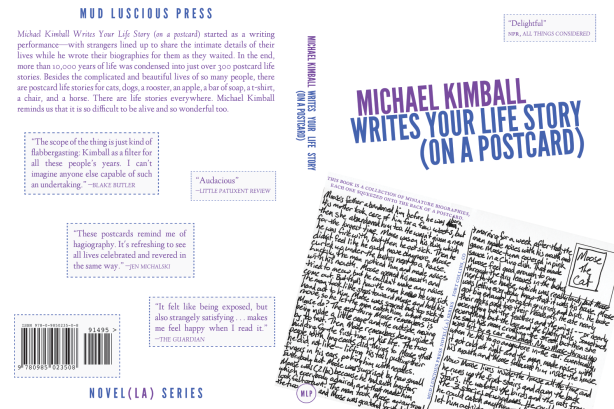
“I never expected strangers to tell me so much about themselves, so many things they have never told anybody else, but I found an unexpected intimacy in the postcard life story project,” writes Michael Kimball in the introduction to his new book, the aptly titled Michael Kimball Writes Your Life Story (On a Postcard). Kimball continues: “It tapped into something human and humane. I was continually amazed by what people told me.”

Kimball’s respect for the people whose stories he is telling comes through in his spare but descriptive prose, an economical rhetoric undoubtedly necessitated by the confines of his small canvasses. When I interviewed Kimball about the project, he told me:

There are difficult things at different stages of the process. The first difficult thing is asking the right questions for the particular participant. The second difficult thing is being representative when condensing what I’ve been told. The third difficult thing is writing small enough to squeeze six hundred words or so onto a single postcard.

Through that asking, condensing, and squeezing, Kimball distills his subject’s lives into compact but moving stories.

Michael Kimball Writes Your Life Story (On a Postcard) began as a performance piece at the Transmodern Performance Festival and then continued as a blog. Kimball eventually wrote over three hundred postcards; over fifty of these are collected in the new book. A not-insubstantial number of these are devoted to the biographies of contemporary writers, including folks like Tao Lin, Matt Bell, and Blake Butler:

By 4 years old, Blake was performing considered monologues, crazy dances, music videos, and both sides of talk shows. It’s all on video (his mother will show you, if you want). Despite these performances, Blake was a fat child by the 4th grade. He liked comic books and video games. By 10th grade, he weighed 250 pounds and felt disregarded. His bedroom walls were covered with pictures of women that he tore out of magazines at the grocery store and took home.

There’s also a first-person POV bio of Edgar Allan Poe, the last few paragraphs of which I can’t help sharing:

In 1831, my foster father and I had a terrible disagreement, after which I was court-martialed and kicked out of West Point. In 1834, my foster father died and did not leave me any of his money. To console myself, I married my 14-year-old cousin, Virginia Clemm.

For years, I published poems and stories and criticism, but it did not make me happy or money. In 1837, I was fired from a newspaper job for drinking. After that, I published a novel, but that didn’t help much either. Readers are sick. That’s why Virginia got tuberculosis and died in 1847. I was so lonely and so cold. I could not stop drinking.

It was 1849 when I stopped in Baltimore. I remember going down in the street, and, later, two hazy men taking me someplace white. I don’t remember dying, but I was glad I didn’t have to keep trying.

The mix of empathy and humor we see here resonates throughout the collection, whether Kimball is telling the life story of a U.S. President, or an ex-crack addict who met his wife at an all-you-can-eat buffet, or a rooster. Kimball handles his subjects with an intense honesty appropriate to the often tragic trajectory these tales take—even a piece like “Red Delicious Apple,” which takes metaphysical license of a sort, leads to a sad end:

The first thing Red Delicious Apple remembered was being a flower and the way the birds sounded in the trees. Later, Apple remembered the wind and losing his petals. Apple wanted to jump down after them, but stayed on the branch, in the tree. … Not long after that, Hand delivered Apple to the teeth. Apple could feel the teeth cutting through his skin and into his meat, what was left of his insides turning brown. Afterward, he sickened, softened. The last thing Apple remembered was the trashcan, the lid, the rotting darkness.

Or the fate of “Chair”:Chair thought, Wood and glue.

Chair thought, Next time, I’m letting go.
Chair cracked. He broke one of his legs and then his back.
Chair thought, That didn’t even hurt.

Update : Chair was thrown into a dumpster.

But perhaps I bring up “Chair” and “Red Delicious Apple” because their tragic contours are easier to allude to quickly than many of the biographies here, which often involve missing parents,  mental illness, and suicidal thoughts, all delivered in the spare, striking prose that the confines of Kimball’s project necessitate. The stories are sometimes shocking and sometimes sad and usually very moving. As the titular anonym of “G” suggests, “tragedy can be beautiful.”

Michael Kimball Writes Your Life Story (On a Postcard) is new from Mud Luscious Press.

Yoko Ogawa’s Revenge Is an Elegant Collection of Creepy Intertextual Tales

revenge

In Yoko Ogawa’s new collection Revenge, eleven stories of fascinating morbidity intertwine at oblique angles. Tale extends into tale: characters, settings, and images float intertextually from chapter to chapter, layering and reticulating themes of death, crime, consumption, and creation. (And revenge, of course. Let’s not forget revenge). Not quite a story cycle or a novel-in-tales, Revenge’s sum is nevertheless greater than its parts. It’s a brisk, engaging read, and as I worked my way to the final story, I already anticipated returning to the beginning to pull at the motifs threading through the book.

The book’s dominant motifs of death and food arrive in the first tale, “Afternoon Bakery,” where a mother tries to buy strawberry shortcakes for her dead son’s birthday—only the baker is too busy bawling to attend to sales. We learn why this baker is crying in “Fruit Juice,” the second story, a tale that ends inexplicably with an abandoned post office full of kiwi fruit. The third story, “Old Mrs.  J” (one of Revenge’s stand-outs) perhaps answers where those kiwis came from. More importantly, “Old Mrs. J,” with its writer-protagonist, elegantly introduces the thematic textual instability of the collection. There’s a  haunting suspicion here that the characters who glide from one tale to the next aren’t necessarily the silent extras they seem to be on the surface. Our characters, background and fore, are doppelgängers, ghost writers, phantoms.

The penultimate tale “Tomatoes and the Full Moon” lays the ghosting bare. Its protagonist is a magazine writer, whose “articles” really amount to little more than advertising. Staying at a seaside resort, he’s pestered by an old woman, one of the many witches who haunt Revenge. The old woman claims to be a novelist, and points out one of her books in the resort’s library:

Later, in my room, I read ‘Afternoon at the Bakery.’ It was about a woman who goes to buy a birthday cake for her dead son. That was the whole story. I should have gone back to my article, but I read her novel through twice, finishing for the second time at 3:00 a.m. The prose was unremarkable, as were the plot an characters, but there was an icy current running under her words, and I found myself wanting to plunge into it again and again.

The final line is perhaps a description of Revenge’s haunting intertextual program—although to be clear, Ogawa’s plot and characters are hardly “unremarkable,” and her prose, in Stephen Snyder’s English translation, is lucid and descriptive. It’s the “icy current running under her words” that makes Ogawa’s tales stick so disconcertingly in the reader’s psychic gullet. And if her prose is at times “unremarkable,” it’s all in the service of creating a unifying tone. All eleven tales are narrated in first-person, and each narrator is bound to the limits of his or her own language.

These limitations of language bump up against the odd, the spectacular, the alien, as in “Sewing for the Heart”:

She had explained that she was born with her heart outside of her chest—as difficult as that might be to imagine.

The line is wonderful in its mundane trajectory: Our narrator, an artisan bagmaker, witnesses this woman who lives with her heart outside her chest and concedes that such a thing might be “difficult . . . to imagine”! There’s something terribly paltry in this, but it’s also purposeful and controlled: Here we find the real in magical realism.

But this bagmaker can imagine, as we see in an extraordinary passage that moves from the phenomenological world of sight and sound and into the realm of our narrator’s strange desires:

She began to sing, but I could not make out the words. It must have been a love song, to judge from the slightly pained expression on her face, and the way she tightly gripped the microphone. I noticed a flash of white skin on her neck. As she reached the climax of the song, her eyes half closed and her shoulders thrown back, a shudder passed through her body. She moved her arm across her chest to cradle her heart, as though consoling it, afraid it might burst. I wondered what would happen if I held her tight in my arms, in a lovers’ embrace, melting into one another, bone on bone . . . her heart would be crushed. The membrane would split, the veins tear free, the heart itself explode into bits of flesh, and then my desire would contain hers—it was all so painful and yet so utterly beautiful to imagine.

Painful and utterly beautiful: Another description of Revenge.

Sometimes the matter-of-fact tone of the stories accounts for marvelous little eruptions of humor, as in “The Last Hour of the Bengal Tiger”:

At fifteen, I took an overdose of sleeping pills. I must have had a good reason for wanting to kill myself, but I’ve forgotten what it was. Perhaps I was just fed up with everything. At any rate, I slept for eighteen hours straight, and when I woke up I was completely refreshed. My body felt so empty and purified that I wondered whether I had, in fact, died. But no one in my family even seemed to have noticed that I had attempted suicide.

The scene is simultaneously devastating and hilarious, an evocation of abyssal depression coupled with mordant irony. The scene also underscores the dramatic uncertainty that underpins so many of the tales, where the possibility that the narrator is in fact a ghost or merely a character in someone else’s story is always in play.

There’s no postmodern gimmickry on display here though. Ogawa weaves her tales together with organic ease, her control both powerful and graceful. Her narrators contradict each other; we’re offered perspectives, glimpses, shades and slivers of meaning. A version of events recounted differently several stories later seems no more true than an earlier version, but each new detail adds to the elegant tangle. Like David Lynch and Roberto Bolaño, Ogawa traffics in beautiful, venomous, bizarre dread. Like those artists, she offers a discrete world we sense is complete and unified, even as our access to it is broken and discontinuous. And like Angela Carter, Ogawa channels the icy current seething below the surface of our darkest fairy tales, those stories that, with their sundry murders and crimes, haunt readers decades after first readings.

What I like most about Revenge is its refusal to relieve the reader. The book can be grisly at times, but Ogawa rarely goes for the lurid image. Instead, the real horror (and pleasure) of Revenge is the anxiety it produces in the reader, who becomes implicated in the crimes cataloged in the text. Witness to first-person narratives that often omit key clues, the reader plays detective—or perhaps accomplice. Recommended.

Revenge is new in handsome trade paperback from Picador; Picador also released Ogawa’s novel Hotel Iris in 2010.

A Riff on Paul Thomas Anderson’s Film The Master (Including a Take on the Ending)

TheMasterPosterTurkishFullBWaltv2

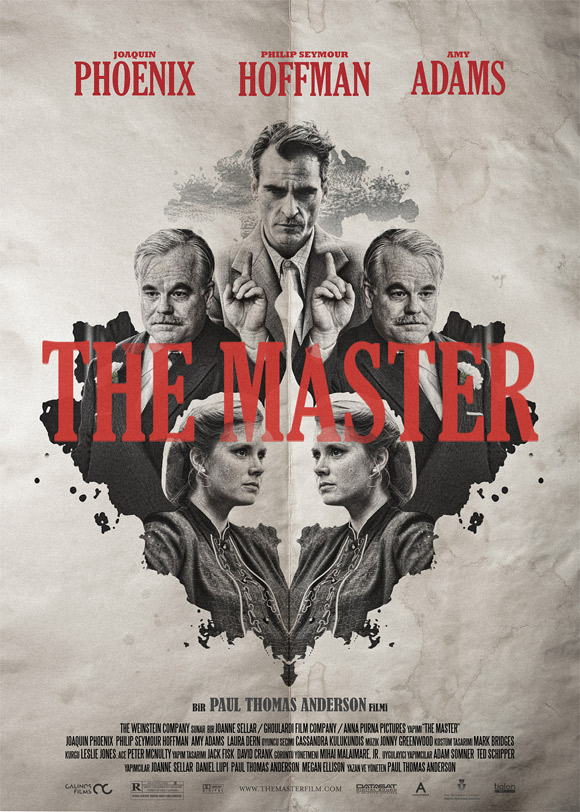
1. I finally saw Paul Thomas Anderson’s 2012 film The Master last night. I’m going to riff on the film. Fair warning:this riff will contain spoilers—I’ll talk about the film’s final scene, for instance (and if you just want to read about the ending, scroll down to point 23, after the embedded video).

2. The first hour of The Master is probably the best thing PTA has done.

3. The Master begins on a beach somewhere in the South Pacific. These are the final days of WWII. Navy boy Freddie Quell (portrayed by Joaquin Phoenix), solitary from his fellows, pours from a can of the mystic moonshine he brews into a coconut he’s hacked open with a machete. He then drinks the potion and mimes chopping off his hand with the machete. After this, he humps a woman made of sand and jerks off into the ocean.

4. The idyll of the Pacific beach contrasts strongly with Quell’s tortured psyche—it’s clear from the film’s first few moments that he’s borderline deranged, a sex-obsessed alcoholic who was damaged long before the war.

5. Quell is also a profoundly talented chemist (or alchemist) capable of brewing strange cocktails mixed from whatever’s at hand. These potions intrigue Lancaster Dodd (henceforth Master, played by Philip Seymour Hoffman), who samples a flask and asks Quell to brew more. Quell says he’ll make Master something different from that first batch, asking him, “How do you want to feel?”

6. “How do you want to feel?”

This question governs The Master, and the film is at its best when probing and plumbing these depths.

7. Back to my second statement: The first hour or so of The Master is probably the best thing PTA has done. Freddie Quell is an intriguing figure, a desperate madman who recapitulates the crimes of Oedipus where ever he goes.

He is The Misfit of Flannery O’Connor’s story “A Good Man Is Hard to Find,” trying to match faith to the phenomenal world.

He is Jonah, fleeing angry Yaweh, stowing away on a ship.

8. The first scenes of The Master borrow liberally from the Terrence Malick playbook:

The opening scene on the beach strongly recalls the opening of The Thin Red Line, and the subsequent scenes where Quell maybe murders a man and then must run feel like the opening minutes of Days of Heaven.

Like Malick, PTA lets the gorgeous cinematography convey meaning; dialog passes through the background of the film.

9. The dialog begins when Quell meets Master, charismatic leader of “The Cause.” You know of course that Master is based on L. Ron Hubbard, founder of Scientology. It’s worth pointing out that the film isn’t really about Scientology, or cults, or charlatans—although these points are explored, for sure—it’s really about the search for meaning, for stability. For some kind of peace.

10. The friendship—and friendship-as-dialog—between Master and Quell is by far the most compelling part of The Master, and the film’s best scene is a long episode where Master initiates “Processing” with Quell—delving into the man’s founding traumas to purify his spirit. I usually hate to laud actors, but Hoffman and Phoenix are sublime here, fully inhabiting the characters through the scenes deep emotional shifts.

The Master never surpasses this scene.

11. Indeed, the biggest failure of the film is that there’s no moment in its back half that can respond to the Processing scene. The film’s final scene attempts to mirror it in some ways, but the attempt lacks the weight. It’s off balance.

12. I feel the need to preface what I’m about to write by saying very clearly:

Paul Thomas Anderson is an extremely gifted auteur, a filmmaker who has, moreso than perhaps any of his contemporaries, continued in the (anti-)tradition of the New Hollywood films of the seventies. I would rather watch a PTA film than a film by just about anybody.

But:

The guy has a real problem sticking the ending. His films fail to cohere, to transcend the sum of their parts. This might be an editing issue or a plotting issue or something more commercially-driven, like running time. I don’t know.

13. Exceptions to PTA not sticking the ending:

Punch Drunk Love, easily his most concise and focused film, a long short story from a filmmaker who works in sprawling novels.

Possibly Boogie Nights, which sags in the final third but is nevertheless buoyed by an energetic scene featuring Alfred Molina, a mixtape, some cocaine, and fireworks. (This scene is lifted from Robert Downey Sr.’s Putney Swope, by the way).

14. For the most part though, PTA’s films swell outside of the margins that their own narratives establish in the beginning of each film (I’m not sure if this sentence makes sense—what I mean is that the films’ endings fall apart w/r/t the films’ beginnings).

In There Will Be Blood, PTA uses a stunning, violent, unforgettable final moment as a punchline to the film. It’s probably what most of us remember, and it’s certainly a great way to close the epic. Still: When I rewatch Blood, I start to become impatient with the film’s meandering after its thrilling opening hour. I start to anticipate the horrific punchline.

15. The easiest example to point to of PTA’s undisciplined sprawl is Magnolia. I can’t think of a film with a stronger opening that so quickly devolves into Altmanesque chaos. Which is the point, yes, I get—but Magnolia, again, is a PTA film which can’t live up to its first hour. (Again, PTA covers over the back end’s sloppiness with a marvelous final scene).

16. So, to return to The Master: I went into the film with high expectations—hoping that this would be the film by PTA that coheres, that is more than just a collection of fantastic performances and amazing scenes. And for the first hour, I was enthralled: I cared deeply about Freddie Quell, found his strange passions heartbreaking, was moved by his bizarre relationship with Master.

And the film is great—it really is—but it’s not as great as I wanted it to be. (Which, yes, I know, says nothing about the film and everything about me).

17. The film’s seams start to show after the magical sea voyage from California to New York. The first few scenes in New York are fascinating (especially when Master is confronted by a skeptic at a party), but as the The Cause moves back West over land, PTA increasingly relies on montages and shorter scenes that seem like placeholders to cobble together the film’s longer sections.

18. The last truly transcendent scene is where Master sings “I’ll Go No More A-Roving,” and it comes at almost exactly the half-way point of the film’s 138 minute running time.

19. All kinds of interesting stuff happens after the “Roving” scene—and PTA seems content to raise more mysteries than he resolves, which I’m fine with—but a long montage showcasing the different Processing techniques of The Cause sucks the energy right out of the film.

20. What follows is a lot of meandering, a lot of unexplained—or worse, unexplored—moments between characters that shift focus away from the relationship between Master and Quell.

21. Maybe I want a longer edit of The Master.

22. Here’s a 20 minute reel of cut footage:

23. And what about the ending of The Master? As I tried to convey in points 13-15, PTA usually closes with a very strong scene or image. With the exception of There Will Be Blood, I’d argue that the final moments of PTA’s films generally depict moments of love, redemption, or reconciliation. The Master fits into this trend. How so?
24. Okay: So The Master is in some ways formally Oedipal.

Quell’s crimes are two-fold: He kills a man who he says reminds him of his father and he has sex with his aunt. The film leaves open the possibility that both of these crimes—crimes he confesses to Master during Processing—are simply displacements for the more direct sins of killing his real father and fucking his real mother.

The Oedipal tensions that underwrite the film are strongly on display in the relationship between Master and Quell: Master is in love with Quell; Quell needs a father figure. All sorts of weird familial displacements ensue between Master’s family members and Quell.

The Oedipal theme also evinces in the film’s motif of breasts, bellies, and other pregnancy images. While not many of The Cause’s ideas are expressed clearly in The Master, the idea that all founding traumas are recorded in/on the soul is made plain several times. Put another way, all people are subjected to traumas that exist in pre-Oedipal, pre-lingual, pre-conscious states.

Quell wants to return to the womb to correct or ameliorate or avoid these traumas. The impossibility of achieving this desire drives him to self-medicate with his homemade brews and to see sex in everything.

The film ends with Quell having sex with a stranger he picks up in a bar. They laugh heartily—another of the film’s motifs—laughter as a measurement of joy, but also dejection, also hysteria, also fear, also irrationality, also no language, just laughter—they laugh heartily, and in a shot that foregrounds his sex partner’s large breasts, Quell begins Processing her.

25. We then get the film’s last line, delivered with laughter: “Stick it back in, it fell out.”

The referent of the “it” is, on the surface level, Quell’s penis, but it also serves as a substitution for Quell himself, who would like to return to a mother, to start again in a new life. (The scene, a riff on Quell’s first Processing with Master, can also be read as the displaced sexual consummation between the two men).

The film’s final image gives us Quell lying down next to the woman made of sand, her huge breasts erect, dominating the shot; he curls into her, peaceful, serene, fetal. The shot is deceptive: It suggests reconciliation or even redemption, but the memory of peace is just one fragment of Quell’s terribly fragmented life. Significantly, the moment comes from the beginning of the film. If Quell is to be reborn and live again—as Master believes all people are—it is clear that he has not transcended his base animal urges.

When Quell awakes, he awakes to trauma.

26. Having riffed on the film’s end, I think the film is probably better than I gave it credit for earlier. It’s a cold Sunday. I think I’ll watch The Master again.

Selections from One-Star Amazon Reviews of Melville’s Moby-Dick

[Ed. note: The following citations come from one-star Amazon reviews of Herman Melville’s novel Moby-Dick. To be very clear, I think Moby-Dick is fantasticbut I also enjoy seeing what people compelled to write negative reviews of the book on Amazon had to say. What follows are selections of one-star Amazon reviews; I’ve preserved the reviewers’ unique styles of punctuation and spelling. See also: on Joyce’s Ulysses and Markson’s Wittgenstein’s Mistress].


Yechh.

It made for a smashing movie.

If you want to read lots of meaningless whale trivia read the book.

Boy gets whale. Boy loses whale. Boy gets whale. Spawns yawns

I think if you made it into a short comic strip, you would have liked it.

I bought this book for a friend in jail. Alas, he was unable to read it because the font was too small.

Ray Bradbury, who wrote the screenplay for this novel, (a la Gregory Peck) couldn’t even finish the damn thing!

If you like a story with nonessential information and an author that is entirely to verbose, then this book is for you.

I am quite the fan of stories which involve man eating sea creatures, such as Jaws. Moby Dick is nothing compared to such classics, I fear.

Throughout the book, you may read one chapter with some action only to be followed by 5 or 6 chapters of tangents that are not necessary to understand the story.

Moby Dick, was a horrible waiste of time. Along with its wordy paragraphs, it also talked about uninteresting issues. It is also to long, and you don’t hear of them encountering the whale until the end of the book.

The only people who like this book are english teachers who derive a feeling of moral superiority from forcing others to read this incredibly bad novel.

First of all, classiflying it as fiction is a mistake. Probably a good 60% of the book is non-fiction – chapter after chapter dedicated to every imaginable detail of the biology of the whale and every imaginable nuance of whaling.

I love literatur just as much as the next guy but we must face it 100 years or so ago American literature was reall weak and lagging from the rest of the world, perhaps now they’re starting to catch up with writers like Ann Rice and them.

I have seen better writing in a Hallmark card! Boring! Give me a good ole copy of Elvis and Me! A true story that really tugs at your heart strings! I sleep with that one under my pillow! Keep Moby Dick away from my bed!

Those chapters about Ishmael sleeping with whatever his name was and Ishamel had such a good time with the other guy’s arm over him and leg over him that he didn’t know if he was straight or gay any more.

i personally didn’t enjoy the philosophical or deep side of the book, i have read much much better books in that regard.

There is no suspense, and I find the idea of people hunting whales offensive. Offensive with a capital O.

Honestly, Over 400 pages devoted to killing a whale because it ate your hand? Come on.

It is hard to read. like work. Doubt he could get published today.

What is the whales motivation? You dont know.

It is 540somepages of boring whaling details.

No wonder Melville flopped as a writter.

OMG, this is tedious and torture to read.

I HATE this book. Why? It’s BORING!

Moby Ick’s more like it.

Moby-Dick: A Short Riff on a Long Book

Green and White, Georgia O'Keeffe
Green and White, Georgia O’Keeffe

1. Prompted by Call Me Ishmael, Charles Olson’s marvelous study of Moby-Dick, I took a fifth trip through Melville’s massive opus this past month.

2. Every time I read Moby-Dick it seems funnier and sadder. Richer. Thicker.

3. I cobbled together my reading over different media and spaces: I listened to William Hootkins‘ outstanding unabridged audiobook version, and then reread on my Kindle key passages I’d mentally underlined; I then checked those passages against the copy of Moby-Dick I annotated the hell out of in grad school.

As I read, I posted some of my favorite excerpts on this blog.

4. I posted some of my favorite excerpts of Moby-Dick here on Biblioklept because I knew that I wouldn’t be able to write about the book—not really—that I wouldn’t be able to handle all of its language. (My riff on Olson’s book obsesses over Olson’s ability to write after Melville and Melville’s ability to write after Shakespeare).

5. Really, in posting so many fragments of Moby-Dick, I suppose that I’ve attempted to abrogate any kind of critical duty to describe the book under discussion in terms of its own language.

6. Point 5 is really a way of saying: Moby-Dick, like any sublime work of literature, is a self-defining, self-describing, and even self-deconstructing text.

7. Or, another way of making such a claim:

Let me (mis)appropriate Samuel Beckett’s description of Finnegans Wake and contend that the description fits Moby-Dick just as aptly:

Here form is content, content is form. You complain that this stuff is not written in English. It is not written at all. It is not to be read – or rather it is not only to be read. It is to be looked at and listened to. His writing is not about something, it is that something itself.

8. So here circumnavigate back to my own recent reading and auditing of the book:

Hootkins’ audio recording would make a great starting point for anyone (unnecessarily) daunted by Melville’s big book. He performs the book, commanding his audience’s attention. He unpacks the humor that might otherwise hide from untuned 21st century ears; he communicates the book’s deep, profound sorrow. His Ishmael is perceptive, clever, generous. His Stubb, hilarious. His Ahab a strange philosophical terror.

After listening to Hootkins on my commute, I’d return to key passages on my Kindle, and then finally review the notes I wrote in the cheap hardback Signet edition I read in grad school.

But why bring this up?

9. I don’t know.

Maybe: Unpacking Moby-Dick is too hard, too much—would require its own book, a book that would cite the entirety of Melville’s book.

But discussing the book this way seems a disservice to potential readers; it’s as if we would cloak the book in a mystic veil.

White Figure, Wassily Kandinsky

10. If I have a point to all of this: Moby-Dick is wonderful, funny, moving, engaging; a genre-bender that tackles philosophy, history, science; an adventure tale; a psychological novel brimming with ideas, allusions—but one delivered in sonorous, poetic language. It’s good, great, grand. Read it, if you haven’t. Reread it.

11. So I’ve failed to even try to begin to attempt to pretend to describe the plot.

Here: Ishmael, depressed, suicidal perhaps, decides to go to sea. To go whaling.

He tries to measure the whale, and by measuring the whale, maybe measure the world. But this is not really possible, certainly not in language. Certainly not in first-person perspective.

In Chapter 86, “The Tail,” Ishmael tells us:

The more I consider this mighty tail, the more do I deplore my inability to express it. At times there are gestures in it, which, though they would well grace the hand of man, remain wholly inexplicable. … Dissect him how I may, then, I but go skin deep. I know him not, and never will. But if I know not even the tail of this whale, how understand his head? much more, how comprehend his face, when face he has none? Thou shalt see my back parts, my tail, he seems to say, but my face shall not be seen. But I cannot completely make out his back parts; and hint what he will about his face, I say again he has no face.

(I don’t suppose I need to remark that Melville here lets one mighty tail stand in for another mighty tale—a tale he cannot face).

12. “Call me Ishmael”: our protagonist hails us.

But these famous opening lines aren’t really the beginning of the book. First we have the section titled “Extracts,” and before that “Etymology.” The first entry on the etymology of the whale, from  Hackluyt, warns us not to leave out “the letter H, which almost alone maketh up the signification of the word.”

Whaling. Hailing. Wailing.

The whiteness of the whale.

The witness of the wail.

13. How, just how, does Ishmael witness? How does he manage to tell this story? Did I obsess over this in earlier readings? I don’t think so—I was too concerned with absorbing the what and the why of the story to closely attend the how of its telling.

14. The novel begins in standard first-person point-of-view territory, Ishmael guiding us through Manhattan, New Bedford, Nantucket—but by the time he’s boarded the Pequod and set out into the wide watery world, this first-person perspective transcends the limits of physics: Our narrator not only attends the private conversations of Ahab, his mates, his harpooners, his men—but also the very interior of those men, their minds, their dreams, their imaginations.

Is Ishmael a ghost?

Leviathan-Job 40-21, Salvador Dali

15. And to return to Ahab for a moment: My godwhat a voice! His infecting, addicting insanity. His agon with Moby Dick, with the sun, with himself.

16. And Starbuck: Starbuck comes across weaker and weaker each time I read the book. We’re to believe he’s a man of convictions, but he moves in half-measures. In his final moments he tries to match or feign or approximate Ahab’s insanity: tragicomedy.

17. And Stubb: Despite his cruelties, he may be my favorite character in the book.

18. While I’m riffing: Is there a novel more phallic in the American canon than Moby-Dick? All that sperm: All that life-force.

19. This is maybe what Moby-Dick is about: Life-force. The attempt to to resurrect and die and resurrect again. The coffin that serves as life-buoy. The life-line that connects men that might also be their death. A counterpane to counter pain. A condensation of oppositions.

A yarn, a rope, a series of knots, layered, layering, self-contextualizing.

An attempt to put into language what cannot be put into language.

20. Twenty points: Maybe too long for the “short riff” promised in the title, but also surely too short to even begin to start to approach to pretend to say something adequate about the novel. So a parting thought: Moby-Dick is better—richer, fuller, deeper—each time I read it, and I look forward to reading it again.

Seven-Inch Sundays #2 // The Swirlies — “Wrong Tube”

20130224-130231.jpg

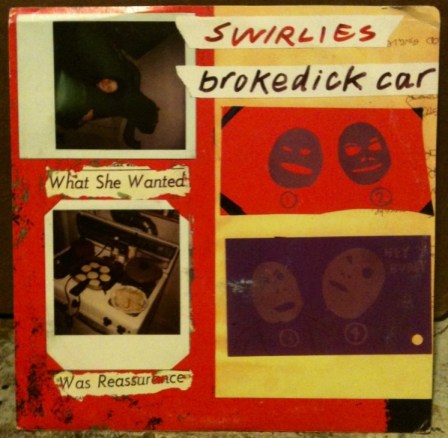
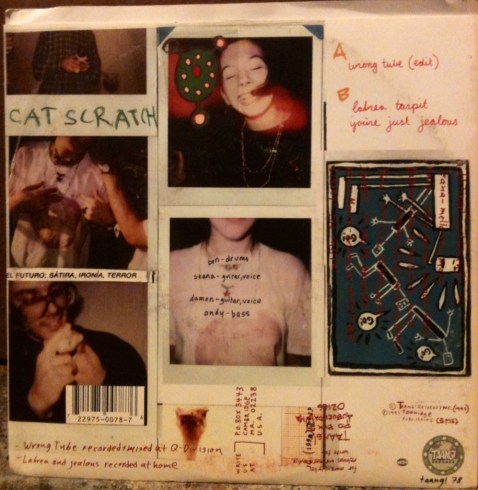
In my estimation, The Swirlies were the greatest indie rock band of the 1990s to never really make it big—and by “make it big” I mean indie rock big—Sebadoh big, Superchunk big. They made two stellar albums of shoegazed-influenced dream pop, Blonder Tongue Audio Baton (1993), and They Spent Their Wild Youthful Days in the Glittering World of the Salons (1996). These albums are crammed with fuzzy four-track recorder experiments, folky half-songs, and a handful of truly stellar, muscular, dream pop songs that would fit nicely on any mixtape between jams from My Bloody Valentine and Stereolab. One such song is “Wrong Tube,” the a-side to this Taang! Records 7″ purporting to be the Brokedick Car EP (it’s not the full EP, which has two other songs).

20130224-130239.jpg

“Wrong Tube” was a staple in my ’86 Camry’s tape deck for years, and I still love it today. I haven’t listened to this 7″ in years—I almost certainly bought it because of the blue vinyl (and, ashamedly, certain completist tendencies). The guitars are crunchy, swerving, swirly, guitarists Seana Carmody and Damon Tutunjian attacking their tremolo bars with abandon and trading verses as the band crashed through in a high tempo. I still find the final moments of the song exhilarating, as one of the guitars hammers out a  sweet melody in the highest register as Carmody harmonizes along. Somehow the entire version of the song doesn’t fit on the 7″, which is a shame I guess. B-sides “Labrea Tarpit” and “You’re Just Jealous” are a forgettable experiment followed by a forgettable ditty.

Seven-Inch Sundays #1 // Archers of Loaf — “Harnessed in Slums”

20130216-150618.jpg

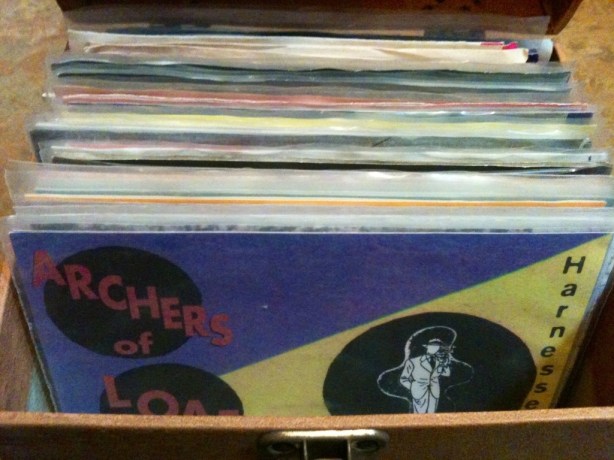
Before mp3s, we used to buy these things called seven-inches, small disks of vinyl, usually played at 45rpm, usually offering an a-side with the band or singer’s single, and backed with (b/w) a b-side offering a song (or songs!) that probably wouldn’t be on the album. A lot of times, 7″s would consist of songs that wouldn’t be on any album. Or that would be it for the band—just the one 7″. I bought many, many of these little disks between 1992 and 1999, and I still have three boxes full of them gathering dust in a utility room.

Anyway, new feature: I’ll pull out one each Sunday, listen to it, photograph it, share some thoughts on it, etc.

For this week, I pulled out the closest box and then pulled out the first 7″ in the stack: Archers of Loaf’s 1995 single for “Harnessed in Slums,” b/w “Telepathic Traffic.”

20130216-150634.jpg

“Harnessed in Slums” is the second track from the band’s second album, 1996’s album Vee Vee.

Vee Vee came out shortly after the 1995 EP Vs. the Greatest of All Time, which I think might be the Archers’ best work—or at least, that’s how I remember it. Anyway, I loved this early arc of the band’s career, which kicked off with Icky Mettle, a basically perfect glob of nineties indie rock.

I haven’t listened to Archers of Loaf in years. I lost interest in what the band was doing by the late nineties, and like many of the albums I listened to thousands of times in my teens, I find their music too intertwined in intense memories and feelings to listen to again. I have a hard time extricating the psychic detritus of my youth from certain albums.

20130216-150656.jpg

The crunchy warbled opening  of “Harnessed in Slums” brought back a strange rush of the past. I remembered seeing the band—on a school night!—in support of Icky Mettle. My friend Wayne brought a paper headband to the show and guitarist Eric Johnson wore it through most of the set. They gave us the set list (on a paper plate) and autographed stuff. I wonder if they thought it was weird that we wanted their autographs—think it’s weird now. (By the time I was 17 I had almost no interest in talking to anyone in a band, let alone getting an autograph).

“Harnessed in Slums” is a perfect Archers track, poppy, proggy, fake-sloppy, a punk anthem channeled through the crunchy trademark sound of the 1990s NC Triangle. Weirder and darker than Superchunk, tighter and more metallic than Pavement, Archers of Loaf hit a not-too-sweet spot somewhere between prog virtuosity and DIY punk aesthetic. The lyrics are bizarre, maybe meaningless, a shout-along that could have come from a Burroughs cut up (“I want waste / We want waste / They want waste / Slaves want waste”; “Strip the color from the meat of my eye”).

20130216-150643.jpg

The b-side is “Telepathic Traffic,” a jam that swells with acoustic guitars and snaky, snarly guitar lines—there’s almost something crime noir about the song. It’s sinister anyway. Eric Bachmann’s opening barks are almost comical, as if he’s imitating some British post-punk hero, before clustering into a pogoing chorus. “Telepathic Traffic” bears a few too many conventions that can become tiresome over an album—the track slows and speeds up unnecessarily when it should plow straight ahead (or perhaps just get faster).

Listening to these tracks again doesn’t make me want to pull out Icky Mettle as much as it makes me want to check out Erich Bachmann’s latest stuff. Has he mellowed out? Added more/different instrumentation? Complicated or simplified his sound? I remember being perplexed by his 1995 solo album Barry Black, which I recall having chamber arrangements. Maybe I should check it out.

A Brief Review of David Malouf’s Essay The Happy Life (Book Acquired, Some Time in December 2012)

20130107-201922.jpg

When David Malouf’s little hardback essay The Happy Life showed up late last year to Biblioklept World Headquarters, I’ll admit to grimacing a bit. I judge books by their covers, their appearance, their size, and frankly Malouf’s little book, with its smallish dimensions and hokey subtitle seemed to scream “self-help/gift book.” And oh the emoticon!

But before I do these “Books Acquired” I always take the time to sample the prose a bit. Here’s what happened with Malouf: I kept reading. Malouf snagged me into doing a thought experiment on the first page (“Think of a medieval farmer as he struggled to keep body and soul together”), an exercise that quickly led to citations from Solzhenitsyn, Montaigne, and Sir Henry Wotton—before posing the book’s central questions:

The question that arises is not so much ‘How should we live if we want to be happy?’ but how is it, when the chief sources of human unhappiness, of misery and wretchedness, have largely been removed from our lives—large-scale social injustice, famine, plague and other diseases, the near-certainty of an early death—that happiness still eludes so many of us? What have we succumbed to or failed to do that might have helped us? What is it in us, or in the world we have created, that continues to hold us back?

First World Problems! Seriously though, Malouf seems aware of the simple answer to these questions—it’s impossible and likely dangerous to be happy all the time; what he really seems concerned about are the paradigms and ideologies and systems—government, media, corpocracy, pick your poison—that create impositions of happiness as a kind of ideal. As such, Malouf returns again and again to Jefferson’s “life, liberty, and the pursuit of happiness,” along with Solzhenitsyn’s One Day in the Life of Ivan Denisovich. He ends his long essay with a discussion of Solzhenisyn’s Shukov, “an unlikely example of the happy man.” And through this storytelling, we can find a moment of stabilizing happiness too:

Fiction, with its preference for what is small and might elsewhere seem irrelevant; its facility for smuggling us into another skin and allowing us to live a new life there; its painstaking devotion to what without it might go unnoticed and unseen; its respect for contingency, and the unlikely and odd; its willingness to expose itself to moments of low, almost animal being and make them nobly illuminating, can deliver truths we might not otherwise stumble on.

Shukhov is not happy because he has solved the problem of ‘how to live’ —the live he lives is too provisional, too makeshift for that. Or because, as the classical schools would have put it, he has achieved quite self-containment, self-sufficiency. Quite the opposite.

What he achieves, briefly, intermittently, is moments of self-fulfillment, something different and more accessible, more democratic we might call it, than self-containment. But he achieves it only at moments.

He is happynow—who can know what tomorrow or the day after will do to him? He is happy within limits—and this may be a clue to what makes happiness possible for him, or for any of us.

There’s nothing really radical about this thesis—that we can claim agency to our own happiness by choosing to measure it in small units—but the way that Malouf reaches it is pleasurable to follow and intellectually engaging. I hope that some suckers judge this book by its cover, pick it up in the hopes of buying a map to contentment, and then stick around for Malouf’s journey through literature, philosophy, art, and history. Good stuff.

The Happy Life is new in hardback from Pantheon.


Flann O’Brien’s Novel At Swim-Two-Birds Is a Postmodernist Masterpiece of Comic Storytelling

20130210-161617.jpg

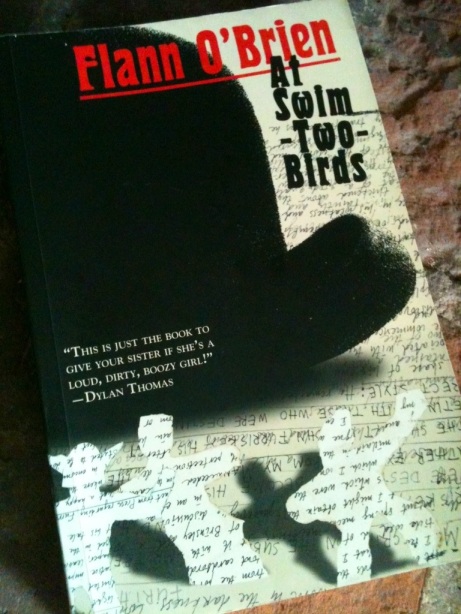
The vibrant force of storytelling in Flann O’Brien’s excellent first novel At Swim-Two-Birds threatens to overwhelm reader and narrator alike—and what a strange joy it is to be overwhelmed. This novel overflows with stories; its plot threads twist into each other, break out of each other, erupt into new ideas, characters, riffs, sketches. First published in 1939—the same year as James Joyce’s Finnegans WakeAt Swim-Two-Birds seems light years ahead of its time—indeed, this is a book that is still ahead of its time.

Summarizing At Swim-Two-Birds is difficult but worth attempting. We have an unnamed narrator, a student living with his uncle who doesn’t think much of how his nephew spends his time. Our narrator likes to imbibe large quantities of porter and wax philosophical with his friends about his literary projects. These projects, our narrator’s riffs and scribblings, begin to take on lives of their own: they intersect, overlap, intermarry, degenerate and regenerate.

The book’s opening paragraph announces the novel’s intention to disregard the classical unities of action, place, and time:

Having placed in my mouth sufficient bread for three minutes’ chewing, I withdrew my powers of sensual perception and retired into the privacy of my mind, my eyes and face assuming a vacant and preoccupied expression. I reflected on the subject of my spare-time literary activities. One beginning and one ending for a book was a thing I did not agree with. A good book may have three openings entirely dissimilar and inter-related only in the prescience of the author, or for that matter one hundred times as many endings.

First, we meet “Pooka MacPhellimey, a member of the devil class,” a hobgoblin of Irish folklore (he turns out to be a thoughtful and polite fellow). Then, there’s John Furriskey, who “was born at the age of twenty-five and entered the world with a memory but without a personal experience to account for it.” Furriskey is the literary creation of another of the narrator’s literary creations, one Dermot Trellis, a grumpy old man who writes Westerns; Trellis (an author, it’s worth reiterating) is the eventual antagonist of the novel, the target for all of the other characters’ vengeance. The third opening offers up Finn Mac Cool, “a legendary hero of old Ireland.”

Much of the early part of At Swim-Two-Birds features Finn Mac Cool holding forth on all matters Irish in wonderfully baroque and hyperbolic passages. Here’s a snippet (a long one!), featuring Finn on the ideal man:

When pursued by a host, he must stick a spear in the world and hide behind it and vanish in its narrow shelter or he is not taken for want of sorcery. Likewise he must hide beneath a twig, or behind a dried leaf, or under a red stone, or vanish at full speed into the seat of his hempen drawers without changing his course or abating his pace or angering the men of Erin. Two young fosterlings he must carry under the armpits to his jacket through the whole of Erin, and six arm-bearing warriors in his seat together. If he be delivered of a warrior or a blue spear, he is not taken. One hundred head of cattle he must accommodate with wisdom about his person when walking all Erin, the half about his armpits and the half about his trews, his mouth never halting from the discoursing of sweet poetry. One thousand rams he must sequester about his trunks with no offence to the men of Erin, or he is unknown to Finn. He must swiftly milk a fat cow and carry milk-pail and cow for twenty years in the seat of his drawers. When pursued in a chariot by the men of Erin he must dismount, place horse and chariot in the slack of his seat and hide behind his spear, the same being stuck upright in Erin. Unless he accomplishes these feats, he is not wanted of Finn. But if he do them all and be skillful, he is of Finn’s people.

It’s hard not to feel something of Joyce in the passage (I’m particularly reminded of the Cyclops episode of Ulysses), and O’Brien’s narrator name-checks Joyce (along with Aldous Huxley) in the first few pages of the book. The narrator’s comically mechanical and precise descriptions also recall Joyce. Joyce and O’Brien drew from the same well of mythology, but O’Brien more keenly attunes his focus on Irish legend and folklore in At Swim-Two-Birds, while Joyce’s project skews to archetypes. Similarities and divergences aside, there’s something strangely fitting about O’Brien’s Finn Mac Cool dreaming his way into other characters’ lives in At Swim-Two-Birds, as if this Finn is the psychic twin of Joyce’s Finn.

Indeed, such a reading would fit neatly into our young narrator’s ideas about the function of character in literature:

Characters should be interchangeable as between one book and another. The entire corpus of existing literature should be regarded as a limbo from which discerning authors could draw their characters as required, creating only when they failed to find a suitable existing puppet. The modern novel should be largely a work of reference. Most authors spend their time saying what has been said before – usually said much better. A wealth of references to existing works would acquaint the reader instantaneously with the nature of each character, would obviate tiresome explanations and would effectively preclude mountebanks, upstarts, thimble-riggers and persons of inferior education from an understanding of contemporary literature.

This decree strikes me as wonderfully post-postmodernist. That the “modern novel should be largely a work of reference” finds its suitable echo over half a century later in the note-card novels of David Markson (and other reality smugglers). The citation above serves as a metatextual description of At Swim-Two-Birds itself: O’Brien’s narrator framing the various tales that erupt in the novel, but also undoing the frames, allowing his characters to converge, to tell their own stories (and within those stories characters tell other stories…).

In its finest moments (of which there are many), At Swim-Two-Birds operates on an ad hoc logic that it creates and describes in motion, a kind of improvised dream response pattern. Most books, particularly postmodern books, teach the reader how to read them—that is, most novels provide keys, hints, and reading rules early enough in the text to allow perceptive readers to interpret (subjectively, of course) what the novel is doing. O’Brien’s novel in toto, with its discontinuities, gaps, eruptions, and juxtapositions, paradoxically is its own discrete, unified key.

But I seem to be getting bogged down in a bit of literary theory, which is not my intent at all.

Instead, let me draw attention to a wonderful extended jaunt in the middle of At Swim-Two-Birds where the Pooka MacPhellimey enters into an ersatz quest with the Good Fairy, two cowboyish thugs (or thuggish cowboys) named Slug and Shorty, the poet Jem Casey, and the mad King Sweeny. This ragtag band sets out to bequeath gifts to the forthcoming child of Miss Lamont (the creation of a creation of a creation). These episodes unfold in comic bravado, their slapstick rhythms recalling the manic but precise energy of Buster Keaton and Charlie Chaplin and the linguistic brio of the Marx brothers. This miniature picaresque is tempered in sweet pathos for poor crazy Sweeny who must be plied forward with the promise of a feast. The poor man, broken, starving, and living solely on watercress, falls into despair. What eventually moves him? The force of language:

And getting around the invalid in a jabbering ring, they rubbed him and cajoled and coaxed, and plied him with honey-talk and long sweet-lilted sentences full of fine words, and promised him metheglin and mugs of viscous tarblack mead thickened with white yeast and the spoils from hives of mountain-bees, and corn-coarse nourishing farls of wheaten bread dipped in musk-scented liquors and sodden with Belgian sherry, an orchard and a swarm of furry honey-glutted bees and a bin of sun-bronzed grain from the granaries of the Orient in every drop as it dripped at the lifting of the hand to the mouth, and inky quids of strong-smoked tabacca with cherrywood pipes, hubble-bubbles, duidins, meerschaums, clays, hickory hookahs and steel-stemmed pipes with enamel bowls, the lot of them laid side by side in a cradle of lustrous blue plush, a huge pipe-case and pipe-rack ingeniously combined and circumscribed with a durable quality of black imitation leather over a framework of stout cedarwood dovetailed and intricately worked and made to last, the whole being handsomely finished and untouched by hand and packed in good-quality transparent cellophane, a present calculated to warm the cockles of the heart of any smoker. They also did not hesitate to promise him sides of hairy bacon, the mainstay and the staff of life of the country classes, and lamb-chops still succulent with young blood, autumn-heavy yarns from venerable stooping trees, bracelets and garlands of browned sausages and two baskets of peerless eggs fresh-collected, a waiting hand under the hen’s bottom. They beguiled him with the mention of salads and crome custards and the grainy disorder of pulpy boiled rhubarb, matchless as a physic for the bowels, olives and acorns and rabbit-pie, and venison roasted on a smoky spit, and mulatto thick-tipped delphy cups of black-strong tea. They foreshadowed the felicity of billowy beds of swansdown carefully laid crosswise on springy rushes and sequestered with a canopy of bearskins and generous goatspelts, a couch for a king with fleshly delectations and fifteen hundred olive-mellow concubines in constant attendance against the hour of desire. Chariots they talked about and duncrusted pies exuberant with a sweat of crimson juice, and tall crocks full of eddying foam-washed stout, and wailing prisoners in chains on their knees for mercy, humbled enemies crouching in sackcloth with their upturned eye-whites suppliant. They mentioned the leap of a fire on a cold night, long sleeps in the shadows and leaden-eyed forgetfulness hour on hour – princely oblivion. And as they talked, they threaded through the twilight and the sudden sun-pools of the wild country.

I’ve perhaps overshared here, let our characters babble on too long—but the verbal dexterity of the passage above illustrates O’Brien’s rhetorical force, the force he lends his characters in order that they should move their insane and desperate friend forward. There’s a sublime alchemy at work here, where imagination turns into words and words turn into food and drink.

I also fear these big chunks of text I’ve pulled from At Swim-Two-Birds don’t highlight O’Brien’s extraordinary talent at rendering speech. The dialogue in this novel is hilarious but nuanced, its ironies rarely if ever remarked upon by intrusive attributions. That O’Brien’s narrator’s characters (and their characters…) speak through the layers of texts adds to the book’s juxtapositions.

These juxtapositions will perhaps confuse or even alienate many readers. At Swim-Two-Birds can be read as an attack on the classical unities of action, place, and time. O’Brien’s novel is a send-up of stability, order, and tradition. Some of the novel’s best moments are its strangest indulgences, as when O’Brien (or his narrator) gives the novel over to citations from imaginary antique texts, or allows his characters to indulge in a seemingly endless recitation of obscure facts, or satirizes the moral dangers of tea-tasting. These moments seem to erupt from nowhere, bizarre, wonderful, joyous.

At Swim-Two-Birds lacks the cohesion of theme and voice that characterizes O’Brien’s other masterpiece, The Third Policeman, but this is hardly a deficiency. At Swim-Two-Birds is one of those rare books that actually deserves to be called dazzling, a critic’s crutch-word that mars too many blurbs. Its dazzle derives from its rhetorical force, its humor, and its openness to experiment with not just the novelistic form, but the form of storytelling itself. And it’s here that O’Brien’s novel is most real—he captures the strangeness of storytelling, its mutability, its crazy rhythms. Ultimately, this is a novel unconcerned with providing pat answers and clear solutions. I loved this book, loved reading it—and then immediately rereading it. I’ll let O’Brien get the last word:

Answers do not matter so much as questions, said the Good Fairy. A good question is very hard to answer. The better the question the harder the answer. There is no answer at all to a very good question.

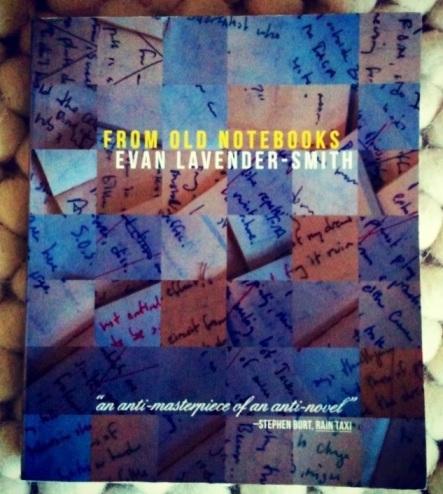
I Anti-Review Evan Lavender-Smith’s Anti-Novel, From Old Notebooks

20130202-121935.jpg

The style of this review is probably a bad idea.

In fact, it’s such a bad idea that it’s probable someone has already done it. Or considered doing it but had the good sense to refrain.

From Old Notebooks as the presentation of a subject through his daily jotting downs.

To clarify: All block quotes—like the one above—belong to Evan Lavender-Smith’s From Old Notebooks.

Which I read twice last month.

And am writing about here.

From Old Notebooks: A Novel: An Essay.

From Old Notebooks: An Essay: A Novel.

From Old Notebooks blazons its anxiety of influence: Ulysses, Infinite Jest, Nietzsche, Wittgenstein. Shakespeare.

Joycespeare.

References, critiques, ideas about Joyce, DFW, Wittgenstein, Nietzsche repeatedly evince in From Old Notebooks—and yet David Markson, whose format E L-S so clearly borrows, is evoked only thrice—and not until page 74 (this in a book of 201 pages):

I count David Markson’s literary-anecdote books among the few things I want to read over and over again, yet I have no idea whether they are actually any good. They’re like porn for English majors.

And then again on page 104:

If David Markson hadn’t written his literary-anecdote novels, would I have ever thought to consider F.O.N. a novel? Would I have ever thought to write such a book?

(I should point out that the page numbers I cite are from Dzanc Book’s first edition of From Old Notebooks; Dzanc’s 2012 printing puts the book back in print).

Like Markson’s anti-novels (Reader’s Block, This Is Not a Novel, Vanishing Point, The Last Novel), E L-S’s F.O.N. is constantly describing itself.

There may be some question as to F.O.N.’s status as fiction, poetry, philosophy, nonfiction, etc., but hopefully there will be no question about its status as a book.

Is E L-S’s book postmodern? Post-postmodern?

Perhaps there is nothing quintessentially postmodern about the self-reflexivity, fragmentation and pastiche of F.O.N., if only because all of it follows from form.

From Old Notebooks as a document constantly performing its self-critique:

If there were a Viking Portable Lavender-Smith containing an abridgment of F.O.N., I would be very interested to read it, because there’s no reason that the total value of the book wouldn’t be gained, through editorial happenstance, with much greater efficiency.

From Old Notebooks as a document of authorial anxiety.

A reader could make a case that there are a number of elided texts within or suggested by From Old Notebooks, including the one that gives the author the authority to write such a book.

F.O.N. is also a generative text, bustling with ideas for short stories, novels, plays, films, pamphlets, somethings—it is E L-S’s notebook after all (maybe). Just one very short example—

Novel about a haunted cryonics storage facility.

F.O.N.’s story ideas reminded me of my favorite Fitzgerald text, his Notebooks.

Reading From Old Notebooks is a pleasurable experience.

Personal anecdote on the reading experience:

Reading the book in my living room, my daughter and wife enter and begin doing some kind of mother-daughter yoga. My wife asks if they are distracting me from reading. I suggest that the book doesn’t work that way. The book performs its own discursions.

I shared the tiniest morsel here of my family; E L-S shares everything about his family in F.O.N.:

I know that the reconciliation of my writing life and my family life is one of the things that F.O.N. is finally about, but I can’t actually see it in the book; I don’t imagine I could point to an entry and say, Here is an example of that.

It would be impossible for me not to relate to the character of the author or novelist or narrator of F.O.N. (let me call him E L-S as a simple placeholder): We’re about the same age, we both have a son and a daughter (again of similar ages); we both teach composition. Similar literary obsessions. Etc. After reading through F.O.N. the first time I realized how weird it was that I didn’t feel contempt and jealousy for what E L-S pulls off in F.O.N.—that I didn’t hate him for it. That I felt proud of him (why?) and liked him.

There are moments where our obsessions diverge; the E L-S of F.O.N. is preoccupied with death to an extent that I simply don’t connect to. He:

1) Think always about sex. 2) Have a family. 3) Think always about death.

I:

1) Think always about sex. 2) Have a family. 3) Think always about sex.

But generally I get and feel and empathize with his descriptions of his son and daughter and wife.

And his work. Big time:

Getting up the motivation to grade student essays is like trying to pass a piece of shit through the eye of a needle.

Or

I have perfected my lecture after giving it for the third time, but my fourth class never gets to realize it because my voice is hoarse and I’m so tired from giving the same lecture four times in one day, so their experience of my perfect lecture at 8-9:40 PM is of approximately equal value to that of my students receiving my imperfect lecture at 8-9:40 AM, as well as my students at 2:30-3:55 and 5:30-7:10—and it all evens out to uniform mediocrity in the end.

The novel is not jaded or cynical or death-obsessed though (except when it is).

What E L-S is trying to do is to remove as much of the barrier between author and reader as possible:

Contemporary authors who construct a thick barrier between themselves and their readers such that authorial vulnerability is revealed negatively, i.e., via the construction of the barrier.

Perhaps my suggestion that E L-S tries to remove the barrier is wrong. Maybe instead: E L-S’s F.O.N. maps the barrier, points to the barrier’s structure, does not try to deny the barrier, but also tries to usher readers over it, under it, through its gaps—-and in this way channels a visceral reality that so much of contemporary fiction fails to achieve.

I really, really liked this book and will read it again.


Franchise Films, Alternate Worlds, and Why Wong Kar Wai Should Direct the Next Star Wars Film

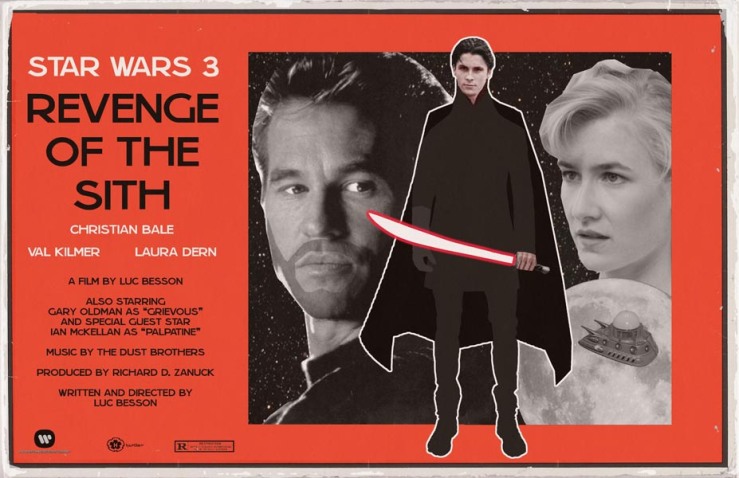
STAR WARS 3 hartter

News that J.J. Abrams will direct the seventh Star Wars film almost broke the internet yesterday. It’s easy to see why anyone who nerds out over franchise properties would take interest. After all, Abrams helmed the 2009 big-screen reboot of Star Trek, a film that shook the camp and cheese from the franchise’s previous films, replacing it with hip humor, thrilling action, and lots and lots of lens flare. Abrams’s sequel, Star Trek Into Darkness is perhaps the most anticipated franchise film of the year. 

I won’t speculate whether an Abrams Star Wars film will be successful or not—you probably wouldn’t want me to, because I hold the extreme minority opinion that Lucas’s Revenge of the Sith is a deeply profound and moving work of cinema art—but I do think that the choice to hand the next big film in the Star Wars franchise over to Abrams represents the worst in corporate thinking. This goes beyond the playground logic of Abrams swiping all the marbles—he gets both the “Star” franchises!—what it really points to is the bland, safe commercial mindset that guides the corporations who own these franchises. J.J. Abrams is a safe bet. I can more or less already imagine the movie he’ll make.

Star Wars: A New Hope came out in 1977, perhaps at the exact moment that the innovations of the “New Hollywood” movement crested (before Heaven’s Gate crashed the whole damn thing in 1980). The films of this decade—Badlands, The Godfather films, Bonnie & Clyde, Chinatown, Nashville, Dr. Strangelove, etc.—helped to redefine film as art; they also captured and illustrated a zeitgeist that’s almost impossible to define. And while plenty of filmmakers today continue in this spirit, their films are often pushed into the margins. The Hollywood studio system is tangled up in big budget spectacle. I have no problem with this, but at the same time I think that there’s something sad in it all—in the bland safety of having Abrams turn out Star Wars and Star Trek films—it all points to a beige homogeneity.

The problem I’m talking about is neatly summed up by Gus Van Sant in a 2008 interview with The Believer:

So, there were some projects I never really could get going, and one of them was Psycho. It was a project that I suggested earlier in the ’90s. It was the first time that I was able to actually do what I suggested. And the reason that I suggested Psycho to them was partly the artistic appropriation side, but it was also partly because I had been in the business long enough that I was aware of certain executives’ desires. The most interesting films that studios want to be making are sequels. They would rather make sequels than make the originals, which is always a kind of a funny Catch-22.

They have to make Bourne Identity before they make Bourne Ultimatum. They don’t really want to make Bourne Identity because it’s a trial thing. But they really want to make Bourne Ultimatum. So it was an idea I had—you know, why don’t you guys just start remaking your hits.

Lately it seems that the studios trip over themselves to reboot their franchises—the latest Spider-Man film (the one you probably forgot existed) being a choice example of corporate venality. In a way, it’s fascinating that Sam Raimi, something of an outsider director, was allowed to do the first Spider-Man films at all. Of course, now and then a franchise film (or potential franchise film) winds up in the hands of an auteur—take Harry Potter and the Prisoner of Azkaban, for example. Alfonso Cuarón’s third entry in the franchise can stand on its own (it certainly saved the franchise from the tepid visions of Chris Columbus). Even stranger, take Paul Verhoeven’s films RoboCop and Starship Troopers. These films were brilliant subversive satires, and what did Hollywood do to the movies that came after them? These franchises devolved into flavorless, flawed, run of the mill muck.

Of course, entertainment conglomerates have good (economic) reasons to “protect” their product. David Lynch’s Dune remains one of the great cautionary tales in recent cinema history. What could have reinvigorated “New Hollywood” instead proved a disastrous flop.  Dune never panned out as the blockbuster franchise that it could have been; instead, it gets to hang out in a strange limbo, greeting newer arrivals like Chris Weitz’s atrocious adaptation of The Golden Compass and Andrew Stanton’s underrated John Carter from Mars. It’s actually sort of surreal that we even gotDune film by David Lynch, complete with Kyle MacLachlan, Brad Dourif, Jack Nance, and fucking Sting.

What’s even weirder is that Alejandro Jodorowsky tried to adapt Dune, working with artists H.R. Geiger and Moebius. (Jodorowsky also planned to involve Orson Welles, Mick Jagger, and  Karlheinz Stockhausen among others in the film). What a Jodorowsky Dune film might have looked like is a constant source of frustrated fun for film buffs.

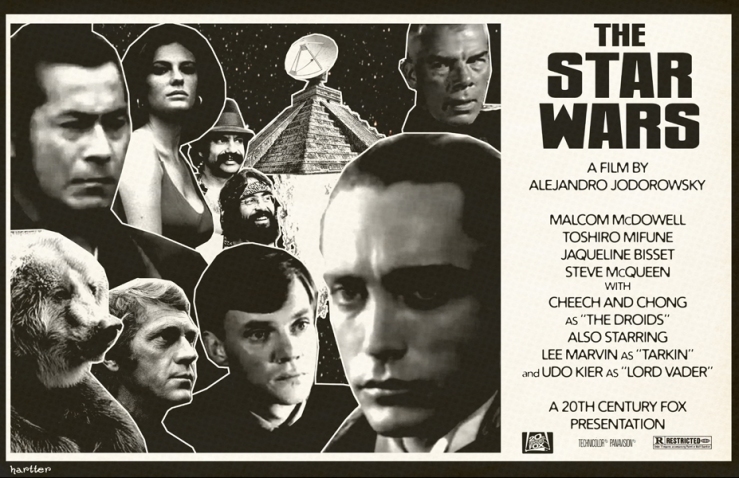
But what about a Star Wars film by Jodorowsky? What might that look like?

the star wars hartter

Sean Hartter imagines such prospects in his marvelous posters for films from an alternative universe. Hartter’s posters—most of which include not just cast and director but also specific studios, producers, and soundtrack composers and musicians—conjure up wonderful could-have-beens. They posit the kind of daring spirit and experimentalism I’d like to see more of from Hollywood franchises.

Most Hollywood franchises revere the illusion of stability in the property—the idea of a constancy of character throughout film to film. Even a franchise like the James Bond films, with its ever-rotating leads, tries to create the guise of a stable aesthetic along with narrative continuity. I would love to see something closer to the Alien franchise, the only line of films I can think of where each film bears the distinctive mark of its respective filmmaker; even if I don’t think Fincher’s Alien 3 is a particularly good film, at least it feels and looks and sounds like a Fincher film and not a weak approximation of a Cameron blockbuster or a stock repetition of Scott’s space horror (and Jeunet’s Resurrection—how weird is that one!).

But back to Bond for a moment—wouldn’t it be great to see Wes Anderson do James Bond, but as a Wes Anderson film? Or Werner Herzog? Or Cronenberg? What would Jane Campion do with Bond? (I’m tempted to add Jim Jarmusch, but he already made an excellent James Bond film called The Limits of Control). I’d love to see a range of auteur versions of the franchise. (Similarly, I’ve recently been fascinated by the way certain cult artists render major corporate franchise characters, like Dave Sim doing Iron Man, or Moebius doing Spider-Man, or Jaime Hernandez doing Wonder Woman). Obviously this fantasy will never happen—the auteur would have to have complete control—a Coen brothers’ Bond film would have to be first and foremost a Coen brothers film, not a 007 film—but hey, just like with Hartter’s posters, it’s fun to pretend.

Imagine a year of James Bond movies, one a month, featuring different directors, actors, studios, production designs. 007 films from Spike Lee, Tarantino, Almodavar, Lynne Ramsay, Lynch, Wong Kar Wai.

What would a Wong Kar Wai James Bond film look like?

What would a Wong Kar Wai Star Wars film look like?

I don’t know. I imagine it would be beautiful and moody and at times impressionistic. I imagine its narrative would tend toward obliqueness. I imagine it might infuriate die-hard fans (I imagine this last part with a big grin). I imagine that it would easily be the most human Star Wars film.

But beyond that, it’s hard to imagine what a Wong Kar Wai Star Wars film might look and sound and feel like because his films are powerful and moving and evoke the kind of imaginative capacity that marks great art, great original and originating art. Put another way, I can’t really imagine what a Wong Kar Wai Star Wars film would look like—which is precisely why I’d love to see one.

The Worst Poetry I Have Ever Read

At the home of some good friends this past weekend, reclined nicely in a warm armchair, the warmth of various ales coursing through me, I picked off the shelf by my right hand a crumbling first edition of Modern Library’s A Comprehensive Anthology of Modern Poetry, edited by Conrad Aiken. I opened at random and found a small and perhaps undue joy that my stochastic flipping led to sections 10 and 11 of Song of Myself—maybe my favorite parts of Walt Whitman’s longassed poem.

Do you recall these bits? The trapper’s wedding? The runaway slave? The twenty-eight bathers and the woman who spies on them? I read them aloud to the room, ostensibly to the people in the room, but maybe just to myself. Walt Whitman’s storytelling is at its best when he moves most away from himself, when he puts on different hats, wears different ears, strolls around America a bit. I love his free verse in spite of—or even maybe because of—its swollen scope, its tendency toward bombast or even hamminess. O Walt! Get over yourself!—but not really, never change! Song of Myself is one of my favorite novels, or one of my favorite epics, or one of my favorite monologues—whatever it is, it’s one of my favorites (especially taken with doses of Emily Dickinson’s strange potions).

I don’t really know a lot about poetry, despite teaching the study of it in certain literature survey classes.

But hang on, it seems I was telling a story, or at least teasing out an anecdote, or at least going somewhere with all this: So, after riffling through the anthology a bit more, my friend says, Hey, if you want to read some really terrible poetry, check out that book to your right. Here is the book:

20130120-102401.jpg

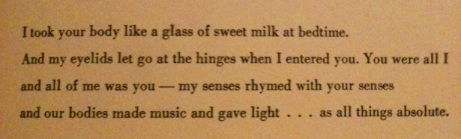
I had never heard of Walter Benton or his (unintentionally) hilarious volume This Is My Beloved until that moment. So what is it? Combining the worst elements of Whitmanesque free verse with a downright silly conceit that these are diary entries, This Is My Beloved attempts to be the erotic record of a passionate love affair. Benton tries to keep his language sultry, sexy, and sensuous without veering into pornography, but the results are bizarre and grotesque. Here’s an entire page as evidence:

20130120-102411.jpg

“Your breasts are snub like children’s faces”?!

“…your lips match your teats beautifully”?!

And my favorite: “The hair of your arm’s hollow and where your thighs meet / agree completely, being brown and soft to look at like a nest of field mice.” A nest of field mice! Women love to be complimented on their matching pits and pubes, followed by a simile comparing said regions to a rodent’s hovel.

Indeed, Benton loves animal similes for his lady—later he writes: “Yes, your body makes eyes at me from every salient, / promises warm, lavish promises— / curved, colored . . . finished in a warm velvet like baby rabbits.”

But it’s not just the rabbits and mice that are gross. Lines like “We had loved hard—it’s all over your throat and hair” are simply queasy, bad writing. Or this nugget: “The white full moon like a great beautiful whore / solicits over the city, eggs the lovers on / the haves . . . walking in twos to their beds and to their mating. / I walk alone. Slowly. No hurry. Nobody’s waiting.”

Or this snippet:

20130120-102418.jpg

It’s just really, really bad—I mean, at least when Henry Miller is gross, he’s deeply, earnestly gross, abject even, depraved perhaps (recall the famous lines: “I have set the shores a little wider. I have ironed out the wrinkles. After me you can take on stallions, bulls, rams, drakes, St. Bernards. You can stuff toads, bats, lizards up your rectum. You can shit arpeggios if you like, or string a zither across your navel”).

So, to return to my little story, we read most of Benton’s book aloud, doubling over laughing at times at just how wonderfully awful it is. And, wiping the tears from my eyes, I went to my trusty dusty iPhone to do a little background research—surely the world knew of this awful, awful poetry? Surely folks were getting the same giggly fun as happy we from poor Benton’s lurid verse?

And here, really, comes the occasion for this post, the real reason I write: It turns out that folks love this book—in a sincere, earnest, serious way. No fewer than four audio recordings were made of the book, all set to music (the most famous seems to be by Arthur Psyrock); the book has near-perfect five star review averages on both Amazon and Goodreads; and, perhaps most shocking of all, the book has been continuously in print since it was first published in 1949—it’s in its 34th edition (prestigious hardback with prestigious deckle edges, by the way). And of course you can buy an ebook version! (Unlike, say, Georges Perec’s Life A User’s Manual). Even worse, hack crooner Rod McKuen cites Benton as a major influence, so we have that to thank him for as well.

I don’t know. Am I wrong? Is Benton’s stuff actually good? I mean, I’ll concede that I enjoyed reading the book, but only inasmuch as it made me laugh so much. I don’t know. I already admitted I don’t know much about poetry. (As I write this, I pause to watch and listen to Richard Blanco read his inauguration poem “One Day”; I have no idea if it’s good or not). Benton’s verse seems so hammy, clumsy, indelicate; too earnest, too priapic, tripping over its own boners. It reads like a bad cribbing of Whitman and Miller, with an occasional lift from Hemingway. Even worse, it strikes me as amateurish, as the sort of thing that a teen might scrawl in his Moleskine only to cringe at later before hiding it somewhere. I just can’t believe that this book has been in continual publication from a major house (Knopf) for more than a half-century.

But maybe I’m misreading. Maybe I’m cynical. Maybe the poem is beautiful and profound and not icky solipsistic dreck. But I doubt it.

theNewerYork #2 Reviewed

20130106-104720.jpg

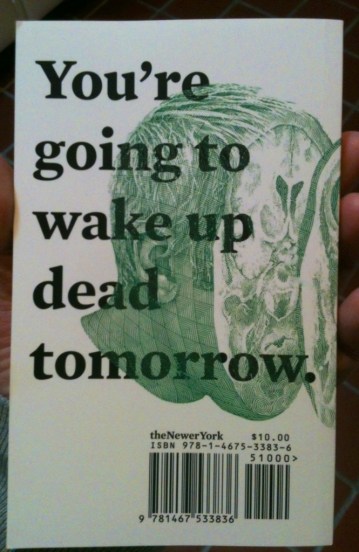
TheNewerYork is a new little magazine or journal or whatever you want to call it, featuring short fiction, poetry, art, lists, labels, fake reviews, and other stuff. Issue #2, clocking in at just over 80 pages fits neatly into a man’s jacket pocket and can be read in queues or at red lights or in between other readings or discreetly during end of semester faculty meetings. (I’m pretty sure you could read it in other occasions but I didn’t). You can see the front cover above; here’s the back cover, featuring this worrisome promise:

20130106-105947.jpg

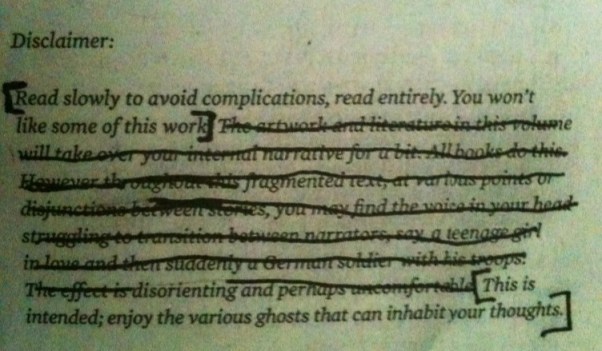
Maybe the best way to summarize (what I take to be) theNewerYork’s aesthetic/literary mission is to show off the issue’s disclaimer (which is preceded by a fancy Foucault quote):

20130106-105653.jpg

“You won’t like some of this work” seems like a fair warning, but theNewerYork is more hit than miss, starting with its excellent opener, ‘The Thank You War” by Elliot L. Ackerman, a four-paragraph flash that tackles how would-be patriotic citizens bungle human relationships with returning soldiers. Also very good is Jamie Grefe’s list “Over Thirteen,” which is a lovely little horror story that makes meaningful use of the reader’s imagination. Another list, Bruce Harris’s “Nearly A Dozen Things Sherlock Holmes Never Said” made me laugh (sample: “Watson, you’re right.”)

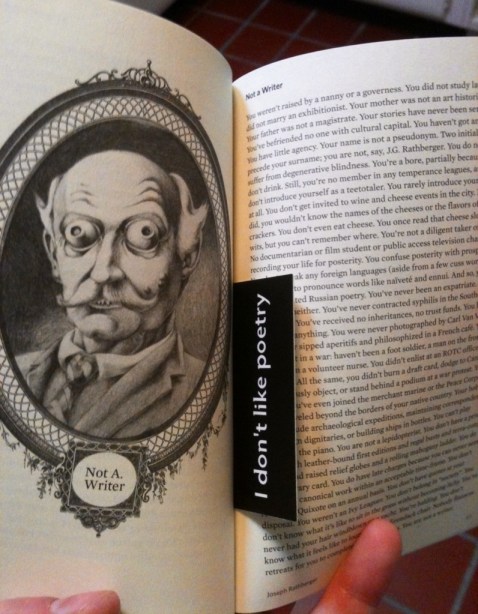
One of my favorite pieces in the volume is “Not a Writer” by Joseph Rathberger (indexed as “A Put Down”). You can see it below, filling up a page; you can also see the art that precedes it and the nifty bookmark that comes with the issue:

20130106-104746.jpg

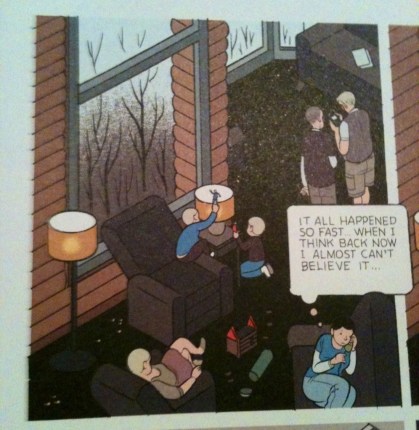
Most of the art in the issue is black and white and all of it is varied (in style and in quality). Here is Food Poop by Shaina Yang:

20130106-104753.jpg

TheNewerYork’s willingness to showcase experimentation in what goes on paper for people to look at and read is both a strength and a weakness. Most of the pieces succeed, even when they shouldn’t (why is a Google translation from “Baby Got Back” from English to Latin and then back into English so funny?). The pieces in the issue that don’t succeed fail on their own terms: half-formed or poorly executed ideas, the occasionally gimmicky experiment, and, thankfully more rarely, pieces that feel too imitative. But like I said, most of the texts in theNewerYork’s second issue succeed, which is to say they entertain or amuse or baffle or occasionally move the reader. What I like most about theNewerYork is its spirit, which is daring and experimental without the heavy robes of irony that often cloak these sorts of operations. A promising beginning.

A Riff on What I Read (And Didn’t Read) in 2012

20121218-132128.jpg

I didn’t really read that many new books—by which I mean books published in 2012—this year.

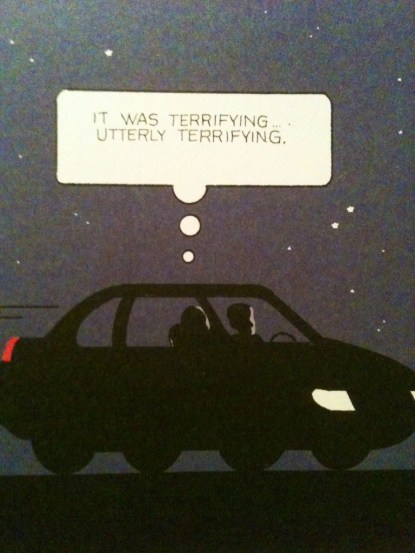
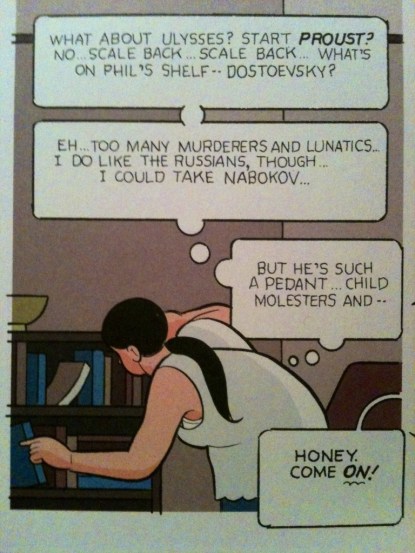
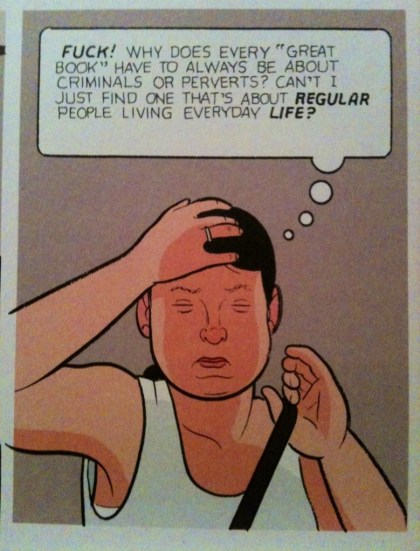
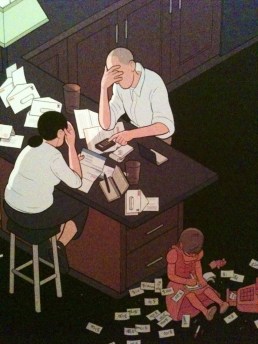
The highlight of the new books I did read was Chris Ware’s Building Stories, the moving story of the lives of several people (and a bee!) who live in the titular building (and other places. And other buildings. Look, it’s difficult to describe). Building Stories is a strange loop, a collection of 14+ elements (the big box it comes in is part of the puzzle) that allows the reader to reconstruct the narratives in different layers.

I also really dug the second installment of Charles Burns’s trilogy, The Hive; Burns and Ware are two of the most talented American writers working right now, suggesting that some of the most exciting stuff happening in American literature is happening in comic books.

Speaking of second installments in ongoing trilogies, I also listened to Hilary Mantel’s Bring Up the Bodies, which I liked, and read Lars Iyer’s Dogma and liked it as well—sort of like Beavis & Butthead Do America by way of Samuel Beckett.

I read Dogma at the beach the same week I read Michel Houellebecq’s The Map & The Territory, an uneven but engaging novel about art; the novel eventuually shifts into a strange murder procedural before exploring a fascinating vision of what a post-consumer future might look like. I dig Houellebecq and look forward to whatever he’ll spring on us next.

Another strange book I liked very much was Phi by Giulio Tononi, an exploration of consciousness written as a kind of Dante’s Inferno of the brain. A beautiful and perhaps overlooked book of 2012.

Indie presses in general tend to get overlooked—not in the sense that their books don’t have a community of readers, but in that their books don’t always reach the wider audience they deserve. I liked new books this year by Matt Bell (Cataclysm Baby), Matt Mullins (Three Ways of the Saw), and Jared Yates Sexton (An End to All Things). These books are all very different in style and content, but all marked by precise, unpretentious writing. Good stuff.

Like I said though, I didn’t read that many books published in 2012—even when I intended to. Like George Szirtes’s English translation of László Krasznahorkai’s novel Satantango, for instance. I was right in the middle of something when I got my review copy, and by the time I started it the hype surrounding it was almost unbearable—the sort of palate-clouding noise (to mix and misuse metaphors) that deafens a fair reading. (To be clear: I blame myself. I could easily refrain from Twitter and quit following lit news online). By the time Hari Kunzru documented the hype in a mean-spirited (but hilarious) article forThe Guardian, I knew I’d have to set Satantango aside for a bit. It’s worth noting here that Hari Kunzru’s own novel Gods without Men had been lingering in my to read stack for some time at that point, but his Satantango article managed to get it shelved. Still, I’m interested in reading it—maybe sometime late next year.

There were plenty of top listed writers who put out books this year that I probably would’ve been excited to read six or seven years ago or at least feel obligated to read and write about two or three years ago. But by 2012 I just don’t care anymore. At the risk of sounding overly dismissive (not my intention), I just can’t make time for another middling Michael Chabon novel, or another bloated tome from Zadie Smith, or another empty exercise in style from Junot Diaz, or another whatever from Dave Eggers.

Most of the great new stuff I read in 2012 was really just playing catch up to 2011—I loved Teju Cole’s Open City, found Nicholson Baker’s House of Holes to be an amusing diversion, and declared Denis Johnson’s Train Dreams a perfect novella. I also read Adam Johnson’s The Orphan Master’s Son, and used it, along with Jeffrey Eugenides’s The Marriage Plot as a kind of springboard to discuss lit criticism (which everyone in my particular echo chamber wanted to spar about this year) and what I want from books these days.

Two books I pretty much hated: Joshua Cody’s clever but empty memoir [sic] and Alain de Botton’s facile self-help book Religion for Atheists.

On the whole though, most of what I read in 2012 was fantastic and most of what I read in 2012 was published before 2012.

The major highlight of the year was finally reading William Gaddis’s novels The Recognitions and J R. I also read Gaddis’s posthumous novella AgapēAgape, an erudite rant that purposefully echoes the work of Thomas Bernhard, another cult writer I finally got to in 2012. His novels Correction and The Loser challenged me, made me laugh, and occasionally disturbed me.

And while I’m on Bernhard, perhaps I should squeeze in the collection I read by one of his predecessors, Robert Walser, and the poetry collection (After Nature) I read by one of his followers, W.G. Sebald. Both were excellent. And while I’m squeezing stuff in—or perhaps showing how writers lead me to read other writers—I’ll admit that I hadn’t read Thomas Browne’s Urn Burial (referenced heavily in Sebald’s The Rings of Saturn) until this year.

Another book that I finally got to this year that blew me away was John Williams’s lucid and sad novel Stoner. Reading Stoner, produced one of those can’t-believe-I-haven’t-read-it-before moments, which I experienced again even more intensely with Flann O’Brien’s The Third Policeman, a surreal comic masterpiece which may be the best book I read in 2012. I also finally read—and was blown away by—Fyodor Dostoevsky’s Crime and Punishment (why had I not read it yet? Maybe I read it before. Not sure. In any case, if I did read it before it’s clear to me that I didn’t really read it). I took another shot at Marcel Proust but it didn’t take. Again.

Clarice Lispector received some much-deserved attention from the English-speaking world this year when New Directions released four new translations of her work. I found her novella The Hour of the Star sad, funny, and captivating. Also on the novellas-by-South-Americans: I’m working my ways through Alvaro Mutis’s Maqroll novellas and they are fantastic.

I also finally got to David Markson’s so-called “note card novels,” devouring them in a quick stretch. I reviewed the last one, The Last Novel.Markson’s novels are often called “experimental,” a term I kind of hate, but perhaps serves as easy tag for many of the novels I enjoyed best this year, including Ben Marcus’s The Age of Wire and String and Barry Hannah’s hilarious tragedy Hey Jack!

Hey, did you know David Foster Wallace wrote an essay on David Markson? The previous sentence is an extremely weak attempt to transition to Both Flesh and Not, a spotty collection from the late great writer; it showcases some brilliant moments along with undercooked material and a few throwaways probably better left uncollected. I fretted about the book on Election Night.

The posthumous book mill also kept pumping out stuff from Roberto Bolaño, including an unfinished novel called The Woes of the True Policeman that seems like a practice sketch for 2666 (I haven’t read Woes and don’t feel particularly compelled to). I did read and enjoy The Secret of Evil, a book that might not be exactly essential but nevertheless contains some pieces that further expand (and darken and complicate) the Bolañoverse. Going back to that Bolañoverse was a highlight of the year for me—rereading 2666proved to be tremendously rewarding, yielding all kinds of new grotesque insights. I also reread The Savage Detectives, and while it’s hardly my favorite by RB, I got more out of it this time.

I also revisited The Hobbit this year and somehow decided it’s a picaresque novel. Definitely a picaresque: Blood Meridian, which I reread as well. In fact, I’ve reread it at least once a year since the first time I read it, and it gets funnier and richer and more devastating with each turn. I also reread Herman Melville’s “Bartleby” and tried to make sense out of it. I will reread Moby-Dick next year, although it’s not “Bartleby” that sparked the desire—chalk it up to Charles Olson’s amazing study Call Me Ishmael.

Olson’s study reminds me to bring up some of the nonfiction I enjoyed this year: Stephen Bronner’s Modernism at the Barricades, Robert Hughes’s Goya biography, the parts of William T. Vollmann’s Imperial that I read, Patti Smith’s memoir Just Kids,and big chunks of William Gass’s collection Finding a Form.

Perhaps the most significant change in my reading habits this year was embracing an e-reader. I got a Kindle Fire for Christmas last year and wound up reading from it—a lot. About half the books I read this year I read on the Kindle. I also read lots of comics on it with my daughter, including all of Jeff Smith’s Bone, much of Tintin, and all of Carl Barks’s Donald Duck stuff. (I also read several hard to find volumes from Moebius via the Kindle).

And while I love my Kindle and it’s become my go-to for night reading (it’s lightweight and self-illuminating), I can’t see it replacing physical books. To return to where I started: Chris Ware’s Building Stories, an innovative, sprawling delight simply would not be reproducible in electronic form. Ware’s book (if it is a book (which it is)) reminds us that the aesthetics of reading—of the actual physical process of reading—can be tremendously rewarding as a tactile, messy, sprawling experience.

Perhaps because I’ve freed myself from the anxiety of trying to write on this blog about everything that I read, and perhaps because I’ve freed myself from trying to write traditional reviews on this blog, and perhaps because I’ve freed myself from trying to cover contemporary literary fiction on this blog—perhaps because of all of this, I’ve enjoyed reading more this year than I can remember ever having enjoyed it before.

Reading Chris Ware’s Building Stories / It All Happened So Fast

20121213-185225.jpg

As seems to be the case more often than not in this series of write-ups on reading Chris Ware’s Building Stories, I’ve taken the title from the first line of the first panel (below); you can see the scale of this chapter in folded broadside in the pic above (which also reveals the heart of this episode).

20121213-185234.jpg

This particular episode focuses again on Lonely Girl/Married Mom/The Amputee, who has slowly emerged as the protagonist of Ware’s novel. Here, she deals with the news of her father’s illness, an event that brings her back to her childhood home repeatedly. The motif of homes and buildings evinces again too, of course—it’s a subtle but omnipresent device in Building Stories:

20121213-185305.jpg

20121213-185312.jpg

And as always, Ware’s genius shows in the way he conveys so much truth in the smallest detail. Below he illustrates Lonely Girl’s disconnected relationship with her architect husband in just a panel:

20121213-185243.jpg

“It All Happened So Fast” is a fair name for this chapter—Ware’s panels illustrate the way that our lives (and the narrativizing of those lives) can become radically compressed, how our memories fail us, how seemingly trivial details anchor themselves to the emotional strata of our personalities even as concrete fact slips away. Still, another title could come from this panel:

20121213-185256.jpg

I’ll close this out by offering three panels that strike me as so utterly real, so wonderfully truthful, that I won’t bother to comment further:

20121213-185321.jpg

20121213-185328.jpg

20121213-185336.jpg

Reading Chris Ware’s Building Stories / Disconnect

20121206-181909.jpg

“Disconnect,” one of the longer episodes in Chris Ware’s novel Building Stories, serves as a reminder of Ware’s strength as a prose writer. Wordiness tends to kill illustrated storytelling, at least in my estimation. Sure, there are exceptions—Joe Sacco and Harvey Pekar come to mind—but in general, I think comics are at their best when thought and word bubbles are uncluttered (or nonexistent).  Ware clearly understands the economy of his medium, and some of Building Stories’ finest moments have been wordless ones where Ware constructs the story in pure imagery. We can see so much of the plot and themes of  “Disconnect” in this full page, for instance:

20121206-181944.jpg

But Ware also packs plenty of storytelling into his prose in “Disconnect,” where he continues the story of Lonely Girl, who it’s probably better to now call Married Mom—I still think of her as Lonely Girl though, after first really meeting her in “September 23rd, 2000,” an episode ostensibly narrated by her diary. “Disconnect” is a second diary of sorts, her internal narration guiding us subtly through episodes in her life over a series of years. “Disconnect” focuses on LG/MM raising her young daughter against the backdrop of a strained marriage.

Lonely Girl/Married Mom’s observations ring particularly true. She points out that “When your children aren’t around, you miss them with every fiber of your being—but when they are, you just want to get them to bed so you can go read the news or something,” an observation simultaneously profound, disturbing, and banal. When our heroine recalls how her relationship to her pet cat changed after her child was born, I also saw shades of myself:  “The day we brought Lucy home, almost to the minute, all applied personality to Miss Kitty evaporated, and we saw her for what she was—an animal—and an animal who we were beholden to feed and house, with, suddenly it seemed, little to offer in return.”

Through Lonely Girl/Married Mom, Ware paints a portrait of modern disconnection and alienation, and, even as we sympathize with the heroine, Ware also allows us to see through her—or rather, to see what she can’t see, or to see what she refuses to see. The effect is an irony that tips into small, banal tragedy.

Ware’s prose is usually overshadowed by his gifts as a draftsman, an architect—he’s the builder of Building Stories, a fact that this chapter alludes to, both internally, intertextually, and metatextually. We learn, for example, that Branford the Bee is a story within a story:

20121206-181917.jpg

This nesting of stories emerges in the final part of “Disconnect,” wherein our aged narrator—addressing her grown daughter—relates a dream:

20121206-181924.jpg

The scene culminates so beautifully that it brought a little tear to my eye. Most postmodern novels contain (often more than once) their own descriptions, and Building Stories is no exception:

20121206-181934.jpg

And yet what we see here isn’t postmodern cleverness or empty gimmickry, but the evocation of dream and imagination and desire and creation—the spirit of the book, of what it means to build stories. Reading the final panels of “Disconnect,” I immediately recalled the epigraph to Building Stories (it’s on the interior of the box lid, by the colophon and dedication):

20121206-181951.jpg


Three Beautiful Books For Children (and Adults)

As the season for giving arrives, Biblioklept reviews three beautiful books that children and adults alike will enjoy.

20121118-123043.jpg

First up is E.T.A. Hoffman’s 1816 Christmas classic Nutcracker in translation by Ralph Manheim and beautifully illustrated by the late Maurice Sendak. In 1983, Sendak designed sets and costumes for the Pacific Northwest Ballet’s adaptation of Nutcracker and in 1984 he translated some of those designs into a book edition.

20121118-123123.jpg

According to a 2001 profile with NPR, Sendak was initially unsure about working on what he considered “the most bland and banal of ballets.” However, upon reading Hoffman’s original text, Sendak discovered a work full of “weird, dark qualities that make it something of a masterpiece,” an observation he notes in his introduction to Nutcracker.

The NPR profile notes that Sendak intended to bring “Hoffmann’s original story back to audiences, especially by having the main character, a girl named Clara, brought back into the story.” Sendak believed

The whole ballet is about her and for the most part you get her in act one, and then she discreetly disappears for the rest of the work. My feeling is this has to be disturbing to children. . . . [She goes] where the wild things are . . . She is overwhelmed with growing up and has no knowledge of what this means. I think the ballet is all about a strong emotional sense of something happening to her, which is bewildering.

20121118-123102.jpg

These “strange, weird” qualities—the same tones that made Sendak’s Where the Wild Things Are a classic of children’s literature—are on display in Nutcracker. Hoffman’s text in Manheim’s translation has a wonderfully episodic, even picaresque quality that restores a sense of adventure—and even peril—to the smooth play we might be familiar with sitting through each December.

Nutcracker’s reading level, length, and tone make it likely appropriate for children over eight or nine, but younger children will enjoy reading the story through Sendak’s marvelous and strange illustrations.

Nutcracker is available in a new hardback edition from Random House.

20121118-123054.jpg

Next up is Annelore Parot’s Kokeshi Kimonos from Chronicle Books.

20121205-150255.jpg

Koskeshi Kimonos is a fun and stylish book that uses kokeshi dolls to showcase facets of Japanese culture including attire and family life. The book features folding flaps, pull out sections, and other interactive features that will appeal to younger children. It’s the sort of aesthetically charming book that adults can enjoy as well.

20121205-150303.jpg

Kokeshi Kimonos will likely appeal to younger readers—five to nine—and seems particularly suited to girls (although this doesn’t mean boys wouldn’t enjoy it, of course). The cute kokeshis are a wonderful alternative to the sterile, plastic world of Barbie and other facile dolls.

20121205-150310.jpg

Finally, Ernest Raboff’s Albrecht Dürer, part of his Art for Children series. The book is out of print but not impossible to find.

20121205-150318.jpg

Raboff presents Dürer’s life simply and in clear context, using about a dozen beautiful  prints from the German master, as well as many of his etchings. Raboff also hand letters the book, and provides his own sketches and illustrations occasionally to clarify and explain Dürer’s work.

20121205-150327.jpg

What I love most about Raboff’s book though is the way he integrates elements of art appreciation into his book in subtle, simple ways. Lovely:

20121205-150335.jpg

20121205-150343.jpg